

How Can I Boost My Financial Confidence as a Woman?
Last reviewed: July 2026
You boost your financial confidence as a woman by taking small, repeatable financial actions, building targeted knowledge that applies to your own life, and refusing to apologize for asking questions. Confidence comes from evidence, not perfection. Every statement you open, every fee you question, and every decision you watch play out adds to a track record that proves you can handle money. The goal of financial confidence women want is not expertise. It is trust in your own judgment and the willingness to ask for help when you need it.
Key Takeaways
- Financial confidence grows through action and repetition, not through becoming a financial expert or eliminating every uncertainty.
- Women control roughly one-third of U.S. household financial assets, projected to grow sharply this decade.
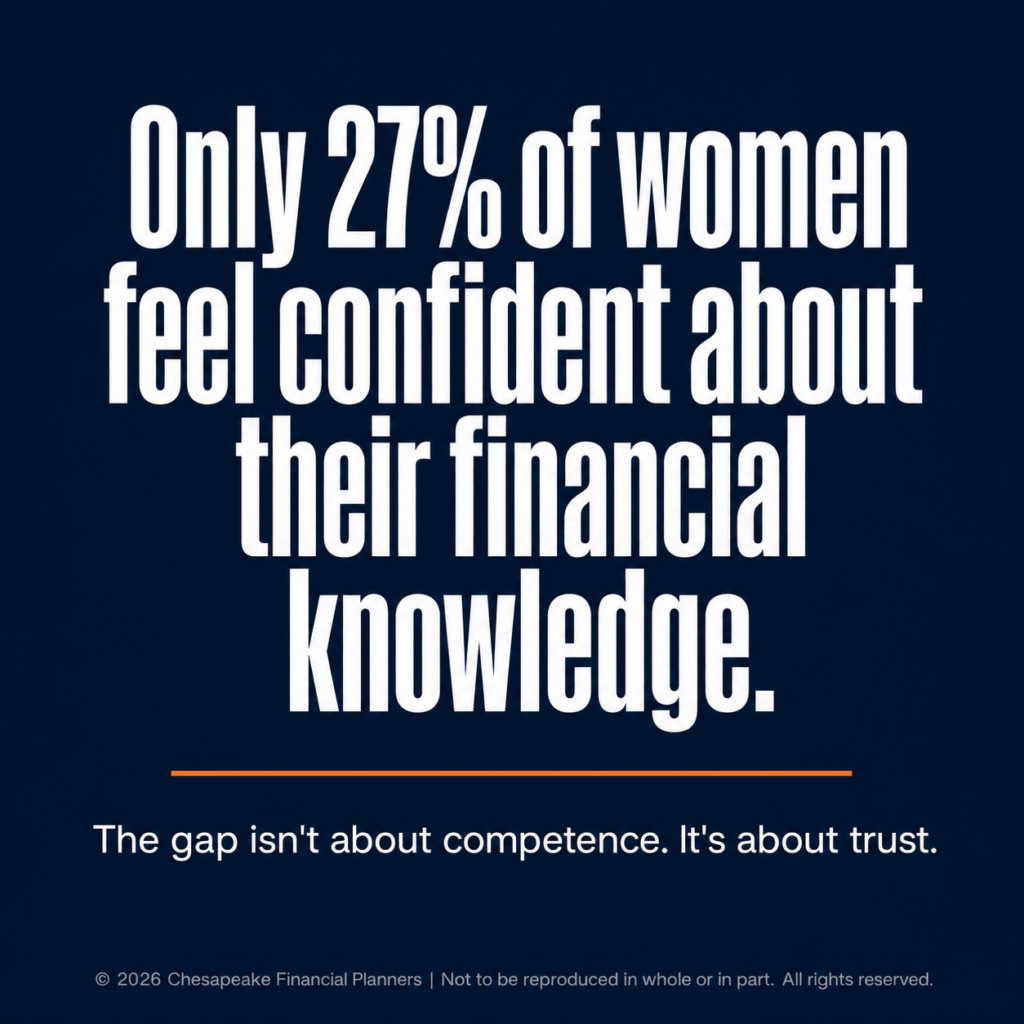
- Confidence gaps, not knowledge gaps, explain most financial behavior differences between women and men at similar education levels.
- The median weekly earnings gap means women earned about 83% of men's pay in 2025, leaving less margin for error.
About the Author: Jeff Judge, CFP®, AEP®, ChFC®, CLU® is Managing Partner of Chesapeake Financial Planners in Forest Hill, Maryland. Jeff often tells clients that the women he works with are rarely missing knowledge. They are missing permission to trust the decisions they are already capable of making. He has been helping families and business owners in Harford County and the Baltimore metro area navigate major life transitions and build financial independence since earning his CFP® certification in 2013, by using Chesapeake Financial Planners’ signature process, the R.U.D.D.E.R. method™.
Why Do Women Often Feel Less Financially Confident?
Women often feel less financially confident because of structural and cultural factors, not because of any deficiency in skill. Research consistently shows women make sound financial decisions, often with strong risk-adjusted investment results. The gap is about trusting those decisions, not making them.
Financial education starts differently in childhood. Boys are more often invited into direct money conversations, while girls absorb money lessons indirectly. That early pattern follows women into adulthood, where they are less likely to be drawn into financial discussions or taken seriously when they ask questions.
The earnings gap compounds the problem. According to the Bureau of Labor Statistics, women working full time earned about 83 cents for every dollar men earned in 2025. Career interruptions for caregiving create real retirement savings shortfalls and reduced Social Security benefits. These systemic realities can feel like personal failures when they are nothing of the kind.
Jeff Judge has watched this pattern up close. The women who walk into his office apologizing for "not knowing enough" almost always understand their own finances better than they think. The confidence, not the competence, is what went missing somewhere along the way.
Why Does Confidence Matter More Than Knowledge?
Confidence matters more than knowledge because the cost of low confidence shows up as inaction. You don't invest because you are not "sure enough." You don't negotiate salary because you doubt your value. You stay with a poor advisor because you assume the problem is your understanding rather than their service.
Confidence gaps, not knowledge gaps, explain most of the difference in financial behavior between women and men at similar education levels. Two people with identical financial knowledge still behave differently if one trusts their judgment and the other second-guesses every move.
Confidence also changes how others treat you. When you approach a financial conversation with clarity about your own priorities, advisors and partners take you seriously. When you defer or apologize for asking, you invite the dismissal you were already afraid of.
This is one reason a strong healthy money mindset matters as much as any spreadsheet. The story you tell yourself about money shapes every decision that follows.
How Can I Build Financial Knowledge That Supports Confidence?
You build supportive financial knowledge by focusing on the few concepts that actually touch your life, not by trying to master everything. Knowledge alone does not create confidence, but it removes the specific anxiety of not knowing what you don't know.
Start with the basics that directly affect you: how compound interest works, what fees you pay on your investments, how tax-advantaged retirement accounts function, and what basic estate planning covers. The SEC's investor education site explains these without jargon and without assuming you arrived already fluent.
Learn how to evaluate advice, not just follow it. Knowing what questions to ask, what fees are reasonable, and what red flags look like protects you even without deep technical expertise. The CFP Board outlines what a real planning process should include, which gives you a benchmark.
Accept that you will never know everything. Even financial professionals specialize. At Chesapeake Financial Planners, we use a six-step process called the R.U.D.D.E.R. Method™, Chesapeake Financial Planners' six-step planning process: Review and Recognize, Uncover and Understand, Design and Develop, Discuss and Decide, Execute and Empower, and Reassess and Refine. The point of a structured process is that you do not have to carry every detail in your head. You need enough understanding to make good decisions and to recognize when you need specialized help. If you want a deeper dive, our guide on investing as a woman covers the next layer.
What Practical Steps Build Financial Confidence?
Practical confidence-building steps share one trait: they generate evidence. Confidence grows through action and observed outcomes, not through study alone.
Take small actions that previously felt intimidating. Open the account statement you have been avoiding. Log into your retirement plan and review the asset allocation. Call about a fee you don't understand. Each time you do something uncomfortable and discover you handled it, you add proof that you are capable.
Track your wins, not just your worries. You manage a household budget. You have made career moves that raised your income. You have navigated major transitions without financial collapse. Women tend to dismiss successes and dwell on uncertainties, which produces an inaccurate self-assessment.
Ask questions without apologizing. "I'm sorry, this is probably a dumb question" undermines you before you start. Try "I want to understand this clearly, so walk me through it." Your questions are not stupid. They are evidence that you care about understanding before deciding.
Negotiate something, anything. Start small with a medical bill or a recurring service charge, then build the muscle for bigger negotiations like salary. The Department of Labor tracks the earnings gap that makes self-advocacy matter so much.
Make decisions and watch the outcomes. Invest and observe the growth and the normal fluctuation. Build a budget and notice what changes. Confidence comes from seeing that your decisions generally work out, not from guaranteeing perfection.
How Should I Work With a Financial Advisor as a Confident Partner?
You work with an advisor as a confident partner by choosing someone who educates rather than dictates and who treats you as an equal decision-maker. The right relationship should build your confidence, not chip away at it.
Look for an advisor who explains the "why" behind every recommendation and answers questions without condescension. An advisor who says "just trust me" or makes you feel foolish for asking is not serving you. Jeff Judge tells clients that if an advisor cannot explain a recommendation in plain English, the problem is the advisor, not you.
Expect to be treated as an equal in your own plan. You set the priorities. The advisor brings the technical execution. If you feel patronized or sidelined, that is information about the advisor, not a verdict on your worth.
If you are weighing whether a planner who understands women's financial realities is worth it, our piece on working with an advisor who understands women's needs walks through what to look for. For anyone moving through a divorce, loss, or career shift, staying financially strong through major life changes covers the practical side.
Frequently Asked Questions
How do I start building financial confidence if I feel completely lost?
Start with one small action you have been avoiding, like logging into your retirement account or reviewing a single fee. Confidence is built from evidence that you can handle things, so each completed action gives you proof. You do not need a plan for everything. You need momentum, and momentum starts with one step you actually take this week.
Do women really make worse financial decisions than men?
No, women do not make worse financial decisions than men. Research consistently shows women make sound choices and often achieve strong risk-adjusted investment results. The difference between women and men is largely confidence, not competence. Women with the same financial knowledge as men still invest and negotiate less assertively, which means the gap is about trust in judgment, not the quality of the decisions themselves.
How much do I actually need to know about finance to feel confident?
You need enough knowledge to make decisions appropriate to your situation and to recognize when you need help, not comprehensive expertise. Focus on how compound interest works, what fees you pay, how retirement accounts function, and basic estate planning. Even financial professionals specialize, so the goal is informed decision-making and knowing the right questions to ask, not mastering every topic in finance.
Why does the wage gap matter for my financial confidence?
The wage gap matters because earning less leaves a smaller margin for financial error, which raises the stakes on every decision. According to the Bureau of Labor Statistics, women earned about 83% of men's median weekly pay in 2025. Career interruptions for caregiving also reduce retirement savings and Social Security benefits. Understanding these as systemic realities, not personal failures, frees you to plan around them with confidence.
How do I negotiate when negotiation makes me anxious?
Build the skill in low-stakes settings first. Negotiate a medical bill, a recurring subscription, or a minor purchase before you tackle salary. Each successful negotiation proves you can ask for what you want without automatically accepting the first answer. The anxiety fades as the evidence stacks up, and the muscle you build on small negotiations transfers directly to the bigger ones that change your income.
How do I know if my financial advisor is right for me?
A good advisor educates you, answers questions without condescension, and treats you as an equal decision-maker in your own plan. If an advisor says "just trust me," dodges your questions, or makes you feel foolish for asking, that is a signal to look elsewhere. The right relationship builds your confidence over time rather than keeping you dependent on someone else's authority.
Building financial confidence is not about reaching a finish line where every doubt disappears. It is about stacking enough small wins that you start trusting your own judgment. If you want a partner who explains the why and treats you as an equal in your own plan, Jeff Judge and the Chesapeake team work with women across Harford County and the Baltimore metro every week. Schedule a free fit call at chesapeakefp.com.
Want to go deeper? Our Identifying Woman-Centric Financial Planners walks through this step by step.
Disclosures
The information provided is for educational purposes only and should not be construed as investment advice. Investment strategies should be tailored to individual circumstances, risk tolerance, and goals. Past performance doesn't guarantee future results. Consult with qualified financial professionals regarding your specific situation.
Advisors associated with Chesapeake Financial Planners may be either (1) LPL Financial Registered Representatives offering securities through LPL Financial, Member FINRA and SIPC, and investment advisor representatives offering investment advice through Great Valley Advisor Group; or (2) solely investment advisor representatives offering investment advice through Great Valley Advisor Group and not affiliated with LPL Financial. Great Valley Advisor Group, and Chesapeake Financial Planners are separate entities from LPL Financial.


