

What Are the Basics of Retirement Planning I Need to Know?
Last reviewed: July 2026
Retirement planning basics come down to four moves: save a consistent share of your income, invest it in the right mix of tax-advantaged accounts, plan when to claim Social Security, and build a withdrawal strategy that lasts the rest of your life. Get those four right and the rest is refinement. The hard part isn't the math. It's starting, then staying consistent for decades.
Key Takeaways
- Retirement planning means saving consistently, investing in the right accounts, timing Social Security, and building income that outlasts you.
- For 2026 you can contribute up to $24,500 to a 401(k), or $32,500 if you are 50 or older.
- A common starting point is the 25x rule: save 25 times your desired annual spending.
- Waiting to claim Social Security past full retirement age raises your benefit roughly 8% per year until 70.
About the Author: Jeff Judge, CFP®, AEP®, ChFC®, CLU® is Managing Partner of Chesapeake Financial Planners in Forest Hill, Maryland. He has been helping families and business owners in Harford County and the Baltimore metro area navigate retirement planning since earning his CFP® certification in 2013, by using Chesapeake Financial Planners’ signature process, the R.U.D.D.E.R. method™. Jeff's blunt observation: most people obsess over investment returns and ignore the two levers that actually move the needle — their savings rate and their tax bracket in the years right before they retire.
What Is Retirement Planning, Really?
Retirement planning is the process of figuring out how much money you need to live the life you want after you stop working, then building a strategy to get there. It is not just saving. It is the full system that turns a number into reliable monthly income.
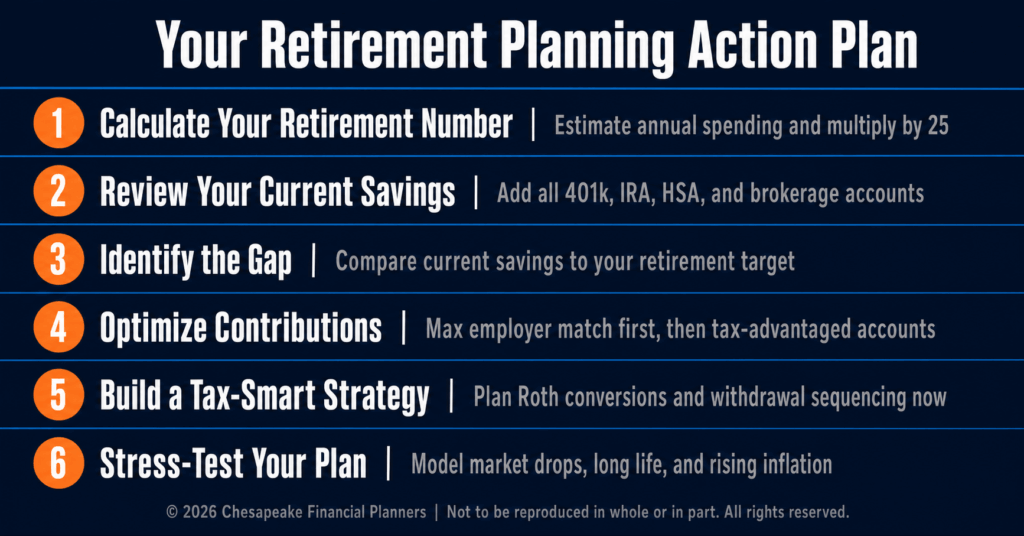
A real plan addresses six things: estimating your future expenses, choosing the right investment accounts, optimizing for taxes, planning for healthcare costs, managing risk from market downturns and inflation, and creating income that can last 20, 30, or even 40 years. Miss any one of those and the plan develops a leak.
The goal isn't simply to stop working. It is to have the security to keep living the life you built. At Chesapeake Financial Planners we use the R.U.D.D.E.R. Method™, our six-step planning process — Review and Recognize, Uncover and Understand, Design and Develop, Discuss and Decide, Execute and Empower, and Reassess and Refine — to keep all six moving parts working together instead of in isolation. Jeff Judge notes: "Most people come in thinking retirement planning means picking investments, but what we're really building is a coordinated system where your taxes, healthcare costs, income sources, and spending plan all work together so nothing falls through the cracks."
How Do I Know If I'm On Track for Retirement?
When Should You Start Retirement Planning?
Now. That is the honest answer, and it holds whether you are 25 or 55.
The earlier you start, the more time compounding works in your favor. Small contributions in your 20s and 30s can become serious wealth by your 60s because growth compounds on growth. Starting later isn't a death sentence — it just means leaning harder on savings rate and tax strategy to catch up.
Here is a rough timeline by decade:
- 20s and 30s: Build the habit of saving and investing consistently. Time is your single biggest advantage.
- 40s: Ramp up contributions as income climbs. Start running real projections and thinking about tax strategy.
- 50s: Maximize catch-up contributions, refine the plan, and consider transition timing.
- 60s: Lock in your withdrawal strategy, healthcare plan, and Social Security claiming decision.
Jeff has watched clients delay this decision for two and three years running. It never gets cheaper to wait — every year of delay forces a higher savings rate later to reach the same finish line.
Alt text: retirement planning basics timeline by decade
How Much Do You Need to Retire?
The amount you need depends on five factors: your desired lifestyle, the age you retire, how long you live, your other income sources, and the drag from inflation and taxes. Someone retiring at 55 with travel plans needs far more than someone retiring at 67 who plans to live simply.
A common starting point is the 25x rule — save roughly 25 times your desired annual spending. Want $60,000 a year from your portfolio? Aim for about $1.5 million. That rule pairs with the 4% guideline, which suggests withdrawing about 4% of your savings in year one and adjusting for inflation after that.
Rules of thumb are starting points, not answers. A personalized projection that accounts for your Social Security, any pension, and your actual tax picture is the only way to know your real number. According to the Social Security Administration, benefits replace only about 40% of pre-retirement income for an average earner — which is why your own savings carry most of the load.
How Do I Create Multiple Income Streams for Retirement?
What Are the Building Blocks of a Retirement Plan?
Every solid plan addresses three core building blocks: your savings rate, your account mix, and your asset allocation.
Savings rate is the percentage of income you direct toward retirement. A common guideline is 15% of gross income, but the right number depends on when you started and your target retirement age. Automate it so the money moves before you ever see it.
Account mix matters because each account type is taxed differently. Here is how the main options compare for 2026:
| Account Type | Tax Treatment | 2026 Contribution Limit |
|---|---|---|
| 401(k) / 403(b) | Pre-tax in, taxed on withdrawal; possible employer match | $24,500 ($32,500 if 50+) |
| Traditional IRA | Deductible in, taxed on withdrawal | $7,500 ($8,600 if 50+) |
| Roth IRA | After-tax in, tax-free growth and withdrawals | $7,500 ($8,600 if 50+) |
| Taxable brokerage | No tax breaks, no limits or withdrawal rules | No limit |
| HSA (family) | Triple tax advantage for medical costs | $8,750 |
Asset allocation is the split between stocks, bonds, and cash. Younger investors can hold more stock for growth. As retirement nears, shifting toward bonds and cash cushions against a market drop hitting right when you start withdrawing. The HSA is the most overlooked tool on this list — its triple tax advantage makes it one of the best retirement accounts available, not just a medical account.
Should I Take Social Security at 62 or Wait Until 70?
How Does Social Security Fit In?
Social Security is the income floor most retirees build everything else on top of, and the timing of your claim is one of the highest-value decisions in the whole plan. You can claim as early as 62, but doing so permanently reduces your benefit. Wait past your full retirement age of 67 and your benefit grows roughly 8% per year until age 70.
That single decision can swing your lifetime benefits by tens of thousands of dollars. It also interacts with taxes and Medicare premiums in ways that surprise people. Coordinating the claim with the rest of your income plan is where a lot of value hides.
How does my Social Security claiming decision affect my Medicare premiums?
Frequently Asked Questions
How much should I save for retirement each year?
A widely used guideline is 15% of your gross income, including any employer match. If you started late, you may need a higher rate to catch up. The exact figure depends on your current age, target retirement age, and how much you have already saved, so a personalized projection beats any one-size-fits-all percentage.
What is the 25x rule in retirement planning?
The 25x rule says to save roughly 25 times your desired annual spending from your portfolio. If you want $60,000 a year, you target about $1.5 million. It pairs with the 4% withdrawal guideline. Treat it as a starting estimate, not a precise target, because it ignores your Social Security and tax situation.
When should I claim Social Security?
You can claim Social Security as early as age 62, but your benefit is permanently reduced. Waiting until full retirement age of 67, or up to age 70, increases your monthly benefit by roughly 8% per year past full retirement age. The right age depends on your health, other income, and whether you are married.
How much can I contribute to a 401(k) in 2026?
For 2026 you can contribute up to $24,500 to a 401(k), according to the IRS. If you are age 50 or older, the catch-up provision raises that to $32,500. Many employers also match a portion of your contributions, which is effectively free money you should capture in full before funding other accounts.
Is a Roth IRA or Traditional IRA better for retirement?
A Roth IRA uses after-tax money and grows tax-free, while a Traditional IRA gives you a deduction now but taxes withdrawals later. A Roth generally wins if you expect to be in a higher tax bracket in retirement than you are today. Many people split contributions to keep both tax-free and tax-deferred buckets.
What is the biggest retirement planning mistake?
The biggest mistake is waiting to start, followed closely by ignoring taxes. Many people optimize investment returns while overlooking the savings rate and the tax bracket in the years right before retirement. Those two levers move the needle far more than chasing an extra point of return, and both are within your control.
Retirement planning basics aren't complicated, but they are easy to put off — and the cost of waiting compounds every year. If you found this helpful, our retirement planning guide walks through how much to save, account selection, and Social Security timing in depth. Download it at chesapeakefp.com to start building a plan around your actual numbers.
Disclosures
The information provided is for educational purposes only and should not be construed as investment advice. Investment strategies should be tailored to individual circumstances, risk tolerance, and goals. Past performance doesn't guarantee future results. Consult with qualified financial professionals regarding your specific situation.
Advisors associated with Chesapeake Financial Planners may be either (1) LPL Financial Registered Representatives offering securities through LPL Financial, Member FINRA and SIPC, and investment advisor representatives offering investment advice through Great Valley Advisor Group; or (2) solely investment advisor representatives offering investment advice through Great Valley Advisor Group and not affiliated with LPL Financial. Great Valley Advisor Group, and Chesapeake Financial Planners are separate entities from LPL Financial.


