

Is Your Estate Plan Outdated? Signs It No Longer Fits
Last reviewed: July 2026
An outdated estate plan review is worth doing if your will or trust was signed more than a few years ago, because the tax rules those documents were built around have moved and yours may not have. The documents still carry your signature and still look official. The law underneath them changed. A plan drafted for one set of rules can quietly become the wrong plan when the rules shift, and the people it affects usually have no idea anything is off.
This is not about a bad attorney or a flawed document. Estate law moves. Your plan is a snapshot of the rules the day you signed it, and the only question is whether that snapshot still matches the picture today.
Key Takeaways
- The 2026 federal estate and gift tax exemption is $15 million per person, $30 million per couple, made permanent.
- Maryland's own estate tax exemption is just $5 million, so a family under the federal line can still owe Maryland tax.
- Maryland is one of the few states with both an estate tax and a separate inheritance tax on certain heirs.
- Beneficiary designations and named fiduciaries drift out of date faster than tax law, and they override your will.
About the Author: Jeff Judge, CFP®, AEP®, ChFC®, CLU® is Managing Partner of Chesapeake Financial Planners in Forest Hill, Maryland. He has been helping families and business owners in Harford County and the Baltimore metro area navigate estate and legacy planning since earning his CFP® certification in 2013, by using Chesapeake's signature process, the R.U.D.D.E.R. Method™. "I have sat with too many families who found out their plan was solving a problem that had disappeared years earlier," Jeff says. "The fix is almost always a review, not a rebuild."
Did the federal exemption move the way your plan expected?
No, it moved the opposite way, and that is the first thing worth checking. For years a lot of estate planning was done bracing for a drop. The federal exemption was scheduled to fall, so many families built plans to lock in benefits before the door closed. Then the door did not close.
Under the law in effect for 2026, the federal estate and gift tax exemption is $15 million per person, or $30 million per couple, and that level was made permanent rather than allowed to expire. The IRS confirms the basic exclusion amount rose to $15,000,000 for 2026 under the One Big Beautiful Bill, up from $13.99 million in 2025, with the top rate holding at 40%. The drop so many plans were built around never happened.
So what is the quiet problem? If your plan was engineered to manage a much lower exemption, it may now be solving for a federal tax exposure you simply do not have. Machinery built for a problem becomes needless complexity once the problem is gone, and complexity is not free. It can mean extra administration, less flexibility for your surviving spouse, and structures your family has to work through that no longer serve their purpose. This is the kind of drift the "Review and Recognize" step of the R.U.D.D.E.R. Method™ is built to catch, before it lands on anyone.
Do old trust structures still fit at a $15 million exemption?
Sometimes yes, sometimes no, and that is the point: a structure that was clearly right under the old rules deserves a fresh look under the new ones. The clearest example is a common design that splits assets into separate trusts at the first spouse's death. It was built specifically to use both spouses' exemptions back when those exemptions were modest and squeezing full value out of them mattered.
With the exemption now at $15 million per person, far fewer families face federal estate tax at all, and that same automatic split can add rigidity and administrative work the surviving spouse never needed. The structure was a sensible answer to the old rules. Under today's rules, for many families, it is answering a question no one is asking anymore.
"I am not in the business of ripping out trust structures on sight. For some families the old split is still exactly right. What I want is for someone to actually look, because the correct answer may have quietly changed underneath a document nobody reopened."
Jeff Judge, CFP®
The worst outcome is leaving an automatic mechanism in place simply because no one revisited it, then having your family discover its effects at the hardest possible moment. For a fuller walkthrough of how these pieces fit together, our estate planning guide covers wills, trusts, and the structures worth a second look.

Can Maryland tax an estate the federal rules would leave alone?
Yes, and this catches a lot of Maryland families off guard. Even with the federal exemption at $15 million, Maryland levies its own separate estate tax with an exemption of just $5 million per person, at a rate up to 16%. Maryland is also one of the few states that charges both an estate tax and an inheritance tax. That combination is unusual, and it matters for anyone here in Harford County or the Baltimore metro who assumed the large federal number was the only one in play.
The gap is the whole story. A family can sit comfortably under the federal threshold and still have a taxable estate at the state level. A plan reviewed only against the federal rules can miss the Maryland exposure entirely. I have watched families assume they were well clear of any estate tax because they were fixed on the $15 million number, not realizing the Maryland figure is a fraction of it and applies squarely to them.
The inheritance tax adds a second wrinkle, because per the Comptroller of Maryland it is imposed on the clear value of property passing to certain beneficiaries, meaning it can apply based on who inherits, not just how much. As Jeff Judge tells clients, the families who avoid an unpleasant surprise are usually the ones who had their plan checked against both the federal and the Maryland rules, because the two do not move together and the state side is the one people overlook. Our post on Maryland estate tax and inheritance tax breaks down how the only-state-with-both problem actually works.
What parts of a plan go stale even when the tax law does not?
The human parts go stale first, and they drift faster than the tax rules. Two culprits show up again and again: beneficiary designations and the people you named to act.
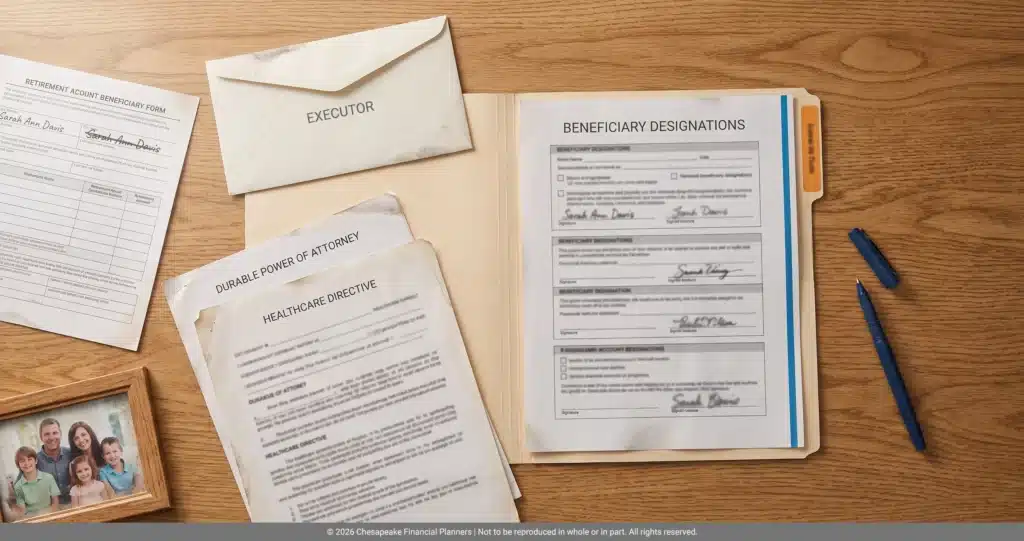
Beneficiary designations are the quiet one. Retirement accounts and life insurance pass to whoever is named on the form, regardless of what your will says. If those forms were filled out years ago and never touched, they may name an ex-spouse, leave out a child born later, or list someone who has since died. The will can be immaculate while the beneficiary form quietly overrides it and sends money somewhere you would never choose.
Who did you name to act, and are they still the right people? The executor of your will, the trustee of your trust, the agents under your financial and healthcare powers of attorney, the guardian for minor children: all were chosen at a certain moment in your life. The sibling who made sense as trustee fifteen years ago may not fit now, and the friend named to make medical decisions may have moved away. None of that is about tax law. It is about whether the plan still reflects your actual life.
Life events reshape everything else. Marriage, divorce, births, deaths, a move to a new state, a meaningful change in assets: any of these can mean a plan no longer does what you intend, even if every document is technically valid. A move is an especially quiet one, because people relocate and assume their documents carry over, without realizing estate and inheritance rules vary sharply by state. If you have married recently, the checklist in our post on updating your estate plan after marriage is a good place to start, and choosing the right fiduciary is worth thinking through in who should you name as trustee.
How do you run an outdated estate plan review yourself?
You ask a few plain questions and answer them honestly. An outdated estate plan review does not require any specialized knowledge of estate law. Here is the short self-audit I walk clients through.
- When was the plan last reviewed, not drafted, but actually reviewed against current law and your current life? More than a handful of years, or a major life event since, is reason enough for a fresh look.
- Have you checked the beneficiary designations on every retirement account and insurance policy recently, and do they match what the overall plan intends?
- Are the people named as executor, trustee, and agents still the right people, still able and willing to serve?
- Has anyone checked the plan against both the federal rules and the Maryland rules, given how differently the two treat estates?
There is one more failure mode worth naming, because it has nothing to do with the documents and everything to do with whether they can be used. A plan only helps your family if they can find it and understand it. I have seen carefully drafted plans sit unused because no one knew where they were, who the attorney was, or that certain accounts existed. As more of life has moved behind logins no one else holds, assets can go unclaimed because the family never knew they were there. Part of keeping a plan current is making sure the people who will need it know it exists, know roughly what it says, and know how to reach the professionals who can carry it out.
If any of those questions gave you pause, that is useful information. It does not mean something is wrong. It means the snapshot may no longer match the picture, and that is worth confirming rather than assuming.
Frequently Asked Questions
How often should I review my estate plan?
Review your estate plan every three to five years and after any major life event, such as a marriage, divorce, birth, death, an out-of-state move, or a significant change in assets. Tax law changes are a separate trigger. A signed plan feels finished, but nothing about it generates a reminder, so the review has to be one you schedule deliberately rather than wait for.
Do beneficiary designations override my will?
Yes, beneficiary designations override your will for the accounts they govern. Retirement accounts, life insurance, and similar assets pass directly to the person named on the beneficiary form, regardless of what your will says. That is why a stale form naming an ex-spouse or omitting a later child can quietly redirect money against your actual wishes, even when the will itself is perfectly drafted.
Can my estate owe Maryland tax if it is under the federal exemption?
Yes. The Maryland estate tax exemption is $5 million per person, far below the $15 million federal exemption, so a family clear of federal estate tax can still have a taxable estate at the state level. Maryland also charges a separate inheritance tax on property passing to certain beneficiaries, which can apply based on who inherits rather than the size of the estate.
What happens if my family cannot find my estate plan?
If your family cannot locate your plan, understand it, or reach the professionals behind it, the plan effectively fails when it is needed most. Documents that sit in an unknown drawer, or accounts hidden behind logins no one else holds, can leave heirs reconstructing a financial life from scattered statements. Make sure the people who will act know the plan exists and know how to access it.
Does the permanent $15 million exemption mean I no longer need estate planning?
No. The permanent $15 million federal exemption removes federal estate tax for most families, but estate planning still governs who inherits, who acts for you, how probate is handled, and Maryland's own $5 million estate tax and inheritance tax. A plan built for a lower exemption may now carry structures worth simplifying, which is a review, not a reason to skip planning.
Should I remove an old trust that splits assets at the first death?
Not automatically. A trust that splits assets at the first spouse's death was often built to capture both exemptions when they were low, and for some families it still serves a real purpose. For others it now adds rigidity the surviving spouse does not need. Have it reviewed against the current $15 million exemption before deciding, rather than keeping or dismantling it on reflex.
If it has been more than a few years since anyone looked at your documents, that is the signal for an outdated estate plan review. Pull them out, check when they were last updated, and start a conversation about whether they still do what you intend under today's federal and Maryland rules. Schedule a no-obligation call with Jeff Judge to have your existing plan checked against both, before your family ever has to.
A version of this article was originally published on Chesapeake Financial Planners' LinkedIn.
Disclosures
The information provided is for educational purposes only and should not be construed as investment advice. Investment strategies should be tailored to individual circumstances, risk tolerance, and goals. Past performance doesn't guarantee future results. Consult with qualified financial professionals regarding your specific situation.
This information is not intended to be a substitute for specific individualized tax, investment or legal advice. We suggest that you discuss your specific situation with a qualified tax, legal or financial advisor.
CFP Board owns the marks CFP®, CERTIFIED FINANCIAL PLANNER®, and CFP® (with plaque design) in the U.S.
The ChFC® is the property of The American College of Financial Services, which reserves sole rights to its use, and is used by permission.
The CLU® is the property of The American College of Financial Services, which reserves sole rights to its use, and is used by permission.
Advisors associated with Chesapeake Financial Planners may be either (1) LPL Financial Registered Representatives offering securities through LPL Financial, Member FINRA and SIPC, and investment advisor representatives offering investment advice through Great Valley Advisor Group; or (2) solely investment advisor representatives offering investment advice through Great Valley Advisor Group and not affiliated with LPL Financial. Great Valley Advisor Group, and Chesapeake Financial Planners are separate entities from LPL Financial.
Chesapeake Financial Planners | 2402 Scotlon Ct, Forest Hill, MD 21050 | (410) 652-7868 | www.chesapeakefp.com
© 2026 Chesapeake Financial Planners | Not to be reproduced in whole or in part. All rights reserved.


