

What Is Umbrella Insurance and How Much Coverage Do I Need?
Last reviewed: July 2026
Umbrella insurance is excess liability coverage that pays out after your home, auto, or other liability policies hit their limits. A personal umbrella policy starts at $1 million and protects your assets and future income from a large lawsuit or judgment. Most people need umbrella insurance equal to at least their net worth, and the coverage is cheaper than almost anyone expects.
Key Takeaways
- Umbrella insurance adds liability protection above your home and auto policies, usually starting at $1 million in coverage.
- The Insurance Information Institute reports umbrella policies are among the least expensive coverage relative to protection provided.
- A common rule is to carry umbrella coverage equal to or greater than your net worth.
- Defense costs are typically paid in addition to your policy limit, not subtracted from it.
- Umbrella insurance does not cover business liability, professional malpractice, or intentional acts.
About the Author: Jeff Judge, CFP®, AEP®, ChFC®, CLU® is Managing Partner of Chesapeake Financial Planners in Forest Hill, Maryland. He has been helping families and business owners in Harford County and the Baltimore metro area navigate asset protection and risk management since earning his CFP® certification in 2013, by using Chesapeake Financial Planners’ signature process, the R.U.D.D.E.R. method™. Jeff often tells clients that the cheapest insurance they own is the one that protects everything they have already built.
What Is Umbrella Insurance and How Does It Work?
Umbrella insurance is excess liability coverage that sits on top of your existing homeowners, auto, and other liability policies. When a claim exhausts the liability limit on your primary policy, the umbrella policy pays the rest, up to its own limit.
Here is how it works in practice. Say your auto policy carries $500,000 in liability coverage and you cause an accident with $2 million in damages. Your auto policy pays the first $500,000. A $1.5 million or larger umbrella policy covers the remaining $1.5 million. Without the umbrella, that gap comes out of your savings, your home equity, and potentially your future wages.
Personal umbrella policies typically start at $1 million and scale to $10 million or more. The name fits: it opens over the top of everything underneath it. Jeff Judge has watched clients treat liability limits as an afterthought for years, only to realize during an underwriting review how thin their protection actually was.
How Much Should I Have in My Emergency Fund?
Why Standard Home and Auto Coverage Isn't Enough
Standard homeowners and auto policies cap liability somewhere between $300,000 and $500,000. That sounds like a lot until you price out a real claim.
A severe car accident injuring multiple people can run past $500,000 in medical bills alone. Add lost earning capacity for someone permanently disabled, pain and suffering, and in some cases punitive damages, and the number climbs into seven figures fast. The National Highway Traffic Safety Administration tracks the human and economic cost of serious crashes, and the dollar figures behind major injury claims are sobering.
The exposure goes well beyond driving. A delivery worker slips on your icy walkway. A guest is hurt at a party. Your teenager posts something online that triggers a defamation suit. A dog you are watching bites a child. These events are rare, but when they happen, the dollar amounts are not small. Excess liability coverage exists for exactly these low-probability, high-cost scenarios.
What are the fundamentals of personal financial planning?
What Does Umbrella Insurance Cover?
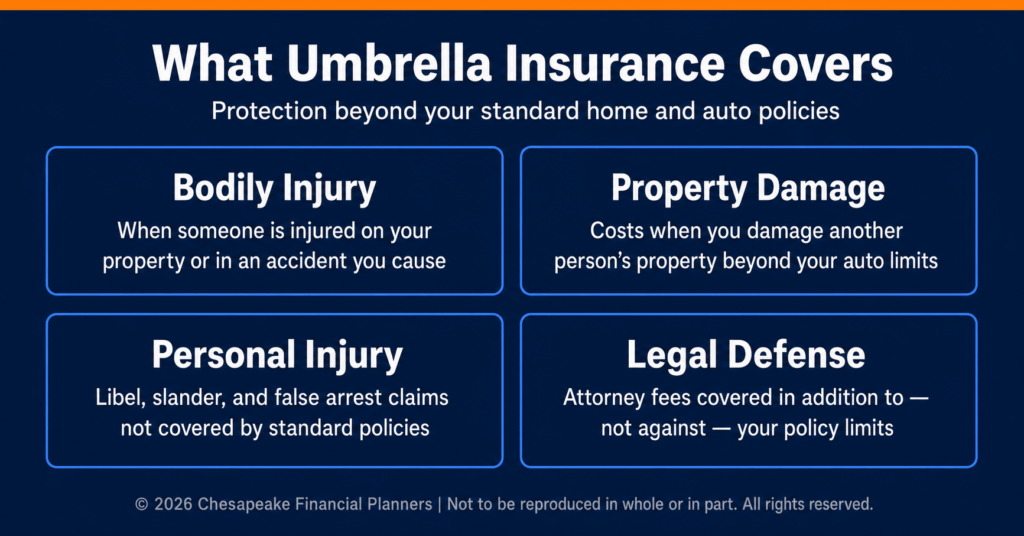
A personal umbrella policy covers a defined set of liability claims that exceed your underlying limits. The core protections include:
- Bodily injury liability you cause to others
- Property damage liability
- Personal injury claims, including libel and slander
- Legal defense costs
- False arrest, detention, or wrongful eviction claims
One feature matters more than people realize: defense costs are usually paid in addition to your policy limit, not deducted from it. If you are sued for $5 million and run up $300,000 in legal fees, a well-structured umbrella policy covers both the judgment and the defense without shrinking your coverage.
Some policies also fill gaps your underlying coverage leaves open, subject to a self-insured retention that works like a deductible. That can include liability from serving on a nonprofit board or certain claims that occur abroad.

What Umbrella Insurance Does Not Cover
Umbrella insurance is liability coverage, not all-purpose protection. It excludes several major categories:
- Business-related liability, which requires separate commercial coverage
- Professional malpractice, which requires professional liability insurance
- Intentional or criminal acts
- Your own injuries or damage to your own property
If you are a physician, attorney, or consultant, your personal umbrella will not touch a malpractice claim from your professional work. Contractual liabilities you take on beyond what you would otherwise owe are typically excluded too. Rental properties you own may have only limited coverage, so landlords often need separate liability protection.
This is where the R.U.D.D.E.R. Method™ earns its keep. The R.U.D.D.E.R. Method™ is Chesapeake Financial Planners' six-step planning process: Review and Recognize, Uncover and Understand, Design and Develop, Discuss and Decide, Execute and Empower, and Reassess and Refine. The Uncover and Understand step is where these coverage gaps usually surface before they become a problem.
What is the best way to pay off debt quickly?
Frequently Asked Questions
How much umbrella insurance do I need?
A common rule is to carry umbrella coverage at least equal to your net worth, so a $2 million net worth suggests $2 million in coverage. Many advisors push higher when future income, teenage drivers, a pool, or household staff increase your liability exposure. The goal is making sure a judgment cannot wipe out what you have built.
How much does umbrella insurance cost?
Umbrella insurance is inexpensive relative to the protection it provides. According to the Insurance Information Institute, the first $1 million in coverage commonly costs a few hundred dollars annually, with each additional million costing meaningfully less. Cost depends on your location, vehicles, homes, driving record, and claims history. For most families, it is one of the cheapest forms of asset protection available.
What are the requirements to buy an umbrella policy?
Insurers usually require you to carry minimum underlying liability limits before issuing an umbrella policy, often $300,000 to $500,000 on both auto and homeowners coverage. You will list all vehicles, properties, and drivers in your household. Boats, RVs, and rental properties may need their own liability coverage first. Some insurers prefer that your umbrella sit over policies they already write.
Does umbrella insurance cover lawsuits from my business?
No, a personal umbrella policy does not cover business or professional liability. Claims arising from your business activities, your work as a licensed professional, or services you provide for pay require separate commercial or professional liability insurance. Jeff Judge regularly reminds business-owner clients that mixing personal and business risk under one personal policy leaves a dangerous gap that only shows up after a claim is filed.
How often should I review my umbrella coverage?
Review umbrella coverage at least once a year, and any time your financial picture changes. Growing wealth, a new home, a child getting a driver's license, hiring household help, or starting a side activity can all raise your exposure. Treating excess liability coverage as a set-it-and-forget-it purchase is how families end up underinsured exactly when a claim hits.
Is umbrella insurance worth it for the average household?
For many households, yes, especially if you own a home, have drivers in the family, or have assets and future income worth protecting. The cost is low and the downside it guards against, a judgment that exceeds your primary limits, can be financially catastrophic. The value comes from the size of the loss it prevents, not how often you expect to use it.
Building Umbrella Coverage Into Your Plan
Umbrella insurance is one layer in a broader risk management strategy. It works alongside well-set underlying limits, sound asset protection structures, and basic precautions like maintaining safe properties and driving carefully. The point is to stack protection so that if one layer falls short, another stands behind it.
If you want to understand where the gaps in your own coverage sit, our risk management guide walks through how excess liability fits with the rest of your financial foundation. Download it at chesapeakefp.com to see how umbrella coverage protects the assets you have spent years building.
Umbrella insurance is offered through various insurance carriers. Coverage, terms, and costs may vary by carrier and situation. This is not an offer of insurance coverage.
Want to go deeper? Our Cost vs. Value walks through this step by step.
Disclosures
The information provided is for educational purposes only and should not be construed as investment advice. Investment strategies should be tailored to individual circumstances, risk tolerance, and goals. Past performance doesn't guarantee future results. Consult with qualified financial professionals regarding your specific situation.
This material is for educational purposes only. Insurance products contain exclusions, limitations, and terms for keeping them in force. Please contact a qualified insurance professional for costs and complete details.
Advisors associated with Chesapeake Financial Planners may be either (1) LPL Financial Registered Representatives offering securities through LPL Financial, Member FINRA and SIPC, and investment advisor representatives offering investment advice through Great Valley Advisor Group; or (2) solely investment advisor representatives offering investment advice through Great Valley Advisor Group and not affiliated with LPL Financial. Great Valley Advisor Group, and Chesapeake Financial Planners are separate entities from LPL Financial.


