

Published: | Last reviewed: November 2026 by Jeff Judge, CFP®
Part of our guide: What Is a Succession Plan for a Financial Advisor?
Should I sell my practice to an individual advisor or a large aggregator? An aggregator often brings the higher headline price and more resources, but an individual or small-firm buyer tends to offer more continuity, culture fit, and a steadier client experience. For many sellers, that makes the individual or small-firm buyer the better fit.
Key Takeaways
- Fidelity reports private equity backed 88% of RIA deals in 2025, so aggregators are a large part of the market.
- Fidelity counted 276 completed RIA transactions with $796.4 billion in purchased assets in 2025, a record year.
- Nine private equity sponsors backed more than one active acquirer in 2025, up from six in 2024, according to Fidelity.
- Mercer Capital attributes much of RIA valuation resilience in 2025 to PE-backed transactions, so aggregators are strong on price.
About the Author: Jeff Judge, CFP®, AEP®, ChFC®, CLU® is Managing Partner of Chesapeake Financial Planners in Forest Hill, Maryland. He has been helping families and business owners in Harford County and the Baltimore metro area navigate business transitions and exit planning since earning his CFP® certification in 2013, by using Chesapeake's signature process, the R.U.D.D.E.R. Method™. "A higher price on paper only matters if the structure, the people, and the clients hold up after closing."
Should I Sell My Practice to an Individual Advisor or a Large Aggregator?
Neither is wrong, so start with where aggregators are strong. They bring capital, technology, compliance support, and often a higher headline price. Mercer Capital says RIA valuation multiples have stayed resilient largely because PE-backed buyers are drawn to the sector's recurring revenue. If price and platform resources are your main priorities, an aggregator deserves a serious look.
The lean here is toward an individual or small-firm buyer, for three reasons: continuity of the client relationship, a culture that matches yours, and a service model clients already recognize. Chesapeake Financial Planners acquires advisory practices and is the kind of buyer this post leans toward, so weigh that disclosure as you read.
Jeff Judge often tells advisors to picture the client's first year after the sale before they look at the price. If that picture looks the same to the client, the price is worth chasing. If it looks different, the price needs to explain why.
How Do Price and Deal Structure Compare?
Aggregators and an RIA roll up tend to win on headline price. The structure behind that price deserves the same attention. A large deal often pays part of the price in the buyer's equity, which FIH's deal-structure guide describes as reinvestment rather than deferred payment, illiquid until the acquiring entity itself transacts, where the upside is real and so is the possibility of zero. Earn-out terms matter too. Advisor Legacy says buyers push for earn-outs, extended transition periods, or smaller upfront payments to guard against attrition risk. Our post on how practice sales are structured explains each piece.
Does the highest headline price mean the highest payout?
Not necessarily. Two offers with the same headline can pay different amounts once you separate cash at closing from equity, earn-outs, and other contingent pieces. Compare the cash you receive at closing and ask what the contingent pieces depend on, and who controls those factors, before you compare headlines.
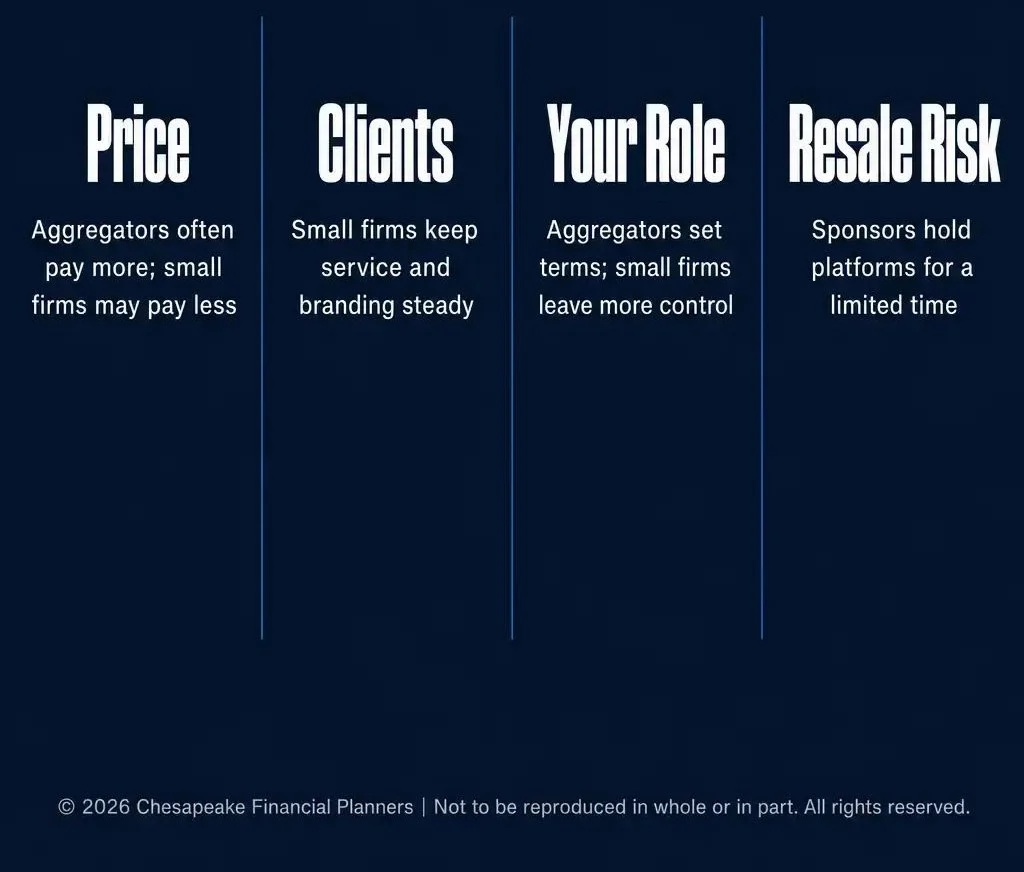
What Changes for Clients and for You After the Sale?
Clients feel the changes first. A larger platform may change the custodian, the planning software, the fee schedule, the service team, or the firm name. Advisor Legacy puts the risk plainly: if the buyer's service model does not align with how you have served clients, clients will notice and might leave, and if the buyer's goals involve cost-cutting or aggressive cross-selling, your legacy may be damaged even if the deal closes.
Your own role changes as well. FP Transitions describes a seller's post-closing consulting and non-compete commitments as core components of a practice sale. With an aggregator, add the employment terms, reporting lines, and decision rights that come with joining a larger organization. Ask what you will control, what moves to the platform, and what happens if you leave early. A small-firm buyer often leaves more of the client relationship and day-to-day decisions in your hands during the transition.
Before you decide, ask each buyer these questions:
- Will my clients keep the same planning process and service team?
- What happens to fees, custodian, and branding?
- What authority will I keep during the transition?
- What are my employment and non-compete terms?
- Who will own the buyer in five years?
What Is the Resale Risk with a Private Equity-Backed Aggregator?
A private equity RIA platform is owned for a limited period, so a sale to an aggregator can mean a second sale later. The law firm Cooley notes that private equity sponsors hold portfolio companies for a handful of years, called a holding period. Fidelity reports that nine PE sponsors each backed more than one active acquirer in 2025, so a platform you join can also sit inside a larger set of holdings.
For you, resale risk means your rollover equity, your employment terms, and your clients may meet a new owner with different priorities. Sponsors plan their own exits, and your timeline may not match theirs. That does not make an aggregator a poor choice, but it is a risk a small-firm buyer with long-term ownership mostly avoids. If you sell to an aggregator, ask how long its sponsor expects to hold the platform and how rollover equity is treated in a later sale. A thoughtful buyer will answer directly, and a vague answer is information about how the relationship will work after closing.

How Do the Two Buyer Types Compare Side by Side?
| Factor | Individual or small-firm buyer | Large PE-backed aggregator |
|---|---|---|
| Headline price | May be lower | Often higher, with strong resources |
| Deal structure | May be more cash-oriented, with simpler terms | May include equity rollover and earn-outs |
| Client experience | Continuity of service, brand and team | Platform, pricing, and branding may change |
| Seller role | Often more autonomy during the transition | Employment terms and decision rights set by the platform |
| Resale risk | Lower when ownership is long term | Higher, as sponsors hold for a limited period |
| Culture fit | Easier to assess in person | Varies by platform and team |
The table is a general guide, not a rule, and an aggregator can fit a seller who values price and resources above other factors. If client experience and continuity matter more, lean toward a buyer who will keep them intact. Our post on selling to a junior advisor covers the internal path, and our succession plan guide shows how the options fit together. The R.U.D.D.E.R. Method™ is Chesapeake Financial Planners' six-step planning process: Review and Recognize, Uncover and Understand, Design and Develop, Discuss and Decide, Execute and Empower, and Reassess and Refine.
Weighing "should I sell my practice to an individual advisor or a large aggregator"? Jeff Judge and the Chesapeake team welcome an early, confidential conversation about which buyer fits your practice. Schedule a fit call with Jeff at chesapeakefp.com.
Frequently Asked Questions
Should I sell my practice to an individual advisor or a large aggregator?
It depends on what you value. An aggregator often offers a higher headline price and more resources. An individual or small-firm buyer tends to offer more continuity, culture fit, and client stability. If keeping the client experience intact matters more, lean toward the individual or small-firm buyer.
Why do aggregators often pay a higher headline price?
Private equity backing gives them capital, and Mercer Capital says PE-backed transactions are drawn to the recurring revenue and growth potential of RIAs. That demand supports valuation multiples. A higher headline can include equity and earn-outs, so compare cash at closing and contingent terms.
What is equity rollover in an aggregator deal?
Equity rollover means you take part of the price as ownership in the buyer or its platform instead of cash. It is reinvestment rather than deferred payment. The stake can be illiquid and its value can rise or fall, so read the shareholder agreement as closely as the price.
What happens to my clients after I sell to an aggregator?
That depends on the platform. Custodian, planning software, fees, service team, and branding may change. Advisor Legacy warns that clients notice when the buyer's service model does not match yours and might leave. Ask the buyer what will stay the same and put commitments in writing.
What is resale risk with a PE-backed buyer?
Sponsors hold investments for a limited time, so the platform you join may be sold again. Your rollover equity, employment terms, and clients could then meet a new owner. Ask how long the sponsor expects to hold the platform and what happens to rollover equity in a later sale.
Disclosures
The information provided is for educational purposes only and should not be construed as investment advice. Investment strategies should be tailored to individual circumstances, risk tolerance, and goals. Past performance doesn't guarantee future results. Consult with qualified financial professionals regarding your specific situation.
Advisors associated with Chesapeake Financial Planners may be either (1) LPL Financial Registered Representatives offering securities through LPL Financial, Member FINRA and SIPC, and investment advisor representatives offering investment advice through Great Valley Advisor Group; or (2) solely investment advisor representatives offering investment advice through Great Valley Advisor Group and not affiliated with LPL Financial. Great Valley Advisor Group, and Chesapeake Financial Planners are separate entities from LPL Financial.
Chesapeake Financial Planners | 2402 Scotlon Ct, Forest Hill, MD 21050 | (410) 652-7868 | www.chesapeakefp.com
© 2026 Chesapeake Financial Planners | Not to be reproduced in whole or in part. All rights reserved.


