

Published: | Last reviewed: November 2026 by Jeff Judge, CFP®
Part of our guide: What Is a Succession Plan for a Financial Advisor?
A sunset deal is an arrangement that lets a retiring financial advisor step back in stages while clients and income move to a successor over an agreed period. You keep working, a little less each year, and the successor takes over the relationships. The details decide whether it's a good exit, so read them closely.
Key Takeaways
- A sunset deal pays a retiring advisor over time while a successor takes the clients, so the contract terms drive what you keep.
- J.D. Power's 2025 study, cited by RightCapital, found 30% of advisors planning to retire within five years have no formal succession plan.
- Cerulli Associates reports more than 100,000 advisors, 37.4% of industry headcount, plan to retire over the next decade, according to RightCapital.
- DeVoe & Company counted more than 300 RIA deals closed in 2025, Schwab reports, so an outside sale is a live option.
About the Author: Jeff Judge, CFP®, AEP®, ChFC®, CLU® is Managing Partner of Chesapeake Financial Planners in Forest Hill, Maryland. He has been helping families and business owners in Harford County and the Baltimore metro area navigate succession and exit planning since earning his CFP® certification in 2013, by using Chesapeake's signature process, the R.U.D.D.E.R. Method™. "A sunset deal can feel like the easy road, but the easy road still has terms, and you want to read every one of them before the first client moves."
What Is a Sunset Deal and How Does It Work?
A sunset deal, also called a sunset agreement or sunset program, moves a retiring advisor's clients to a successor over a set period while the retiring advisor is paid for the transition. Portfolio Medics describes a sunset program as a structured initiative that lets advisors reduce their workload over a defined period, with mentoring and knowledge transfer built in.
There are two common versions. The first is a firm-run program, usually at a large brokerage, where the firm owns the client accounts. Succession Resource Group's white paper lays out the mechanics: the advisor enters the program, selects a successor, negotiates the duration and split within the program's limits, and then retires, while the successor receives a growing share of the revenue. Its figures date to 2018 and 2019, so we skip them.
The second version is a phased sale. FP Transitions calls it Sell and Stay®: an owner sells the practice but, "instead of walking away once the sale is complete, they stay on as an independent contractor or employee earning wages for work performed."
The pattern is the same either way. You hand over clients gradually, and your role shrinks on a schedule. If you own your clients, you're selling a book of business, and a sunset arrangement is one way to structure that sale. It can also be one piece of a financial advisor succession plan, though it isn't the whole plan. Our post on what a succession plan covers for a financial advisor explains the rest.
How Do the Payments and the Tapering Role Work?
Payments in a sunset deal are usually spread over years and tied to the successor's results. SRG describes pay "contingently based on the buyer's success over a period of up to five years." Programs vary by firm, so treat that as a description, not a promise.
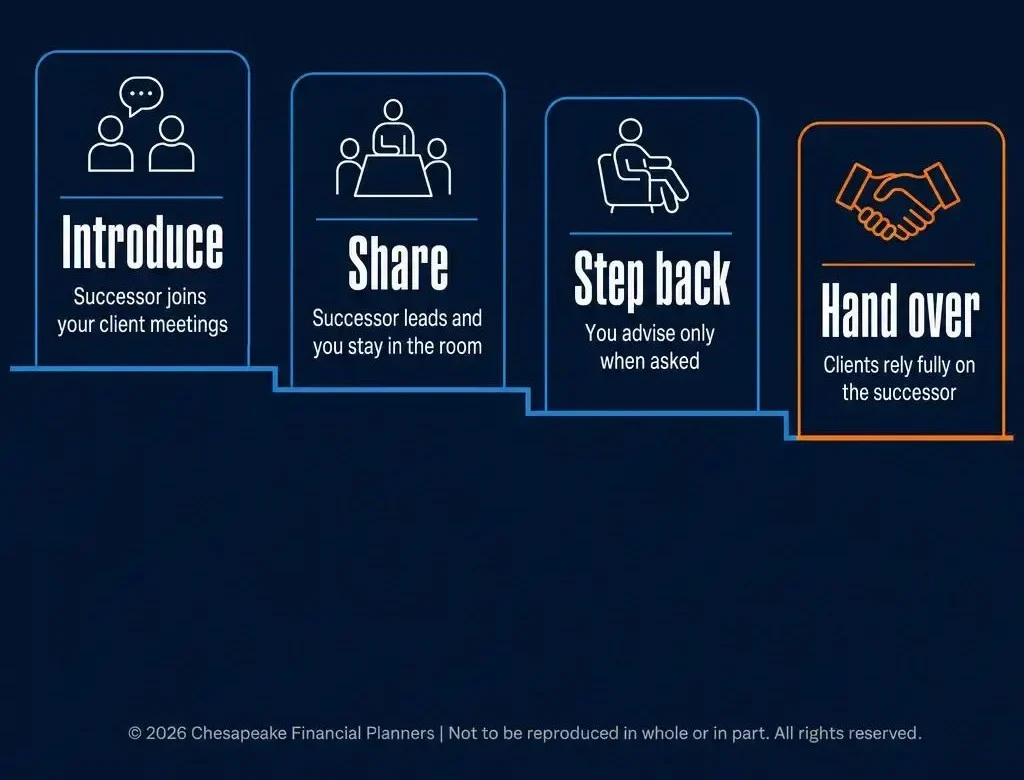
Because the money depends on client retention, your tapering role matters. In a typical arrangement you cut your own client work in steps while the successor takes more meetings, introductions and decisions. A written schedule beats a handshake. RightCapital's guide advises deciding up front how involved you'll be during and after the handoff and putting every term in writing.
Is sunset income taxed like a sale?
Often not. SRG says sunset payouts are taxed as ordinary income, while a practice sale can be taxed differently depending on how the price is allocated. Our post on how the sale of a financial advisory practice is taxed walks through that allocation, so run your numbers with a CPA before you sign.
| Feature | Firm sunset program | Phased sale (sell and stay) | Outright sale |
|---|---|---|---|
| Who pays you | The firm, from revenue the successor generates | The buyer, plus wages for work you keep doing | The buyer |
| Payment timing | Over a set number of years | Part for the practice, part as wages | Mostly at or near closing, though notes and earn-outs are common |
| Your role | Steps down gradually | Employee or contractor for an agreed period | Short transition, then you leave |
| Typical tax treatment | Ordinary income, per SRG | A mix of sale price and wages | Depends on how the price is allocated |
What Are the Pros and Cons of a Sunset Deal?
A sunset deal buys convenience and a gradual exit, and it can cost you value and control. Here is how the sources weigh it.
- Convenience. SRG says the employer manages the payout, with little paperwork for you or your clients.
- A gradual exit. Portfolio Medics notes that advisors receive steady income during the transition and adjust to retirement slowly.
- Possibly less money. SRG argues that sellers of independent practices come out ahead of sunset payouts. SRG advises sellers, so weigh that source's interest.
- Less control. Diamond Consultants, a recruiting firm, says wirehouse sunset programs "typically permit little customization and contain provisions which tie the business to the firm."
- A thin successor. SRG notes the successor may be poorly paid during the sunset period and may lack motivation.
Can you negotiate a sunset agreement?
Within limits. SRG describes negotiating the duration and split inside the program's rules, while Diamond Consultants says the programs allow little customization. Ask what is fixed and what is open before you commit.
Who Is a Sunset Deal Right For?
A sunset deal fits an advisor who works inside a firm that runs a program, wants to taper rather than stop, and has no internal buyer ready. It also suits someone who values simplicity over the last dollar. It fits less well if you own an independent practice with transferable clients, because a sale may pay differently and give you more say. Our posts on selling to an individual advisor or a large aggregator and how practice sales are structured cover those paths.
Jeff Judge sees a pattern in advisors who feel good about their exit: "They chose the structure on purpose, not because it was the first one offered."
Chesapeake Financial Planners acquires advisory practices, so we sit on the buyer's side of this table at times. Weigh our view with that in mind. Chesapeake uses the R.U.D.D.E.R. Method™ with clients. The R.U.D.D.E.R. Method™ is Chesapeake Financial Planners' six-step planning process: Review and Recognize, Uncover and Understand, Design and Develop, Discuss and Decide, Execute and Empower, and Reassess and Refine.

Frequently Asked Questions
What is a sunset deal for a financial advisor?
A sunset deal is an arrangement that moves a retiring advisor's clients to a successor over an agreed period while the retiring advisor is paid for the transition. The advisor's workload tapers on a schedule, and the pay often depends on the successor's results. Terms vary by firm.
How long does a sunset deal last?
It depends on the agreement, and there's no single answer. SRG's white paper describes firm programs that pay over a period of up to five years, while a phased sale, which FP Transitions calls Sell and Stay®, runs for whatever period the buyer and seller write down. Get the dates in writing.
Is a sunset deal better than selling my practice?
It depends on what you own and what you value. A firm sunset program is convenient and gradual. A practice sale can pay differently, and SRG argues it often pays more, though SRG advises sellers. Compare after-tax proceeds, control, and the risk of contingent payments.
What does a tapering role look like?
A tapering role means you reduce client work in steps while the successor takes on more meetings and decisions. Advisor Legacy notes that many deals involve a phased exit in which the seller stays involved for a set period. Write down the schedule and your duties.
What happens to my clients in a sunset deal?
Your clients move to the successor over the agreed period, usually through introductions and joint meetings. Advisor Legacy recommends hosting joint meetings with the new owner so clients can get to know them while you're there to support them. Tell clients early and in person.
Ready to Talk Through a Sunset Deal?
If you're weighing a sunset deal against a sale, Jeff Judge and the Chesapeake team can talk through your options with you. They serve families and business owners across Harford County and the Baltimore metro, and they work with retiring advisors on what comes next. Schedule a free fit call at chesapeakefp.com.
Disclosures
The information provided is for educational purposes only and should not be construed as investment advice. Investment strategies should be tailored to individual circumstances, risk tolerance, and goals. Past performance doesn't guarantee future results. Consult with qualified financial professionals regarding your specific situation.
This information is not intended to be a substitute for specific individualized tax, investment or legal advice. We suggest that you discuss your specific situation with a qualified tax, legal or financial advisor.
Advisors associated with Chesapeake Financial Planners may be either (1) LPL Financial Registered Representatives offering securities through LPL Financial, Member FINRA and SIPC, and investment advisor representatives offering investment advice through Great Valley Advisor Group; or (2) solely investment advisor representatives offering investment advice through Great Valley Advisor Group and not affiliated with LPL Financial. Great Valley Advisor Group, and Chesapeake Financial Planners are separate entities from LPL Financial.
Chesapeake Financial Planners | 2402 Scotlon Ct, Forest Hill, MD 21050 | (410) 652-7868 | www.chesapeakefp.com
© 2026 Chesapeake Financial Planners | Not to be reproduced in whole or in part. All rights reserved.


