

Published: | Last reviewed: November 2026 by Jeff Judge, CFP®
Part of our guide: What Is a Succession Plan for a Financial Advisor?
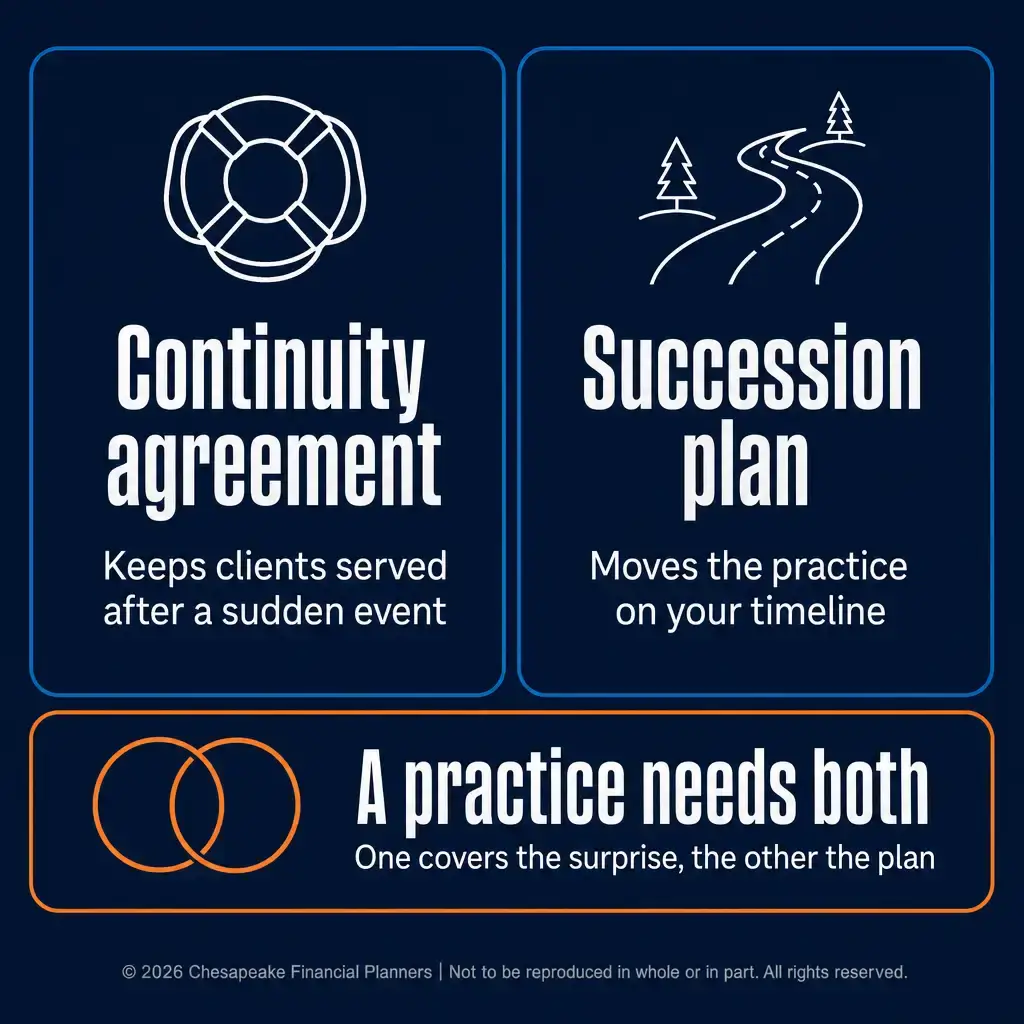
The difference between a continuity agreement and a succession plan comes down to trigger and timing. A continuity agreement is a document that keeps clients served if an advisor dies or can't work. A succession plan is a multi-year strategy for transferring the practice when the advisor decides to leave. A practice needs both.
Key Takeaways
- A continuity agreement covers a sudden death or disability, while a succession plan covers a planned exit over several years.
- J.D. Power's 2025 study, cited by RightCapital, found 30% of advisors planning to retire within five years have no formal succession plan.
- RightCapital advises starting succession planning five to ten years before your intended exit, while a continuity agreement should exist today.
- FINRA Rule 4370 sets ten minimum elements for a member firm's continuity plan, a firm-level rule that does not replace your own.
About the Author: Jeff Judge, CFP®, AEP®, ChFC®, CLU® is Managing Partner of Chesapeake Financial Planners in Forest Hill, Maryland. He has been helping families and business owners in Harford County and the Baltimore metro area navigate succession and continuity planning since earning his CFP® certification in 2013, by using Chesapeake's signature process, the R.U.D.D.E.R. Method™. "A succession plan is about the exit you choose. A continuity agreement is about the one you don't."
What Is the Difference Between a Continuity Agreement and a Succession Plan?
A continuity agreement answers "what happens tomorrow?" A succession plan answers "what happens in five years?" The first is triggered by something you didn't choose. The second is triggered by a decision you did. People search for a continuity agreement vs succession plan answer because the two get blurred, and the blur is dangerous.
| Continuity agreement | Succession plan | |
|---|---|---|
| Trigger | Death, disability or sudden inability to practice | Your decision to retire, sell or transfer |
| Timeline | Takes effect immediately | Unfolds over years |
| Main goal | Keep clients served without a gap | Transfer ownership, clients and value on your terms |
| Successor | A named backup ready to step in now | Chosen and developed over time |
| Typical terms | Client notification, account authority, interim service, payment to your estate | Valuation, payment structure, transition role, client transfer |
| Risk if missing | Clients and family are left waiting | A rushed sale on someone else's schedule |
Read the table as two layers. The continuity agreement is the floor: it keeps clients served in the worst week. The succession plan is the ceiling: it shapes what the practice is worth and who inherits the relationships. Neither one substitutes for the other, and a practice that has only one is exposed on the other side.
What Does a Continuity Agreement Do?
A continuity agreement names who steps in, how clients are told, how accounts move, and what your estate or family receives. Our post on what a continuity agreement for financial advisors is walks through each element in detail.
The money itself isn't the main exposure. Under the SEC's custody rule, an adviser must generally keep client funds and securities with a qualified custodian, so the exposure is service: who answers the phone, who places trades, and who tells clients what happened. A continuity agreement answers those questions in advance.
Does my firm's continuity plan already cover this?
Probably not fully. FINRA's rule says: "Each member must create and maintain a written business continuity plan identifying procedures relating to an emergency or significant business disruption." That is a firm-level plan, so it doesn't settle who serves your clients if you can't. The SEC proposed a similar requirement for advisers in 2016, and SEC.gov still lists it as a proposed rule. Check what your own plan says about an individual advisor's death or disability.
What Does a Succession Plan Do?
A succession plan covers the exit you choose. RightCapital describes it as a multi-year strategy for transferring ownership, client relationships and operational continuity to a successor, internal or external. It treats the work as a chain of decisions:
- Assess the practice: client demographics, revenue mix, key-person dependencies and documents.
- Value the practice with someone experienced in advisory transitions.
- Formalize the agreement, including payment structure and transition-period duties.
- Communicate the plan to clients once there is a named successor and a timeline.
Valuation drives the plan too. RightCapital lists recurring revenue as a share of total revenue, average client age, assets per household, client retention, revenue growth and documentation quality as key drivers. A financial advisor succession plan is where you improve those inputs, which is why it takes years and not weeks.
The timeline is the other big difference. RightCapital says an internal succession needs five or more years, while an external sale still benefits from two to three years of preparation. Our post on preparing an advisory practice for sale covers the three-to-five-year runway, and our guide to what a succession plan is covers the full picture.
Do You Need Both, and How Do They Work Together?
Yes. A succession plan with no continuity agreement covers the exit you see coming and ignores the one you don't. A continuity agreement with no succession plan covers the emergency but leaves the long-term outcome to chance. Together they cover both doors.
Good financial advisor succession planning treats the continuity agreement as the first layer, not an afterthought. Make them point the same way. The backup named in your continuity agreement should be someone you trust with your clients over the long run, and your succession plan should account for that person. A few ways to keep the two aligned:
- Name the same successor in both documents, or write down why they differ.
- Check that the payment terms in the continuity agreement don't conflict with the long-term deal.
- Revisit both once a year and after any change in staff, clients or plans.
Jeff Judge puts it this way: "If the two documents name different people, you haven't made a plan, you've made two guesses."
Can one document do both jobs?
Some practices combine them, but they answer different triggers. Test each one separately: what happens tomorrow if you can't work, and what happens over the next five years if you choose to leave?
Review both whenever staff, clients or your own plans change. Chesapeake Financial Planners acquires advisory practices, and we see how often one of the two documents is missing. The R.U.D.D.E.R. Method™ is Chesapeake Financial Planners' six-step planning process: Review and Recognize, Uncover and Understand, Design and Develop, Discuss and Decide, Execute and Empower, and Reassess and Refine. That last step is the point: a plan that isn't reassessed goes stale.

Frequently Asked Questions
What is the difference between a continuity agreement and a succession plan?
A continuity agreement keeps clients served if an advisor dies or can't work, and it takes effect immediately. A succession plan transfers the practice over several years when the advisor chooses to leave. One handles the sudden event, and the other handles the planned exit.
Do I need both a continuity agreement and a succession plan?
Yes, because they cover different events. A succession plan won't help clients if you die next month, and a continuity agreement won't prepare the practice for a planned sale. Having both, and making sure they name compatible people, closes the gap between a crisis and a deliberate exit.
Who should be named in a continuity agreement?
A specific, qualified party who has agreed in advance to step in, such as a named advisor or firm. A vague promise that someone will figure it out isn't enough. The named party needs to know the clients, accept the terms and be reachable on short notice.
How long does a succession plan take?
Longer than most advisors expect. RightCapital recommends starting five to ten years before your intended exit, with internal successions needing five or more years and external sales benefiting from two to three years of preparation. Starting late narrows your options and your negotiating room.
Is a continuity agreement required by law?
Not by one rule for every adviser. FINRA Rule 4370 requires member broker-dealers to keep a written business continuity plan, while the SEC's 2016 proposal for registered advisers is still listed as a proposed rule on SEC.gov. Whatever the rule says, clients depend on a named plan.
Want a Second Opinion on Your Plan?
If you're sorting out a continuity agreement and a succession plan for your own practice, a second opinion costs you nothing. Jeff Judge and the Chesapeake team serve families and business owners across Harford County and the Baltimore metro. Visit chesapeakefp.com to learn more.
Disclosures
The information provided is for educational purposes only and should not be construed as investment advice. Investment strategies should be tailored to individual circumstances, risk tolerance, and goals. Past performance doesn't guarantee future results. Consult with qualified financial professionals regarding your specific situation.
This information is not intended to be a substitute for specific individualized tax, investment or legal advice. We suggest that you discuss your specific situation with a qualified tax, legal or financial advisor.
Advisors associated with Chesapeake Financial Planners may be either (1) LPL Financial Registered Representatives offering securities through LPL Financial, Member FINRA and SIPC, and investment advisor representatives offering investment advice through Great Valley Advisor Group; or (2) solely investment advisor representatives offering investment advice through Great Valley Advisor Group and not affiliated with LPL Financial. Great Valley Advisor Group, and Chesapeake Financial Planners are separate entities from LPL Financial.
Chesapeake Financial Planners | 2402 Scotlon Ct, Forest Hill, MD 21050 | (410) 652-7868 | www.chesapeakefp.com
© 2026 Chesapeake Financial Planners | Not to be reproduced in whole or in part. All rights reserved.


