

Last reviewed: October 2026
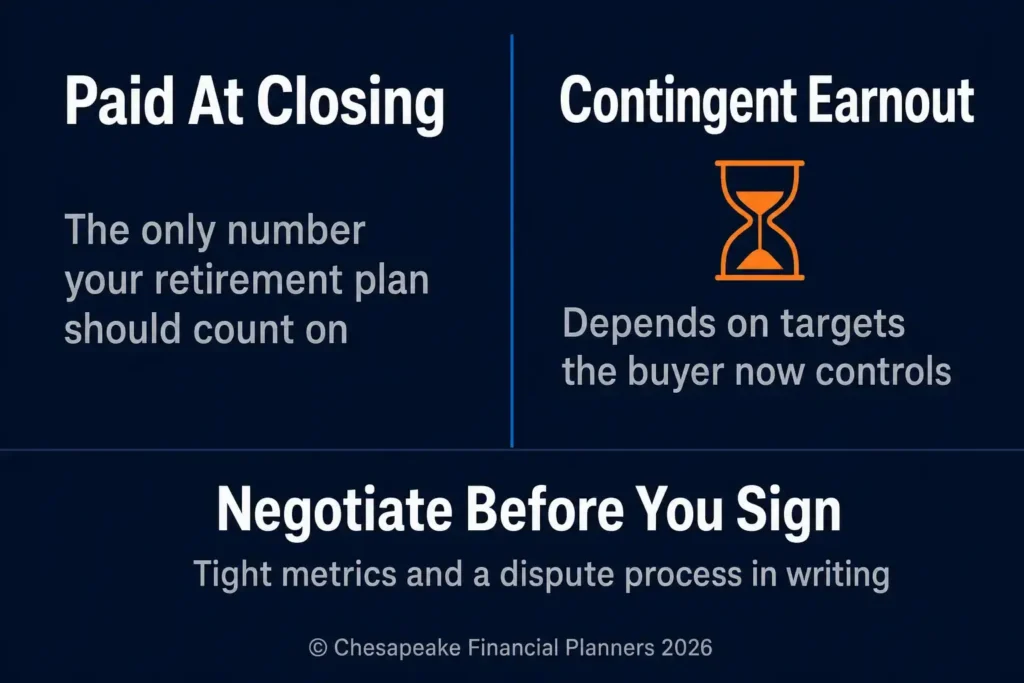
An earnout clause can cut your business sale price because it makes part of the money contingent on targets the buyer now oversees, so what you collect may fall short of the announced figure. An earnout is the slice of the purchase price paid after closing, often over one to three years, and only if the business hits agreed revenue, profit, or client retention targets. The money that lands at closing is the sale price you can plan around; the rest is a possibility.
Key Takeaways
- An earnout makes part of your sale price contingent on post-closing targets, and 24% of private-target deals in 2025 included one.
- SRS Acquiom reports that closer to one out of five dollars gets paid across deals with an earnout, so count closing money first.
- Money collected later is still taxed: long-term capital gains rates run 0%, 15%, and 20%, and a 3.8% surtax can apply.
- Tight revenue metrics, written reporting rights, and a dispute process do more for you than a bigger headline number.
About the Author: Jeff Judge, CFP®, AEP®, ChFC®, CLU® is Managing Partner of Chesapeake Financial Planners in Forest Hill, Maryland. He has been helping families and business owners in Harford County and the Baltimore metro area navigate business sales and exits since earning his CFP® certification in 2013, by using Chesapeake's signature process, the R.U.D.D.E.R. Method™. "Owners fall in love with the headline number, and I understand why, but I ask them to count what arrives at closing and treat everything after that as a bonus," Jeff says.
What Is an Earnout in a Business Sale?
An earnout is a piece of the purchase price that is not paid at closing. It is paid over time, often one to three years, and only if the business hits agreed targets after the sale. When owners ask what is an earnout in practice, the plain answer is a promise to pay later, conditioned on results the buyer now influences. The terms live in the earnout clause of the purchase paperwork, and sometimes in a separate earnout agreement.
Buyers like earnouts because they limit exposure: if a seller's forecasts prove optimistic, the buyer is not stuck paying full price. Sellers can like them too, at first glance, since the headline number gets bigger. The catch is that once the earnout period starts, you are no longer running the company, and the buyer's incentives do not automatically match yours.
The structure is common and getting more so. SRS Acquiom's 2026 study reports that 24% of private-target deals outside life sciences in 2025 included an earnout, up from 19% in 2014. Its lower middle-market report found earnouts in 29% of deals up to $50 million and 35% of the smallest, those up to $25 million. These are deal-database figures, not a forecast for your sale.
Why Does the Headline Price Rarely Match the Money You Collect?
Because the buyer, not you, runs the company while the earnout clock ticks. A business owner we worked with spent nearly two decades building his company and sold it for a headline number that made his family proud: $4.2 million, announced at the closing dinner. Eighteen months later he had received about $2.9 million, and he was not entirely sure why. The answer sat in the deal documents. Nearly a third of the price, about $1.3 million, was an earnout tied to post-closing targets, and some of those targets were not met. (We have simplified the details, and every deal is different.)
Jeff Judge puts it bluntly with clients who are excited about a big headline figure that includes a large earnout component: the number in the press release and the number that actually lands in your account are often two separate conversations, and the earnout is often where the gap lives.
Does a missed earnout mean the buyer acted in bad faith? Rarely. Missed targets often trace back to ordinary decisions a new owner makes. A buyer might fold your company into a larger sales team, which changes how revenue is credited, or redirect marketing spend to another product line, or change pricing, staffing, and vendors in ways that make sense for the whole company and happen to depress the numbers your earnout measures. Sometimes the cause has nothing to do with your company: a buyer's finances shift, an acquisition freeze lands, or leadership turns over. You have no say in any of it.
How Are Earnout Payments Taxed?
Earnout payments are taxed as you receive them, which changes the timing of your bill. In the IRS's words, "An installment sale is a sale of property where you'll receive at least one payment after the tax year in which the sale occurs," per IRS Topic 705.
An earnout adds a wrinkle because the total price is not fixed at closing. IRS Publication 537 calls this a contingent payment sale: "A contingent payment sale is one in which the total selling price can’t be determined by the end of the tax year of sale." Spreading gain across years can smooth the bill, but a smaller-than-expected earnout may leave you having reported income or allocated basis using numbers that did not arrive. Gain from depreciable assets that is taxed as ordinary income under the depreciation recapture rules must be reported in the year of sale, even if the money comes later, according to IRS Topic 705.
Do I owe tax on earnout dollars that do not arrive? Under the installment method you report gain as payments come in, so you are not taxed on dollars you do not receive. Electing out of the installment method changes that, and an earlier-year return may need revisiting if payments come in lower than expected. Your CPA should model both paths before you sign.
Rates matter too. IRS Topic 409 shows net capital gains taxed at 0%, 15%, or 20% depending on taxable income, with 20% applying to the extent income exceeds the thresholds for the 15% rate. Beyond that, the 3.8% net investment income tax can apply once modified adjusted gross income passes $250,000 for a married couple filing jointly. Whether it reaches your sale depends on how your business is structured and how you take part in it, so ask your CPA.
How Should an Earnout Shape Your Retirement Plan?
Build the plan on the closing payment and treat the earnout as upside. We regularly see owners build a post-sale retirement plan around the full headline number, contingent portion included, before a single earnout dollar has arrived. It is understandable; after years of running a business, the headline price feels like the finish line. But if a $4.2 million sale is really $2.9 million at closing and $1.3 million contingent, a plan built on $4.2 million rests on a number that may not fully arrive. That gap can mean delaying retirement, returning to some form of work, or changing a lifestyle you had planned around the larger figure.
We run this test through the R.U.D.D.E.R. Method™, Chesapeake Financial Planners' six-step planning process: Review and Recognize, Uncover and Understand, Design and Develop, Discuss and Decide, Execute and Empower, and Reassess and Refine. The early steps separate money that has arrived from money that is promised, and the design step decides how conservatively to invest closing proceeds. Our post on whether you can retire after selling your business picks up from there.
| Question | Paid at closing | Earnout |
|---|---|---|
| When it arrives | On the closing date | Over one to three years, if targets are met |
| Who influences the result | You and the buyer, at signing | The buyer, running the company after closing |
| How to treat it in your plan | The working assumption | Upside until it is paid |
| What can change it | Nothing after signing | Buyer decisions, market conditions, and disputes |
Harford County owners have a local layer added to the federal one. Maryland taxes the gain too: the state's 2026 income tax rate reaches 6.5%, at incomes above $1 million for single filers and $1.2 million for joint filers, and counties add their own tax; the Comptroller's 2026 withholding guidance lists 3.06% for Harford County residents. A separate Maryland capital gains surtax may also apply to large gains. A Forest Hill or Bel Air owner whose earnout arrives over several tax years should ask a CPA how each payment lands on the Maryland return, and our post on selling a business in Maryland walks through the state layer.

What Should You Negotiate Before You Sign an Earnout Agreement?
Deal with earnout risk before signing, not after targets are missed. Five points matter.
- Negotiate the metrics tightly and measurably. Revenue targets are harder to manipulate than profit targets, because profit can be shaped by allocated overhead, corporate expenses, and accounting decisions made at a level you no longer oversee.
- Ask for operating commitments. Some deals require the buyer to run the business reasonably consistently with how it ran before the sale, or give the seller visibility into decisions that touch the earnout metrics. They are not bulletproof, but they improve your position in a dispute.
- Write the dispute process into the purchase agreement, with clear reporting requirements so you can see whether targets are being met. Year two, when the relationship has cooled, is a poor time to invent one.
- Bring your CPA and an attorney experienced in M&A into the earnout conversation itself. Earnout structuring is its own specialty, and the language that serves a seller in a dispute differs from the rest of the purchase agreement. It is also why your CPA, attorney, and financial planner need to coordinate before the terms are set.
- Negotiate the size of the earnout itself. A smaller, well-structured earnout layered on a larger closing payment is often a better outcome than a bigger headline number with a bigger contingent piece.
Jeff Judge often tells owners that chasing the biggest total is understandable and expensive. In his experience, owners do well when they chase the biggest number they can count on, and raise the earnout while a buyer is still courting them.
None of this makes earnouts bad; plenty pay in full when buyer and seller stay aligned during the transition. The owner from the start of this post recovered part of his shortfall through the dispute process his attorney had written into the original agreement, though it took the better part of a year and cost more in legal fees than either side wanted. On a more recent sale we worked on, the seller negotiated tighter revenue-based metrics and a real reporting requirement up front, and the earnout paid close to its estimated value, on schedule, with no dispute. One deal is not a pattern, and results vary; but the difference was settled months before either deal closed.
By the time a letter of intent is on the table, much of the structure has been shaped by whoever arrived first with a proposal. Our post on why sale structure gets set before your advisor joins covers the same timing problem. If you are a year or two from selling, check whether your retirement plan works on the closing payment alone. Then it is far easier to turn down an aggressive earnout when your retirement does not depend on accepting it.
Frequently Asked Questions
What is an earnout in a business sale?
An earnout is part of the purchase price paid after closing, often over one to three years, and only if the business hits agreed targets such as revenue, profit, or client retention. It lets a buyer limit exposure and lets a seller pursue a higher headline price, but the seller then depends on results the buyer influences.
Should I count the earnout when planning my retirement?
Plan around the money paid at closing first and treat the earnout as upside. A retirement plan built on the full headline number can fall short if targets are missed, so we test whether your plan works on closing proceeds alone before the sale, then let any earnout payment improve it.
Is an earnout better than a higher price?
A smaller earnout layered on a larger closing payment is often a better outcome than a bigger headline number with a larger contingent piece, because the closing payment is settled and contingent dollars depend on the buyer's decisions. Compare offers by closing payment first, then by the earnout terms around it.
Who should review an earnout agreement before I sign?
Your CPA and an attorney experienced in M&A should both review the earnout language before you sign. The attorney checks the metrics, operating commitments, and dispute process; the CPA works out tax timing; and your financial planner tests the result against your retirement plan so each piece fits the others.
How are earnout payments taxed in Maryland?
Earnout payments are taxed federally as you receive them under the installment rules, and Maryland residents owe state and county income tax as well. For 2026 the Maryland state rate reaches 6.5% at the upper brackets and the Comptroller lists 3.06% for Harford County residents, so your CPA should confirm how each payment lands on both returns.
What can I do if the buyer disputes my earnout?
Your options are set by the dispute process written into the purchase agreement, which is why it has to be negotiated before you sign. A defined path, such as a reporting requirement followed by an agreed review step, gives you somewhere to go; without one, you may be left negotiating or litigating with a buyer who now owns the books.
Ready to Test Your Sale Plan Against the Closing Payment Alone?
If you are anywhere near selling, the earnout conversation belongs early, before a buyer is at the table. Jeff Judge and the Chesapeake team work with families and business owners across Harford County and the Baltimore metro area, and we would rather stress-test your plan than find the gap after the ink dries. Schedule a free fit call with Jeff to see where an earnout could change your picture.
A version of this article was originally published on Chesapeake Financial Planners' LinkedIn.
Disclosures
The information provided is for educational purposes only and should not be construed as investment advice. Investment strategies should be tailored to individual circumstances, risk tolerance, and goals. Past performance doesn't guarantee future results. Consult with qualified financial professionals regarding your specific situation.
This information is not intended to be a substitute for specific individualized tax, investment or legal advice. We suggest that you discuss your specific situation with a qualified tax, legal or financial advisor.
CFP Board owns the marks CFP®, CERTIFIED FINANCIAL PLANNER®, and CFP® (with plaque design) in the U.S.
The ChFC® is the property of The American College of Financial Services, which reserves sole rights to its use, and is used by permission.
The CLU® is the property of The American College of Financial Services, which reserves sole rights to its use, and is used by permission.
Advisors associated with Chesapeake Financial Planners may be either (1) LPL Financial Registered Representatives offering securities through LPL Financial, Member FINRA and SIPC, and investment advisor representatives offering investment advice through Great Valley Advisor Group; or (2) solely investment advisor representatives offering investment advice through Great Valley Advisor Group and not affiliated with LPL Financial. Great Valley Advisor Group, and Chesapeake Financial Planners are separate entities from LPL Financial.
Chesapeake Financial Planners | 2402 Scotlon Ct, Forest Hill, MD 21050 | (410) 652-7868 | www.chesapeakefp.com
© 2026 Chesapeake Financial Planners | Not to be reproduced in whole or in part. All rights reserved.


