

How Does Compound Interest Actually Work?
Last reviewed: July 2026
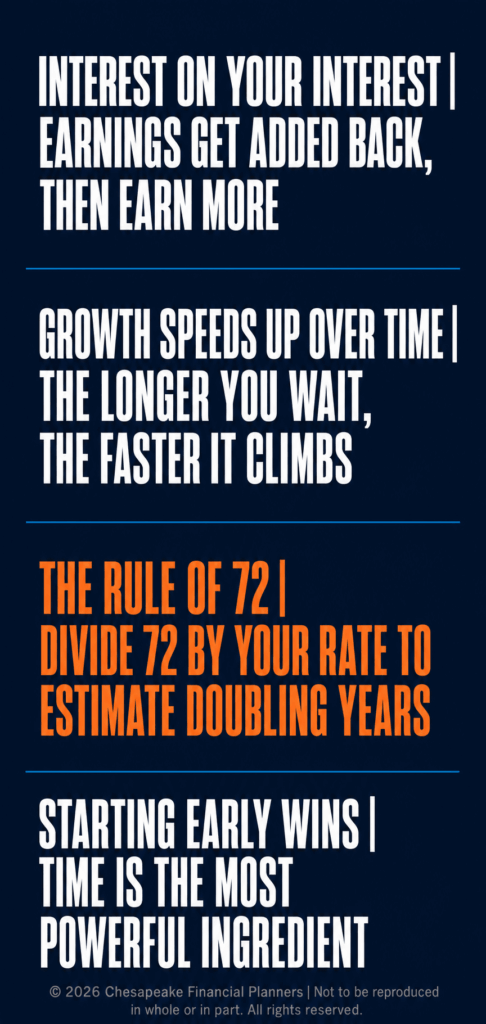
Compound interest is interest earned on both your original money and the interest that money has already earned. Each period, your balance grows, and the next round of interest is calculated on that larger balance. Over time, the growth accelerates because you're earning returns on a bigger and bigger pile. That snowball effect is the entire reason small, steady savers often end up ahead of people who start later with more money.
Key Takeaways
- Compound interest pays you interest on your interest, so your balance grows faster the longer you leave it alone.
- The Rule of 72 estimates how long money takes to double: divide 72 by your annual return rate.
- Time matters more than the amount you start with, which is why early savers win.
- At the 2026 401(k) limit of $24,500, consistent contributing plus compounding builds real wealth.
About the Author: Jeff Judge, CFP®, AEP®, ChFC®, CLU® is Managing Partner of Chesapeake Financial Planners in Forest Hill, Maryland. He has been helping families and business owners in Harford County and the Baltimore metro area understand the mechanics of saving and investing since earning his CFP® certification in 2013, by using Chesapeake Financial Planners’ signature process, the R.U.D.D.E.R. method™. Jeff often tells clients that the most underrated force in personal finance isn't a hot stock pick. It's time in the market doing quiet, boring work in the background.
What Is Compound Interest in Plain English?
Compound interest is what happens when your earnings start earning. You put money in. It earns interest. Then that interest gets added to your balance, and next period you earn interest on the new, larger total. Repeat that for years, and the math starts working hard on your behalf.
Compare it to simple interest, where you only ever earn on your original deposit. Say you put in $1,000 at 5% simple interest. You earn $50 every year, forever. With compound interest at 5%, you earn $50 the first year, then $52.50 the second year (because you're now earning on $1,050), then more the year after that. The gap is small at first. Given enough time, it becomes enormous. Jeff Judge notes: "That gap between simple and compound interest looks trivial in year two, but when I show clients a 30-year projection side by side, the difference in the ending balance is often larger than everything they originally put in."
The Consumer Financial Protection Bureau describes compound interest as interest you earn on both your principal and the interest already added to your account. That second part is the whole game.
How Does Compound Interest Work With Real Numbers?
Numbers make this concrete. Let's run a clean example using compound interest examples you can check yourself.
Say you invest $5,000 once and never touch it. Assume a 7% annual return, compounded yearly:
| Year | Starting Balance | Interest Earned (7%) | Ending Balance |
|---|---|---|---|
| 1 | $5,000 | $350 | $5,350 |
| 5 | $6,553 | $459 | $7,012 |
| 10 | $9,179 | $642 | $9,836 |
| 20 | $18,051 | $1,264 | $19,348 |
| 30 | $35,514 | $2,486 | $38,061 |
Your original $5,000 turns into roughly $38,000 after 30 years, and you never added a dime. Notice the interest earned in year 30 ($2,486) is larger than your entire balance after year one. That's compounding accelerating.
Now add monthly contributions. If you invest $300 a month at a 7% return for 30 years, you'd contribute $108,000 of your own money and end up with roughly $352,000. The other $244,000 came from compounding. Historically, the long-run average annual return of the U.S. stock market has been roughly 10% before inflation, according to data published by Morningstar, so 7% is a deliberately conservative planning assumption.
Jeff Judge has watched clients in their twenties shrug off this math and then watch the same clients in their fifties wish they'd started ten years earlier. The do-over isn't available. Time is the one input you can't buy back.
To run your own numbers, the SEC's compound interest calculator at Investor.gov lets you adjust principal, rate, and time horizon in seconds.
What Is the Rule of 72 and How Do You Use It?
The Rule of 72 is a shortcut for estimating how long it takes money to double. Divide 72 by your expected annual return, and the answer is roughly the number of years required.
At a 6% return, your money doubles in about 12 years (72 ÷ 6). At 8%, it doubles in roughly 9 years. At 10%, about 7.2 years. It's not perfectly precise, but it's close enough to make decisions with in your head.
The Rule of 72 also works in reverse on debt. Credit card interest compounds against you. At a 24% APR, the lender's money doubles in about three years if left unpaid. The same force that builds wealth can quietly demolish it. If you're carrying high-rate balances, see our guide on the What is the best way to pay off debt quickly? before you focus on investing.
Why Does Starting Early Matter So Much?
Because compounding rewards time more than it rewards the amount you contribute. Two savers can put in identical dollars and end up worlds apart based purely on when they started.
Take two people, both earning a 7% return. Alex invests $300 a month from age 25 to 35, then stops, leaving the money to grow. Sam waits until 35 and invests $300 a month all the way to 65. Alex contributed $36,000 total. Sam contributed $108,000, three times as much. At 65, Alex usually ends up with more money, simply because that first decade of compounding did work no later contribution could replicate.
This is the single most important idea in personal finance, and it's also the most ignored. Building a stable foundation first matters too, which is why a cash cushion comes before aggressive investing. Our How Much Should I Have in My Emergency Fund? walks through that step.
Frequently Asked Questions
How does compound interest work in a savings account?
In a savings account, the bank pays interest on your balance, then adds that interest to your principal, so the next interest calculation runs on the larger amount. Most banks compound daily or monthly. The more frequently interest compounds, the slightly higher your effective annual yield, though the difference is modest at typical savings rates.
What is the difference between compound interest and simple interest?
Simple interest is calculated only on your original principal, so the dollar amount you earn stays flat every period. Compound interest is calculated on your principal plus all previously earned interest, so the dollar amount you earn grows each period. Over long stretches, compound interest produces dramatically larger totals than simple interest on the same starting balance.
How do I calculate compound interest myself?
Use the formula A = P(1 + r/n)^(nt), where P is your principal, r is the annual rate as a decimal, n is how many times interest compounds per year, and t is the number of years. For a quick mental estimate of doubling time, the Rule of 72 works: divide 72 by your annual return percentage to get the approximate years to double.
Does compound interest work against me with debt?
Yes, compound interest works against you on most credit cards and revolving debt because unpaid interest gets added to your balance and then accrues more interest. A 24% APR card can effectively double the lender's claim on you in about three years if left unpaid. Paying high-rate debt down quickly is one of the highest guaranteed returns available to most households.
How much do I need to invest to benefit from compounding?
You can benefit from compounding with very small amounts, because the key variable is time, not size. Investing $100 a month at a 7% return for 40 years grows to roughly $264,000, of which only $48,000 is your own contribution. Starting small and staying consistent beats waiting until you can invest a large lump sum later.
Compound interest isn't complicated, but it is patient, and patience is the part most people skip. If you want a clear picture of how saving, investing, and tax planning fit together over a lifetime, our free guide to financial planning foundations breaks it down step by step. Download it at chesapeakefp.com and start putting time to work on your side.
Want to go deeper? Our Why Financial Advice Isn’t Just for Retirees walks through this step by step.
Disclosures
The information provided is for educational purposes only and should not be construed as investment advice. Investment strategies should be tailored to individual circumstances, risk tolerance, and goals. Past performance doesn't guarantee future results. Consult with qualified financial professionals regarding your specific situation.
CFP Board owns the marks CFP®, CERTIFIED FINANCIAL PLANNER®, and CFP® (with plaque design) in the U.S.
Certified Financial Planner Board of Standards Center for Financial Planning, Inc. owns and licenses the certification marks CFP®, CERTIFIED FINANCIAL PLANNER®, and CFP® (with plaque design) in the United States to Certified Financial Planner Board of Standards, Inc., which authorizes individuals who successfully complete the organization’s initial and ongoing certification requirements to use the certification marks.
Advisors associated with Chesapeake Financial Planners may be either (1) LPL Financial Registered Representatives offering securities through LPL Financial, Member FINRA and SIPC, and investment advisor representatives offering investment advice through Great Valley Advisor Group; or (2) solely investment advisor representatives offering investment advice through Great Valley Advisor Group and not affiliated with LPL Financial. Great Valley Advisor Group, and Chesapeake Financial Planners are separate entities from LPL Financial.


