

What Should I Do in the First 90 Days After an Inheritance, Settlement, or Business Sale?
Last reviewed: July 2026
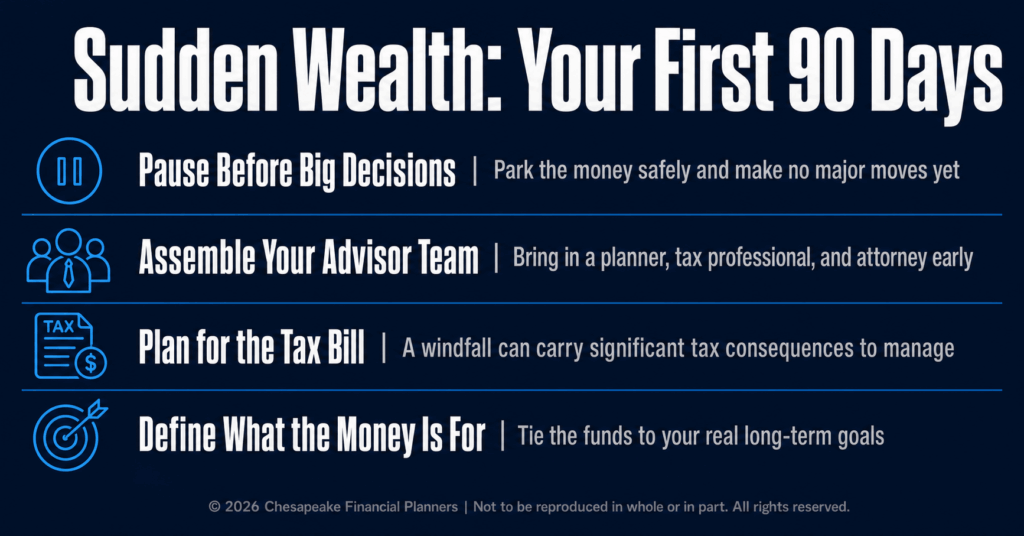
The first thing to do after a sudden wealth event is nothing. Park the money in an FDIC-insured account, hold off on every major decision for at least 30 days, and resist the calls from people who suddenly want to help you spend it. A sudden wealth checklist starts not with investing or spending, but with a deliberate pause that protects you from the costliest mistakes people make in the first 90 days. The right moves in those three months can preserve hundreds of thousands of dollars; the wrong ones can unravel a lifetime of opportunity in a single quarter.
On This Page
- Key Takeaways
- Why the First 90 Days Decide Everything
- Step 1: Pause and Protect the Money for 30 Days
- Step 2: Quantify Exactly What You Received
- Step 3: Build Your Professional Team in the Right Order
- Step 4: Understand the Tax Bill Before You Touch a Dollar
- Step 5: Address Debt, Cash Reserves, and Short-Term Needs
- Step 6: Set Goals Before You Set a Strategy
- Step 7: Handle Family, Friends, and the Requests That Follow
- How the R.U.D.D.E.R. Method Structures a Sudden Wealth Plan
- Frequently Asked Questions
- Where to Go From Here
- Disclosures
Key Takeaways
- Do nothing with the money for the first 30 days. Park it in FDIC-insured accounts and let the emotional spike settle before any decision.
- Standard FDIC insurance covers $250,000 per depositor, per bank, per ownership category, so a large windfall needs spreading across institutions.
- The federal estate tax exemption rises to $15 million per person in 2026 under IRS guidance, reshaping most inheritance planning.
- Build your team in a deliberate order: fiduciary advisor, then CPA, then estate attorney, before you spend or invest a dollar.
- Inherited IRAs from non-spouses generally follow a 10-year withdrawal rule, a trap that surprises most heirs.
About the Author: Jeff Judge, CFP®, AEP®, ChFC®, CLU® is Managing Partner of Chesapeake Financial Planners in Forest Hill, Maryland. He has been helping families and business owners in Harford County and the Baltimore metro area navigate sudden wealth events since earning his CFP® certification in 2013, by using Chesapeake Financial Planners’ signature process, the R.U.D.D.E.R. method™. Jeff has watched more windfalls disappear from rushed generosity and bad first decisions than from any market downturn, which is why the first 90 days matter more than almost any quarter that follows.
Why the First 90 Days Decide Everything
The first 90 days after a sudden wealth event are the highest-risk window of your financial life. You are making consequential decisions while your judgment is compromised by grief, relief, excitement, or all three at once. Research on windfall recipients consistently shows that the timing of money is harder to manage than the amount.
A sudden wealth checklist exists because the brain treats a windfall differently than earned income. Money that arrives suddenly feels less "real," which is precisely why people spend it faster and more carelessly. The Consumer Financial Protection Bureau has documented how large lump sums create decision pressure that pushes people toward choices they would never make with their regular paycheck.
Here is the pattern Jeff Judge sees again and again: the recipient is fine for about three weeks. Then a relative calls. Then a friend has a "can't-miss" business idea. Then a salesperson smells the money. By day 60, the person who was going to be careful has already committed to two things they cannot undo. The damage in sudden wealth rarely comes from one giant mistake. It comes from a dozen small yeses said too quickly.
What makes a windfall different from regular income?
A windfall is different because it arrives without the gradual habits that normally govern money. With a salary, you learn to manage cash flow over years. With a $2 million business sale, you are handed a sum larger than your lifetime savings overnight, with no muscle memory for how to steward it. The absence of practice, not the size of the sum, is what makes windfalls dangerous.
Step 1: Pause and Protect the Money for 30 Days
Move the funds into an FDIC-insured account and do nothing else for 30 days. This is the single most important step on any sudden wealth checklist, and it is the one people most want to skip.
Standard FDIC deposit insurance covers $250,000 per depositor, per insured bank, for each ownership category. A $1.5 million windfall sitting in one checking account is mostly uninsured. Spread it across multiple institutions, or use a single bank's cash-management sweep that distributes deposits across partner banks to extend coverage. For very large sums held briefly, Treasury bills and money market funds backed by government securities offer safety while you plan.
The 30-day rule is not about laziness. It is about waiting for the emotional spike to pass. Decisions made in the first weeks after an inheritance or settlement are decisions made by a different person than the one you will be in month four.
What account should I put a windfall in first?
Put a windfall first in an FDIC-insured high-yield savings or cash-management account that keeps the full balance insured and immediately accessible. Avoid brokerage accounts, annuities, or any investment vehicle in the first 30 days. The goal is preservation and accessibility, not growth, until you have a plan and a team in place.
Step 2: Quantify Exactly What You Received
Before you can plan, you need to know precisely what you have. This sounds obvious, but the gross figure people quote almost never matches what lands in their account.
A business sale of $3 million might net $2.1 million after taxes, broker fees, and any earn-out held in escrow. An inheritance of "the house and some accounts" might include an inherited IRA with a 10-year distribution clock, a brokerage account with a stepped-up cost basis, and a property with a mortgage you did not know about. A lawsuit settlement money payment may be partly tax-free and partly taxable depending on what it compensates.
Make a single document listing every asset, its type, its current value, any associated debt, and any tax characteristic you know. For inherited retirement accounts, note the original owner's death date because that sets your distribution deadline. For a windfall financial planning exercise, this inventory is the foundation everything else builds on.
Jeff Judge tells clients that the number in your head is almost always wrong, usually too high. The "I got $2 million" feeling collides with the "I actually control $1.4 million after taxes and obligations" reality, and that gap is where overspending lives. Get the real number on paper before you let yourself dream about it.
How do I figure out the after-tax value of a windfall?
To figure out the after-tax value of a windfall, separate each asset by its tax treatment, then estimate the tax owed on each. Pre-tax retirement accounts are taxed as ordinary income on withdrawal; appreciated stock may owe capital gains; inherited assets often receive a stepped-up basis; and certain settlement payments for physical injury are tax-free. A CPA should confirm the figure before you spend.
Step 3: Build Your Professional Team in the Right Order
A sudden wealth event is too big to handle alone, but the order in which you assemble help matters as much as who you hire. Build the team in this sequence: a fee-based fiduciary financial advisor first, then a CPA, then an estate attorney.
The advisor goes first because they coordinate the others and keep the whole picture in view. A CFP Board fiduciary is legally required to act in your interest, which matters enormously when large sums attract people who are not. The CPA handles the tax mechanics that determine how much of the windfall you actually keep. The estate attorney updates your will, beneficiary designations, and any trust structures, which a sudden increase in net worth almost always requires.
Avoid the reverse pattern, where a recipient hires whoever calls first, usually a commissioned product salesperson, and ends up locked into an annuity or insurance contract before anyone has looked at the full situation. According to research summarized by FINRA, unsuitable product sales spike around liquidity events precisely because the money is visible and the recipient is overwhelmed.
For business owners who just completed a sale, the team often needs a fourth member: someone who understands the specific tax treatment of your transaction, including any qualified small business stock exclusion or installment sale structure. What Should I Do After My Startup Gets Acquired?
Who should I hire first after a windfall?
Hire a fee-based fiduciary financial advisor first after a windfall. A fiduciary is legally obligated to put your interests ahead of their own compensation, and they coordinate the CPA and estate attorney who follow. Hiring a commissioned salesperson first is the most common and most expensive mistake, because product sales often get locked in before anyone reviews your full financial picture.
What professionals does a lottery winner need to hire first?
Step 4: Understand the Tax Bill Before You Touch a Dollar
Taxes determine how much of a windfall survives, and the rules differ sharply by source. Misjudging the tax bill is how people end up owing money they have already spent.
For inheritances, there is generally no federal income tax on the money you receive, but the assets carry their own rules. Most inherited assets get a stepped-up cost basis to the date-of-death value, which can erase years of unrealized capital gains. The federal estate tax, paid by the estate before you inherit, applies only above a high threshold. The federal estate tax exemption rises to $15 million per individual in 2026 under the IRS inflation adjustments, meaning the vast majority of estates owe no federal estate tax at all.
Inherited retirement accounts are the trap. Under the SECURE Act, most non-spouse beneficiaries must empty an inherited IRA within 10 years of the original owner's death, and for many heirs annual required distributions apply during that window. The IRS finalized these rules, and getting the timing wrong triggers penalties and can push you into a higher bracket. A large 401(k) inherited at age 45 can become a decade-long tax management project, not a windfall.
For lawsuit settlement money, the tax treatment depends on what the payment compensates. Settlements for physical injury or sickness are generally excluded from income, while punitive damages and lost-wage components are usually taxable. The IRS publishes specific guidance, and the allocation language in your settlement agreement matters enormously.
For a business sale, the structure drives the bill. An asset sale, a stock sale, an installment sale, and a qualified small business stock exclusion each produce a different tax outcome on the same headline price. The top long-term capital gains rate remains 20% federally for high earners in 2026, plus the 3.8% net investment income tax above certain thresholds per IRS guidance.
What happens to my finances after a liquidity event?
How much tax will I owe on an inheritance?
Most heirs owe no federal income tax on an inheritance itself, because the estate pays any estate tax before distribution and that exemption is $15 million per person in 2026. However, inherited pre-tax retirement accounts are taxed as ordinary income when withdrawn, and the 10-year withdrawal rule for non-spouse heirs can create a significant ongoing tax bill that surprises most people.

Step 5: Address Debt, Cash Reserves, and Short-Term Needs
Once the money is protected and the tax picture is clear, the next move is unglamorous and almost always correct: shore up your financial foundation before doing anything ambitious.
Start with high-interest debt. Paying off a credit card charging 22% is a guaranteed 22% return with zero risk, which beats nearly any investment you could make with the same dollars. The Federal Reserve reports average credit card interest rates near record highs in 2026, which makes payoff one of the highest-value uses of windfall dollars. Mortgages and low-rate auto loans are a closer call and depend on the rate, your tax situation, and your goals.
Next, build a cash reserve that fits your new reality. The old rule of three to six months of expenses still holds, but a windfall often changes the math. If the money lets you leave a job, your reserve needs to be larger. If it does not change your income, a standard emergency fund plus a separate "windfall opportunity" account keeps you from raiding the lump sum for daily life.
Resist the urge to make a big lifestyle purchase in the first 90 days. There is nothing wrong with eventually buying the house or the car, but doing it before the plan exists locks in a recurring cost, property taxes, insurance, maintenance, against a number you have not yet stress-tested. Jeff often suggests clients give themselves a small, capped "fun" budget, a few thousand dollars to enjoy guilt-free, while the rest stays parked. The capped indulgence relieves the pressure to splurge without endangering the windfall.
Should I pay off my mortgage with a windfall?
Paying off a mortgage with a windfall depends on your interest rate, tax situation, and goals rather than a single rule. A mortgage below roughly 4% is often worth keeping if you can earn more by investing, while a higher-rate mortgage may be worth eliminating for the guaranteed return and peace of mind. The right answer also weighs liquidity, since a paid-off house is hard to tap in an emergency.
Step 6: Set Goals Before You Set a Strategy
Most people invert this step. They ask "how should I invest this?" before asking "what is this money actually for?" The strategy should serve the goal, never the reverse.
A windfall financial planning process starts with defining what the money needs to do. Does it replace your income so you can stop working? Does it fund your children's education and your own retirement? Does it let you start the business you have always wanted? Each of those goals implies a completely different investment approach, risk tolerance, and time horizon. Money meant to throw off income next year should not sit in the same place as money meant to grow for 30.
This is where the temptation to chase returns becomes dangerous. After a windfall, people often feel they should be doing something clever, swinging for growth or jumping into whatever is hot. But for most recipients, the goal is not to multiply the windfall; it is to keep it and make it last. A reasonable, boring, diversified plan that preserves the money beats an aggressive one that risks it, especially when the windfall is irreplaceable.
Jeff Judge frames it this way for clients: there are two kinds of money, the money you need and the money you want. Lock down the "need" money in something safe and reliable first. Only the genuine surplus, the "want" money you could lose without changing your life, belongs anywhere aggressive. Most people never separate the two, and that is why a single bad bet can take down a sound plan.
What should you do when you suddenly receive a large sum of money?
How should I invest a large windfall?
You should invest a large windfall only after defining what the money is for, then matching the investment to the goal's time horizon and risk tolerance. Money needed within a few years belongs in safe, liquid holdings, while money intended to grow for decades can take measured market risk through a diversified portfolio. Avoid chasing returns; for most recipients, preserving the windfall matters far more than multiplying it.
Step 7: Handle Family, Friends, and the Requests That Follow
The hardest part of a sudden wealth event is rarely the money. It is the people. Word travels, and with it come requests, expectations, and a quiet shift in how others treat you.
You are under no obligation to tell anyone the amount. In fact, the fewer people who know the precise figure, the better. A useful script for any request is simple: "I'm working with my financial team on a plan right now, and I'm not making any decisions until that's done." This is true, it buys time, and it lets the advisor be the designated "no" so you do not have to be.
If you do want to help family, build it into the plan rather than reacting to each ask. The federal annual gift tax exclusion rises to $19,000 per recipient in 2026 according to the IRS, meaning you can give that amount to any number of people each year without filing a gift tax return. Larger gifts are still possible but use part of your lifetime exemption. Planned giving feels generous and stays controlled; reactive giving drains the account and never seems to end.
Jeff has watched generosity become the single biggest threat to a windfall, more than markets, more than taxes. The recipient who cannot say no ends up funding everyone else's emergencies until their own security is gone. Deciding in advance how much, if any, you will give, and routing every request through that predetermined limit, is the only thing that consistently protects both the money and the relationships.
What should you tell family after winning the lottery?
How do I say no when family asks for money after a windfall?
Say no by deferring to your plan and your financial team rather than rejecting the person directly. A script like "I'm not making any financial decisions until my advisor and I finish the plan" is honest, buys time, and shifts the gatekeeping to a professional. If you want to give, set a predetermined annual amount in advance and route every request through that limit so generosity stays controlled.
How Can I Protect Inherited Money from Scams and Bad Decisions?

How the R.U.D.D.E.R. Method™ Structures a Sudden Wealth Plan
A sudden wealth checklist gives you the immediate moves, but the longer arc needs a process. The R.U.D.D.E.R. Method™ is Chesapeake Financial Planners' six-step planning process: Review and Recognize, Uncover and Understand, Design and Develop, Discuss and Decide, Execute and Empower, and Reassess and Refine.
In a windfall, the process maps cleanly. Review and Recognize is the 30-day pause and the full inventory of what you received. Uncover and Understand is the tax analysis and goal definition. Design and Develop is where the actual investment and estate strategy takes shape. Discuss and Decide is where you weigh tradeoffs, like how much to gift or whether to pay off the mortgage. Execute and Empower puts the plan in motion. Reassess and Refine acknowledges that a windfall plan made in month two will need adjusting as life changes.
The point of a method is that it slows you down at the exact moments speed would hurt you. People who try to handle sudden wealth as a series of disconnected decisions tend to optimize each one in isolation and miss how they interact. A 401(k) withdrawal strategy, a gifting plan, and a home purchase are not three separate choices; they are one integrated picture, and the tax and cash-flow consequences of each ripple into the others.
How do I handle a lawsuit settlement or insurance payout I wasn't expecting?
What should I do with money I inherited from a relative?
Frequently Asked Questions
What is the first thing to do after receiving sudden wealth?
The first thing to do after receiving sudden wealth is nothing. Move the money into FDIC-insured accounts and wait at least 30 days before making any major financial decision. This deliberate pause lets the emotional intensity settle and prevents the rushed yeses, generous gifts, and impulse purchases that cause most of the damage in the first 90 days.
How long should I wait before investing an inheritance or settlement?
You should wait at least 30 days before investing an inheritance or settlement, and often closer to 90 days until your plan and professional team are in place. The money loses nothing by sitting in an FDIC-insured account briefly, but a rushed investment, annuity, or insurance product can lock you into a costly decision you cannot easily reverse.
Do I have to pay taxes on inherited money?
You generally do not pay federal income tax on inherited money itself, because any estate tax is paid by the estate before distribution and the 2026 federal exemption is $15 million per person. However, inherited pre-tax retirement accounts are taxed as ordinary income when withdrawn, and most non-spouse heirs must empty them within 10 years under current IRS rules.
Is lawsuit settlement money taxable?
Lawsuit settlement money may be partly taxable and partly tax-free depending on what the payment compensates. Settlements for physical injury or physical sickness are generally excluded from income, while punitive damages, interest, and lost-wage components are usually taxable. The allocation language in your settlement agreement drives the outcome, so a CPA should review it before you treat any portion as tax-free.
How much money can I give to family after a windfall without paying tax?
You can give up to $19,000 per recipient in 2026 without filing a gift tax return, under the IRS annual gift tax exclusion. There is no limit to the number of people you can give that amount to each year. Larger gifts are still allowed but use part of your lifetime exemption, which sits at $15 million per person in 2026.
Should I quit my job after a business sale or inheritance?
You should not quit your job in the first 90 days after a business sale or inheritance, even if the money seems large enough. Wait until your plan stress-tests whether the windfall can actually replace your income for the rest of your life. The decision to stop working is permanent for many people, and a windfall that feels limitless often supports far less lifetime spending than expected.
What professionals do I need after a sudden wealth event?
After a sudden wealth event you typically need three professionals: a fee-based fiduciary financial advisor, a CPA, and an estate attorney. Hire them in that order, because the advisor coordinates the others and keeps your full picture in view. Business sale recipients often add a fourth specialist who understands the specific tax treatment of their transaction.
How do I avoid scams and bad advice after coming into money?
Avoid scams and bad advice by refusing every unsolicited offer in the first 90 days and routing all financial decisions through a fee-based fiduciary advisor. Never disclose the exact amount you received, be wary of "can't-miss" opportunities, and remember that legitimate professionals do not pressure you to decide quickly. The 30-day pause is itself a scam filter, because most pressure-based pitches cannot survive a deliberate delay.
Where to Go From Here
The first 90 days after sudden wealth are not about doing more. They are about doing less, slowly, and in the right order. Protect the money, learn exactly what you have, build your team, understand the tax bill, and only then make the bigger decisions. A sudden wealth checklist works because it replaces panic and pressure with sequence.
If this was helpful, our free guide on navigating a windfall walks through each of these steps in greater depth, including worksheets for the asset inventory and the team-building sequence. Download it at chesapeakefp.com to give yourself a clear, calm path through the most consequential financial quarter of your life.
Prefer a different starting point? Our Transition Readiness Questionnaire is worth a look.
Disclosures
The information provided is for educational purposes only and should not be construed as investment advice. Investment strategies should be tailored to individual circumstances, risk tolerance, and goals. Past performance doesn't guarantee future results. Consult with qualified financial professionals regarding your specific situation.
Advisors associated with Chesapeake Financial Planners may be either (1) LPL Financial Registered Representatives offering securities through LPL Financial, Member FINRA and SIPC, and investment advisor representatives offering investment advice through Great Valley Advisor Group; or (2) solely investment advisor representatives offering investment advice through Great Valley Advisor Group and not affiliated with LPL Financial. Great Valley Advisor Group, and Chesapeake Financial Planners are separate entities from LPL Financial.


