

Should I Choose a Solo 401(k) or SEP IRA for My Business?
Last reviewed: July 2026
The choice between a Solo 401(k) vs SEP IRA comes down to one question: do you want maximum flexibility or maximum simplicity? A Solo 401(k) lets you contribute as both employee and employer, allows Roth contributions, and permits loans. A SEP IRA is faster to open and easier to run, but ties every dollar you save to your business profit. For most self-employed business owners without employees, the Solo 401(k) wins on contribution power and tax control.
Key Takeaways
- A Solo 401(k) and SEP IRA both allow up to $72,000 in 2026 contributions, but they get you there differently.
- The Solo 401(k) lets you save even in a low-profit year through employee deferrals of up to $24,500.
- SEP IRAs have no loan provision and offer Roth treatment only where the provider supports it under the SECURE 2.0 Act, while Solo 401(k) plans include both Roth and loans as standard.
- SEP IRAs win on simplicity; Solo 401(k) plans require a Form 5500 filing once assets pass $250,000.
About the Author: Jeff Judge, CFP®, AEP®, ChFC®, CLU® is Managing Partner of Chesapeake Financial Planners in Forest Hill, Maryland. He has been helping families and business owners in Harford County and the Baltimore metro area navigate self-employed retirement plans since earning his CFP® certification in 2013, by using Chesapeake Financial Planners’ signature process, the R.U.D.D.E.R. method™. Jeff has watched too many owners default to a SEP IRA simply because it was the first plan their accountant mentioned, then realize three years later they could have saved far more with a Solo 401(k).
What Is the Difference Between a Solo 401(k) and a SEP IRA?
A Solo 401(k) is a retirement plan built for self-employed people and business owners with no employees besides a spouse. You contribute in two roles. As the employee, you can defer up to $24,500 in 2026. As the employer, you can add up to 25% of your compensation. Together those contributions can reach $72,000, or $80,000 if you are 50 or older and use the catch-up.
A SEP IRA works through a single employer contribution of up to 25% of your net self-employment earnings, capped at the same $72,000 for 2026. There is no separate employee deferral. That single difference drives almost everything else about how these two plans behave.
The plans look like twins on a contribution-limit chart. They are not twins in practice. The Solo 401(k) gives you levers a SEP IRA generally does not: built-in Roth contributions, plan loans, and the ability to save when profit is thin. (Under the SECURE 2.0 Act, a SEP IRA can offer Roth treatment too, but only where the provider supports it — and it still has no loan feature.) The SEP IRA gives you one thing the Solo 401(k) cannot match, which is a setup you can finish in an afternoon.
How do business owners plan for retirement differently?
Which Plan Lets You Contribute More?
For most owners earning under roughly $200,000, the Solo 401(k) lets you contribute more. The reason is the employee deferral. A SEP IRA caps you at 25% of compensation, so a sole proprietor netting $100,000 can contribute around $20,000. A Solo 401(k) owner at the same income adds the full $24,500 employee deferral on top of the employer share, reaching a much higher total.
At higher incomes the two plans converge, because the 25% employer formula alone eventually hits the $72,000 ceiling. The gap matters most for the middle-income self-employed person, which describes a large share of the business owners Jeff works with across Harford County.
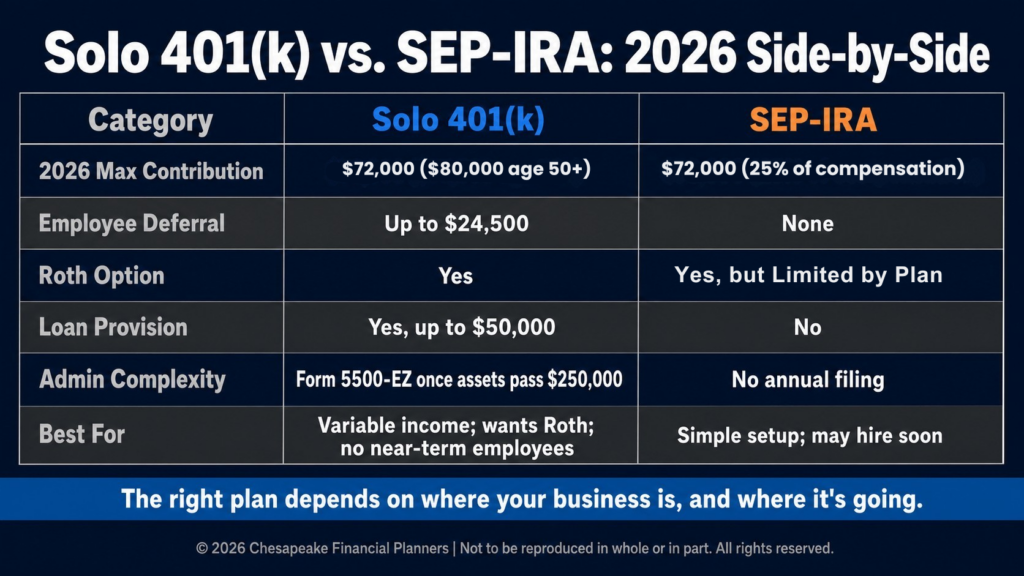
Here is how the contribution mechanics compare directly:
| Feature | Solo 401(k) | SEP IRA |
|---|---|---|
| 2026 maximum contribution | $72,000 ($80,000 age 50+) | $72,000 |
| Employee deferral | Up to $24,500 | None |
| Employer contribution | Up to 25% of compensation | Up to 25% of compensation |
| Contribution in a low-profit year | Yes, via deferral | Limited to 25% of low earnings |
| Roth option | Yes | Yes, but Limited By Plan |
| Loan provision | Yes, up to $50,000 | No |
Jeff often tells clients that the contribution chart only tells half the story. The real edge of a Solo 401(k) shows up in a year when revenue dips and a SEP contribution would shrink to almost nothing.
How do business owners save for retirement without a 401(k)?
When Does Plan Flexibility Actually Matter?
Plan flexibility matters most when your income is uneven, when you want tax-free growth, or when you may need emergency access to capital. The Solo 401(k) addresses all three. You can defer your $24,500 in a slow year regardless of profit. You can route contributions into a Roth source so qualified withdrawals come out tax-free in retirement. And you can borrow up to $50,000 or half your balance if your business hits a wall.
A SEP IRA offers less flexibility on these three. Under the SECURE 2.0 Act, some SEP-IRAs can offer Roth contributions, but availability and implementation are limited by the plan/provider. SEP-IRAs still do not offer loans, and there is no deferral floor in a lean year. You can also convert SEP dollars to a Roth IRA later, but you pay tax on the conversion in that year.
This is exactly the spot where business owners get the decision wrong. They compare the two plans on the maximum contribution line, see the same $72,000, and assume the plans are interchangeable. They are not. The flexibility difference is the whole decision for an owner with variable income.
How Can Business Owners Use Profit-Sharing Plans for Tax Benefits?
How Much Harder Is a Solo 401(k) to Manage?
A Solo 401(k) is moderately harder to manage, mostly because of one filing requirement. Once your plan assets exceed $250,000, you must file IRS Form 5500-EZ each year. A SEP IRA carries no annual filing at any balance, which is its biggest practical advantage.
For an owner who values a clean back office above everything, that simplicity is worth real money in saved time and accountant fees. For an owner focused on building the largest possible nest egg, one annual form is a small price for the extra contribution room and the Roth and loan features.
Jeff frames it this way with clients: the question is not which plan is simpler, because the SEP IRA always wins that contest. The question is whether the Solo 401(k)'s extra features are worth one yearly form once your account grows. For most owners committed to serious saving, they are. This is the kind of trade-off the firm works through using the R.U.D.D.E.R. Method™, Chesapeake Financial Planners' six-step planning process: Review and Recognize, Uncover and Understand, Design and Develop, Discuss and Decide, Execute and Empower, and Reassess and Refine. Jeff Judge notes: "For a self-employed owner maxing out contributions every year, filing one Form 5500-EZ annually is a minor administrative task compared to the thousands of additional dollars the Solo 401(k) lets you shelter above what a SEP IRA would allow."
How Should Business Owners Pay Themselves Salary vs Distributions?
What Should You Do If You Plan to Hire Employees?
If you expect to hire employees soon, weigh both plans carefully, because each treats staff differently. A Solo 401(k) is built for an owner-only business; the moment you add an eligible employee, you generally must move to a traditional 401(k) plan, which adds cost and testing. A SEP IRA can keep working, but it forces you to contribute the same percentage of pay for every eligible employee that you contribute for yourself.
That uniform-percentage rule can get expensive fast. An owner who funds 20% of their own pay must fund 20% for each eligible employee too. Neither plan is automatically better for a growing team, so map your hiring plans before you commit. According to the Bureau of Labor Statistics, small business employment continues to be a major share of the U.S. workforce, which means many owners face this decision sooner than they expect.
How do business owners plan for retirement differently?
Frequently Asked Questions
Can I have both a Solo 401(k) and a SEP IRA?
You can technically maintain both, but it rarely helps because contributions are coordinated across plans and share the same overall limits. In almost every case, picking one plan and funding it fully beats splitting contributions. Most self-employed owners are better served choosing the single plan that fits their income and goals.
Which plan is better for a self-employed person with no employees?
For most self-employed people with no employees, the Solo 401(k) is the stronger choice because it allows the $24,500 employee deferral on top of the employer contribution, plus Roth and loan features. A SEP IRA only makes sense when administrative simplicity outweighs the extra contribution room and flexibility.
Does a SEP IRA allow Roth contributions?
Under the SECURE 2.0 Act, some SEP-IRAs can offer a Roth option, but availability and implementation are limited by the plan/provider. If your SEP-IRA does not support Roth contributions, SEP contributions are typically pre-tax. You can also convert SEP IRA funds to a Roth IRA afterward, but you owe income tax on the converted amount that year. If tax-free retirement growth is a priority, the Solo 401(k)'s built-in Roth option is often the cleaner path.
What happens to my Solo 401(k) if I hire an employee?
Once you hire an employee who meets the plan's eligibility rules, your Solo 401(k) generally must convert to a traditional 401(k) plan with full nondiscrimination testing and higher administrative costs. Many owners planning near-term hiring choose a SEP IRA upfront to avoid that transition, though the SEP requires equal-percentage funding for staff.
How much can I contribute to a Solo 401(k) in 2026?
For 2026 you can contribute up to $72,000 to a Solo 401(k), or $80,000 if you are 50 or older and use the catch-up contribution. That total combines the $24,500 employee deferral with an employer contribution of up to 25% of your compensation, subject to IRS coordination rules.
Is a SEP IRA or Solo 401(k) easier to set up?
A SEP IRA is easier to set up and can usually be opened in a single afternoon with minimal paperwork and no annual filing. A Solo 401(k) takes more effort upfront and requires an annual Form 5500-EZ once assets exceed $250,000. The trade-off is more contribution room and flexibility.
If you are weighing these two plans for your own business, our guide to retirement options for business owners walks through the full decision with worksheets you can use today. Download it free at chesapeakefp.com and see exactly how much each plan could save you.
Want to go deeper? Our Tax Strategy Readiness Quiz walks through this step by step.
Disclosures
The information provided is for educational purposes only and should not be construed as investment advice. Investment strategies should be tailored to individual circumstances, risk tolerance, and goals. Past performance doesn't guarantee future results. Consult with qualified financial professionals regarding your specific situation.
Contributions to a traditional IRA may be tax deductible in the contribution year, with current income tax due at withdrawal. Withdrawals prior to age 59 ½ may result in a 10% IRS penalty tax in addition to current income tax.
A Roth IRA offers tax deferral on any earnings in the account. Qualified withdrawals of earnings from the account are tax-free. Withdrawals of earnings prior to age 59 ½ or prior to the account being opened for 5 years, whichever is later, may result in a 10% IRS penalty tax. Limitations and restrictions may apply.
Advisors associated with Chesapeake Financial Planners may be either (1) LPL Financial Registered Representatives offering securities through LPL Financial, Member FINRA and SIPC, and investment advisor representatives offering investment advice through Great Valley Advisor Group; or (2) solely investment advisor representatives offering investment advice through Great Valley Advisor Group and not affiliated with LPL Financial. Great Valley Advisor Group, and Chesapeake Financial Planners are separate entities from LPL Financial.


