

How Much of My Portfolio Should Be in One Stock?
Last reviewed: July 2026
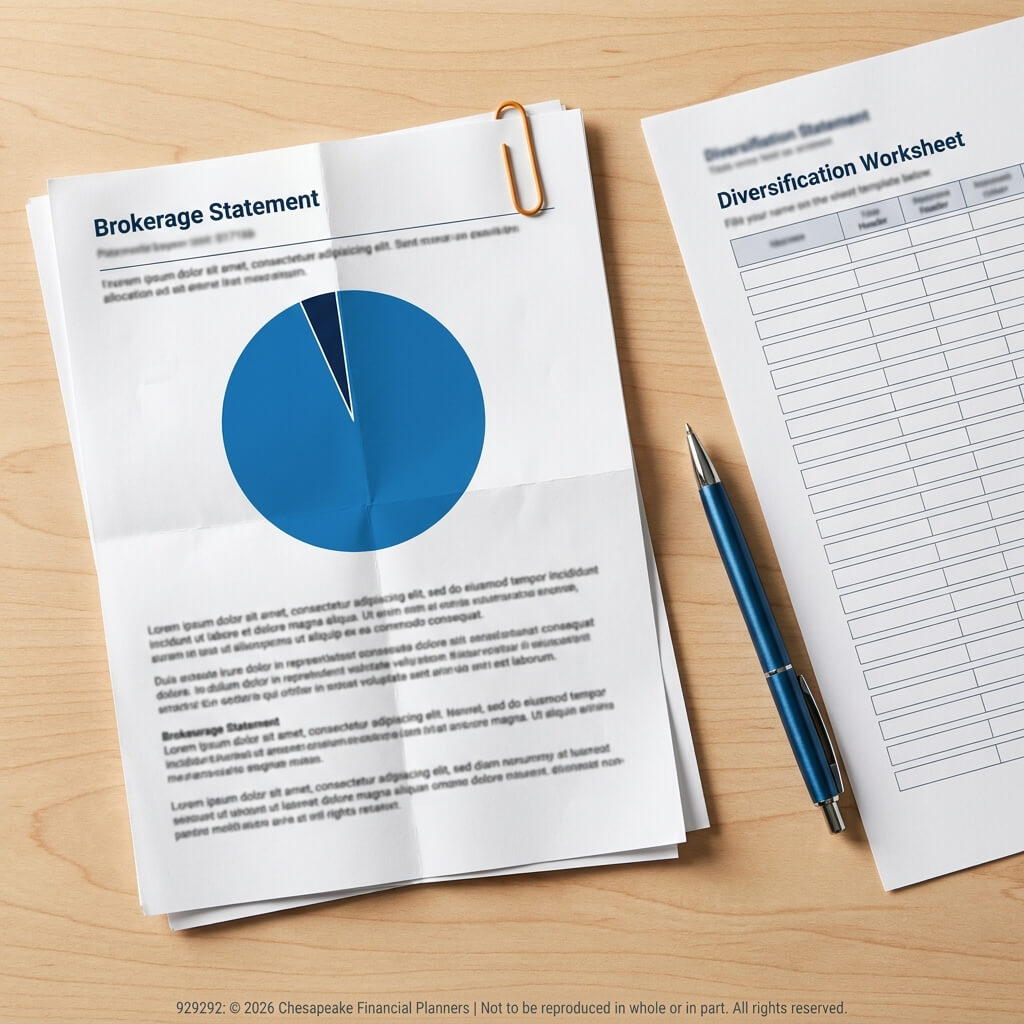
No single stock should make up more than 10% to 15% of your portfolio, and for most people, your employer's stock belongs at the lower end of that range. Concentration risk is the danger that one position dominates your net worth so heavily that its decline could wreck your entire financial plan. When 40% of your wealth sits in one company, a 50% drop in that stock cuts your total net worth by 20% in a single stretch. The math is bad enough. With employer stock, it gets worse.
Key Takeaways
- No single stock should exceed 10% to 15% of your total portfolio, and employer stock often warrants an even lower ceiling.
- The top long-term capital gains rate of 20% in 2026 is far better than absorbing a 50% loss on a concentrated position.
- Employer stock concentration is correlated risk: your salary, future grants, and portfolio can all fall at once.
- A rule-based selling plan removes emotion and protects you from trying to time the market.
About the Author: Jeff Judge, CFP®, AEP®, ChFC®, CLU® is Managing Partner of Chesapeake Financial Planners in Forest Hill, Maryland. He has been helping families and business owners in Harford County and the Baltimore metro area navigate equity compensation and concentration risk since earning his CFP® certification in 2013, by using Chesapeake Financial Planners’ signature process, the R.U.D.D.E.R. method™. Jeff has watched talented engineers and executives ride a single stock to a fortune on paper, then give half of it back because they couldn't bring themselves to sell.
What Is Concentration Risk and Why Does It Matter?
Concentration risk is the exposure that comes from holding too much of your net worth in a single investment. A diversified portfolio spreads your money across hundreds or thousands of holdings so that no one company can sink you. A concentrated portfolio puts a large share of your future in the hands of one management team, one product line, and one set of market conditions.
The danger isn't just volatility. A diversified index fund moves up and down too. The difference is that a single stock can go to zero and stay there, while a broad market index has never permanently failed to recover. According to SEC investor guidance, individual stocks carry company-specific risk that diversification is designed to eliminate. When you concentrate, you keep that risk on the table by choice.
Jeff Judge often tells clients to run a simple test: if you sold the entire position today and held cash, would you turn around and buy 40% of your net worth back in that one stock tomorrow? Almost no one says yes. That gap between what you'd buy fresh and what you're holding is the size of your concentration problem.
Why Is Employer Stock Concentration Especially Dangerous?
Employer stock concentration is the single most dangerous form because your risks are correlated. When your company stumbles, multiple parts of your financial life decline at the same time.
Consider what happens when your employer's stock drops 50% because the business is struggling. The company may announce layoffs. Your job could be at risk. Your next equity grant may be cut or repriced. Your unvested RSUs lose half their expected value. And your investment portfolio falls right alongside everything else. That is not normal market noise. That is a single point of failure for your income, your benefits, your future compensation, and your savings, all firing at once.
You already carry enormous exposure to your employer through your salary, your bonus, your future grants, and your career trajectory. Stacking 40% of your investment portfolio on top of that exposure means your entire financial life rises and falls with one company. History is full of cautionary cases: employees at Enron, Lehman Brothers, and dozens of 2021 SPAC darlings learned this the hard way. Even Cisco shareholders who held through 2000 waited more than two decades to recover.
What Cognitive Biases Keep People Holding Too Much?
Most people don't stay concentrated because they ran the numbers and decided it was smart. They stay concentrated because of predictable mental traps. Recognizing the bias is the first step to acting on a sound diversification strategy.
Recency bias convinces you that a stock that gained 200% over 18 months will keep climbing. Recent performance feels like proof of a permanent edge. It isn't.
Anchoring bias locks you onto an arbitrary price. "I'll sell when it hits $300." The market does not care about your target, and that number keeps you holding through declines.
Sunk cost fallacy tells you that because you've held the position for years, you should keep holding. How long you've owned something has zero bearing on whether you should own it now.
Overconfidence bias is the trickiest. Working at the company gives you real insight into your team and product, so you feel like an insider. But you have no special read on market pricing, competitor moves, or macroeconomic shocks. Even genuine insiders take heavy losses despite their information advantage.
This is exactly the kind of moment where Jeff Judge has seen smart, analytical people make emotional decisions. The fix is to take the decision out of your own hands with a written plan. At Chesapeake Financial Planners, we use the R.U.D.D.E.R. Method™, our six-step planning process: Review and Recognize, Uncover and Understand, Design and Develop, Discuss and Decide, Execute and Empower, and Reassess and Refine. Naming the bias is the "Recognize" step. Building the selling rule is "Design and Develop."
How Do I Build a Diversification Strategy Without a Huge Tax Bill?
Start by calculating your true exposure, set a target allocation, then sell systematically on a schedule instead of trying to time the top. Letting taxes paralyze you is its own mistake. Paying capital gains tax on a winner stings far less than watching a concentrated position lose half its value.
First, add up your full position: vested RSUs and exercised options, unvested grants, and the grants you expect over the next two to three years. Divide that total by your net worth. Anything above 20% is overconcentrated for most people.
Next, set a target. Most individuals should aim for 10% to 15% maximum in employer stock. Anything above 30% is a speculative bet, not a plan.
Then build a rule-based selling plan rather than guessing at the perfect exit. Many high earners use a 10b5-1 trading plan to sell a set number of shares on a fixed schedule, which removes both emotion and timing pressure. The top long-term capital gains rate is 20% in 2026 for the highest earners, with most filers paying 15% or even 0%. Compare that to the alternative: a 50% loss isn't deductible against your peace of mind. Selling steadily, harvesting losses elsewhere to offset gains, and reinvesting the proceeds into a broad portfolio is how you trade a single point of failure for a durable financial plan.
The decision isn't whether to diversify. It's whether you do it on your terms or the market's.
How do I diversify a concentrated company stock position without a huge tax bill?
How does equity compensation affect my financial plan?
How should my investment mix change as I get closer to retirement?
Frequently Asked Questions
What percentage of my portfolio should be in a single stock?
No single stock should make up more than 10% to 15% of your total portfolio, and employer stock often warrants an even lower limit. Above that threshold, one company's decline can meaningfully damage your overall net worth. For most investors, keeping any individual position under 10% is the safer target.
Is it bad to have 40% of my net worth in one stock?
Yes, holding 40% of your net worth in one stock is a serious concentration risk. A 50% decline in that stock would cut your total net worth by 20% on its own. If it's your employer's stock, your job, future grants, and portfolio could all fall together, creating a single point of failure for your finances.
How much employer stock is too much?
Employer stock exposure above 10% to 15% of your portfolio is generally too much, and concentrations over 30% are speculative rather than prudent. You already depend on your employer for salary, bonuses, and future equity, so stacking a large investment position on top multiplies risk that is already correlated to one company.
Should I avoid selling concentrated stock because of taxes?
No, you should not let taxes prevent sound diversification. While capital gains taxes are real, the top long-term rate of 20% in 2026 is far better than absorbing a 50% loss on an undiversified position. A rule-based selling plan, paired with loss harvesting to offset gains, keeps your tax bill manageable while reducing risk.
What is the best way to diversify a concentrated stock position?
The best way is to calculate your true exposure, set a target allocation of 10% to 15%, and sell systematically on a fixed schedule rather than timing the market. Many high earners use a 10b5-1 plan to automate sales. Reinvesting the proceeds into a broad, diversified portfolio replaces single-company risk with market exposure.
If this breakdown helped clarify your concentration risk, our free guide to equity compensation and diversification covers RSU selling strategy and portfolio diversification in depth. Download it at chesapeakefp.com.
Want to go deeper? Our 10 Signs You're Ready for a Certified Financial Planner walks through this step by step.
Advisors associated with Chesapeake Financial Planners may be either (1) LPL Financial Registered Representatives offering securities through LPL Financial, Member FINRA and SIPC, and investment advisor representatives offering investment advice through Great Valley Advisor Group; or (2) solely investment advisor representatives offering investment advice through Great Valley Advisor Group and not affiliated with LPL Financial. Great Valley Advisor Group, and Chesapeake Financial Planners are separate entities from LPL Financial.
© 2026 Chesapeake Financial Planners | Not to be reproduced in whole or in part. All rights reserved.
Disclosures
The information provided is for educational purposes only and should not be construed as investment advice. Investment strategies should be tailored to individual circumstances, risk tolerance, and goals. Past performance doesn't guarantee future results. Consult with qualified financial professionals regarding your specific situation.
This information is not intended to be a substitute for specific individualized tax, investment or legal advice. We suggest that you discuss your specific situation with a qualified tax, legal or financial advisor.
Advisors associated with Chesapeake Financial Planners may be either (1) LPL Financial Registered Representatives offering securities through LPL Financial, Member FINRA and SIPC, and investment advisor representatives offering investment advice through Great Valley Advisor Group; or (2) solely investment advisor representatives offering investment advice through Great Valley Advisor Group and not affiliated with LPL Financial. Great Valley Advisor Group, and Chesapeake Financial Planners are separate entities from LPL Financial.


