

When Does a Roth Conversion Make Financial Sense and How Do You Execute It?
Last reviewed: July 2026
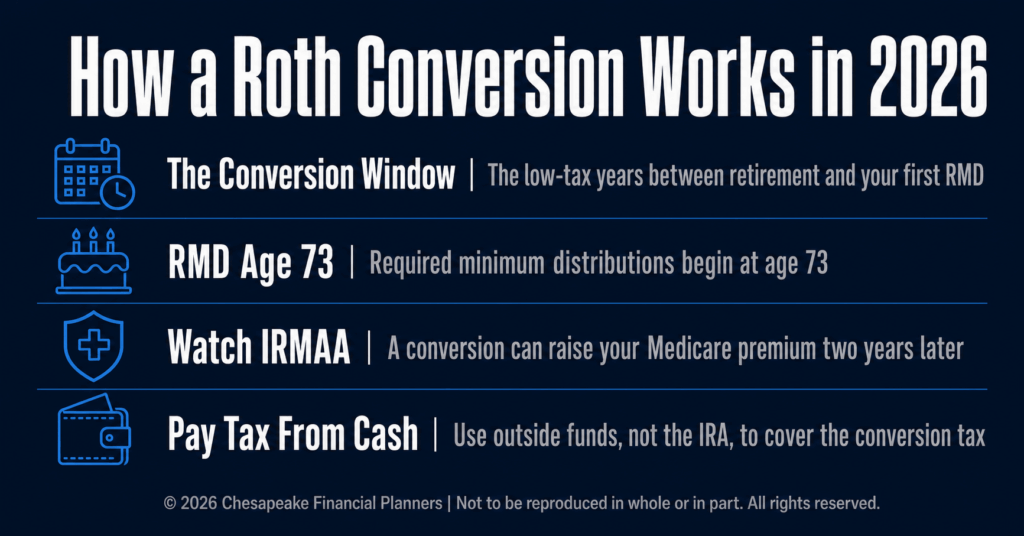
A Roth conversion makes financial sense when your tax rate today is lower than the rate you expect to pay in retirement, and the most common window runs from the year you stop working until RMDs begin at age 73. You move pre-tax IRA or 401(k) money into a Roth IRA, pay ordinary income tax on the converted amount this year, and never pay tax on that money or its growth again. A sound roth conversion strategy is about controlling which bracket fills the conversion, not about converting everything at once.
On This Page
- Key Takeaways
- What Is a Roth Conversion and Why Does It Matter?
- When Does a Roth Conversion Make Financial Sense?
- How Does the Conversion Window Between Retirement and Age 73 Work?
- How Much Should You Convert Without a Tax Surprise?
- How Do IRMAA and Medicare Premiums Change the Roth Conversion Math?
- How Do RMDs Interact With a Roth Conversion Strategy?
- How Do You Execute a Roth Conversion Step by Step?
- Frequently Asked Questions
- Where to Go From Here
- Disclosures
Key Takeaways
- A Roth conversion makes sense when your current marginal tax rate is lower than your expected retirement rate, often during the gap years between retirement and age 73.
- You pay ordinary income tax on the converted amount in the conversion year; there is no annual conversion limit and no income cap.
- The IRS set the 2026 RMD age at 73, creating a conversion window many pre-retirees overlook.
- Large conversions can push you over an IRMAA bracket, raising Medicare premiums two years later, so size each conversion against those thresholds.
- There is no longer a five-year wait to recharacterize; conversions are permanent once executed, so the math has to be right before you click convert.
About the Author: Jeff Judge, CFP®, AEP®, ChFC®, CLU® is Managing Partner of Chesapeake Financial Planners in Forest Hill, Maryland. He has been helping families and business owners in Harford County and the Baltimore metro area navigate Roth conversion strategy since earning his CFP® certification in 2013, by using Chesapeake Financial Planners’ signature process, the R.U.D.D.E.R. method™. Jeff's view: the biggest conversion mistakes he sees aren't about whether to convert, they're about converting too much in a single year and triggering a Medicare premium surcharge nobody warned the client about.
What Is a Roth Conversion and Why Does It Matter?
A Roth conversion is the act of moving money from a pre-tax retirement account, such as a traditional IRA or an old 401(k), into a Roth IRA, and paying ordinary income tax on the amount you move in the year you move it. Once the money is in the Roth, it grows tax-free and comes out tax-free in retirement, provided you follow the holding rules.
The reason this matters comes down to one idea: you are choosing to pay tax now instead of later. That trade only works in your favor if "now" is a cheaper tax environment than "later." For a lot of pre-retirees, the years right after they stop working are exactly that cheaper environment, because their wages have stopped but their Social Security and RMDs have not yet started.
Who is a Roth conversion actually for?
A Roth conversion is most valuable for someone who expects to be in the same or a higher tax bracket in retirement than they are in today. That includes high earners with large pre-tax balances heading toward big future RMDs, pre-retirees with a few low-income years before Social Security begins, and anyone who wants to leave tax-free money to heirs. It is rarely a fit for someone who expects a much lower retirement bracket or who would have to pull from the converted account to pay the tax bill.
Jeff Judge often tells clients that the conversion question is really a bracket-management question in disguise. The account type is the tool. The tax bracket is the target.
What is the right retirement withdrawal order for your accounts?
When Does a Roth Conversion Make Financial Sense?
A Roth conversion makes financial sense in three situations: when your current marginal rate is lower than your expected retirement rate, when you have years of artificially low income before Social Security and RMDs kick in, or when you want to reduce the future RMDs that will be forced out of a large pre-tax balance. The common thread is a temporary gap between a low-tax year and a high-tax future.
The clearest case is the pre-retiree who retires at 62, delays Social Security to 70, and faces an income vacuum in between. During those years, their taxable income might sit comfortably inside the 12% or 22% federal bracket. Filling the rest of that bracket with conversion income is often the single most valuable tax move available to them, because that same money would otherwise come out at 24% or higher once RMDs and Social Security stack on top.
The 2024 federal standard deduction context still applies in spirit: the larger your standard deduction, the more room you have before conversion income starts getting taxed. For 2026, use the current published figures, and frame the plan around the bracket thresholds that apply the year you actually convert.
What makes a Roth conversion a bad idea?
A Roth conversion is a poor decision when you expect a meaningfully lower tax bracket in retirement, when you would have to use part of the converted money to pay the tax bill, or when the conversion would push you into a higher bracket or over an income-based threshold this year. Paying 24% now to avoid 12% later is a guaranteed loss. The math has to favor the future, not just feel productive.
Jeff has watched clients talk themselves into converting during a peak earning year because a headline told them Roth was "always better." It isn't. Converting a six-figure sum on top of a $400,000 salary usually just donates money to the IRS.
The R.U.D.D.E.R. Method™ is Chesapeake Financial Planners' six-step planning process: Review and Recognize, Uncover and Understand, Design and Develop, Discuss and Decide, Execute and Empower, and Reassess and Refine. A conversion decision lives mostly in the "Design and Develop" and "Discuss and Decide" steps, where the multi-year tax projection gets built before anyone touches an account.
How Does Tax Loss Harvesting Work for High Net Worth Investors?
How Does the Conversion Window Between Retirement and Age 73 Work?
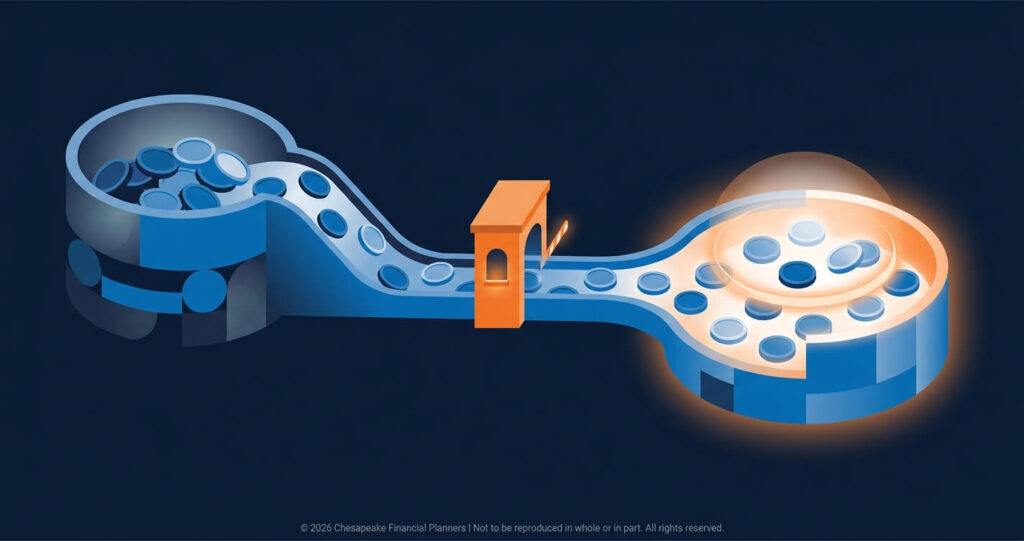
The conversion window is the stretch of years after you stop working but before required minimum distributions begin, and under current law RMDs start at age 73 for those born between 1951 and 1959. For someone who retires at 62, that can be more than a decade of years where their income is low enough to convert at a favorable rate.
These are often called the "gap years," and they are the most underused tax-planning real estate in a retirement plan. Wages have stopped. Social Security may be delayed. RMDs have not started. Taxable income drops, sometimes dramatically, and the lower brackets sit wide open. Every dollar you do not convert during those years is a dollar that may later be forced out at a higher rate once RMDs and Social Security arrive together.
The window has a hard edge on the back end. The SECURE 2.0 Act moved the RMD age to 73 now and 75 for those born in 1960 or later, which extends the planning runway for younger pre-retirees. Once RMDs begin, your baseline income jumps, and the room to convert cheaply shrinks or disappears.
How many years should you spread a conversion over?
You should generally spread conversions across as many gap years as you have, converting only enough each year to fill your target bracket without spilling into the next one. A pre-retiree with eight gap years and a $600,000 IRA might convert $75,000 to $90,000 a year rather than a single $600,000 conversion that would land in the top bracket. Spreading the income keeps each year's marginal rate low and avoids the income-threshold cliffs that punish lump-sum conversions.
In Jeff's experience with pre-retirees, the clients who win the conversion game are rarely the ones who convert the most. They are the ones who convert steadily, year after year, inside a disciplined bracket target.
How do you use the years between retirement and RMDs to reduce lifetime taxes?
[timeline graphic showing retirement at 62, Social Security delayed to 70, and RMDs starting at 73, alt text "roth conversion window timeline between retirement and RMDs"]
How Much Should You Convert Without a Tax Surprise?
You should convert only enough to fill your target tax bracket, stopping before the conversion income crosses into a higher bracket or trips an income-based threshold like IRMAA. The right number is rarely "all of it" and almost never zero. It is the precise amount that keeps each year's marginal rate at or below your expected retirement rate.
Start by projecting your taxable income for the year before any conversion. Subtract that from the top of your target bracket. The gap is your conversion headroom. If you are married filing jointly and your projected taxable income is $60,000, and the top of the 12% bracket sits at roughly $100,800 for 2026, you have meaningful room to convert at 12% before any of it touches the 22% bracket.
Here is how two common bracket targets compare for a married couple planning a conversion:
| Planning factor | Fill the 12% bracket | Fill the 22% bracket |
|---|---|---|
| Typical fit | Modest IRA balance, long gap-year runway | Large IRA balance, fewer gap years |
| Tax cost per dollar converted | Lower marginal cost now | Higher marginal cost now |
| IRMAA risk | Usually low | Moderate to high, watch thresholds |
| Best for | Slow, steady multi-year conversions | Accelerating conversions before RMDs hit |
| Risk of overconverting | Lower | Higher, the bracket is wide |
The tax bill itself should come from outside the retirement account whenever possible. If you pay the conversion tax with money pulled from the IRA, you shrink the amount that actually lands in the Roth and, if you are under 59½, you may owe a penalty on the withheld portion. Paying the tax from a taxable brokerage or savings account is what makes the conversion math work.
What income thresholds should you watch besides your tax bracket?
Beyond your federal bracket, watch the IRMAA thresholds that raise Medicare premiums, the Net Investment Income Tax threshold of $250,000 for joint filers, the taxation of Social Security benefits, and any state income tax brackets that apply. Conversion income counts toward all of these. A conversion that looks fine against your federal bracket can still trigger a Medicare surcharge or pull more of your Social Security into taxable territory, so the full picture matters before you commit.
How Do IRMAA and Medicare Premiums Change the Roth Conversion Math?
IRMAA, the Income-Related Monthly Adjustment Amount, raises your Medicare Part B and Part D premiums when your modified adjusted gross income crosses certain thresholds, and conversion income counts toward that MAGI. The catch that surprises people: IRMAA uses a two-year lookback, so a conversion you do at 63 can raise your Medicare premiums at 65. This is where a lot of otherwise-smart conversion plans go sideways.
IRMAA operates on cliffs, not ramps. Cross a threshold by a single dollar and the surcharge applies to the entire bracket, not just the dollar over. The standard 2026 Medicare Part B premium is the baseline, and the IRMAA surcharges stack on top of that for higher-income filers, adding up to several hundred dollars per month per person at the upper brackets. For a married couple, that surcharge applies to both spouses.
This two-year lookback is exactly why a "convert everything before RMDs" plan can backfire. A single large conversion in your early 60s might save you on future RMD taxes while simultaneously handing you two or three years of inflated Medicare premiums you never modeled. The fix is almost always to size each conversion against the IRMAA brackets, the same way you size it against your tax bracket.
Is it ever worth crossing an IRMAA bracket to convert more?
Yes, crossing an IRMAA bracket can be worth it when the long-term RMD tax savings clearly exceed the one or two years of higher Medicare premiums the conversion triggers. The surcharge is annual and temporary; the RMD tax reduction is permanent and compounds. A large conversion that saves $40,000 in future RMD taxes can be worth a few thousand dollars of IRMAA surcharge, but you have to run both numbers, not just the one you want to see.
Jeff puts it bluntly with clients: IRMAA is a real cost, but it is a knowable, finite cost. Do not let a few hundred dollars a month of Medicare surcharge scare you out of a conversion that saves five figures over your lifetime. Run the comparison, then decide.
How do Roth conversions affect IRMAA and Medicare Part B premiums?

[bar chart showing Medicare premium increases at each IRMAA income bracket, alt text "IRMAA brackets affecting roth conversion strategy and Medicare premiums"]
How Do RMDs Interact With a Roth Conversion Strategy?
Required minimum distributions are the forced, taxable withdrawals the IRS makes you take from pre-tax accounts starting at age 73, and a Roth conversion strategy is one of the few tools that can shrink them before they start. Roth IRAs have no RMDs during the owner's lifetime, so every dollar you convert is a dollar removed from your future RMD base. The earlier you start, the more of that base you can move at favorable rates.
The problem RMDs create is that they are not optional and they grow as a percentage of your account each year. A large pre-tax balance can generate RMDs big enough to push a retiree into a higher bracket, increase the taxable portion of Social Security, and trigger IRMAA all at once. Converting during the gap years is how you defuse that bomb before it goes off, by moving money out of the pre-tax bucket while you still control the timing.
The first-year RMD deadline allows a delay to April 1 of the year after you turn 73, but doing so stacks two RMDs into one tax year, which is usually a mistake. The interaction with conversions is direct: once RMDs begin, you must take the full RMD first, and you cannot convert an RMD. So any conversion you do after 73 sits on top of an already-elevated income floor.
Can you convert your RMD to a Roth?
No, you cannot convert a required minimum distribution to a Roth IRA. The IRS requires you to take the full RMD as a taxable distribution first, and only money above the RMD can be converted. This is the central reason conversions are far more efficient before age 73, when no RMD floor exists yet and you have full control over how much income to recognize. Once the RMD floor arrives, your conversion headroom shrinks by exactly that amount.
For charitably inclined retirees, a qualified charitable distribution can satisfy the RMD without adding to taxable income, which preserves more room for conversions. That is a coordination move worth planning years ahead.
How can a qualified charitable distribution lower my RMD and taxes?
How Do You Execute a Roth Conversion Step by Step?
Executing a Roth conversion is a straightforward administrative process once the tax planning is done, but the order of operations matters. The planning decides how much. The execution makes sure you do not lose money to avoidable mistakes like over-withholding or missing the holding-period rules.
The basic sequence looks like this:
- Project your full-year income before converting. Build a tax projection that includes wages, interest, dividends, capital gains, and any Social Security. This sets your conversion headroom.
- Set your target conversion amount. Decide which bracket and which income thresholds, including IRMAA, you are converting up to, then back into the dollar figure.
- Confirm you can pay the tax from outside the IRA. Earmark cash in a taxable account for the tax bill. Do not have it withheld from the conversion if you can avoid it.
- Initiate the conversion with your custodian. Move the chosen amount from the traditional IRA to the Roth IRA. Most custodians do this with a single online request or a form.
- Decide on tax payment method. Either make a quarterly estimated payment or have the right amount withheld from a separate source, so you do not face an underpayment penalty.
- Document the conversion for your tax return. The conversion generates a Form 1099-R, and you report it on Form 8606. Keep records of the five-year clock for the converted amount.
The most important holding rule: each conversion starts its own five-year clock for penalty-free access to the converted principal if you are under 59½. Earnings have their own rules. For most pre-retirees over 59½, the five-year conversion clock is a non-issue, but it is worth confirming with your custodian or advisor before you assume it.
Jeff's standard process with clients is to run the multi-year conversion projection in the fall, then execute in December once the year's actual income is nearly final. Converting late in the year removes the guesswork about how much headroom you really have.
Frequently Asked Questions
What is a Roth conversion in simple terms?
A Roth conversion moves money from a pre-tax retirement account, like a traditional IRA or old 401(k), into a Roth IRA. You pay ordinary income tax on the amount converted in that year, and in exchange the money grows tax-free and comes out tax-free in retirement. There is no income limit and no annual conversion cap.
Is there an income limit to do a Roth conversion?
No, there is no income limit on Roth conversions. Unlike direct Roth IRA contributions, which phase out at higher incomes, anyone at any income level can convert pre-tax retirement money to a Roth. This is why high earners often use conversions, and the backdoor Roth strategy, when their income is too high to contribute directly. The only practical limit is the tax cost.
When is the best time to do a Roth conversion?
The best time to do a Roth conversion is during a low-income year, most often the gap years after you retire but before Social Security and required minimum distributions begin at age 73. In those years your taxable income drops, lower tax brackets open up, and you can convert at a favorable rate. A market downturn can also create a good conversion opportunity because you convert more shares at a lower tax cost.
How does a Roth conversion affect my Medicare premiums?
A Roth conversion increases your modified adjusted gross income, which can push you over an IRMAA threshold and raise your Medicare Part B and Part D premiums. IRMAA uses a two-year lookback, so a conversion at age 63 can raise your premiums at 65. The surcharge applies to the whole bracket once you cross it, so sizing each conversion against the IRMAA thresholds is essential.
Can I undo a Roth conversion if I change my mind?
No, you cannot undo a Roth conversion. The ability to recharacterize, or reverse, a conversion was eliminated by the Tax Cuts and Jobs Act, so conversions are permanent once executed. This is exactly why the tax planning has to be right before you convert. Because there is no take-back, most advisors recommend converting late in the year when your actual income for the year is nearly final.
Do I have to pay the conversion tax from the IRA itself?
No, and you generally should not. Paying the conversion tax from outside the IRA, using a taxable brokerage or savings account, lets the full converted amount land in the Roth and keeps the strategy efficient. If you withhold the tax from the conversion and you are under 59½, the withheld portion can count as a taxable distribution subject to a 10% penalty. Cover the tax with non-retirement cash whenever possible.
How much should I convert each year?
You should convert only enough to fill your target tax bracket without crossing into a higher bracket or tripping an income threshold like IRMAA. For many pre-retirees that means converting a portion of the IRA each year over several gap years, rather than converting the whole balance at once. The right annual amount depends on your other income, your filing status, and how many low-income years you have before RMDs begin.
Does converting to a Roth reduce my future RMDs?
Yes, converting to a Roth reduces your future required minimum distributions because Roth IRAs have no RMDs during the owner's lifetime. Every dollar you move from a pre-tax account to a Roth is a dollar removed from the balance that future RMDs are calculated on. This is one of the main reasons pre-retirees with large pre-tax balances convert during their gap years, before RMDs start at age 73.
Where to Go From Here
A Roth conversion strategy is rarely a one-time decision; it is a multi-year tax project that touches your brackets, your Medicare premiums, your Social Security, and your future RMDs all at once. The clients who get the most out of it are the ones who model the whole picture before converting a single dollar, then revisit the plan every fall. At Chesapeake Financial Planners, we run multi-year conversion projections with pre-retirees and high earners every week. If you are weighing whether, when, and how much to convert, a second opinion on your roth conversion strategy costs you nothing. Visit chesapeakefp.com to learn more.
Want to go deeper? Our Roth Conversion Window walks through this step by step.
Prefer a different starting point? Our Tax Strategy Readiness Quiz is worth a look.
Disclosures
The information provided is for educational purposes only and should not be construed as investment advice. Investment strategies should be tailored to individual circumstances, risk tolerance, and goals. Past performance doesn't guarantee future results. Consult with qualified financial professionals regarding your specific situation.
Traditional IRA account owners have considerations to make before performing a Roth IRA conversion. These primarily include income tax consequences on the converted amount in the year of conversion, withdrawal limitations from a Roth IRA, and income limitations for future contributions to a Roth IRA. In addition, if you are required to take a required minimum distribution (RMD) in the year you convert, you must do so before converting to a Roth IRA.
A Roth IRA offers tax deferral on any earnings in the account. Qualified withdrawals of earnings from the account are tax-free. Withdrawals of earnings prior to age 59 ½ or prior to the account being opened for 5 years, whichever is later, may result in a 10% IRS penalty tax. Limitations and restrictions may apply.
Advisors associated with Chesapeake Financial Planners may be either (1) LPL Financial Registered Representatives offering securities through LPL Financial, Member FINRA and SIPC, and investment advisor representatives offering investment advice through Great Valley Advisor Group; or (2) solely investment advisor representatives offering investment advice through Great Valley Advisor Group and not affiliated with LPL Financial. Great Valley Advisor Group, and Chesapeake Financial Planners are separate entities from LPL Financial.


