

What Financial Steps Should I Handle After the Death of My Spouse?
Last reviewed: July 2026
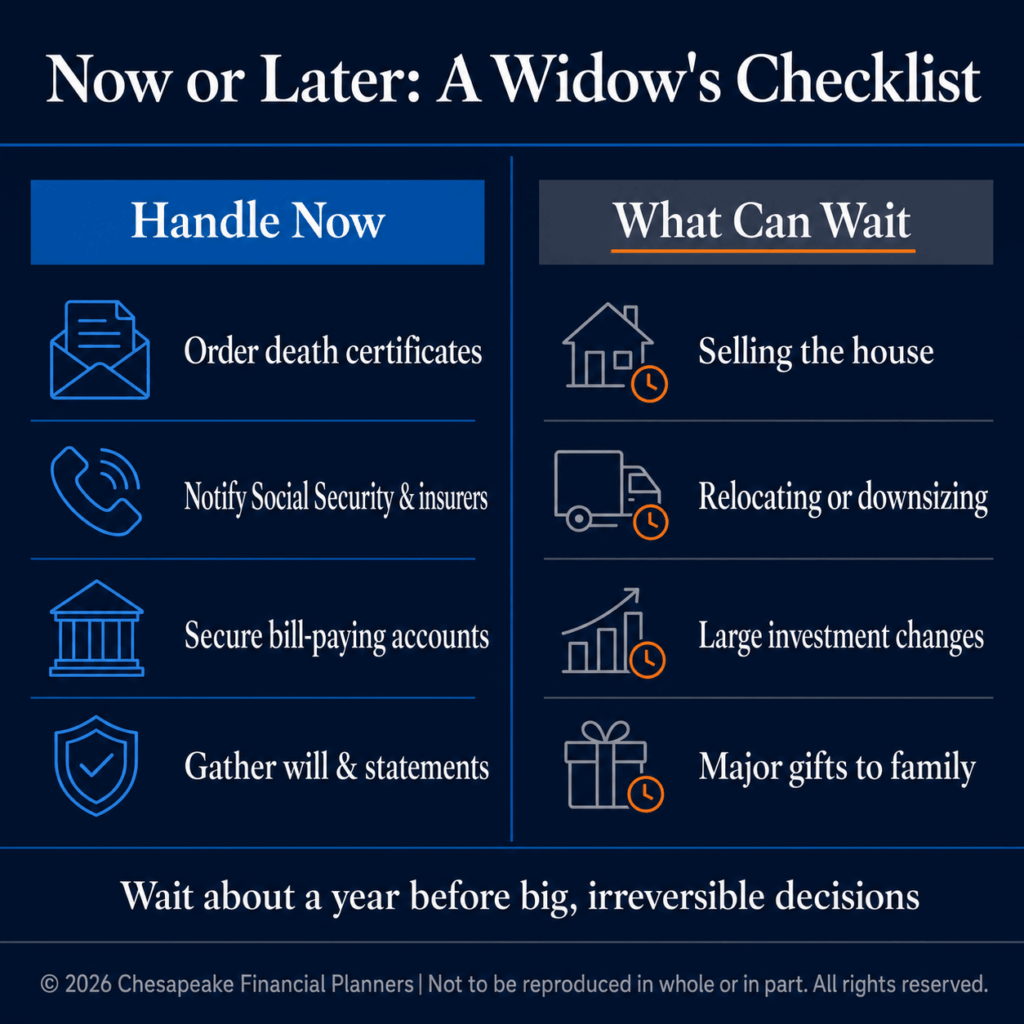
After the death of a spouse, handle the urgent items first: secure cash flow, notify Social Security, locate the will and account statements, and order at least ten certified death certificates. Then deliberately pause. Most large, irreversible financial decisions should wait six to twelve months. This financial checklist after death of spouse separates what truly needs your attention now from what can wait until grief loosens its grip and your thinking clears.
Key Takeaways
- Order ten to fifteen certified death certificates early; nearly every institution requires an original, not a copy.
- Survivor Social Security benefits can equal up to 100% of the deceased spouse's benefit, per the SSA.
- Wait six to twelve months before major decisions like selling the home or moving investments.
- A surviving spouse can roll an inherited IRA into their own IRA, preserving tax-deferred growth.
- Notify Social Security promptly; the agency does not pay survivor benefits for months you fail to claim.
About the Author: Jeff Judge, CFP®, AEP®, ChFC®, CLU® is Managing Partner of Chesapeake Financial Planners in Forest Hill, Maryland. He has been helping families and business owners in Harford County and the Baltimore metro area navigate the financial aftermath of losing a spouse since earning his CFP® certification in 2013, by using Chesapeake Financial Planners’ signature process, the R.U.D.D.E.R. method™. Jeff has watched too many newly widowed clients make a permanent decision in their first grieving month that they regretted within the year. Slowing down is almost always the right call.
Losing a spouse is one of the hardest things a person goes through. The last thing you need is a stack of financial tasks competing for what little energy you have left. So this guide does two things. It tells you the short list of things that genuinely cannot wait, and it gives you permission to ignore everything else for now.
Step 1: How Do I Handle the First Two Weeks After Losing a Spouse?
Focus only on what protects your immediate cash flow and legal standing. Start by ordering certified death certificates from the funeral home or your state vital records office. You will need an original for each account, insurance claim, and government agency, so order ten to fifteen. Photocopies almost never work.
Next, locate the essential documents: the will, any trust, recent bank and investment statements, life insurance policies, and the deed to your home. Do not try to organize everything. Just find what proves ownership and what pays bills.
If your spouse handled the household finances, make a simple list of every bill that comes due in the next 30 days and confirm you can access the accounts that pay them. Widow finances unravel fastest when an automatic payment fails because an account was frozen or a login was lost.
One thing you do not have to do this week: read every policy, calculate your full net worth, or decide anything about the future. Survival mode is allowed.
Step 2: Who Do I Need to Notify, and When?
Notify the right institutions in order of urgency, starting with Social Security. The funeral home often reports the death to the Social Security Administration, but confirm it yourself, because survivor benefits do not start until you apply. A surviving spouse may qualify for survivor benefits worth up to 100% of the deceased's benefit if claimed at full retirement age.
After Social Security, contact:
- Life insurance companies to begin claims. Most pay within 30 to 60 days once they receive a death certificate.
- Employer or former employer for pension survivor benefits, unpaid wages, and any group life coverage.
- Banks, credit card companies, and lenders to update account titling and stop fraud risk on the deceased's individual accounts.
- The three credit bureaus to flag the file as deceased and prevent identity theft, which spikes after a death.
Keep a notebook of every call: the date, the representative's name, and what they told you. You will repeat these conversations more than once, and a paper trail saves hours later.
Step 3: How Do I Retitle Accounts and Claim What I'm Owed?
Retitling accounts means moving ownership from your spouse's name into yours, and the process depends on how each asset was held. Jointly owned accounts and assets with a beneficiary or transfer-on-death designation usually pass to you directly with a death certificate, no probate required. Assets in your spouse's name alone, with no beneficiary, typically go through probate.
For retirement accounts, you have a powerful option. As a surviving spouse, you can roll an inherited IRA or 401(k) into your own IRA, treating it as if it were always yours. This preserves tax-deferred growth and lets you use your own required minimum distribution timeline rather than a faster inherited-account schedule. This is one of the few decisions worth getting right early, because the rollover choice affects taxes for decades.
When it comes to survivor benefits, claim everything you are entitled to: Social Security survivor benefits, pension survivor options, life insurance proceeds, and any veterans benefits if your spouse served. The Department of Veterans Affairs offers Dependency and Indemnity Compensation to eligible surviving spouses.
A practice note from years of doing this work: Jeff Judge tells clients to never combine an inherited IRA with their own IRA before confirming the rollover rules with an advisor. One wrong move can accelerate a tax bill you never needed to pay.
Step 4: What Decisions Should I Deliberately Wait On?
Postpone every large, irreversible decision for six to twelve months. This is the single most valuable piece of advice in this entire guide. Grief impairs judgment in measurable ways, and the financial industry knows it. You will get sales calls. You will feel pressure to "do something" with the insurance money or the house.
Resist it. Specifically, wait on:
- Selling the family home. A sale you regret cannot be undone, and the emotional weight of the house often shifts after the first year.
- Moving investments or buying annuities. A locked-in product purchased in month two may not fit the life you actually build.
- Giving large gifts to children or grandchildren. Generosity feels healing, but you need to know your own long-term picture first.
- Major lifestyle changes like moving across the country to be near family.
Park insurance proceeds in a high-yield savings account or money market fund where they are safe and liquid. You lose almost nothing by waiting, and you protect yourself from decisions made in fog. As FINRA notes, taking time before making major financial moves after a loss is one of the most protective steps a survivor can take.

Step 5: How Do I Rebuild a Financial Plan as a Single Person?
Rebuild your plan only after the urgent tasks are done and the early grief has eased, usually around the one-year mark. Your financial life has changed in ways that go beyond losing a person. Your tax filing status changes. Your income may drop. Your Social Security strategy is now built around one benefit, not two.
This is where the R.U.D.D.E.R. Method™ helps create order. The R.U.D.D.E.R. Method™ is Chesapeake Financial Planners' six-step planning process: Review and Recognize, Uncover and Understand, Design and Develop, Discuss and Decide, Execute and Empower, and Reassess and Refine. For a new widow or widower, it starts with simply recognizing the new reality before designing anything around it.
Three things change for nearly everyone in your situation. First, you will likely file as a single taxpayer beginning the year after the death, which often means a higher effective tax rate on the same income, sometimes called the "widow's penalty." Second, you should update every beneficiary designation, since your spouse is likely named on accounts, insurance, and your own will. Third, you need a fresh estate plan, because the documents you built as a couple no longer match your life. Jeff Judge notes: "The widow's penalty is real — filing single on the same income you had as a couple often means a noticeably higher tax rate, and if we don't plan around that shift, you can lose thousands a year without ever seeing it happen."
You do not have to do this alone, and you do not have to do it on a deadline. The goal of this stage is clarity, not speed.
Frequently Asked Questions
How many death certificates should I order after my spouse dies?
Order ten to fifteen certified death certificates. Nearly every bank, insurer, retirement plan, and government agency requires an original certified copy, not a photocopy, to process a claim or retitle an account. Ordering extras upfront is far cheaper and faster than requesting more later, when grief and paperwork have already piled up.
How much will I receive in Social Security survivor benefits?
A surviving spouse can receive up to 100% of the deceased spouse's benefit if you claim at your full retirement age, according to the Social Security Administration. The exact amount depends on your age when you claim, your own work record, and whether you were already receiving benefits. Contact Social Security directly, because survivor benefits are not paid automatically.
Should I sell my house after my spouse passes away?
Wait six to twelve months before deciding whether to sell your home. A home sale is irreversible, and the emotional and financial weight of the house often changes after the first year of grief. Unless the mortgage is genuinely unaffordable, give yourself time. Decisions made in the early months of loss are frequently regretted later.
What happens to my spouse's retirement accounts when they die?
As a surviving spouse, you can roll your deceased spouse's IRA or 401(k) into your own IRA, treating it as if it had always been yours. This preserves tax-deferred growth and lets you use your own required minimum distribution timeline. This rollover decision affects taxes for years, so confirm the rules with an advisor before moving any funds.
Do I need to update my will and beneficiaries after losing my spouse?
Yes, update your will, trust, and every beneficiary designation as soon as you have the energy. Your spouse is almost certainly named on your accounts, insurance policies, and estate documents. Leaving those designations unchanged can send assets to the wrong place or trigger probate delays. This is a key step, though it can wait until the urgent first-month tasks are complete.
Where to Start
The most powerful financial move you can make right now is the one that feels least productive: slow down. Handle the short list of urgent items, claim the survivor benefits you are owed, and then give yourself permission to wait on everything else. The financial checklist after death of spouse is shorter in its urgent column than most people fear.
If this guide helped, our free Widowhood Financial First-Year Guide walks through each of these steps in greater depth, with checklists you can work through at your own pace. Download it at chesapeakefp.com.
What financial steps should a surviving spouse take in the first year after loss?
What Financial Steps Should I Take After Losing My Spouse?
How do I stay financially strong after a major life change?
Can a financial planner help me navigate a major life transition?
Want to go deeper? Our What To Do When You Lose a Loved One walks through this step by step.
Disclosures
The information provided is for educational purposes only and should not be construed as investment advice. Investment strategies should be tailored to individual circumstances, risk tolerance, and goals. Past performance doesn't guarantee future results. Consult with qualified financial professionals regarding your specific situation.
Advisors associated with Chesapeake Financial Planners may be either (1) LPL Financial Registered Representatives offering securities through LPL Financial, Member FINRA and SIPC, and investment advisor representatives offering investment advice through Great Valley Advisor Group; or (2) solely investment advisor representatives offering investment advice through Great Valley Advisor Group and not affiliated with LPL Financial. Great Valley Advisor Group, and Chesapeake Financial Planners are separate entities from LPL Financial.


