

Where Should I Keep My Cash: High-Yield Savings, Money Market, or CDs?
Last reviewed: July 2026
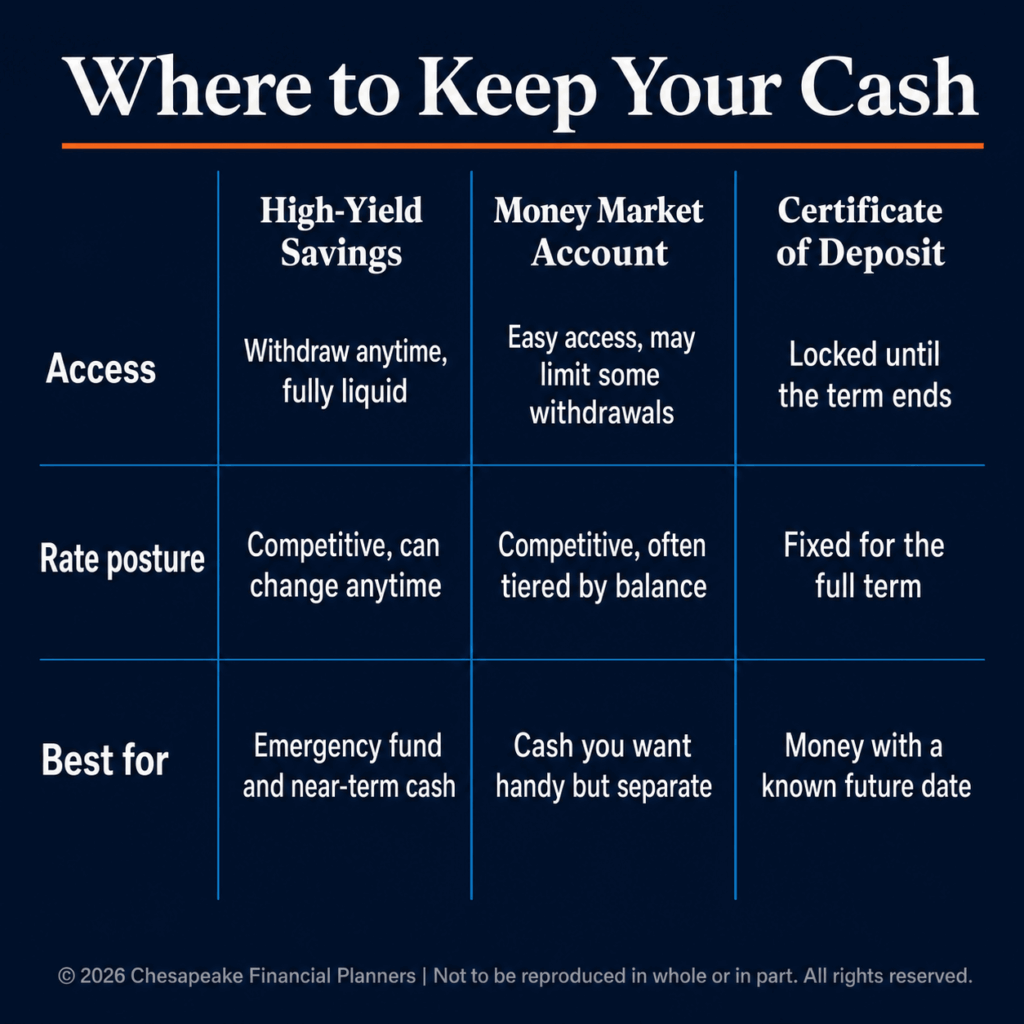
Where to keep cash savings comes down to three main options: a high-yield savings account for money you might need anytime, a money market account for a blend of access and slightly higher yield, and a certificate of deposit (CD) for money you can lock away for a set term. The right choice depends on one question: when will you need the money? Cash you might touch next month belongs somewhere liquid. Cash you won't need for a year can earn more in a CD.
Key Takeaways
- High-yield savings accounts give you full access to your cash while paying far more than the FDIC national savings average of 0.40% as of 2026.
- Money market accounts often pair check-writing with competitive yields, but watch for minimum balance requirements.
- CDs reward you for locking money away, though early withdrawal usually costs you several months of interest.
- All three are protected up to $250,000 per depositor, per bank, by FDIC insurance.
About the Author: Jeff Judge, CFP®, AEP®, ChFC®, CLU® is Managing Partner of Chesapeake Financial Planners in Forest Hill, Maryland. He has been helping families and business owners in Harford County and the Baltimore metro area navigate cash management and savings decisions since earning his CFP® certification in 2013, by using Chesapeake Financial Planners’ signature process, the R.U.D.D.E.R. method™. Jeff often tells clients the biggest cash mistake isn't picking the wrong account, it's leaving too much sitting in a checking account earning nothing.
What Is a High-Yield Savings Account and When Should You Use It?
A high-yield savings account is a deposit account that pays a much higher interest rate than a standard savings account while keeping your money fully accessible. You can move funds in and out, usually within a day or two, without locking up a single dollar.
The appeal is liquidity. Your emergency fund, a down payment you're saving for, or cash you might need on short notice all belong here. As of 2026, the FDIC reports a national average savings rate of just 0.40%, yet competitive high-yield accounts pay multiples of that. The gap between an average account and a competitive one can mean hundreds of dollars a year on a meaningful balance.
Jeff Judge has watched clients leave five figures in a checking account paying nothing for years, simply because moving it felt like a chore. That inertia is expensive. The fix takes an afternoon.
The tradeoff: rates on these accounts are variable. The bank can lower your rate whenever it wants. You get flexibility, not a guarantee.
As of 2026, the FDIC reports a national average savings rate of just 0.40%, while competitive high-yield accounts pay multiples of that — a gap that can add up to hundreds of dollars a year on a meaningful balance.
How Much Should I Have in My Emergency Fund?
How Does a Money Market Account Differ From Savings?
A money market account is a deposit account that combines features of savings and checking, often offering check-writing privileges or a debit card alongside a competitive interest rate. It sits in the middle of the cash spectrum.
Functionally, money market accounts and high-yield savings accounts overlap heavily today. Both are liquid, both are insured, and both pay variable rates. The historical distinction was that money market accounts let you write a limited number of checks each month, which made them handy for larger, occasional expenses like a tax payment or a contractor invoice. Jeff Judge notes: "Before you chase the name 'money market,' pull up the actual APY and compare it to a high-yield savings account, because the label tells you almost nothing about what you'll actually earn."
Watch two things. First, many money market accounts carry minimum balance requirements, and dropping below the threshold can trigger fees or a lower rate. Second, the yield isn't automatically higher than a good high-yield savings account. Compare the actual annual percentage yield, not the account name.
Don't confuse a money market account with a money market fund. The account is a bank deposit covered by FDIC insurance. The fund is an investment product sold by brokerages and is not FDIC-insured, though it carries different protections.
When Does a CD Make Sense and How Do CD Ladders Work?
A certificate of deposit is a deposit account where you agree to leave your money untouched for a fixed term, anywhere from three months to five years, in exchange for a locked-in interest rate. The longer the term, the higher the rate tends to be.
CDs make sense for money you're confident you won't need before the term ends. A known expense 18 months out, like a planned home renovation or a tuition bill, fits well. The locked rate also protects you if rates fall, since your yield is fixed for the whole term.
The catch is the early withdrawal penalty. Pull your money out before maturity and most banks charge several months of interest. According to Consumer Financial Protection Bureau guidance, that penalty is set by the bank and disclosed when you open the account, so read the terms before you commit.
What Is a CD Ladder?
A CD ladder is a strategy where you split your cash across several CDs with staggered maturity dates so that a portion comes due at regular intervals. Instead of putting $20,000 into one five-year CD, you might open five CDs maturing one year apart. As each matures, you either spend it or reinvest into a new long-term CD. The result: you capture longer-term rates while keeping a slice of your money becoming available every year. Jeff uses laddering with clients who want CD yields without surrendering all their access at once.
How Do These Three Options Compare?
| Feature | High-Yield Savings | Money Market | CD |
|---|---|---|---|
| Liquidity | Full access anytime | Full access, often with checks | Locked until maturity |
| Rate type | Variable | Variable | Fixed |
| Early withdrawal penalty | None | None | Yes, typically months of interest |
| Best for | Emergency fund, short-term cash | Larger occasional expenses | Known expenses 6+ months out |
| FDIC insured | Yes, to $250,000 | Yes, to $250,000 | Yes, to $250,000 |
The honest answer is that most people use more than one. A high-yield savings account holds the emergency fund and everyday cash. A CD or short CD ladder holds money earmarked for a goal with a date attached. Money market accounts fill the gap when check-writing matters.
A quick note on safety: deposits at banks are protected by FDIC insurance up to $250,000 per depositor, per bank. At a credit union, the equivalent coverage comes from the NCUA at the same $250,000 limit. If your cash exceeds that figure at a single institution, spread it across more than one bank to stay fully covered.
What are the fundamentals of personal financial planning?
What is the best way to pay off debt quickly?
Frequently Asked Questions
Is a high-yield savings account safe?
Yes, a high-yield savings account is safe when held at an FDIC-insured bank or NCUA-insured credit union, which protects your deposits up to $250,000 per depositor, per institution. The "high-yield" label refers only to the interest rate, not added risk. Your principal does not fluctuate the way an investment does.
How much cash should I keep in savings versus a CD?
Keep enough in liquid savings to cover three to six months of essential expenses plus any cash you might need soon, then consider CDs only for money you're confident you won't touch before maturity. Locking up your emergency fund in a CD defeats its purpose, since you'd face a penalty exactly when you need the cash most.
Can you lose money in a money market account?
No, you cannot lose your principal in a money market account at an insured bank, because it is a deposit covered by FDIC insurance up to $250,000. This differs from a money market fund, which is an investment product sold by brokerages and is not FDIC-insured. Always confirm which product you actually hold before assuming it carries deposit insurance.
What happens if I withdraw from a CD early?
If you withdraw from a CD before its maturity date, the bank charges an early withdrawal penalty, usually equal to several months of interest as disclosed when you opened the account. On shorter CDs the penalty may be smaller, but it can still erase most of your earned interest. Read the penalty terms before committing money you might need.
Are CD rates fixed or variable?
CD rates are fixed for the entire term, which means your yield is locked in the day you open the account and won't change even if market rates move. This is the opposite of high-yield savings and money market accounts, where rates are variable and the bank can adjust them at any time. The fixed rate is what makes CDs useful when you want certainty.
Where to Go From Here
The right home for your cash isn't about chasing the single highest rate, it's about matching each dollar to when you'll need it. Sort your cash by timeline first, then pick the account. If you'd like a clearer picture of how much belongs in each bucket, our guide to building an emergency fund walks through the math step by step. Download it at chesapeakefp.com.
Want to go deeper? Our Why Financial Advice Isn’t Just for Retirees walks through this step by step.
Disclosures
The information provided is for educational purposes only and should not be construed as investment advice. Investment strategies should be tailored to individual circumstances, risk tolerance, and goals. Past performance doesn't guarantee future results. Consult with qualified financial professionals regarding your specific situation.
Forward Dividend Yield is calculated as consensus analyst estimates of dividends for the next 12 months divided by price.
Market Linked CDs (MLCDs) have various risks, including liquidity, market, and interest rate /yield risk, and may not be suitable for every investor.
CDs are FDIC insured to specific limits and offer a fixed rate of return if held to maturity, whereas investing in securities is subject to market risk including loss of principal.
Certificates of Deposit are FDIC insured and offer a fixed rate of return if held to maturity. Brokered CDs sold prior to maturity in the secondary market may result in loss of principal due to fluctuations in the interest rate or lack of liquidity. Brokered CDs are registered with the Depository Trust Corp. (DTC). Brokered CDs with step-down and/or call provisions may be less favorable than traditional CDs without these features.
Advisors associated with Chesapeake Financial Planners may be either (1) LPL Financial Registered Representatives offering securities through LPL Financial, Member FINRA and SIPC, and investment advisor representatives offering investment advice through Great Valley Advisor Group; or (2) solely investment advisor representatives offering investment advice through Great Valley Advisor Group and not affiliated with LPL Financial. Great Valley Advisor Group, and Chesapeake Financial Planners are separate entities from LPL Financial.


