
How Do I Freeze My Credit, and Should I?
Last reviewed: July 2026
To freeze your credit, contact each of the three major credit bureaus (Equifax, Experian, and TransUnion) and request a security freeze. It is free, takes about 15 minutes total, and blocks anyone from opening new credit in your name until you lift it. Yes, you should freeze your credit, especially if you are retired or nearing retirement, because a frozen file is the single most effective barrier against new-account identity theft. This guide on how to freeze credit walks you through each bureau, the information you need, and when to thaw it.
Key Takeaways
- A credit freeze is free at all three bureaus and stops new accounts from being opened in your name.
- The FTC reported roughly 1.1 million identity theft cases in 2024, the latest full-year federal data.
- Freezing does not hurt your credit score and does not stop you from using existing cards.
- You can lift a freeze temporarily in minutes online when you need to apply for credit.
- Retirees are prime targets because they often have strong credit and check it less often.
About the Author: Jeff Judge, CFP®, AEP®, ChFC®, CLU® is Managing Partner of Chesapeake Financial Planners in Forest Hill, Maryland. He has been helping families and business owners in Harford County and the Baltimore metro area protect their financial security since earning his CFP® certification in 2013, by using Chesapeake Financial Planners’ signature process, the R.U.D.D.E.R. method™. Jeff has watched a single stolen Social Security number turn into months of cleanup for clients who thought it would never happen to them. A credit freeze is one of the cheapest, fastest protections he recommends, and almost nobody does it until after the damage is done.
What Is a Credit Freeze and How Does It Work?
A credit freeze, sometimes called a security freeze, is a restriction you place on your credit file that prevents lenders from accessing it. When a thief tries to open a new credit card, loan, or account in your name, the lender pulls your credit report first. If your file is frozen, the lender can't see it, so the application gets denied. No access, no new account.
A freeze is different from a fraud alert. A fraud alert asks lenders to verify your identity before extending credit but doesn't block access. A freeze locks the door entirely. According to the FTC, a security freeze became free nationwide in 2018, so there is no longer any cost to either freezing or thawing your file.
The freeze stays in place until you lift it. It does not affect your credit score, your existing accounts, or your ability to use the cards already in your wallet. It only blocks new credit pulls.
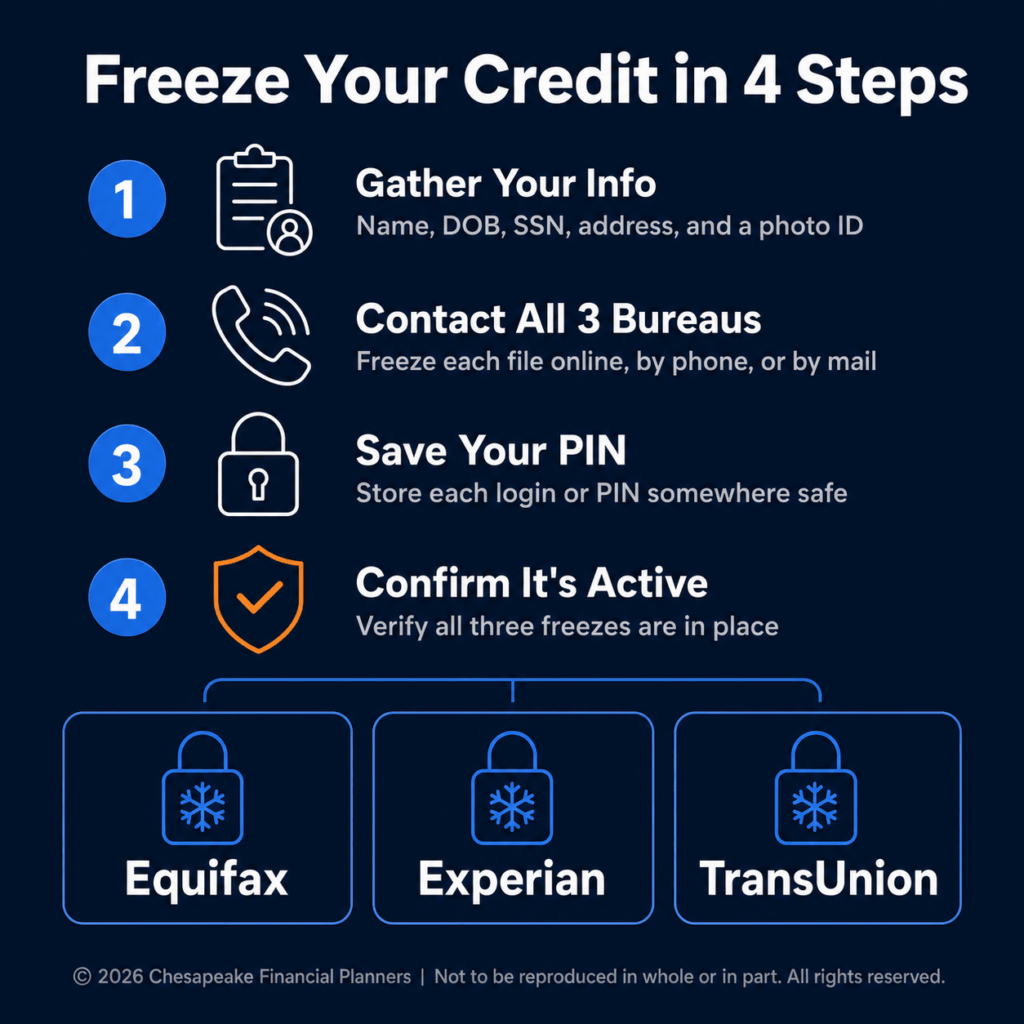
How to Freeze Your Credit in 4 Steps
Here is the exact process. You will repeat it three times, once for each bureau. Set aside about 15 minutes.
- Gather your information. You need your full name, date of birth, Social Security number, current and recent addresses, and often a copy of a government ID and a utility bill. Have these ready before you start.
- Contact each of the three bureaus. Freeze your file separately at Equifax, Experian, and TransUnion. You can do all three online, by phone, or by mail. Online is fastest.
- Create a secure account and save your PIN. Each bureau gives you a PIN or lets you set login credentials. Store these somewhere safe and permanent. You will need them every time you lift or replace the freeze. Losing a PIN means extra verification steps later.
- Confirm all three freezes are active. A freeze at one bureau does not freeze the other two. Thieves only need one unfrozen file to do damage, so confirm each one is locked before you stop.
That is the entire process. Jeff Judge tells clients to schedule it like a chore, block 20 minutes on a Saturday morning, freeze all three, and write the PINs in the same place they keep their estate documents.
When Should You Thaw a Frozen Credit File?
You thaw, or temporarily lift, a freeze any time a legitimate lender needs to check your credit. That includes applying for a mortgage, a car loan, a new credit card, a cell phone contract, or sometimes a rental application or new insurance policy.
Thawing is fast. You log into the bureau, lift the freeze either permanently or for a set window (a few days or for a specific creditor), then refreeze when you're done. The whole process takes minutes online. If you know a car dealer pulls from Experian, you can lift only that bureau for a short window rather than opening all three.
For most retirees, new credit applications are rare, which is exactly why a freeze works so well for this group. You set it once and largely forget it. The R.U.D.D.E.R. Method™ is Chesapeake Financial Planners' six-step planning process: Review and Recognize, Uncover and Understand, Design and Develop, Discuss and Decide, Execute and Empower, and Reassess and Refine. A credit freeze fits squarely in the Execute and Empower step of a broader risk-management plan. Jeff Judge notes: "For retirees who rarely open new credit, a freeze is one of the simplest, highest-impact protective steps they can take — you spend about ten minutes setting it up across all three bureaus and then it works quietly in the background from that point on."
Why Every Retiree Should Freeze Their Credit
Retirees are favorite targets for identity thieves. They typically have established, high-quality credit and substantial assets, and they often check their credit reports less frequently than working adults who apply for credit regularly. According to the FTC's Consumer Sentinel data, older adults reported some of the highest median fraud losses of any age group in 2024.
The math here is simple. A freeze costs nothing and takes 15 minutes. Cleaning up new-account identity theft can take months of disputes, police reports, and affidavits. Jeff has seen clients spend the better part of a year untangling fraudulent accounts that a free freeze would have stopped cold.
Freezing your credit also pairs well with other protections, like monitoring your accounts and setting up an emergency fund so a fraud event doesn't force a rushed financial decision. If you're coordinating your overall risk picture as part of Should I update my financial plan after a big life event?, a credit freeze belongs on that checklist. It also fits naturally alongside the broader work of Why Does a Financial Planning Process Matter More Than Investment Selection? and protecting the income you've built through your What is the best order to withdraw from my 401k, Roth IRA, and taxable accounts in retirement?.
Frequently Asked Questions
Does freezing my credit hurt my credit score?
No, freezing your credit does not hurt your credit score at all. A security freeze simply restricts who can access your credit file. It has no effect on your score, your existing accounts, or your payment history. Your score stays exactly where it was before the freeze went into place.
Is it free to freeze and unfreeze my credit?
Yes, freezing and unfreezing your credit is completely free at all three bureaus. Federal law made security freezes free nationwide in 2018. There is no cost to place a freeze, lift it temporarily, or remove it permanently, and the bureaus cannot charge you for any of these actions.
Do I have to freeze my credit at all three bureaus?
Yes, you should freeze your credit at Equifax, Experian, and TransUnion separately. A freeze at one bureau does not protect the other two. Because lenders may pull from any of the three, a thief only needs one unfrozen file to open a fraudulent account in your name.
Can I still use my existing credit cards if my credit is frozen?
Yes, you can keep using all your existing credit cards and accounts while your credit is frozen. A freeze only blocks new credit applications. It does not affect cards, loans, or accounts you already have open, and your everyday spending and bill payments continue normally.
How long does a credit freeze last?
A credit freeze lasts indefinitely until you choose to lift or remove it. There is no expiration date. You can leave it in place for years, which is exactly what makes it a strong fit for retirees who rarely apply for new credit and want a set-it-and-forget-it protection.
What's the difference between a credit freeze and a fraud alert?
A credit freeze blocks lenders from accessing your credit file entirely, while a fraud alert only asks lenders to verify your identity before extending credit. A freeze is the stronger protection because it stops new accounts from being opened rather than just adding a verification step.
If you found this helpful, our guide to building a complete financial protection plan covers identity theft, insurance, and emergency reserves in depth. Download it at chesapeakefp.com to put a full safety net around the retirement you've worked for.
Disclosures
The information provided is for educational purposes only and should not be construed as investment advice. Investment strategies should be tailored to individual circumstances, risk tolerance, and goals. Past performance doesn't guarantee future results. Consult with qualified financial professionals regarding your specific situation.
Advisors associated with Chesapeake Financial Planners may be either (1) LPL Financial Registered Representatives offering securities through LPL Financial, Member FINRA and SIPC, and investment advisor representatives offering investment advice through Great Valley Advisor Group; or (2) solely investment advisor representatives offering investment advice through Great Valley Advisor Group and not affiliated with LPL Financial. Great Valley Advisor Group, and Chesapeake Financial Planners are separate entities from LPL Financial.


