
What Is Actually Coming Out of My Paycheck?
Last reviewed: July 2026
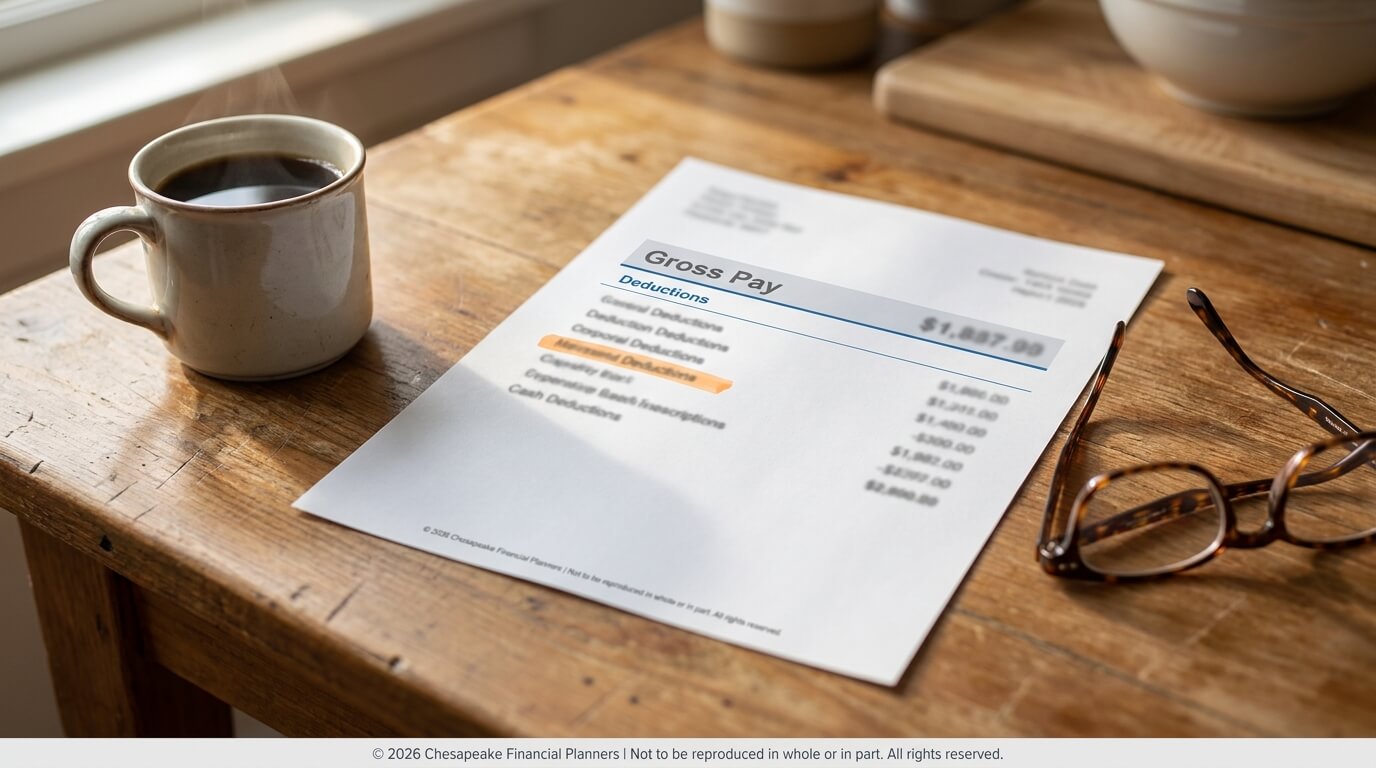
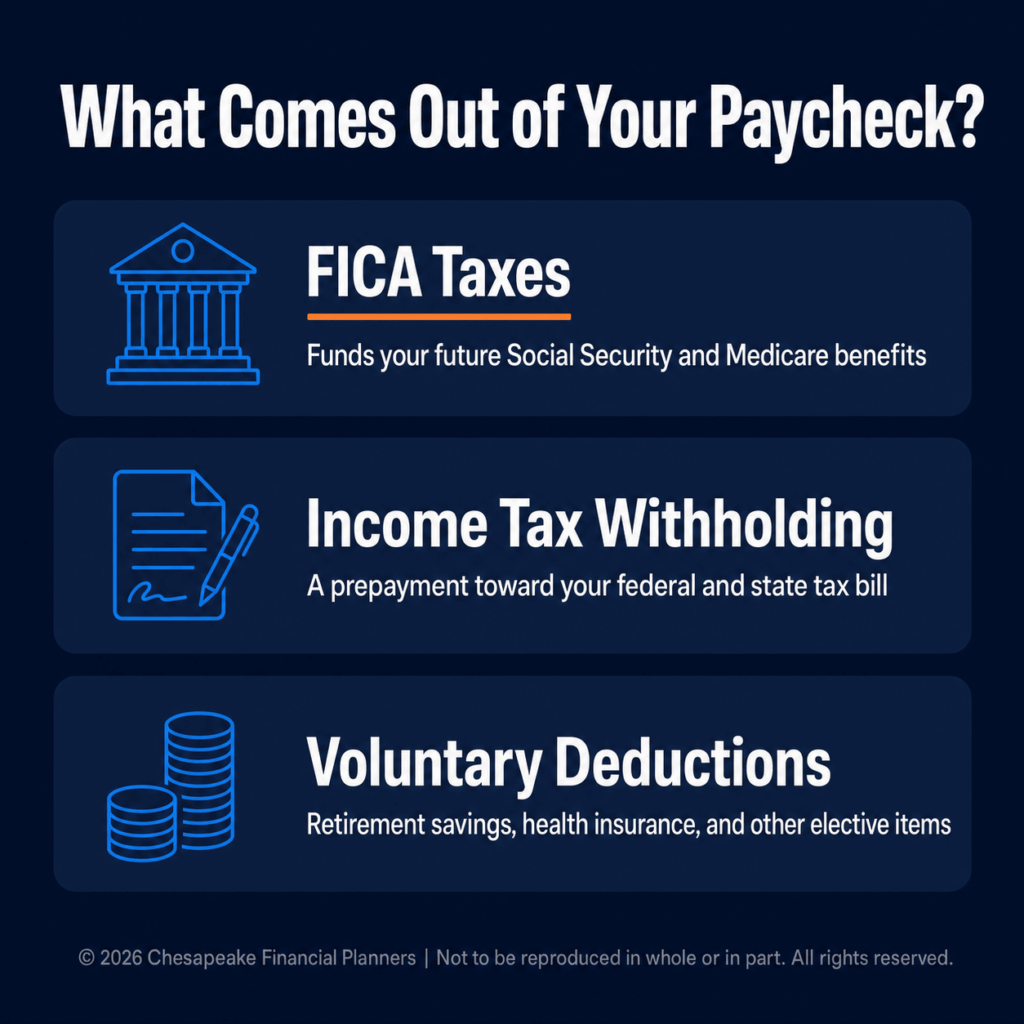
Your paycheck shrinks between gross and net pay because of three things: FICA taxes, income tax withholding, and voluntary deductions like health insurance and retirement contributions. FICA is the biggest mandatory bite for most workers, and understanding what is FICA helps you read your pay stub and plan for retirement. The short version: FICA funds Social Security and Medicare, withholding prepays your income taxes, and deductions cover the benefits you signed up for.
Key Takeaways
- FICA combines a 6.2% Social Security tax and a 1.45% Medicare tax, totaling 7.65% of most paychecks in 2026.
- Social Security tax in 2026 applies only to wages up to the $184,500 wage base, after which it stops.
- Income tax withholding is a prepayment, not a separate tax, and your W-4 controls how much comes out.
- Pre-tax deductions for 401(k) and health premiums lower your taxable income, shrinking your withholding too.
About the Author: Jeff Judge, CFP®, AEP®, ChFC®, CLU® is Managing Partner of Chesapeake Financial Planners in Forest Hill, Maryland. Jeff sees the same thing constantly: people who track their gross salary closely but have no idea why their take-home pay is a fifth smaller, which makes it nearly impossible to budget or plan a retirement claiming strategy. He has been helping families and business owners in Harford County and the Baltimore metro area understand payroll deductions and optimize their take-home pay since earning his CFP® certification in 2013, by using Chesapeake Financial Planners’ signature process, the R.U.D.D.E.R. method™.
What Is FICA and Why Is It on My Pay Stub?
FICA stands for the Federal Insurance Contributions Act, the law that funds Social Security and Medicare through payroll taxes. On your pay stub, FICA usually appears as two separate lines: one for Social Security (sometimes labeled OASDI) and one for Medicare. Together they make up the single largest mandatory deduction for most working Americans.
The total FICA rate for employees is 7.65% of your wages. According to the Social Security Administration, that breaks down into 6.2% for Social Security and 1.45% for Medicare. Your employer matches every dollar you pay, so the government actually collects 15.3% on your wages in total. If you are self-employed, you pay both halves yourself through self-employment tax.
Here is something Jeff Judge tells clients who are years from retirement: the FICA you pay now directly builds your future Social Security benefit. The Social Security Administration calculates your benefit from your 35 highest-earning years, so every paycheck deduction is buying a piece of your retirement income. That reframes payroll taxes from a loss into a contribution.
How Much Social Security and Medicare Tax Do I Pay?
You pay 6.2% in Social Security tax on your wages, but only up to an annual limit called the wage base. For 2026, the Social Security Administration set the wage base at $184,500. Once your year-to-date earnings cross that number, the Social Security portion of FICA stops for the rest of the year. High earners often notice their paycheck gets slightly bigger in the fall for exactly this reason.
Medicare tax works differently. The 1.45% Medicare tax has no wage cap, so it applies to every dollar you earn. On top of that, the IRS applies an Additional Medicare Tax of 0.9% on wages above $200,000 for single filers and $250,000 for married couples filing jointly. That extra tax is the worker's responsibility only; employers do not match it.
For a worker earning $60,000 a year, FICA takes roughly $4,590 annually, split between Social Security and Medicare. That is money you will never see in your checking account, but it is the foundation of your eventual benefit.
What Is Income Tax Withholding and How Is It Different?
Income tax withholding is your employer prepaying your federal and state income taxes from each paycheck on your behalf. Unlike FICA, withholding is not a separate tax. It is an estimate of what you will owe at year-end, collected in installments so you do not face a giant bill every April.
The amount withheld depends on the W-4 form you filled out when hired. Your filing status, dependents, and any extra withholding you requested all feed into the calculation. The IRS offers a free Tax Withholding Estimator that helps you check whether you are having the right amount taken out. Withhold too little and you owe in April; withhold too much and you give the government an interest-free loan all year.
Many states, including Maryland, also withhold state income tax. A handful of states have no income tax at all, which changes the math on this line of your pay stub depending on where you live.
How Does Social Security Work for Retirement Benefits?
What Other Deductions Reduce My Take-Home Pay?
Beyond FICA and withholding, voluntary deductions cover the benefits you elected. The most common are health insurance premiums, 401(k) or 403(b) retirement contributions, health savings account (HSA) deposits, and flexible spending account (FSA) contributions. These come out before you ever see the money.
Many of these are pre-tax, which is a real advantage. A pre-tax 401(k) contribution lowers your taxable income, so it shrinks both your income tax withholding and the size of the check the IRS eventually keeps. For 2026, the IRS sets the standard 401(k) employee contribution limit at $24,500, with an additional $8,000 catch-up for those age 50 and older. Maxing out a pre-tax contribution is one of the cleanest ways to lower your current tax bill while building retirement savings.
Here is where Jeff Judge applies the firm's R.U.D.D.E.R. Method™, the six-step planning process at Chesapeake Financial Planners: Review and Recognize, Uncover and Understand, Design and Develop, Discuss and Decide, Execute and Empower, and Reassess and Refine. The "Uncover and Understand" step often starts with a client's actual pay stub, because knowing exactly what comes out of each check is the foundation for every retirement decision that follows.
How do I know if I'm saving enough for retirement?
How Do I Create Multiple Income Streams for Retirement?
Frequently Asked Questions
What does FICA stand for on my paycheck?
FICA stands for the Federal Insurance Contributions Act, a federal law requiring payroll taxes that fund Social Security and Medicare. On your pay stub it appears as two lines: Social Security (or OASDI) at 6.2% and Medicare at 1.45%. Together these total 7.65% of your wages for most employees.
How much is FICA tax in 2026?
FICA tax for employees totals 7.65% of wages in 2026, made up of a 6.2% Social Security tax and a 1.45% Medicare tax. According to the Social Security Administration, the 6.2% Social Security portion applies only to wages up to the $184,500 wage base, while Medicare's 1.45% has no income cap.
Is FICA the same as federal income tax?
No, FICA and federal income tax are completely separate. FICA is a fixed payroll tax that funds Social Security and Medicare at 7.65% of wages. Federal income tax withholding is a prepayment of your annual income tax bill, and the amount varies based on your W-4, filing status, and total income.
Can I get my FICA taxes back?
Generally no, FICA taxes are not refundable like overpaid income tax withholding. The money funds your future Social Security and Medicare benefits rather than your annual tax return. The one exception is if your employer over-withheld Social Security tax above the annual wage base, in which case you can claim the excess on your tax return.
Why did my paycheck get bigger later in the year?
Your paycheck may grow late in the year if your earnings cross the Social Security wage base, which is $184,500 for 2026 according to the Social Security Administration. Once you exceed that limit, the 6.2% Social Security tax stops for the rest of the calendar year, increasing your take-home pay until January.
If your paycheck still feels like a mystery, you are not alone, and getting clarity is the first step toward a real retirement plan. The free guide How Does Social Security Work for Retirement Benefits? walks through how the FICA you pay today turns into the benefit you collect later. Download it at chesapeakefp.com to see how your paycheck connects to your future income.
Want to go deeper? Our Medicare and Social Security Guide walks through this step by step.
Disclosures
The information provided is for educational purposes only and should not be construed as investment advice. Investment strategies should be tailored to individual circumstances, risk tolerance, and goals. Past performance doesn't guarantee future results. Consult with qualified financial professionals regarding your specific situation.
This information is not intended to be a substitute for specific individualized tax, investment or legal advice. We suggest that you discuss your specific situation with a qualified tax, legal or financial advisor.
Advisors associated with Chesapeake Financial Planners may be either (1) LPL Financial Registered Representatives offering securities through LPL Financial, Member FINRA and SIPC, and investment advisor representatives offering investment advice through Great Valley Advisor Group; or (2) solely investment advisor representatives offering investment advice through Great Valley Advisor Group and not affiliated with LPL Financial. Great Valley Advisor Group, and Chesapeake Financial Planners are separate entities from LPL Financial.


