

Do I Need a Professional Business Valuation for My Company?
Last reviewed: July 2026
You probably need a professional business valuation if you're selling, settling a legal dispute, transferring ownership for estate or gift purposes, or triggering a buy-sell agreement. You probably don't need one yet if you're just curious about ballpark value or planning a sale that's still years away. A professional business valuation matters most when a real number has to hold up under scrutiny: a buyer's diligence team, an opposing attorney, or an IRS reviewer. The question isn't whether valuations are useful. It's whether your situation demands a defensible one right now.
Key Takeaways
- A professional business valuation is required when a number must survive legal, tax, or buyer scrutiny.
- The IRS requires a qualified appraisal for many transferred business interests, and a weak one invites penalties.
- Casual exit planning rarely needs a formal valuation; a broker opinion or CPA analysis often works.
- Buy-sell agreements frequently mandate a professional appraisal, removing emotion from partner transitions.
About the Author: Jeff Judge, CFP®, AEP®, ChFC®, CLU® is Managing Partner of Chesapeake Financial Planners in Forest Hill, Maryland. He has been helping families and business owners in Harford County and the Baltimore metro area navigate exit and succession decisions since earning his CFP® certification in 2013, by using Chesapeake Financial Planners’ signature process, the R.U.D.D.E.R. method™. Jeff has seen owners treat a valuation as a formality right up until a buyer's CFO starts dismantling their assumptions line by line, and that's the moment a credentialed appraisal earns its fee.
When Is a Professional Business Valuation Non-Negotiable?
A professional business valuation is non-negotiable any time the number has to be defended in front of someone with a reason to challenge it. That means courts, the IRS, and serious buyers. In these situations a do-it-yourself estimate or an online calculator isn't just weak, it's a liability that can cost far more than the appraisal would have.
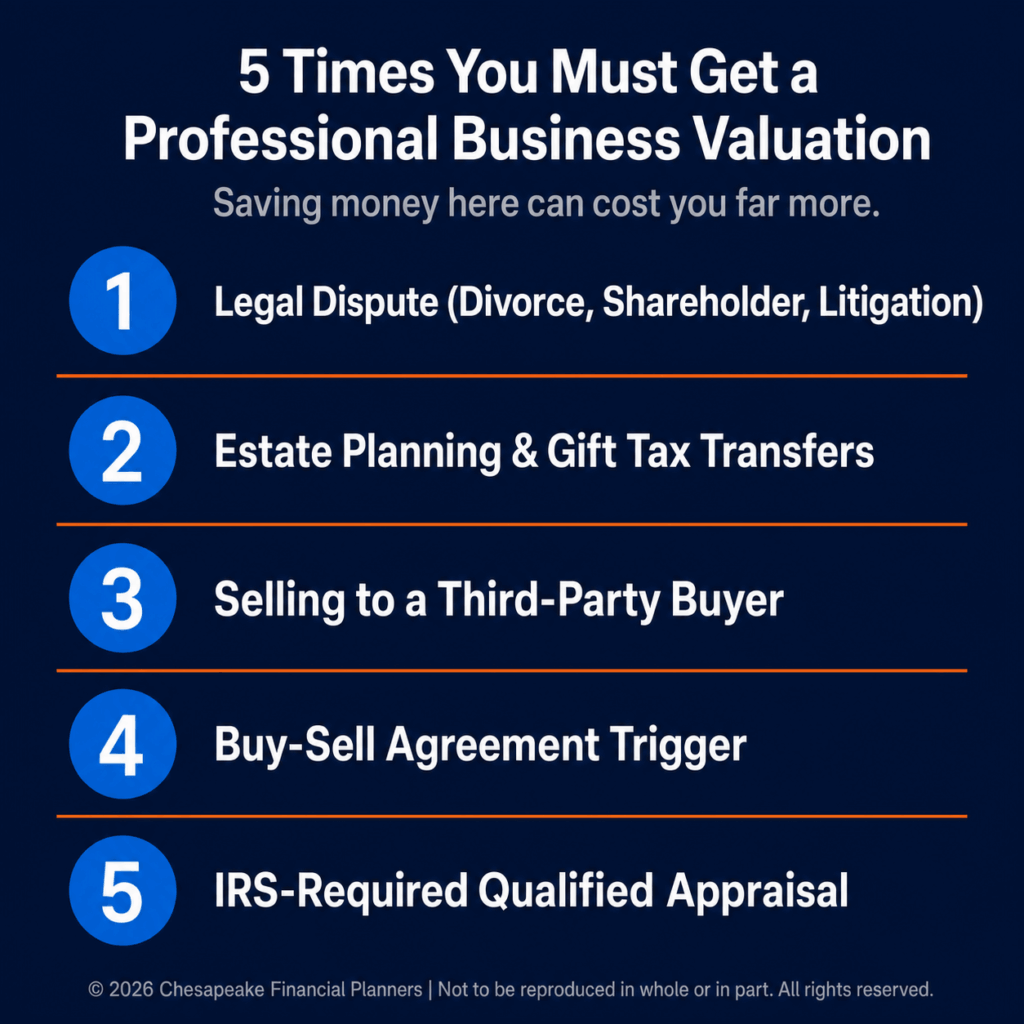
Four scenarios fall squarely in this camp. First, legal disputes such as divorce, partnership dissolution, or shareholder litigation, where the report may face cross-examination. Second, estate and gift tax transfers, where the IRS expects fair market value supported by a qualified appraisal. Third, third-party sales, where a sophisticated buyer will run their own numbers and you want yours to stand beside theirs. Fourth, a buy-sell agreement trigger, which often contractually requires it.
In each case, what protects you is credentials. Look for a certified business appraiser holding an ABV (AICPA), ASA (American Society of Appraisers), or CVA (NACVA) designation. Those letters signal training, ethics standards, and a report that recognized authorities will accept. Jeff Judge often reminds business owners that the credential isn't vanity, it's the difference between a number a judge or an IRS reviewer respects and a number they ignore.
What Is a Buy-Sell Agreement and Why Do Business Partners Need One?
When Can You Skip a Formal Valuation?
You can usually skip a formal valuation when no one with authority will ever scrutinize the number. If the figure is for your own planning, for early-stage exploration, or for a fully cooperative internal transaction with no tax-minimization angle, a lighter approach often does the job at a fraction of the cost.
Three situations qualify. If you're five to ten years from a possible sale and want directional guidance, a business broker's opinion of value or your CPA's analysis of industry multiples is usually enough. If you're making internal decisions, like whether to take on debt or pursue an acquisition yourself, a full certified report is overkill. And if you're selling to family or existing partners on friendly terms with no estate-tax engineering involved, a less formal valuation may suffice, though documentation still protects everyone.
A word of caution from the planning side. Even a friendly transaction benefits from a clean, written basis for the price. It confirms the seller received fair value, confirms the buyer didn't overpay, and gives both sides something to point to if memories diverge later. The cost of clarity is almost always lower than the cost of a dispute.
When should I start valuing my business for a future sale?
What Does a Professional Business Valuation Actually Include?
A professional business valuation includes far more than a multiple applied to last year's earnings. You're paying for a defensible methodology, not a guess. Understanding the components helps you judge whether the cost fits your situation.
A comprehensive engagement typically covers five things. Normalized financial analysis of three to five years of statements, adjusting for owner compensation, one-time expenses, and non-operating assets. Market research into comparable transactions and current industry multiples. Multiple valuation methods, usually the income, market, and asset approaches, reconciled into one supported conclusion. Risk assessment covering customer concentration, management depth, and competitive position. And a detailed written report, often 30 to 50-plus pages, that lays out every assumption.
Cost reflects that depth. Engagements for small to mid-sized companies generally run several thousand dollars and climb with complexity. That range is meaningful money, which is exactly why matching the valuation to the stakes matters. At Chesapeake Financial Planners, we run owners through our R.U.D.D.E.R. Method™, our six-step planning process of Review and Recognize, Uncover and Understand, Design and Develop, Discuss and Decide, Execute and Empower, and Reassess and Refine, partly to decide when a formal valuation is worth commissioning and when it's premature.
How much is my business actually worth if I want to sell?
What Do Business Owners Most Often Forget to Plan Before Exiting?
What Happens If You Skip a Valuation When You Actually Need One?
Skipping a professional valuation to save money is one of the most expensive shortcuts a business owner can take when the situation genuinely calls for one. The savings are small and the downside is large.
Consider the failure modes. Price too low and you may leave six figures on the table at closing, money you never get back. Price too high and your business sits on the market for months while serious buyers walk. Undervalue a gifted or transferred interest and you risk penalties: the IRS can disallow valuations that don't meet qualified-appraisal standards and assess accuracy-related penalties. Walk into litigation with a homemade number and watch opposing counsel take it apart in an afternoon. The appraisal fee is a rounding error against any one of those outcomes.
When Should I Start Planning My Business Exit Strategy?
Frequently Asked Questions
How much does a professional business valuation cost?
A professional business valuation for a small to mid-sized company generally costs several thousand dollars, with the price rising as complexity increases. Engagements involving multiple entities, real estate, or litigation support cost more. The fee reflects the depth of financial analysis, market research, and the formal written report a certified business appraiser produces.
What is a certified business appraiser, and which designation should I look for?
A certified business appraiser is a credentialed professional trained to determine fair market value using recognized methods. Look for an ABV from the AICPA, an ASA from the American Society of Appraisers, or a CVA from NACVA. These designations signal formal training, ethical standards, and reports that courts and the IRS will accept.
Does the IRS require a professional valuation for estate or gift planning?
Yes, the IRS generally requires a qualified appraisal to support the fair market value of business interests transferred through gift or estate planning. According to the IRS, a qualified appraisal must be prepared by a qualified appraiser following recognized standards. A weak or undocumented valuation can trigger penalties and audit challenges.
Can I use an online business valuation calculator instead?
You can use an online calculator for rough, directional curiosity, but not for any situation requiring a defensible number. Calculators apply generic multiples without normalizing your financials, assessing risk, or reconciling methods. For a sale, a legal dispute, a buy-sell trigger, or tax purposes, a certified business appraiser is the only credible option.
Do I need a valuation if I'm years away from selling my business?
No, you usually don't need a formal valuation if a sale is five to ten years away. A business broker's opinion of value or a CPA's analysis gives you enough directional guidance to plan. Commission a formal valuation later, when timing firms up, and spend the intervening years improving the value drivers a buyer will pay for.
Is a professional valuation required to sell my business?
A professional valuation is rarely legally required to sell, but it strengthens your position significantly. It establishes a defensible asking price, builds credibility with serious buyers and their advisors, and helps structure the deal. Sophisticated buyers run their own valuation regardless, so having yours done professionally keeps the negotiation on even footing.
If you're weighing whether your situation calls for a professional business valuation, that's a decision worth making with someone who has watched these transactions play out. Jeff Judge and the Chesapeake team serve business owners across Harford County and the Baltimore metro. Schedule a free fit call at chesapeakefp.com.
Disclosures
The information provided is for educational purposes only and should not be construed as investment advice. Investment strategies should be tailored to individual circumstances, risk tolerance, and goals. Past performance doesn't guarantee future results. Consult with qualified financial professionals regarding your specific situation.
Advisors associated with Chesapeake Financial Planners may be either (1) LPL Financial Registered Representatives offering securities through LPL Financial, Member FINRA and SIPC, and investment advisor representatives offering investment advice through Great Valley Advisor Group; or (2) solely investment advisor representatives offering investment advice through Great Valley Advisor Group and not affiliated with LPL Financial. Great Valley Advisor Group, and Chesapeake Financial Planners are separate entities from LPL Financial.


