

How Can I Reduce Taxes When Selling My Business?
Last reviewed: July 2026
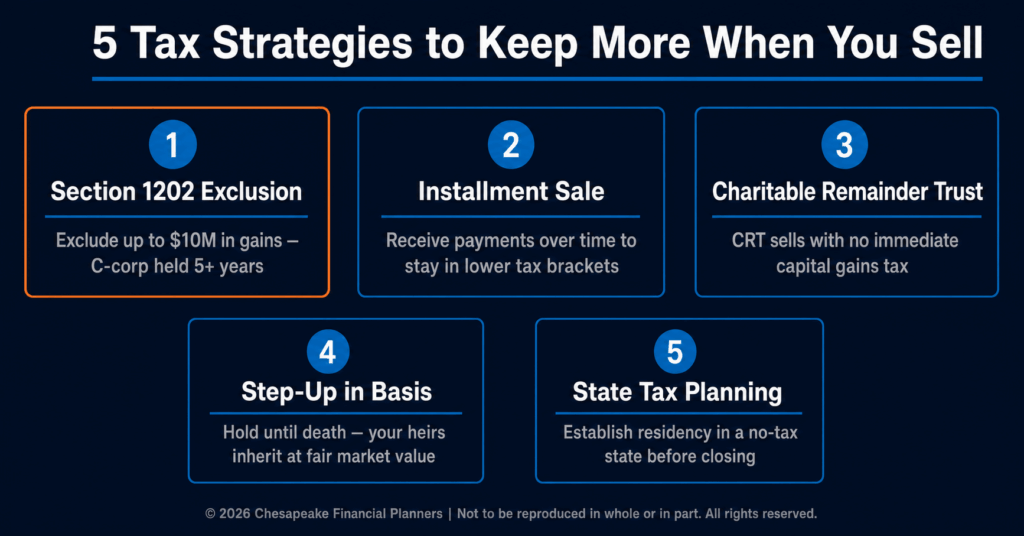
You can reduce taxes when selling your business by structuring the deal as a stock sale to capture capital gains treatment, qualifying for the Section 1202 small business stock exclusion, spreading the gain through an installment sale, or using a charitable remainder trust. The right business sale tax strategies depend on your entity type, your timeline, and how much of the proceeds you actually need up front. Most of the savings come from decisions you make years before closing, not at the closing table.
Key Takeaways
- A stock sale taxed as capital gains usually beats an asset sale, where some proceeds are taxed as ordinary income at rates up to 37%.
- Section 1202 can exclude millions in gain from federal tax if you hold qualifying C-corporation stock long enough.
- Long-term capital gains are taxed at 0%, 15%, or 20% federally, plus a 3.8% net investment income tax for high earners.
- Installment sales spread your gain across multiple years, often keeping you in lower brackets instead of one massive income year.
About the Author: Jeff Judge, CFP®, AEP®, ChFC®, CLU® is Managing Partner of Chesapeake Financial Planners in Forest Hill, Maryland. He has been helping families and business owners in Harford County and the Baltimore metro area navigate business sales and exit planning since earning his CFP® certification in 2013, by using Chesapeake Financial Planners’ signature process, the R.U.D.D.E.R. method™. Jeff has watched more deals get wrecked by tax surprises in the final 90 days than by a low offer, and almost every one was preventable with earlier planning.
For many owners, the business is the bulk of their net worth. Decades of work, compressed into a single liquidity event. Without planning, federal and state taxes can claim 30% to 40% of the proceeds. The difference between a well-structured sale and a rushed one is often measured in seven figures.
How Does the Sale Structure Affect Your Taxes?
The single biggest tax lever is how the deal is structured. There are two basic forms, and they tax very differently.
In an asset sale, the buyer purchases specific assets: equipment, inventory, intellectual property, customer lists. Each category gets taxed on its own terms. Some pieces are ordinary income, some are capital gains, and some trigger depreciation recapture.
In a stock sale (or membership interest sale for an LLC), the buyer purchases your ownership interest in the entity. The whole thing is typically taxed as a capital gain, which is usually far more favorable to you.
Here is the tension that drives most negotiations: buyers prefer asset sales because they get a stepped-up basis and can cherry-pick what they want. Sellers prefer stock sales because the tax treatment is cleaner and the rate is lower. According to the U.S. Small Business Administration, this structure question shapes both the price and the after-tax outcome more than almost any other term. Jeff Judge tells clients to model the after-tax number on both structures before they ever counter an offer, because a higher headline price on an asset sale can net less than a lower price on a stock sale.
What's the Difference Between Capital Gains and Ordinary Income on a Sale?
This distinction decides how much you keep. The gap between the two rates is enormous.
Long-term capital gains apply to assets held more than a year. The federal rate is 0%, 15%, or 20% depending on your taxable income. High earners also owe a 3.8% net investment income tax on top of that.
Ordinary income is taxed at your regular bracket, which can reach 37% federally for high earners, plus state tax. In Maryland, that state layer is meaningful.
In an asset sale, the IRS requires you to allocate the price across asset classes, and each class is taxed differently:
| Asset class | Typical tax treatment |
|---|---|
| Inventory and accounts receivable | Ordinary income |
| Equipment and machinery | Capital gain plus depreciation recapture |
| Real estate | Capital gain plus depreciation recapture |
| Goodwill and intellectual property | Long-term capital gain |
Your goal in any allocation negotiation is to push value toward goodwill and away from depreciated equipment. That single shift can move tens of thousands of dollars from the ordinary income column to the capital gains column.
How Does the Section 1202 Exclusion Work?
If your business is a C-corporation and meets the requirements, Section 1202, also called the qualified small business stock exclusion, can be the most powerful tool available. Under the Section 1202 rules, you may exclude a substantial portion of your gain from federal tax. The 2017-era baseline was the greater of $10 million or 10 times your basis, and recent legislation expanded both the dollar cap and the gross asset ceiling for stock acquired after July 4, 2025.
The core requirements:
- The stock must be issued by a domestic C-corporation, not an S-corp or LLC.
- You must have acquired the stock at original issuance, not bought it secondhand.
- The corporation must run an active qualified trade, not a passive investment or certain personal service businesses.
- The corporation's gross assets must have stayed under the statutory ceiling when the stock was issued.
- You must meet the required holding period before selling.
This is a planning decision made years in advance, not a closing-day move. If you are building a company with an eventual exit in mind, the entity choice you make today determines whether this exclusion is even on the table later. Jeff has seen owners convert from an S-corp to a C-corp purely to start the 1202 clock, and the math only works if you start early enough.

How Can an Installment Sale Lower Your Tax Bill?
Instead of taking the full price at closing, you can structure an installment sale where the buyer pays you over several years. The tax benefit is timing. The IRS lets you recognize gain as you receive payments, which spreads the liability across multiple years and can keep you out of the top bracket in any single year.
A few things to weigh before you sign:
- You are extending credit to the buyer, so their ability to pay becomes your risk.
- The interest portion of each payment is taxable as ordinary income.
- The note should be properly secured, ideally against the business assets themselves.
Installment sales work best when you trust the buyer's creditworthiness and want both deferral and an ongoing income stream. They work poorly when you need full liquidity immediately or when the buyer's finances are shaky.
How Do Charitable Trusts Reduce Tax on a Business Sale?
If you are charitably inclined, a charitable remainder trust (CRT) can deliver several benefits at once. You contribute the business or the sale proceeds to the trust. The trust sells the business without paying capital gains tax, reinvests the full proceeds, and pays you income for life or a set term. Whatever remains goes to charity at the end.
The benefits stack:
- An immediate charitable income tax deduction for the present value of the eventual charitable gift.
- No capital gains tax on the sale inside the trust.
- A lifetime income stream from a larger, untaxed asset base.
- Estate tax reduction, since those assets leave your taxable estate.
The tradeoff is real: your heirs do not inherit the money in the trust. This fits owners who value charitable giving and need income, but it is the wrong tool if leaving wealth to family is the priority. At Chesapeake Financial Planners, we walk owners through these structures using the R.U.D.D.E.R. Method™, our six-step process: Review and Recognize, Uncover and Understand, Design and Develop, Discuss and Decide, Execute and Empower, and Reassess and Refine. Jeff Judge notes: "A CRT is a powerful tool for the right seller, but I always ask first whether leaving that money to charity fits your actual priorities, because if your real goal is transferring wealth to your kids, we need a completely different strategy."
These business sale tax strategies are most effective when you compare them side by side against your actual goals, rather than chasing whichever one sounds most aggressive.
For owners weighing what comes after the sale, see How do I invest the proceeds from selling my business? and Can I retire after selling my business for $2-5 million?. If you are still early in the process, When Should I Start Planning My Business Exit Strategy? and When should I start valuing my business for a future sale? cover the groundwork that makes these tax moves possible.
Frequently Asked Questions
How much tax will I pay when I sell my business?
The amount depends on your deal structure and income, but federal and state taxes commonly consume 30% to 40% of proceeds without planning. A stock sale taxed at long-term capital gains rates of 0%, 15%, or 20% is far cheaper than an asset sale where some value is taxed as ordinary income up to 37%.
Is it better to sell business assets or stock for tax purposes?
For the seller, a stock sale is almost always better for tax purposes because the entire gain is typically taxed as a long-term capital gain. An asset sale splits proceeds across categories, taxing inventory and recaptured depreciation as ordinary income. Buyers usually prefer asset sales, so this becomes a central negotiation point.
What is the Section 1202 small business stock exclusion?
The Section 1202 exclusion lets owners of qualifying C-corporation stock exclude a large portion of their gain, historically up to the greater of $10 million or 10 times basis, from federal tax. You must hold original-issue stock in an active C-corporation that met the gross asset limit when issued, and satisfy the required holding period.
Can I spread out the taxes when I sell my business?
Yes, an installment sale lets you recognize gain and pay tax only as you receive payments over several years. The IRS installment method can keep you out of the highest bracket in any single year. The tradeoff is buyer credit risk, since you are effectively financing part of the purchase yourself.
How can a charitable remainder trust help with business sale taxes?
A charitable remainder trust sells your contributed business without paying capital gains tax, reinvests the full proceeds, pays you income for life or a term, and leaves the remainder to charity. You also get an immediate partial charitable deduction. The catch is that the trust assets go to charity rather than to your heirs.
When should I start tax planning for selling my business?
Start at least three to five years before you intend to sell. Most of the biggest savings, including qualifying for Section 1202 and optimizing your entity structure, require time to set up. Last-minute planning at the closing table almost always leaves money on the table that earlier decisions could have protected.
If you found this helpful, our exit planning resources go deeper on structuring a tax-smart sale. Download the guide at chesapeakefp.com to start building your plan well before you reach the closing table.
Want to go deeper? Our Business Sale Tax Planning Guide walks through this step by step.
Disclosures
The information provided is for educational purposes only and should not be construed as investment advice. Investment strategies should be tailored to individual circumstances, risk tolerance, and goals. Past performance doesn't guarantee future results. Consult with qualified financial professionals regarding your specific situation.
This information is not intended to be a substitute for specific individualized tax, investment or legal advice. We suggest that you discuss your specific situation with a qualified tax, legal or financial advisor.
Advisors associated with Chesapeake Financial Planners may be either (1) LPL Financial Registered Representatives offering securities through LPL Financial, Member FINRA and SIPC, and investment advisor representatives offering investment advice through Great Valley Advisor Group; or (2) solely investment advisor representatives offering investment advice through Great Valley Advisor Group and not affiliated with LPL Financial. Great Valley Advisor Group, and Chesapeake Financial Planners are separate entities from LPL Financial.


