

How Can High-Income Earners Reduce Their Tax Burden?
Last reviewed: July 2026
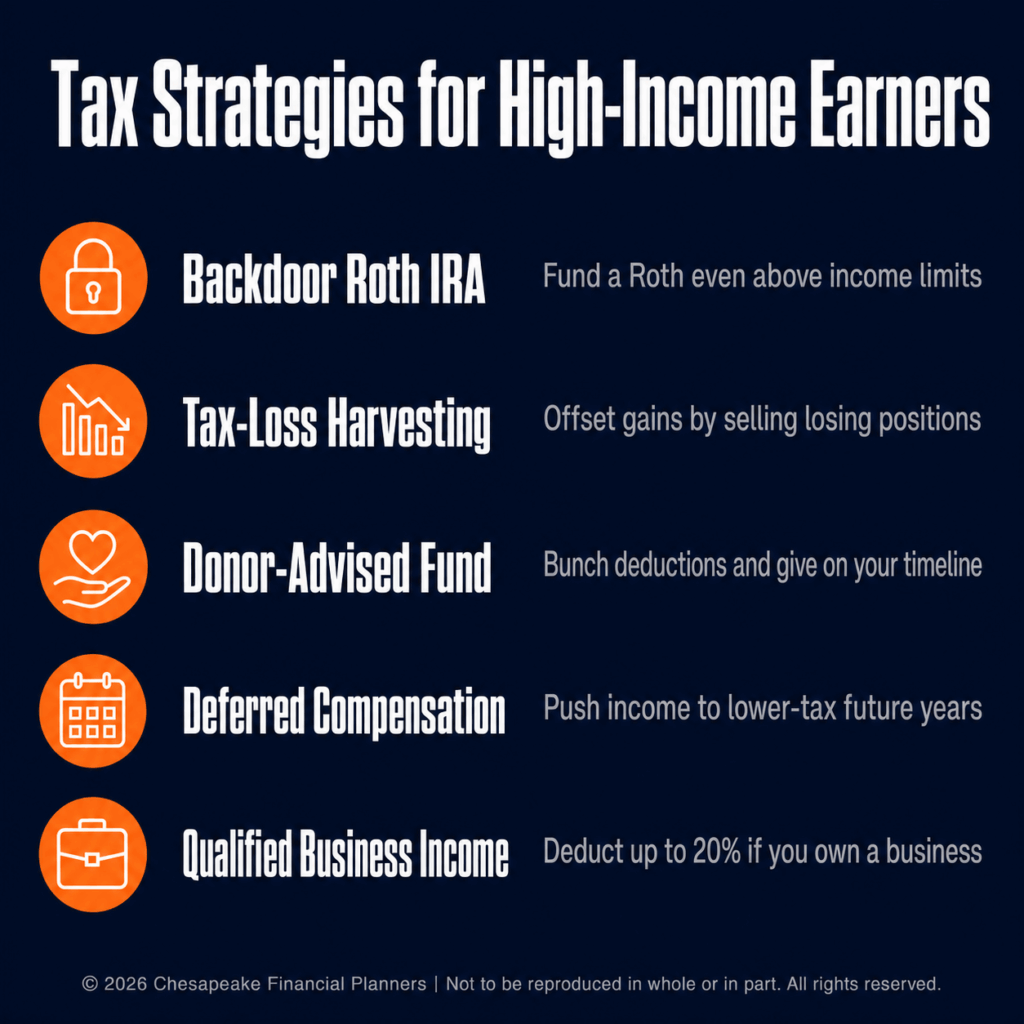
High-income earners reduce their tax burden by maxing out tax-advantaged accounts, harvesting investment losses, timing Roth conversions, and using donor-advised funds to control when income hits their highest brackets. The strategy that matters most is proactive planning across multiple years, not scrambling in April. Tax planning for high-income earners works by lowering income in the top brackets, where every dollar saved is worth the most.
Key Takeaways
- High earners can shelter up to $72,000 in a Solo 401(k) or SEP IRA in 2026, sharply cutting taxable income.
- A backdoor Roth IRA lets high earners fund a Roth despite income limits that block direct contributions.
- Tax-loss harvesting offsets capital gains plus up to $3,000 of ordinary income yearly, with losses carrying forward indefinitely.
- Donor-advised funds let you front-load deductions in a high-income year and give to charity later.
About the Author: Jeff Judge, CFP®, AEP®, ChFC®, CLU® is Managing Partner of Chesapeake Financial Planners in Forest Hill, Maryland. He has been helping families and business owners in Harford County and the Baltimore metro area navigate high-income tax strategy since earning his CFP® certification in 2013, by using Chesapeake Financial Planners’ signature process, the R.U.D.D.E.R. method™. Jeff sees the same pattern every spring: smart, successful people who treat taxes as a once-a-year filing chore instead of a year-round decision, and they overpay because of it.
The key word is proactive. Most high earners think about taxes in April when they're filing last year's return. By then it's too late to do anything except write the check. Real planning happens throughout the year and looks several years ahead.
Here's what actually moves the needle.
What Retirement Accounts Should High Earners Max Out First?
Maxing out tax-advantaged accounts is the foundation of tax planning for high-income earners, yet plenty of high earners leave money on the table here. According to the IRS, the 2026 employee 401(k) contribution limit is $24,500, plus an $8,000 catch-up if you're 50 or older. Under SECURE 2.0, workers aged 60 to 63 get an enhanced catch-up of $11,250 in 2026.
Beyond the basic 401(k), a few accounts do heavy lifting:
- Backdoor Roth IRA: High earners are phased out of direct Roth contributions, but you can fund a traditional IRA and convert it to a Roth. Watch the pro-rata rule if you hold other pre-tax IRA balances.
- Health Savings Account: With a high-deductible health plan, the 2026 HSA limit is $4,400 for individuals and $8,750 for families. It's the only account with triple tax benefits: deductible contributions, tax-free growth, and tax-free medical withdrawals.
- SEP IRA or Solo 401(k): Self-employment income, even a side gig, lets you contribute up to $72,000 in 2026, dramatically reducing taxable income.
Jeff Judge often tells clients that the mega backdoor Roth, where your plan allows after-tax contributions and in-plan conversions, is the most overlooked lever for high earners with strong cash flow. Most people don't even know their plan offers it.
This question of how to keep more as you earn more is exactly where Chesapeake's How can I potentially optimize my taxes as my income grows? guidance starts.
How Does Tax-Loss Harvesting Lower My Taxes?
Tax-loss harvesting lowers your taxes by selling investments that have dropped in value to lock in losses, then using those losses to offset capital gains. If losses exceed gains, you can offset up to $3,000 of ordinary income per year, and unused losses carry forward indefinitely, according to IRS guidance on capital losses.
The mechanics matter. After selling the losing position, buy a similar but not substantially identical investment to keep your market exposure intact. This avoids the wash-sale rule while preserving your allocation. Done consistently across a taxable account, this can save high earners thousands per year and many advisors automate it.
This pairs naturally with smart account structuring, which we cover in How Should I Place Investments Across Taxable and Retirement Accounts?.
How Can Charitable Giving Reduce a High Earner's Tax Bill?
Charitable giving reduces a high earner's tax bill most efficiently through a donor-advised fund, which lets you take a deduction now and give later. You contribute a lump sum of cash or appreciated assets, claim an immediate deduction, let the money grow tax-free, and distribute to charities over time at your own pace.
The strategy shines in spike-income years. If a bonus, business sale, or large Roth conversion pushes you into the top bracket, funding a donor-advised fund offsets that income now, then funds your giving for years. Donate appreciated stock instead of cash and you skip the capital gains tax while deducting the full fair market value.
There's also the bunching angle. The Tax Cuts and Jobs Act raised the standard deduction high enough that many high earners no longer itemize. By doubling charitable gifts in one year and skipping the next, you clear the standard deduction in the "on" year and take the standard amount in the "off" year, saving more across two years than even giving would. Jeff frequently sees clients pair a donor-advised fund with a high-bonus year to smooth this out cleanly. Jeff Judge notes: "When a client has a big bonus year, we'll often fund a donor-advised fund with two or three years' worth of charitable giving at once, so they clear the standard deduction threshold and capture a real itemized deduction they wouldn't have gotten spreading those gifts out."
For households navigating a windfall, see How will inheriting money affect my taxes this year?.
When Do Roth Conversions and Bracket Timing Make Sense?
Roth conversions make sense when you expect your tax rate in retirement to be higher than it is today, and bracket timing is the discipline of converting only up to the top of a target bracket each year. You pay ordinary income tax on the converted amount now in exchange for tax-free growth and withdrawals later.
For high earners, the window often opens later than they think: early retirement years, a sabbatical, a business transition, or any stretch when income dips temporarily. Filling lower brackets in those years with conversions can cut a lifetime tax bill substantially. Business owners weighing an exit should also study What's the most tax-efficient way to exit my business? before triggering a large taxable event.
This is also where the R.U.D.D.E.R. Method™ earns its keep. The R.U.D.D.E.R. Method™ is Chesapeake Financial Planners' six-step planning process: Review and Recognize, Uncover and Understand, Design and Develop, Discuss and Decide, Execute and Empower, and Reassess and Refine. Conversion timing lives in the Design and Develop and Reassess and Refine stages, because the right number changes every year as your income does.
Frequently Asked Questions
What is the best tax strategy for high-income earners?
The best tax strategy for high-income earners combines several moves: maxing out tax-advantaged accounts, using a backdoor or mega backdoor Roth, harvesting investment losses, and front-loading charitable deductions through a donor-advised fund in high-income years. No single tactic wins; the savings come from coordinating them across multiple tax years so income lands in lower brackets.
Can high earners contribute to a Roth IRA?
High earners cannot contribute directly to a Roth IRA once their income exceeds the IRS phase-out limits, but they can use a backdoor Roth. This means contributing to a traditional IRA and converting it to a Roth. If you hold other pre-tax IRA balances, the pro-rata rule applies, so coordinate with a tax professional before converting to avoid an unexpected bill.
How much can a high earner save with tax-loss harvesting?
A high earner can offset unlimited capital gains plus up to $3,000 of ordinary income each year through tax-loss harvesting, with excess losses carrying forward indefinitely. The dollar savings depend on your bracket and portfolio turnover, but consistent harvesting in a taxable account can save high earners in the top bracket thousands of dollars annually with no change to their underlying allocation.
Are donor-advised funds worth it for high-income earners?
Donor-advised funds are worth it for charitably inclined high earners because they separate the tax deduction from the actual giving. You contribute appreciated stock or cash in a high-income year, claim the deduction immediately, avoid capital gains on appreciated assets, and distribute to charities over time. This timing flexibility makes them especially valuable in bonus, equity, or business-sale years.
When should a high earner do a Roth conversion?
A high earner should do a Roth conversion when their current tax rate is lower than the rate they expect in retirement, often during early retirement, a career break, or a low-income transition year. Converting up to the top of a target bracket in those years fills otherwise unused bracket space and can reduce a lifetime tax bill, though it requires year-by-year recalculation.
If you found this helpful, our tax planning guide for high earners covers these strategies in more depth, including the multi-year sequencing that makes them work together. Download it at chesapeakefp.com and start building a plan before next April instead of reacting to it.
Want to go deeper? Our Tax Moves for High Earners walks through this step by step.
Disclosures
The information provided is for educational purposes only and should not be construed as investment advice. Investment strategies should be tailored to individual circumstances, risk tolerance, and goals. Past performance doesn't guarantee future results. Consult with qualified financial professionals regarding your specific situation.
A Roth IRA offers tax deferral on any earnings in the account. Qualified withdrawals of earnings from the account are tax-free. Withdrawals of earnings prior to age 59 ½ or prior to the account being opened for 5 years, whichever is later, may result in a 10% IRS penalty tax. Limitations and restrictions may apply.
This information is not intended to be a substitute for specific individualized tax, investment or legal advice. We suggest that you discuss your specific situation with a qualified tax, legal or financial advisor.
Advisors associated with Chesapeake Financial Planners may be either (1) LPL Financial Registered Representatives offering securities through LPL Financial, Member FINRA and SIPC, and investment advisor representatives offering investment advice through Great Valley Advisor Group; or (2) solely investment advisor representatives offering investment advice through Great Valley Advisor Group and not affiliated with LPL Financial. Great Valley Advisor Group, and Chesapeake Financial Planners are separate entities from LPL Financial.


