

What Is a Continuity Agreement for Financial Advisors?
Last reviewed: July 2026
A continuity agreement for a financial advisor is a legal document that keeps an advisory practice serving clients without interruption if the principal advisor dies, becomes incapacitated, or is suddenly unable to practice. It names who steps in, on what terms, and how clients are told. In short, it answers the hard questions before a crisis forces the answers.
Most clients never think about this until the day it matters. And on that day, it matters a great deal. If your advisor is the person who knows your accounts, your goals, and your tax situation, what happens to all of that knowledge the moment they're gone? A continuity agreement is the difference between a smooth handoff and weeks of silence.
Key Takeaways
- A continuity agreement names a successor advisor to step in immediately if the principal advisor dies or becomes incapacitated.
- FINRA Rule 4370 requires member firms to maintain written business continuity plans covering customer communication and succession.
- A continuity agreement handles the unplanned crisis; a succession plan handles the planned retirement transition.
- Clients have every right to ask whether their advisor has a continuity agreement in place.
- As of 2026, FINRA oversees roughly 3,300 member firms, many of them small practices where one advisor is the whole relationship.
About the Author: Jeff Judge, CFP®, AEP®, ChFC®, CLU® is Managing Partner of Chesapeake Financial Planners in Forest Hill, Maryland. He has been helping families and business owners in Harford County and the Baltimore metro area navigate continuity and succession planning since earning his CFP® certification in 2013, by using Chesapeake Financial Planners’ signature process, the R.U.D.D.E.R. method™. Jeff has watched what happens when a solo advisor dies without a plan, and the clients are the ones who pay for it.
Why Continuity Agreements Exist for Financial Advisors
The continuity agreement financial advisor model exists because the firm-level plan and the advisor-level reality often don't match. FINRA requires member firms to maintain written business continuity plans under FINRA Rule 4370. Those plans cover the firm. But for solo practitioners and small practices, the firm and the advisor are frequently the same person.
A business continuity plan that addresses building access, data backup, and system failures but says nothing about advisor-level death or incapacity leaves a real gap. FINRA's guidance specifically requires firms to address "the succession of management" and "communication with customers." For a practice where one person is the primary relationship manager, a standalone continuity agreement is how that requirement gets met at the individual level.
Independent RIAs face a parallel obligation. The SEC has issued guidance stating that registered investment advisers should adopt business continuity and transition plans that address the death or incapacity of key personnel. Without a continuity agreement, what happens to clients gets decided by circumstances, not by the advisor's intentions. That's a poor outcome for people who trusted you with their financial lives.
What a Continuity Agreement Covers
A well-built continuity agreement spells out the mechanics so nobody is improvising during a crisis. Most agreements address five core elements:
- Successor designation. A specific named advisor, firm, or mechanism steps in immediately. Not "someone will figure it out," but a named party with pre-defined responsibilities.
- Client notification process. How and when clients learn of the change, who makes the calls or sends the letters, and exactly what the message says.
- Account transfer authority. How accounts move to the designated successor, on what timeline, and under whose legal authority.
- Compensation terms. What flows to the estate or the incapacitated advisor's family, and how the acquiring party pays for the practice they receive.
- Term and review. How often the agreement is reviewed and updated, and the conditions under which it can be changed.
The detail is the point. A vague agreement that names no successor and sets no timeline isn't much better than no agreement at all. This is one area where Chesapeake applies its R.U.D.D.E.R. Method™, the firm's six-step planning process: Review and Recognize, Uncover and Understand, Design and Develop, Discuss and Decide, Execute and Empower, and Reassess and Refine. A continuity agreement that never gets reassessed drifts out of date fast.
What Is a Buy-Sell Agreement and Why Do Business Partners Need One?
What Clients Get From an Advisor Continuity Agreement
As a client, you benefit from an advisor continuity agreement whether or not you've ever heard the term. It means your accounts don't sit unmanaged while an estate or a firm scrambles to decide what to do. It means someone already knows the plan before the crisis hits. And it means you get notified quickly and clearly, rather than learning secondhand that your advisor is gone.
Jeff Judge at Chesapeake Financial Planners is blunt about it: "A continuity agreement isn't optional if you take your clients seriously. If you have people who depend on you and you don't have one, you're leaving them exposed. That's not acceptable to me." The exposure is real. The accounts stay safe at the custodian, but responsive service, planning updates, and someone who actually knows your situation can vanish for weeks.
This is also why it's a fair question to ask your own advisor. A practice that has thought through continuity is usually a practice that has its house in order more broadly.
What questions should I ask before hiring a financial advisor?
How a Continuity Agreement Differs From Succession Planning
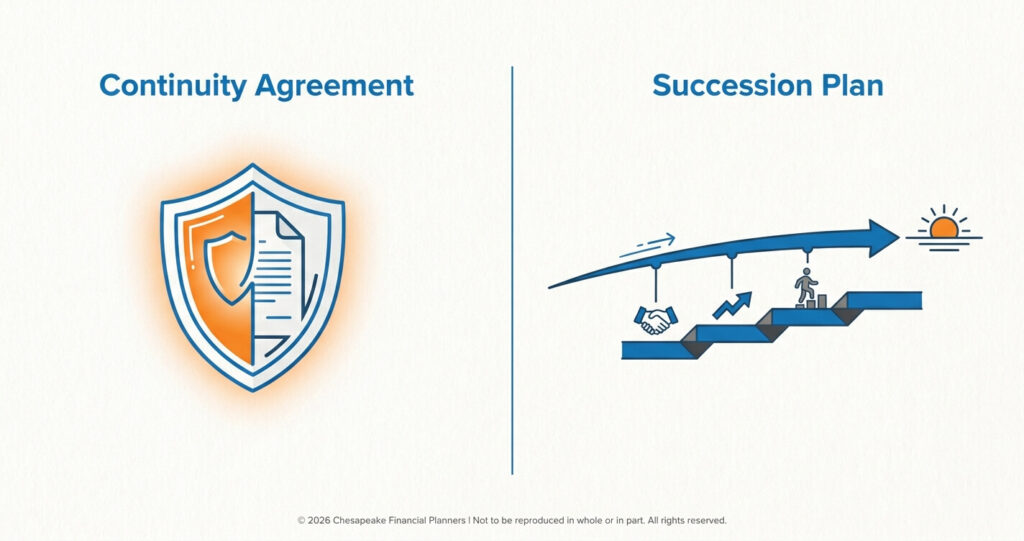
A continuity agreement and a succession plan are related but not the same thing, and confusing them creates a dangerous blind spot.
A continuity agreement handles the immediate and unplanned: what happens today if the advisor cannot practice. A succession plan handles the longer arc: what happens over the next 3, 5, or 10 years as an advisor moves toward retirement. You can have one without the other. But a practice with a succession plan and no continuity agreement has covered the scenario it can see coming while ignoring the one it can't.
That's backwards. The unplanned event, the heart attack or the accident, is exactly when documentation matters most, because nobody had time to prepare. A complete approach covers both the planned exit and the sudden one.
| Feature | Continuity Agreement | Succession Plan |
|---|---|---|
| Triggered by | Sudden death or incapacity | Planned retirement or transition |
| Timeframe | Immediate | 3 to 10 years |
| Primary goal | Uninterrupted client service | Orderly ownership transfer |
| Successor | Pre-named, ready now | Identified and developed over time |
What Is a Succession Plan for a Financial Advisor?
How Chesapeake Financial Planners Approaches Continuity
At Chesapeake Financial Planners, continuity agreements and succession documentation are built into the standard operating structure, not bolted on after the fact. Every client relationship is documented so a designated successor could step in with full context, not a stack of mystery files. That isn't only good business. It's what clients deserve from anyone managing their money.
For advisors weighing Chesapeake as a potential successor party, or for clients who want to understand how their accounts are protected, the conversation starts with the same documentation discipline Jeff applies everywhere else.
How Does Chesapeake Financial Planners Evaluate a Book of Business?
Frequently Asked Questions
Are financial advisors required to have continuity agreements?
Not by a single federal rule, but FINRA's business continuity planning requirements for member firms effectively require coverage of advisor incapacity and death. Independent RIAs registered with the SEC must also maintain business continuity and transition plans. A standalone continuity agreement is the most direct way to address advisor-level disruption.
How is a continuity agreement different from a buy-sell agreement?
A buy-sell agreement governs the transfer of ownership interests in a business, usually between partners. A continuity agreement specifically covers the continuation of client service and practice management if an advisor dies or becomes incapacitated. They often coexist in partnership-based practices, but they solve different problems and shouldn't be treated as interchangeable.
What happens to my accounts without a continuity agreement?
Your assets stay held at the custodian and remain protected. But active management, planning updates, and responsive service can be disrupted for weeks or months while the situation gets resolved. How bad the disruption gets depends on how organized the firm is and whether the broker-dealer or custodian has its own protocol in place.
How often should a continuity agreement be reviewed?
At minimum once a year, or whenever significant changes occur in the practice. Triggers include key staff changes, major growth or contraction in the client base, and any change in the named successor's availability or willingness to serve. A continuity agreement that's never revisited can name a successor who has long since moved on.
Can I ask my advisor if they have a continuity agreement?
Yes, and you should. It's a reasonable question for any client, especially one who has worked with the same advisor for many years. The answer tells you something important about how seriously your advisor takes long-term client care and whether the practice is built to outlast any single person.
Want to go deeper? Our 10 Signs You're Ready for a Certified Financial Planner walks through this step by step.
Disclosures
The information provided is for educational purposes only and should not be construed as investment advice. Investment strategies should be tailored to individual circumstances, risk tolerance, and goals. Past performance doesn't guarantee future results. Consult with qualified financial professionals regarding your specific situation.
Advisors associated with Chesapeake Financial Planners may be either (1) LPL Financial Registered Representatives offering securities through LPL Financial, Member FINRA and SIPC, and investment advisor representatives offering investment advice through Great Valley Advisor Group; or (2) solely investment advisor representatives offering investment advice through Great Valley Advisor Group and not affiliated with LPL Financial. Great Valley Advisor Group, and Chesapeake Financial Planners are separate entities from LPL Financial.


