

What Questions Should Women Ask About Retirement Planning?
Last reviewed: July 2026
Women should ask how longer lifespans, career breaks, and Social Security claiming rules change their retirement math, then build a plan around those facts. The standard retirement playbook assumes an uninterrupted career and an average lifespan, and neither one fits most women's reality. Smart women retirement planning starts with the right questions, not generic rules of thumb.
Key Takeaways
- Women live longer on average, so retirement savings must stretch across more years and higher lifetime healthcare costs.
- The 2026 IRA catch-up contribution for savers 50 and older is $1,100 above the standard limit.
- Social Security bases your benefit on your 35 highest-earning years, so career breaks can quietly shrink your monthly check.
- Being too conservative with investments is a real risk when retirement may last 25 to 30 years.
About the Author: Jeff Judge, CFP®, AEP®, ChFC®, CLU® is Managing Partner of Chesapeake Financial Planners in Forest Hill, Maryland. He has been helping families and business owners in Harford County and the Baltimore metro area navigate retirement income decisions since earning his CFP® certification in 2013, by using Chesapeake Financial Planners’ signature process, the R.U.D.D.E.R. method™. Jeff has noticed that the women who retire most confidently are the ones who started asking pointed questions a decade before they stopped working, not the ones who waited for the perfect spreadsheet.
How Much Do Women Need to Retire?
The honest answer is that women generally need their savings to last longer than men's, so the old "70 to 80 percent of pre-retirement income" rule undersells it. The better question is what your retirement lifestyle costs, then how many years it has to fund.
Women live several years longer than men on average, according to Social Security Administration actuarial data. That extra time means more years of housing, food, and especially medical bills. It also means more exposure to inflation eating away at a fixed income.
Start by tracking what you actually spend now. Then adjust for retirement: maybe more travel early on, lower commuting costs, and rising healthcare expenses later. Jeff Judge often tells women that the number on a retirement calculator matters far less than knowing which expenses are fixed and which they can flex in a bad market year.
At Chesapeake Financial Planners, we walk through this using the R.U.D.D.E.R. Method™, Chesapeake Financial Planners' six-step planning process: Review and Recognize, Uncover and Understand, Design and Develop, Discuss and Decide, Execute and Empower, and Reassess and Refine. It keeps the conversation anchored to your actual life rather than a generic benchmark. For a deeper walkthrough, see our guide on How Much Money Do I Actually Need to Retire Comfortably?.
How Do Career Breaks Affect a Woman's Retirement?
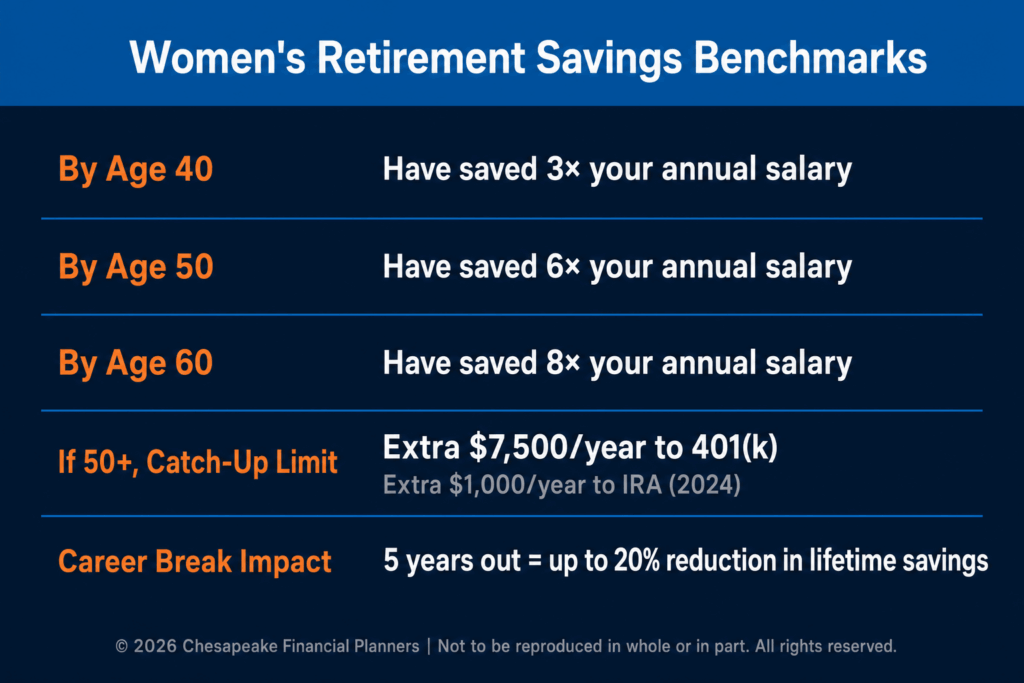
Career breaks for caregiving reduce retirement savings in three ways at once: less money contributed, no employer match during those years, and lost compound growth on both. The damage compounds quietly, which is why so many women underestimate it.
There's also the Social Security hit. The Social Security Administration calculates your benefit using your 35 highest-earning years. Years with zero or reduced income still count toward that 35, dragging the average down. A few caregiving years can shave a meaningful amount off the monthly check you collect for the rest of your life.
This is one area where retirement planning for women diverges sharply from standard advice. If you took time out of the workforce, ask your advisor to quantify the gap and map a catch-up strategy. The fix usually combines higher savings in your peak earning years and a deliberate Social Security claiming plan. Families navigating this often overlap with the financial strain covered in How Do I Help Aging Parents Financially Without Ruining My Retirement?.
Should Women Use Catch-Up Contributions?
If you are 50 or older and behind on savings, catch-up contributions are one of the most powerful tools you have, and many women are the perfect candidates because of earlier career interruptions. The IRS lets older savers add extra money on top of the standard limits.
For 2026, the IRS allows an additional $1,100 in IRA catch-up contributions for those 50 and older, on top of the standard IRA limit. Workplace 401(k) plans allow a larger catch-up amount, and savers aged 60 to 63 can use an even higher "super catch-up" under SECURE 2.0 rules. If your cash flow allows it, maxing these out can close years of lost ground faster than almost anything else.
Female retirement savings often climb fastest in the final decade of work, once kids are grown and earnings peak. Jeff has watched clients use those years to add six figures to their accounts purely through catch-up contributions and a higher savings rate. The window is real, but it closes at retirement.
What's the Right Social Security Strategy for Women?
Social Security matters more for women because they are more likely to reach their late 80s and 90s, when other assets may be drawn down. Getting the claiming decision right can mean tens of thousands of dollars over a lifetime.
Three questions drive the strategy. First, when do you claim? You can start at 62 with a permanently reduced benefit, or wait until 70 for the maximum. Second, do you claim on your own record or a spouse's? You receive the higher of your own benefit or a spousal benefit. Third, how do survivor benefits work? A widow can switch to a late spouse's benefit if it is higher than her own.
Divorced women have rights too. The Social Security Administration allows a divorced spouse to claim on an ex-spouse's record if the marriage lasted at least 10 years and she has not remarried. Many women never realize this benefit exists. Modeling these options before you claim is worth the effort, and it pairs well with planning around How do Roth conversions affect IRMAA and Medicare Part B premiums?.
Are Women Invested Too Conservatively for Retirement?
Often, yes. Women tend to invest more conservatively, and while caution feels safe, being too conservative across a 25 to 30 year retirement is its own risk. Money that doesn't grow can't keep pace with inflation.
The right question is whether your allocation matches your time horizon. If retirement is 20 years out, you can ride out market swings and should hold meaningful stock exposure. As you approach retirement, shift gradually toward a more balanced mix, but don't abandon growth entirely. You still need the portfolio to outlast you.
Jeff puts it bluntly with clients: the woman who keeps everything in cash to avoid losing money often loses more to inflation over three decades than she ever would have lost in a market downturn. Healthcare planning compounds this, so review our overview of How Much Should I Budget for Healthcare Costs in Retirement? alongside your allocation.
Frequently Asked Questions
Why do women need more retirement savings than men?
Women need more retirement savings primarily because they live longer on average, according to Social Security Administration data. A longer lifespan means more years of expenses, greater exposure to inflation, and higher lifetime healthcare and long-term care costs. Many women also experience career breaks that reduce lifetime earnings and savings.
How do career breaks reduce a woman's retirement income?
Career breaks reduce retirement income through lost contributions, missed employer matches, and forgone compound growth during the years away from work. They also lower Social Security benefits, since the SSA averages your 35 highest-earning years and counts low or zero-income years against that total, shrinking your monthly benefit.
What are the 2026 catch-up contribution amounts for women over 50?
For 2026, the IRS allows an additional $1,100 IRA catch-up contribution for savers 50 and older, on top of the standard IRA limit. Workplace 401(k) plans permit a larger catch-up amount, with an even higher super catch-up available for savers aged 60 to 63 under SECURE 2.0.
Can a divorced woman collect Social Security on her ex-spouse's record?
Yes. A divorced woman can claim Social Security on an ex-spouse's record if the marriage lasted at least 10 years and she has not remarried, according to the Social Security Administration. The benefit does not reduce her ex-spouse's payment, and many women are unaware this option exists when planning income.
Should women invest more conservatively as they near retirement?
Women should shift gradually toward a more balanced mix near retirement, but not abandon growth entirely. Because retirement can last 25 to 30 years, holding too little in stocks risks losing purchasing power to inflation. The right allocation matches your time horizon and your tolerance for short-term volatility.
How should women plan for healthcare costs in retirement?
Women should plan for higher lifetime healthcare costs because they tend to live longer and use more care. Build a plan that covers Medicare premiums, supplemental coverage, out-of-pocket expenses, and the real possibility of needing long-term care. A Health Savings Account, if eligible, offers a tax-advantaged way to prepare.
Where to Start
The strongest retirement plans for women come from asking these questions early and revisiting them as life changes. If you found this helpful, our retirement planning resources cover Social Security timing, catch-up strategies, and healthcare costs in greater depth at chesapeakefp.com. The right women retirement planning questions, asked a decade out, are worth far more than any single product or perfect spreadsheet.
Want to go deeper? Our How to Plan for Retirement as a Woman walks through this step by step.
Disclosures
The information provided is for educational purposes only and should not be construed as investment advice. Investment strategies should be tailored to individual circumstances, risk tolerance, and goals. Past performance doesn't guarantee future results. Consult with qualified financial professionals regarding your specific situation.
Advisors associated with Chesapeake Financial Planners may be either (1) LPL Financial Registered Representatives offering securities through LPL Financial, Member FINRA and SIPC, and investment advisor representatives offering investment advice through Great Valley Advisor Group; or (2) solely investment advisor representatives offering investment advice through Great Valley Advisor Group and not affiliated with LPL Financial. Great Valley Advisor Group, and Chesapeake Financial Planners are separate entities from LPL Financial.


