

How Do I Manage Finances During a Career Transition?
Last reviewed: July 2026
Managing your career transition finances comes down to three moves: calculate how many months your savings can cover your expenses, lock in health insurance before your old coverage lapses, and cut spending to stretch your runway. Do those three things first, and you buy yourself time to find the right next role instead of grabbing the first offer out of fear. Everything else builds on that foundation.
Key Takeaways
- Calculate your financial runway by dividing liquid savings by monthly expenses before making any career moves.
- The Bureau of Labor Statistics reported a median unemployment duration of roughly 10 weeks in early 2026.
- COBRA coverage lasts up to 18 months under federal law but requires you to pay the full premium plus a 2% fee.
- Aim for a 6 to 12 month runway for voluntary transitions and protect your emergency fund from lifestyle creep.
- A marketplace ACA plan may cost far less than COBRA if your income drops during the transition.
About the Author: Jeff Judge, CFP®, AEP®, ChFC®, CLU® is Managing Partner of Chesapeake Financial Planners in Forest Hill, Maryland. He has been helping families and business owners in Harford County and the Baltimore metro area navigate career transitions and sudden income changes since earning his CFP® certification in 2013, by using Chesapeake Financial Planners’ signature process, the R.U.D.D.E.R. method™. Jeff has seen the same pattern for years: the people who handle a transition well are not the ones with the biggest savings, they are the ones who run the math early and make calm decisions instead of panicked ones.
A career transition is one of those moments where good planning shows up in your bank balance a year later. The decisions you make in the first 30 days, about spending, insurance, and how long your cash will last, shape whether the change feels like an opportunity or a crisis. Below, I'll walk through how to handle your career transition finances step by step, and answer the questions clients ask me most.
How Do I Calculate My Financial Runway During a Career Change?
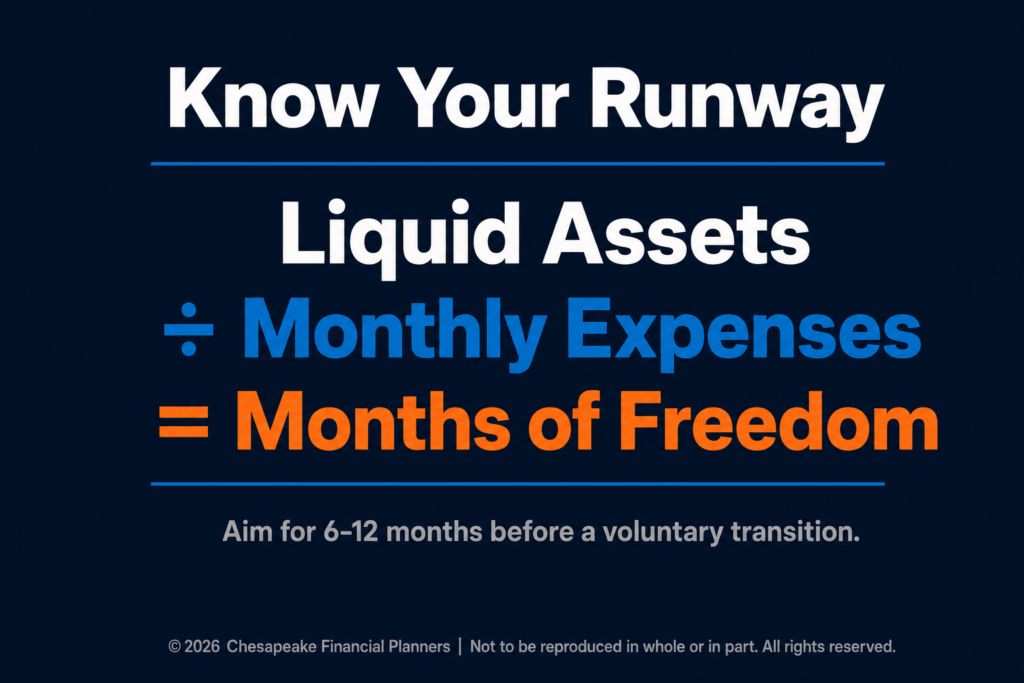
Your financial runway is the number of months you can cover expenses using liquid savings with no income coming in. To calculate it, divide your liquid assets by your average monthly spending. If you have $30,000 in accessible cash and spend $5,000 a month, your runway is six months. That single number drives almost every decision that follows.
Start with your real monthly expenses, pulled from the last three to six months of actual spending, not what you think you spend. Include housing, food, transportation, insurance premiums, debt payments, childcare or eldercare, and the discretionary stuff like subscriptions and dining out. Then total your liquid assets: checking, savings, your emergency fund, money market balances, and any severance.
Jeff Judge often tells clients that the runway number is where panic either starts or stops. People who know they have eight months tend to make sharp, deliberate choices. People who avoid the math tend to grab the first job offer that lands, often at a pay cut they later regret. For a voluntary transition, aim for a six to twelve month runway. If you were laid off, treat every month as something to stretch.
This step pairs well with broader planning if your transition came with a payout. If you received a package, see Can I use my severance package to fund a career change? for how to deploy it strategically.
How Do I Protect My Emergency Fund Between Jobs?
Protect your emergency fund by treating it as off-limits for anything that isn't a true emergency during your career change. That means no lifestyle upgrades, no "I deserve this" purchases, and no funding optional projects while your income is paused. The fund exists to keep you solvent and calm, and the moment you raid it for non-essentials, you shorten your runway and raise your stress.
If you already hold three to six months of expenses, your job now is defense. Keep that money in a high-yield savings account where it stays liquid and earns something. A Federal Deposit Insurance Corporation survey shows national savings rates have stayed well above historical lows into 2026, so park the cash somewhere that actually pays you to wait.
If you don't have an emergency fund yet, build one fast and prioritize it over aggressive investing while you're in transition. The point isn't to optimize returns right now. The point is breathing room, which is what lets you wait for the right opportunity instead of the first one. This same emergency-fund discipline applies after any sudden income event, which is why I cover it in What should you do when you suddenly receive a large sum of money?.
How Should I Cut Spending During a Job Transition?
Cut spending in a career transition by attacking fixed costs first, then variable costs, then discretionary spending, in that order. Fixed costs move the needle most because they repeat every month. Look at whether you can refinance a loan, renegotiate a bill, downgrade a vehicle, or pause a recurring service. Even one fixed-cost cut compounds across your entire transition window.
For variable expenses, cancel unused subscriptions, scale back dining out, pause tech and clothing upgrades, and shop more deliberately. None of these are dramatic on their own, but together they can add a month or two to your runway. Build the new, leaner budget on purpose. A job transition planning approach treats this as temporary discipline, not permanent deprivation.
Discretionary spending doesn't have to vanish. The goal is intention, not misery. Swap a few paid activities for free ones and you keep your sanity without burning cash. The danger I warn clients about is the opposite extreme: career transitions are temporary, but the bad spending habits people pick up during them can become permanent. Set the new budget deliberately so you control the reset instead of drifting into it.

How Do I Handle Health Insurance When I Leave a Job?
Losing employer-sponsored coverage is a qualifying life event, which opens a special enrollment window for a marketplace plan or lets you elect COBRA. You generally have 60 days to decide, and the wrong choice here can cost thousands or leave you exposed during the exact months you can least afford a medical bill. Decide quickly and deliberately.
COBRA lets you keep your existing employer plan for up to 18 months under federal law, as confirmed by the U.S. Department of Labor. The upside is continuity: same plan, same doctors, no gap. The downside is cost. You pay the full premium plus a 2% administrative fee, which often triples what you paid as an employee since your employer was covering most of it.
Marketplace plans under the Affordable Care Act are frequently cheaper during a transition, especially when your income drops. According to HealthCare.gov, premium tax credits are tied to income, so a lower-earning year can unlock subsidies that make a marketplace plan far more affordable than COBRA. Run both numbers before you commit. Here is how the two options compare:
| Factor | COBRA | Marketplace (ACA) Plan |
|---|---|---|
| Coverage continuity | Same plan and doctors | New plan, may change networks |
| Maximum duration | Up to 18 months | Ongoing, renews annually |
| Cost driver | Full premium plus 2% fee | Income-based subsidies available |
| Best when | You need continuity short-term | Your income drops during transition |
| Enrollment window | 60 days from qualifying event | 60-day special enrollment period |
This is exactly the kind of decision the R.U.D.D.E.R. Method™ is built for. The R.U.D.D.E.R. Method™ is Chesapeake Financial Planners' six-step planning process: Review and Recognize, Uncover and Understand, Design and Develop, Discuss and Decide, Execute and Empower, and Reassess and Refine. For a job loss specifically, What should I do financially after losing my job? walks through the full recovery sequence. Jeff Judge notes: "I have seen clients default to COBRA out of habit and spend two to three times more than a marketplace plan would have cost them, simply because they did not realize their income drop made them eligible for subsidies during the transition."
Frequently Asked Questions
How much should I have saved before a career transition?
For a voluntary career transition, save at least six to twelve months of essential expenses before you make the move. If you spend $5,000 a month, that means $30,000 to $60,000 in liquid savings. A larger runway gives you the leverage to wait for the right role rather than accepting a pay cut out of financial pressure.
Can I keep my health insurance after leaving my job?
Yes, you can keep your employer health insurance through COBRA for up to 18 months, but you pay the full premium plus a 2% administrative fee. The U.S. Department of Labor confirms this duration. Many people find a marketplace ACA plan cheaper during a transition, especially when their income drops enough to qualify for subsidies.
Should I pause my retirement contributions during a career change?
Pausing retirement contributions during a career transition can be reasonable when cash flow is tight and your runway is short. Protect liquidity first. Once you have stable income again, restart contributions quickly to limit the long-term cost of the gap. If you have an old 401(k), avoid cashing it out, since early-withdrawal penalties and taxes can erase years of growth.
How long does the average job search take?
The Bureau of Labor Statistics reported a median unemployment duration of roughly 10 weeks in early 2026, though many professional and senior roles take three to six months to land. Plan your runway around the longer end of that range, not the median, so an extended search doesn't force a rushed financial decision.
What's the biggest financial mistake people make during a career transition?
The biggest mistake is failing to calculate the financial runway before making decisions, which leads to panic choices. People who avoid the math often accept the first job offer at a pay cut they later regret, or they raid their emergency fund for non-essentials. Run the numbers early so every decision afterward is calm and deliberate.
Does severance affect my unemployment benefits?
Severance can affect unemployment benefits depending on your state and how the payment is structured. Some states delay or reduce benefits during weeks covered by severance, while others treat a lump sum differently. Check your state's rules before assuming you can collect both at once, and factor the answer into your runway calculation.
What to Do Next
Managing your career transition finances is mostly about sequencing: runway first, insurance second, spending third. Get those right and the rest of the change gets a lot less stressful. At Chesapeake Financial Planners, we work through career and income transitions with clients every week, and a second opinion on your runway and insurance options costs you nothing. If you're weighing a move or recovering from one, visit chesapeakefp.com to learn more.
Want to go deeper? Our Transition Readiness Questionnaire walks through this step by step.
Disclosures
The information provided is for educational purposes only and should not be construed as investment advice. Investment strategies should be tailored to individual circumstances, risk tolerance, and goals. Past performance doesn't guarantee future results. Consult with qualified financial professionals regarding your specific situation.
This material is for educational purposes only. Insurance products contain exclusions, limitations, and terms for keeping them in force. Please contact a qualified insurance professional for costs and complete details.
Advisors associated with Chesapeake Financial Planners may be either (1) LPL Financial Registered Representatives offering securities through LPL Financial, Member FINRA and SIPC, and investment advisor representatives offering investment advice through Great Valley Advisor Group; or (2) solely investment advisor representatives offering investment advice through Great Valley Advisor Group and not affiliated with LPL Financial. Great Valley Advisor Group, and Chesapeake Financial Planners are separate entities from LPL Financial.


