

Should I Pay Off Debt or Invest My Windfall?
Last reviewed: July 2026
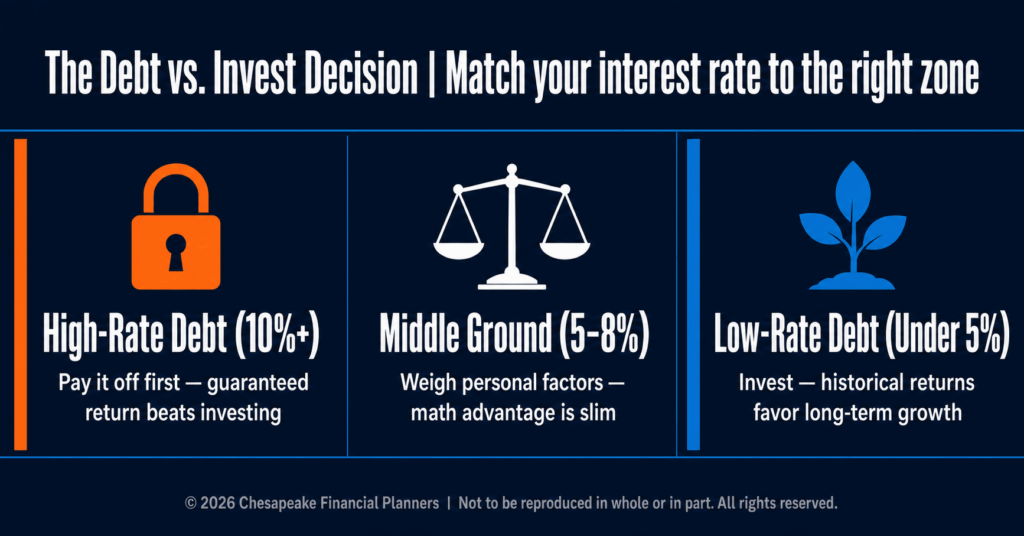
Whether you should pay off debt or invest your windfall depends almost entirely on one number: the interest rate on your debt compared to your expected investment return. If your debt costs more than 8% a year, pay it off first. If it costs less than 5%, investing usually wins over a long enough horizon. Everything in the middle is a judgment call that hinges on your emergency fund, time horizon, and how much debt stress you can tolerate.
Key Takeaways
- Compare your debt's interest rate to your expected investment return; debt above 8% almost always wins the payoff argument.
- Build a 3-to-6-month emergency fund before you do anything else with windfall money.
- The S&P 500 returned about 10% annually over the long run, which beats most low-rate debt.
- Credit card APRs averaged 21.95% in early 2026, making high-interest payoff a guaranteed double-digit return.
- Splitting your windfall between debt and investments is a legitimate strategy when the math is close.
About the Author: Jeff Judge, CFP®, AEP®, ChFC®, CLU® is Managing Partner of Chesapeake Financial Planners in Forest Hill, Maryland. He has been helping families and business owners in Harford County and the Baltimore metro area navigate sudden-money decisions since earning his CFP® certification in 2013, by using Chesapeake Financial Planners’ signature process, the R.U.D.D.E.R. method™. Jeff has watched clients agonize over this exact question, and the people who regret their choice almost always skipped the emergency fund step first.
A windfall, whether it arrives as a bonus, a legal settlement, business sale proceeds, or an inheritance, forces a decision most people only face a handful of times. Pay off debt and you buy guaranteed savings plus a quieter mind. Invest it and you give the money a shot at growing into something far bigger than the debt ever cost you. Both paths are defensible. The trick is matching the path to your actual situation instead of your gut reaction.
How Do I Decide Between Paying Off Debt and Investing?
The decision starts with a simple comparison: your debt's interest rate versus your realistic expected investment return. Money used to retire debt earns a guaranteed return equal to that debt's rate. Money invested earns an uncertain return that, over decades, has historically been higher but never guaranteed.
This is where Chesapeake Financial Planners uses the R.U.D.D.E.R. Method™, our six-step planning process: Review and Recognize, Uncover and Understand, Design and Develop, Discuss and Decide, Execute and Empower, and Reassess and Refine. The "Review and Recognize" step here means listing every debt with its exact rate before you move a dollar.
A $50,000 windfall handled one way versus another can swing your net worth by tens of thousands of dollars a decade later. That spread comes from compounding working in both directions: interest you avoid and growth you capture. According to the Federal Reserve, revolving credit balances carried an average rate near 22% in early 2026, which makes paying off a card the single highest-return move available to most people.
When Does Paying Off Debt Win?
Paying off debt wins decisively when the debt carries a high interest rate, generally above 8%. At those rates, no reliable investment return can compete with the guaranteed savings you lock in by eliminating the balance.
Credit cards, payday loans, and high-rate personal loans fall squarely here. The Federal Reserve put the average credit card APR near 22% in early 2026, and payday loans can exceed 400% on an annualized basis. Pay off a $30,000 card balance at 20% and you have effectively earned a guaranteed, tax-free 20% return, far better than any portfolio can promise.
There is a psychological dividend too. Jeff Judge often tells clients that the people who eliminate high-interest debt sleep better and free up monthly cash flow immediately, which changes how they make every decision afterward. The math is the headline, but the cash-flow relief is what people actually feel.
What's the best way to handle debt coming into a marriage?
When Does Investing the Windfall Win?
Investing tends to win when your debt carries a low interest rate, typically below 5%, and you have a long time horizon. The gap between a 3% mortgage and a diversified portfolio's long-run return compounds powerfully in your favor over a decade or more.
Low-rate mortgages, federal student loans, and many auto loans fall into this category. The S&P 500 has returned roughly 10% annually over the long term, and even balanced portfolios have historically delivered mid-single digits. Investing your windfall in tax-advantaged accounts can stretch that advantage further. The IRS set the 2026 401(k) employee contribution limit at $24,500, giving high earners meaningful room to redirect windfall cash into growth.
Mortgage and student loan interest can also carry tax advantages that lower their effective cost. When debt is cheap and deductible, keeping it while investing is often the rational choice. Still, "historically" is doing real work in that sentence; markets do not owe you 10% on your schedule.
What happens to my finances after a liquidity event?
What About Debt in the 5% to 8% Range?
Debt in the 5% to 8% range is the genuine gray zone, where reasonable people make different choices and neither is wrong. The mathematical edge for investing exists but is thin once you account for taxes on gains and market volatility.
A 5% debt cost against a 7% expected return is only a 2% advantage before risk and taxes. In this zone, the non-math factors should decide: your emergency fund, your time horizon, and how much you hate carrying debt. There is no universally correct answer here, which is exactly why this is the question I get asked about most.
What Should I Do Before Touching the Windfall?
Before you pay off a single debt or buy a single investment, fund your emergency reserve. A windfall that leaves you cash-poor sends the next surprise expense straight back onto a credit card, often at the very rate you just cleared.
Aim for three to six months of essential expenses in an accessible savings account. Bankrate's 2026 survey continues to find that a large share of Americans could not cover a $1,000 emergency from savings, which is precisely the gap a windfall should close first. Build the foundation, then optimize with what remains.
Then look at your full debt picture. Multiple balances at different rates carry a mental cost beyond the math, and a windfall that consolidates several obligations can be worth more than a spreadsheet shows. If your debt payments eat 40% or more of your monthly income, reducing that load may be essential for stability regardless of rates.
What should I do first after inheriting money or property?
Is Splitting the Windfall a Smart Move?
Splitting the windfall between debt payoff and investing is a legitimate strategy, especially in the 5% to 8% gray zone or when you want both guaranteed relief and long-term growth. You do not have to pick one lane.
A common split funds the emergency reserve first, knocks out the highest-rate balance second, and invests whatever remains. This balances the guaranteed return of debt payoff against the growth potential of the market while reducing the regret of going all-in on either side. Your life stage matters here. Someone in their 50s who is behind on retirement might tilt toward investing in tax-advantaged accounts, while someone five years from retirement may value entering it debt-free.
Frequently Asked Questions
Should I pay off my mortgage with a windfall?
Only if your mortgage rate is high or debt-freedom matters more to you than growth. With a sub-5% mortgage, investing the windfall typically builds more wealth over a long horizon, since diversified portfolios have historically returned more than that rate. As you near retirement, the peace of mind from a paid-off home becomes more valuable.
How high does an interest rate need to be before I pay off the debt first?
As a general rule, debt above 8% should be paid off before investing, and debt above 12% almost always wins the payoff argument. Credit cards averaging near 22% in 2026 are the clearest case. Below 5%, investing usually comes out ahead. The 5% to 8% band is a judgment call based on your situation.
Should I invest my windfall or build an emergency fund first?
Build your emergency fund first, every time. Without three to six months of expenses in accessible savings, your next surprise cost lands on a credit card, often undoing the very progress you made. Only after the reserve is funded should you decide between additional debt payoff and investing the remainder.
Does paying off debt count as a guaranteed return?
Yes. Eliminating a debt earns a guaranteed return equal to that debt's interest rate, with no market risk and no taxes owed. Paying off a 20% credit card is mathematically equivalent to earning a guaranteed 20%, which is why high-interest payoff so often beats investing the same dollars.
What should I do with a windfall if all my debt is low-interest?
If every debt sits below 5%, lean toward investing, ideally inside tax-advantaged accounts like a 401(k) or IRA. Confirm your emergency fund is full first, then direct the windfall toward long-term growth. Low, deductible interest rates make keeping the debt and investing the cash the rational, wealth-building choice for most people.
Can I split my windfall between debt and investing?
Yes, and splitting is often the most practical answer. A typical approach fully funds the emergency reserve, then clears the highest-rate debt, then invests whatever remains. This captures both the guaranteed relief of debt payoff and the growth potential of investing, while easing the regret of betting everything on a single path.
If you are weighing what to do with a windfall, the right answer is rarely all-or-nothing, and it depends on numbers most people have never lined up side by side. At Chesapeake Financial Planners, we work through this decision with clients every week. If you want a second opinion before you commit the money, that conversation costs you nothing. Visit chesapeakefp.com to learn more.
Want to go deeper? Our First 90 Days After a Windfall walks through this step by step.
Disclosures
The information provided is for educational purposes only and should not be construed as investment advice. Investment strategies should be tailored to individual circumstances, risk tolerance, and goals. Past performance doesn't guarantee future results. Consult with qualified financial professionals regarding your specific situation.
Advisors associated with Chesapeake Financial Planners may be either (1) LPL Financial Registered Representatives offering securities through LPL Financial, Member FINRA and SIPC, and investment advisor representatives offering investment advice through Great Valley Advisor Group; or (2) solely investment advisor representatives offering investment advice through Great Valley Advisor Group and not affiliated with LPL Financial. Great Valley Advisor Group, and Chesapeake Financial Planners are separate entities from LPL Financial.


