

S-Corp Reasonable Compensation: How Much Salary Is Enough?
Last reviewed: July 2026
S corp reasonable compensation is the salary an owner-employee would have to pay someone else to do the same job, in the same market, with the same skills and hours. The IRS does not publish a dollar amount or a percentage of profit. What it requires is that S-corp shareholder-employees receive W-2 wages for the services they perform before they take distributions, and underpaying that wage line can let the IRS recharacterize distributions as salary, with back payroll taxes, penalties, and interest that often dwarf the original savings.
On This Page
- Key Takeaways
- What does the IRS mean by "reasonable compensation" for an S-corp owner?
- How do you set a defensible S-corp reasonable compensation amount?
- What happens if your S-corp owner salary is too low?
- How does the payroll vs distribution split work with Social Security and Medicare taxes?
- Related Topics Worth Reading
- Frequently Asked Questions
- Putting the salary number on paper
- Disclosures
Key Takeaways
- Reasonable compensation is a facts-and-circumstances test, not a percentage rule or a safe-harbor formula.
- The 2026 Social Security wage base is $184,500, so payroll-tax savings shrink sharply once wages clear that line.
- Distributions avoid the 15.3% self-employment tax, which is the entire reason most owners elect S-corp status.
- A defensible salary triangulates BLS wage data, the cost approach, and the income approach, then sits in a written memo before year-end.
- Underpaying yourself reduces your Solo 401(k) profit-sharing ceiling, your future Social Security benefit, and your audit defense in one move.
About the Author: Jeff Judge, CFP®, AEP®, ChFC®, CLU® is Managing Partner of Chesapeake Financial Planners in Forest Hill, Maryland. He has been helping families and business owners in Harford County and the Baltimore metro area work through S-corp compensation, owner pay, and exit planning since earning his CFP® certification in 2013, by using Chesapeake Financial Planners’ signature process, the R.U.D.D.E.R. method™. Jeff often tells business owners that the payroll vs distribution split is one of the most heavily scrutinized numbers on their tax return and one of the most defensible when it is planned ahead instead of back-rationalized in December.
What does the IRS mean by "reasonable compensation" for an S-corp owner?
Reasonable compensation is the pay an S-corp shareholder-employee would receive for the same services if they were not an owner. The IRS states the rule plainly: "S corporations should treat payments to shareholder-employees for services as wages and not as distributions of cash and property or loans to shareholders." The rule kicks in the moment a shareholder performs more than minor services for the corporation. There is no statutory floor, no required percentage of profit, no safe-harbor formula.
What makes the standard tricky is that "reasonable" depends on the facts of your business and your role within it. A solo consultant generating $300,000 of revenue is in a very different spot than a multi-owner agency where one shareholder spends ten hours a week and another spends fifty. The IRS looks at training, experience, duties, time devoted, hands-on involvement, what comparable businesses pay similar roles, and whether the corporation has a pattern of paying inadequate wages while distributing large profits.
The whole test boils down to one question. If you hired someone else to do exactly what you do, in your market, with your skills and your hours, what would you have to pay them? That number is the floor. Anything above it is fine. The IRS rarely challenges salaries that come in too high, because higher wages mean more payroll-tax revenue. What draws attention is the salary that looks suspiciously low next to a six- or seven-figure distribution.
How do you set a defensible S-corp reasonable compensation amount?
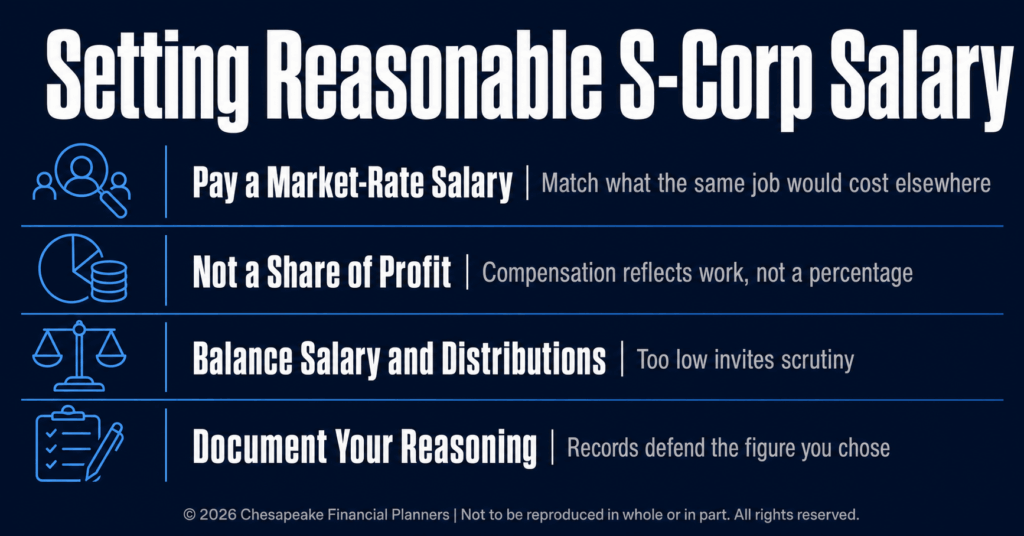
There is no one-size reasonable salary S corp owners can copy off a chart. Most defensible numbers come from one of three benchmarking approaches, and the strongest memos triangulate two or three of them and document the math in writing before payroll runs, not after a notice arrives.
The R.U.D.D.E.R. Method™ is Chesapeake Financial Planners' six-step planning process: Review and Recognize, Uncover and Understand, Design and Develop, Discuss and Decide, Execute and Empower, and Reassess and Refine. We run it with S-corp owners specifically to pressure-test the salary number before the tax return is filed, not after a notice arrives.
| Method | How it works | Best for |
|---|---|---|
| Comparable wage | Pull median or 75th-percentile wage data for your role and metro from BLS Occupational Employment and Wage Statistics, then adjust for experience, credentials, and firm size. | Owners whose work maps cleanly to a defined occupation. |
| Cost approach | Stack the market rate for each function you perform (sales, delivery, billing, management) at the hours you actually spend on each, then add them up. | Owners wearing several hats in a service business. |
| Income approach | Start from total profit, then allocate part as a return on labor (salary) and part as a return on capital (distributions). | Capital-intensive businesses where distributions are partly a return on investment. |
The comparable-wage approach is the cleanest source because BLS data is public and updated annually. For a solo S-corp where the owner sells, delivers, bills, and manages, the cost approach often produces the highest number, since each role carries its own market rate. The income approach tends to push salaries upward for pure service S-corps with little capital at risk, because almost all the profit is a return on labor.
Industry rules of thumb such as the 60/40 split (60% salary, 40% distribution) are easy to remember and have no statutory basis. The IRS has rejected such shortcuts in litigation. Use them as a back-of-the-envelope sanity check, never as a defense. The defensible number is the one supported by data, attached to a written memo, and consistent with the actual work the owner performs.
What happens if your S-corp owner salary is too low?
The IRS can recharacterize part or all of your distributions as wages and then assess back FICA taxes, federal income tax withholding, federal unemployment tax, the additional 0.9% Medicare tax where applicable, plus penalties and interest. The most cited example is Watson v. Commissioner, an Iowa accounting case where the owner paid himself $24,000 in salary while pulling roughly $175,000 to $203,000 in distributions. The court agreed with the IRS that a reasonable salary was closer to $91,000, and the recharacterization carried back payroll taxes plus penalties on top.
The collateral damage often costs more than the direct tax bill. Your Social Security earnings record drops, which can reduce your benefit decades later. Your Solo 401(k) profit-sharing contribution is capped at 25% of W-2 wages for S-corp owners, so a $30,000 salary instead of a $90,000 salary costs you $15,000 of retirement-plan headroom every year. The qualified business income (QBI) deduction calculation can also be affected, because W-2 wages enter the formula at higher income levels.
Audit exposure for S-corps is not theoretical. The IRS has been explicit that under-compensation of officers is a focus area for closely held entities, and modern tax software flags returns where shareholder-employee wages are zero or unusually low relative to distributions and revenue. Jeff Judge has watched owners spend more time and money defending an undocumented number than they would have spent paying the higher salary in the first place. The fix is almost always a written IRS reasonable compensation memo that names the method, cites the wage data, and sits in the file before April.
How does the payroll vs distribution split work with Social Security and Medicare taxes?
The payroll vs distribution decision is mostly a payroll-tax question, and the numbers change sharply at the Social Security wage base. In 2026, the Social Security wage base is $184,500. Below that line, every additional dollar of W-2 wages triggers 12.4% in Social Security tax (split 6.2% employer and 6.2% employee) plus 2.9% in Medicare tax. Above the wage base, only the 2.9% Medicare tax applies, and high earners pay an additional 0.9% Medicare tax on wages over $200,000 single or $250,000 married filing jointly. Jeff Judge notes: "Once your S-corp salary already clears the $184,500 Social Security wage base, the math on pushing it higher shifts dramatically, but you still need to set the number before year-end, not after, to make the retirement-plan contribution work."
This is why the payroll split matters more for owners earning between $80,000 and $185,000 than for owners pulling $500,000 a year. Below the wage base, every extra dollar of salary versus distribution costs about 15.3% in combined payroll taxes. Above the wage base, the cost drops to 2.9%, or 3.8% with the additional Medicare tax layered on. For an S-corp owner who already pays themselves $200,000 in salary on $1 million of profit, pushing the salary higher costs much less than most owners expect.
Compare that to a sole proprietor or single-member LLC, where 100% of net earnings face the full 15.3% self-employment tax up to the wage base, plus 2.9% Medicare on the rest. S-corp status is what shields distributions from the SE tax. The catch is that the IRS will not let you shield wage income masquerading as a distribution, which is the entire reason the reasonable compensation rule exists.
The salary number also drives your retirement-plan ceilings. Your Solo 401(k) salary deferral comes out of W-2 wages, and the profit-sharing portion is capped at 25% of those wages for S-corp owners. Paying yourself an extra $20,000 in salary to unlock a $5,000 employer contribution rarely pencils out; planning the number with your tax advisor and your financial planning team before December avoids the year-end scramble.

Related Topics Worth Reading
If you are working through S-corp compensation, several adjacent decisions usually come up at the same time. Each of these connects directly to how you set, document, and use the salary number.
The choice between S-corp, LLC, and C-corp structures decides whether you face the reasonable compensation rule at all. LLC or s-corp: which saves me more in taxes? walks through the trade-offs in plain language, including when an LLC's simplicity beats the S-corp's payroll-tax savings.
Owner compensation is one piece of a broader business owner planning picture. What does comprehensive financial planning look like for a business owner? covers how salary, distributions, retirement plans, and buy-sell agreements fit together. If you are thinking about exiting in the next five to ten years, Business Sale Tax Planning explains why the salary you pay yourself now affects what your business is worth at sale.
Retirement plans are where the salary number turns into long-term dollars. Solo 401k vs SEP IRA for S-Corp Owners walks through the contribution math at common owner salary levels. What is a cash balance plan, and how can high-income owners save more? covers an option that can shelter six figures of additional compensation in the right business.
For tax planning broadly, 2026 Tax Planning Strategies for Business Owners connects the salary decision to QBI, estimated tax payments, and the broader year-end checklist.
Frequently Asked Questions
Does the IRS publish a minimum S-corp owner salary?
No. The IRS does not publish a minimum dollar amount, a required percentage of profit, or a safe-harbor formula for S-corp shareholder-employee wages. Reasonable compensation is a facts-and-circumstances test based on what someone else would earn doing the same work in your market, given your experience, hours, and duties. Tax-software prompts and online "60/40" rules do not come from the IRS and offer no audit protection on their own.
Can you pay yourself zero salary if the S-corp is barely profitable?
Sometimes, but only when the facts support zero. If the corporation has very little revenue, no distributions, or the shareholder performs only minor services, a zero or token salary may be defensible for that year. As soon as the business is profitable enough to support distributions, the IRS expects wages to come first. Owners who repeatedly run zero-salary returns while pulling cash through distributions face the highest recharacterization risk.
How is reasonable compensation calculated?
Three approaches are commonly used: comparable wage data from BLS Occupational Employment Statistics, a cost approach that prices each role the owner performs at market rates, and an income approach that allocates profit between a return on labor and a return on capital. Strong reasonable compensation memos triangulate two or three methods and document the underlying data in writing before the salary is set.
What documentation supports your S-corp owner salary number?
Keep a written reasonable compensation memo for the year that names the methods used, the wage data sources (BLS occupation code and metro area, comparable salary surveys), the hours worked, the duties performed, and the resulting salary. Update the memo every year as the business grows. Independent reasonable compensation reports from third-party services exist and are inexpensive relative to the audit exposure. The IRS does not require a specific format; what they want is a contemporaneous, defensible analysis.
Do solo S-corp owners get audited more often?
Single-shareholder S-corps with low wages and high distributions are a known IRS focus area. The IRS has stated repeatedly that under-compensation of corporate officers is a compliance priority for closely held entities. Overall S-corp audit rates remain low, but the rate climbs much higher in cases where shareholder wages are zero, suspiciously round, or far below industry norms relative to distributions and revenue.
How does your salary affect your Solo 401(k) contribution?
For S-corp owners, the employer profit-sharing contribution is capped at 25% of W-2 wages, and the employee salary deferral comes out of those same W-2 wages. A salary of $30,000 limits your profit-sharing contribution to $7,500. A salary of $120,000 supports up to $30,000 in profit sharing, plus the full employee deferral. Underpaying yourself on payroll quietly caps your retirement plan.
What if your S-corp salary is too high?
The IRS rarely challenges salaries that are higher than reasonable, because higher wages mean more payroll-tax revenue. The main downside of overpaying is that you give up the payroll-tax savings that drew you to the S-corp election in the first place. Pushing your salary above the Social Security wage base is relatively inexpensive, since only the 2.9% Medicare portion (3.8% with the additional Medicare tax) applies above the base.
Putting the salary number on paper
The cleanest way to take the reasonable compensation question off the table is to set the number before December, document the methodology in a memo, and run payroll consistently across the year. If you want to see how that decision fits with your retirement plan, your exit timing, and your overall tax picture, the CFP team has a Business Owner Financial Planning Guide that walks through s corp reasonable compensation alongside the other big decisions. Download it at chesapeakefp.com to keep this kind of planning ahead of the calendar rather than behind it.
Disclosures
The information provided is for educational purposes only and should not be construed as investment advice. Investment strategies should be tailored to individual circumstances, risk tolerance, and goals. Past performance doesn't guarantee future results. Consult with qualified financial professionals regarding your specific situation.
Advisors associated with Chesapeake Financial Planners may be either (1) LPL Financial Registered Representatives offering securities through LPL Financial, Member FINRA and SIPC, and investment advisor representatives offering investment advice through Great Valley Advisor Group; or (2) solely investment advisor representatives offering investment advice through Great Valley Advisor Group and not affiliated with LPL Financial. Great Valley Advisor Group, and Chesapeake Financial Planners are separate entities from LPL Financial.


