
When Should I Change My Investments Before Retiring?
Last reviewed: July 2026
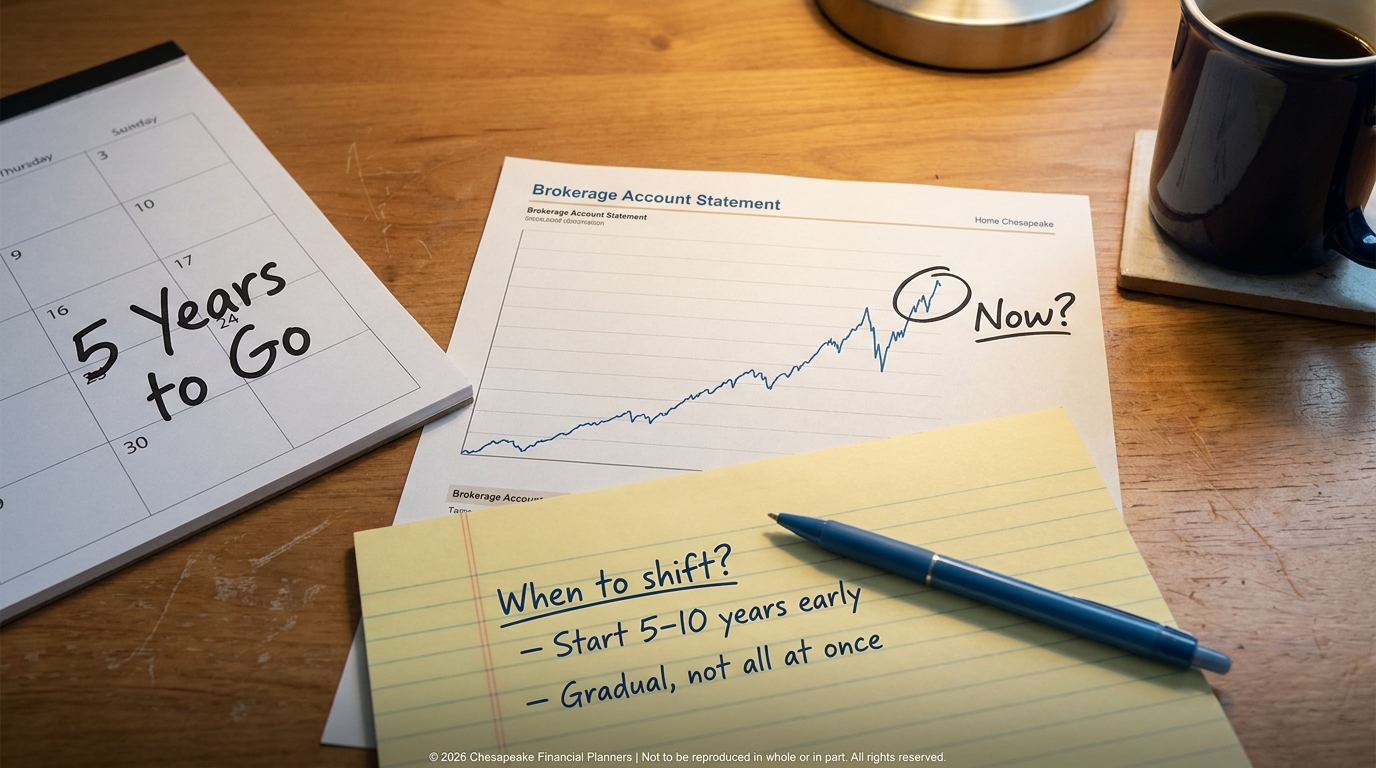
You should start changing your investments before retiring roughly 5 to 10 years out, shifting gradually from growth toward a more balanced mix rather than flipping a switch on your last day of work. The exact timing depends on how close your portfolio is to "just enough," how much guaranteed income you'll have, and your real tolerance for a bad market in the worst possible year. The goal is protecting against a crash in the years right around retirement without giving up the growth a 30-year retirement still demands.
Key Takeaways
- Begin de-risking 5 to 10 years before retirement using a gradual glide path, not a single dramatic shift.
- The "retirement red zone" (roughly ages 55 to 70) is when poor returns do the most damage.
- In 2026, IRA owners under 50 can contribute up to $7,500; those 50+ get a $1,100 catch-up.
- Sequence of returns risk peaks when you stop saving and start withdrawing, so coordinate timing with your withdrawal plan.
About the Author: Jeff Judge, CFP®, AEP®, ChFC®, CLU® is Managing Partner of Chesapeake Financial Planners in Forest Hill, Maryland. He has been helping families and business owners in Harford County and the Baltimore metro area navigate the transition into retirement since earning his CFP® certification in 2013, by using Chesapeake Financial Planners’ signature process, the R.U.D.D.E.R. method™. Jeff's view: the single most expensive mistake he sees near-retirees make isn't picking the wrong fund, it's staying too aggressive in the two or three years before they retire and then panic-selling at the bottom.
The decision to change investments before retiring is less about a magic age and more about your distance from the finish line. Shift too early and you sacrifice growth you'll need across a retirement that may run 30 years. Shift too late and a downturn in the wrong year can permanently reset your standard of living.
What Is the "Retirement Red Zone" and Why Does It Matter?
The retirement red zone is the roughly five years before and five years after your retirement date, when investment losses hurt the most. During this window you hold your largest-ever balance and are about to start, or have just started, withdrawals. A 30% decline on an $800,000 portfolio at age 64 does far more lasting damage than the same percentage on $200,000 at age 40, because you no longer have decades of contributions and compounding to repair it.
This is where sequence of returns risk lives. Sequence risk is the danger that poor returns early in retirement force you to sell investments at depressed prices to fund spending, locking in losses you never recover from. Two retirees can earn the identical average return over 30 years and end up in completely different places purely because of the order in which good and bad years arrive. That is why timing your shift to coordinate with when you'll actually need the money matters as much as the allocation itself. If you want to understand how withdrawals layer on top of this, see What is the best order to withdraw from my 401k, Roth IRA, and taxable accounts in retirement?.
How Should I Use a Glide Path Instead of One Big Shift?
Changing your pre-retirement portfolio works best as a glide path, a gradual reduction in stock exposure that usually starts 5 to 10 years before your target date. This avoids the all-or-nothing bet of moving everything at once, which itself becomes a market-timing decision.
A reasonable framework by age range looks like this:
| Age range | Typical target mix | Primary moves |
|---|---|---|
| 50-55 | Still growth-tilted | Trim small-cap and emerging-market bets; keep core large-cap stocks |
| 55-60 | 70/30 to 60/40 | Add short and intermediate bonds; build 6-12 months cash |
| 60-65 | 60/40 to 50/50 | Build 12-24 months cash; create a bond ladder for early income |
| 65+ | Maintain, then drift lower | Reduce stocks slowly over time; rarely below 30% for inflation protection |
The 30% stock floor matters because inflation does not retire when you do. According to the Bureau of Labor Statistics, consumer prices are tracked continuously, and a portfolio that goes too conservative loses ground in real terms over a multi-decade retirement. Jeff Judge often tells clients that the danger of an all-bond portfolio is quiet: it doesn't crash, it just erodes your purchasing power a little every year until it becomes a problem you can't fix. A glide path keeps enough growth in the mix to fight that while steadily dialing down crash exposure.
When Should I Speed Up My De-Risking Timeline?
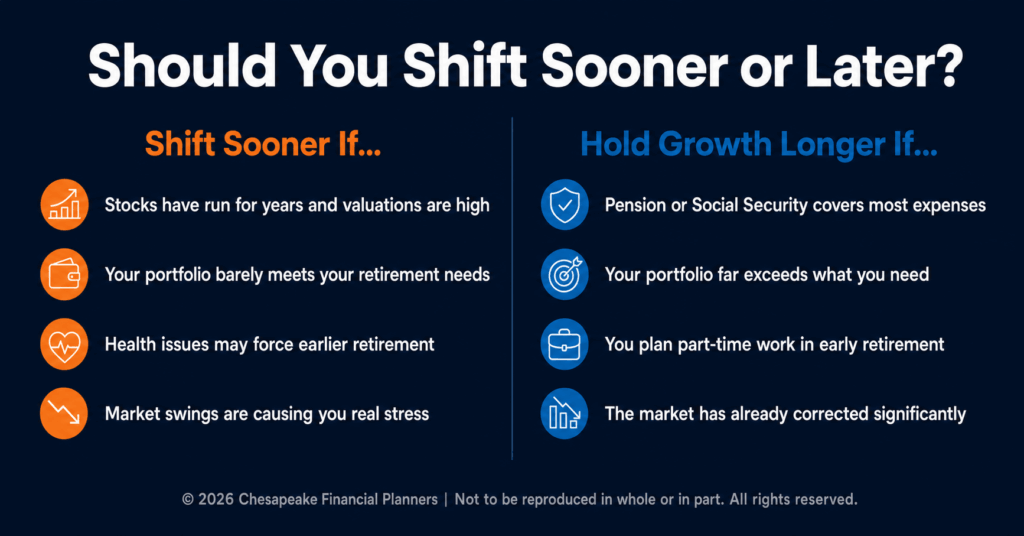
You should accelerate the shift to a more conservative allocation when your portfolio has little margin for error or when a loss would change your decisions. Several situations call for moving faster than the standard glide path.
If you are retiring into an extended bull market with elevated valuations, locking in gains by rebalancing toward bonds reduces the risk of a correction you don't have time to recover from. If your portfolio barely covers a sustainable retirement, you simply cannot afford a 40% drawdown in the final years; protecting against catastrophic timing is worth giving up some upside. Health issues that could force an earlier-than-planned retirement are another reason to de-risk sooner, since you may need to tap the portfolio ahead of schedule.
There's also a behavioral trigger that the spreadsheets miss. In Jeff's experience with pre-retirees, when a client tells him a $50,000 swing is costing them sleep, that's not a math problem, it's a signal the allocation is wrong for the person, regardless of what the age-based model says. The best plan on paper fails the moment someone abandons it at the bottom. For a broader look at the moments that justify a portfolio review, see What Life Events Should Trigger a Financial Plan Review?.
When Can I Afford to Wait Longer Before De-Risking?
You can hold a more aggressive allocation longer when guaranteed income covers most of your essential expenses. If a pension and Social Security together pay for 70% to 80% of your spending, your portfolio only has to fill a smaller gap, which sharply reduces sequence risk and lets you keep more in stocks.
The size of that Social Security floor is meaningful. The Social Security Administration confirms benefits received a 2.8% cost-of-living adjustment for 2026, and the maximum benefit for someone retiring at full retirement age in 2026 is $4,152 per month. When a reliable, inflation-adjusted base like that covers your fixed costs, market volatility on the remaining portfolio is something you can ride out rather than fear. Coordinating these income sources is its own discipline, covered in How do I coordinate all my retirement income sources to minimize taxes and maximize income?.
At Chesapeake Financial Planners, this kind of timing question is one we work through using the R.U.D.D.E.R. Method™, Chesapeake Financial Planners' six-step planning process: Review and Recognize, Uncover and Understand, Design and Develop, Discuss and Decide, Execute and Empower, and Reassess and Refine. Deciding when to change investments before retiring sits squarely in the Design and Develop and Reassess and Refine steps, because the right answer shifts as markets, health, and your actual retirement date move.
Frequently Asked Questions
How many years before retirement should I start changing my investments?
Most people should begin shifting investments 5 to 10 years before retirement, using a gradual glide path rather than one large change. Starting earlier gives you time to de-risk across several market environments instead of being forced into a single timing decision at the worst possible moment.
What is sequence of returns risk in simple terms?
Sequence of returns risk is the danger that poor market returns early in retirement force you to sell investments at low prices to fund spending, permanently shrinking your savings. Two retirees with identical average returns can end up very differently depending only on the order of their good and bad years.
Should I move everything to cash or bonds right before I retire?
No, moving entirely to cash or bonds is usually a mistake because inflation erodes a too-conservative portfolio over a retirement that can last 30 years. Most retirees keep at least 30% in stocks for growth and inflation protection, then hold 1 to 2 years of spending in cash to avoid selling during downturns.
Does having a pension change how aggressive I can stay?
Yes, a pension or large Social Security benefit lets you stay more aggressive longer. When guaranteed income covers roughly 70% to 80% of your expenses, your portfolio only fills a smaller gap, which lowers sequence risk and means you can tolerate more stock-market volatility without jeopardizing your essential spending.
How much cash should I hold going into retirement?
A common target is 12 to 24 months of spending in cash or short-term reserves as you approach and enter retirement. This buffer lets you cover living expenses during a market decline without selling stocks at depressed prices, which is the core defense against sequence of returns risk in the early retirement years.
If you're within a few years of retirement and weighing when to change your investments, a second opinion costs you nothing. Jeff Judge and the Chesapeake Financial Planners team help families and business owners across Harford County and the Baltimore metro pressure-test these exact decisions. Schedule a free fit call at chesapeakefp.com to put a deliberate glide path around your own retirement date.
Disclosures
The information provided is for educational purposes only and should not be construed as investment advice. Investment strategies should be tailored to individual circumstances, risk tolerance, and goals. Past performance doesn't guarantee future results. Consult with qualified financial professionals regarding your specific situation.
Growth investments may be more volatile than other investments because they are more sensitive to investor perceptions of the issuing company's growth of earnings potential.
Advisors associated with Chesapeake Financial Planners may be either (1) LPL Financial Registered Representatives offering securities through LPL Financial, Member FINRA and SIPC, and investment advisor representatives offering investment advice through Great Valley Advisor Group; or (2) solely investment advisor representatives offering investment advice through Great Valley Advisor Group and not affiliated with LPL Financial. Great Valley Advisor Group, and Chesapeake Financial Planners are separate entities from LPL Financial.


