

How Should Upper Chesapeake Health Employees Coordinate Their 403(b), HSA, and Pension Benefits?
Last reviewed: July 2026
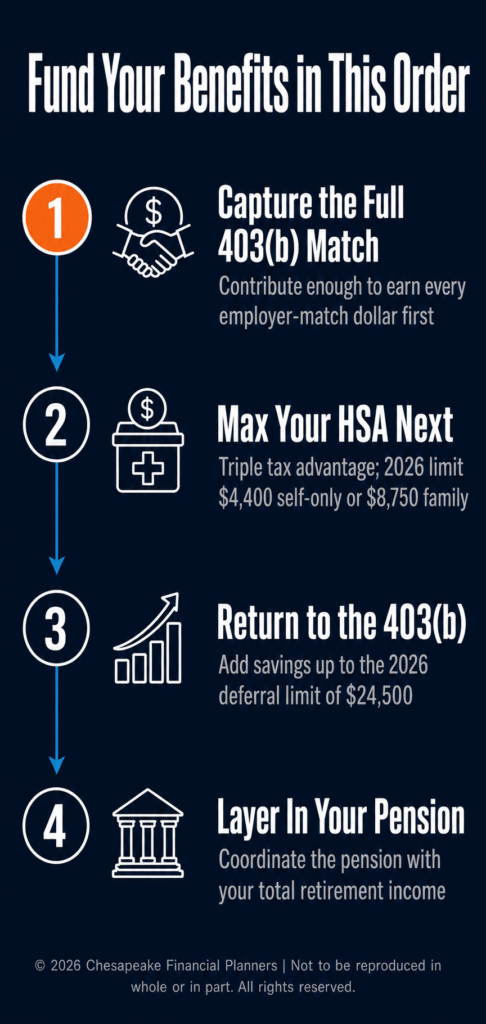
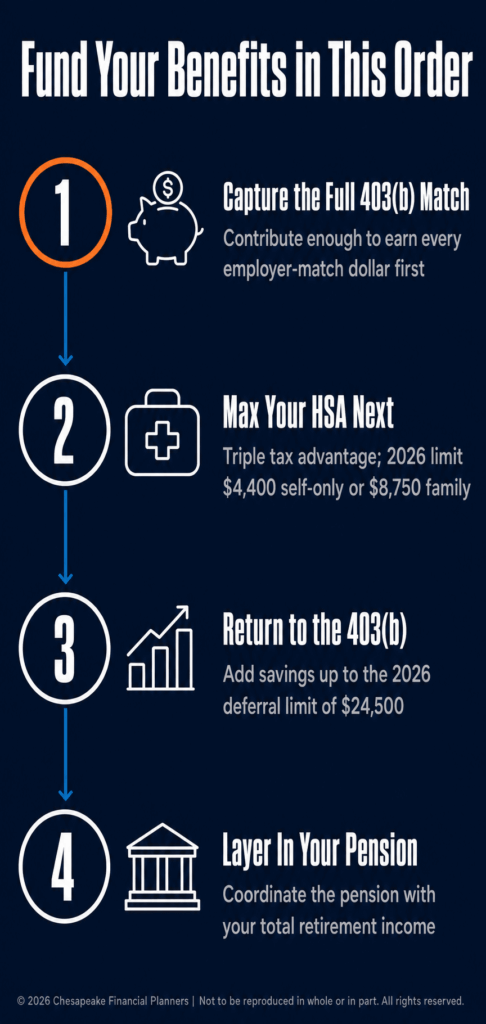
Upper Chesapeake Health employees coordinate their 403(b), HSA, and pension by funding in the right order: capture the full 403(b) match first, max the HSA second for its triple tax advantage, then return to the 403(b) and layer the pension on top as guaranteed income. The pension is the floor, the 403(b) is the flexible growth engine, and the HSA quietly becomes one of the best retirement accounts you own. Getting the sequence right can mean tens of thousands of dollars more by the time you retire from Upper Chesapeake Medical Center.
Key Takeaways
- Fund your 403(b) up to the full employer match first, then redirect dollars to your HSA for its triple tax break.
- The 2026 HSA contribution limit is $4,400 for self-only coverage and $8,750 for family coverage, per IRS guidance.
- The 2026 403(b) elective deferral limit is $24,500, with a $8,000 catch-up at age 50 or older.
- Your pension is guaranteed income that lowers how much investment risk you need to carry in retirement.
- Coordinating all three accounts as one plan beats optimizing each in isolation.
About the Author: Jeff Judge, CFP®, AEP®, ChFC®, CLU® is Managing Partner of Chesapeake Financial Planners in Forest Hill, Maryland. He has been helping families and business owners in Harford County and the Baltimore metro area navigate employer benefit packages since earning his CFP® certification in 2013, by using Chesapeake Financial Planners’ signature process, the R.U.D.D.E.R. method™. Jeff has sat across from dozens of hospital employees in Bel Air who were diligently saving in three accounts and still leaving real money on the table because nobody showed them the order to fund them in.
Upper Chesapeake Medical Center is the flagship hospital in Bel Air, and its benefit package reflects that. Between a 403(b), a health savings account tied to a high-deductible plan, and pension eligibility for many tenured staff, UCHS employee financial planning involves more moving parts than most people realize. The mistake Jeff sees most often in Harford County healthcare workers is treating these three accounts as separate decisions instead of one coordinated strategy.
Step 1: Capture Your Full 403(b) Employer Match First
Before anything else, contribute enough to your 403(b) to get every dollar of the employer match. This is the single highest-return move available to any Upper Chesapeake Health employee. A match is an immediate, guaranteed return on your money that no investment can reliably beat.
The 2026 403(b) elective deferral limit is $24,500, according to the IRS. If you are 50 or older, you can add a catch-up contribution of $8,000, bringing your personal ceiling to $32,500. Workers between ages 60 and 63 may qualify for an even higher catch-up under current rules.
Confirm your exact match formula through HR or your plan portal. Some employers match a percentage of your contribution up to a cap; others use a flat rate. Whatever the formula, contribute at least enough to trigger the full match before you move to step two. Leaving an unmatched dollar on the table is the most expensive mistake in this entire sequence.
Step 2: Max Your HSA for the Triple Tax Advantage in Maryland
Once the match is secured, redirect your next dollars to your health savings account. If you are enrolled in Upper Chesapeake's high-deductible health plan, the HSA is the most tax-efficient account you have access to, and most people underuse it.
The HSA carries a triple tax advantage: contributions go in pre-tax, the money grows tax-free, and qualified medical withdrawals come out tax-free. No other account does all three. The 2026 HSA contribution limit is $4,400 for self-only coverage and $8,750 for family coverage, per the IRS. Account holders 55 and older can add a $1,000 catch-up.
Here is the move most healthcare 403b Maryland savers miss: if you can pay current medical bills out of pocket, do it, and let the HSA invest and compound untouched. After age 65, you can withdraw HSA funds for any reason and pay only ordinary income tax, which makes it function like a second 403(b) with better tax treatment for medical costs. Jeff Judge often tells UCHS clients that the HSA is the most powerful retirement account hiding in plain sight on their benefits menu.
Step 3: Return to the 403(b) and Layer In Your Pension Near Bel Air
With the match captured and the HSA funded, send additional savings back to the 403(b) up to the annual limit. This is your flexible growth engine. Unlike the pension, you control the investments and the withdrawal timing.
Now factor in your Upper Chesapeake Medical Center retirement pension. A pension is guaranteed lifetime income, and it changes how you should think about everything else. Because the pension covers a baseline of your retirement spending, you can often afford to keep your 403(b) invested more aggressively for longer, since you are not relying on it to cover every essential bill. The pension is the floor; the 403(b) sits on top.
Many Harford County hospital employees do not request a formal pension benefit estimate until they are within a year or two of retiring. That is too late to plan around. Jeff has watched clients near Bel Air discover only at the last minute that their pension covered far more of their needs than they assumed, which would have freed them to be bolder with their 403(b) growth years earlier. Request your estimate now and revisit it annually.
Step 4: Coordinate All Three Into One Retirement Income Plan in Harford County
The final step is the one almost everyone skips: stop managing these accounts in isolation and build one plan that sequences them together. This is where the real value lives.
At Chesapeake Financial Planners, we use the R.U.D.D.E.R. Method™, our six-step planning process: Review and Recognize, Uncover and Understand, Design and Develop, Discuss and Decide, Execute and Empower, and Reassess and Refine. For an Upper Chesapeake Health employee, that means mapping which account funds which years of retirement, how the pension start date interacts with Social Security, and how to draw from the HSA, 403(b), and pension in the most tax-efficient order.
Our office sits in Forest Hill, minutes from the UCHS campus in Bel Air, and a large share of our clients are Harford County healthcare workers facing exactly this coordination problem. The Bureau of Labor Statistics reports that healthcare and education employees are among the most likely to have access to both an employer retirement plan and a defined benefit pension, which is precisely why the coordination question matters so much for this group.
What is the right retirement withdrawal order for your accounts?
How do I use an HSA for retirement?
What does a fiduciary financial advisor in Harford County do that a broker doesn't?
Frequently Asked Questions
Can Upper Chesapeake Health employees contribute to both a 403(b) and an HSA in the same year?
Yes. Upper Chesapeake Health employees can fund both a 403(b) and an HSA in the same year, and they are encouraged to. The two accounts have separate contribution limits and serve different purposes. The 403(b) limit is $24,500 in 2026, and the HSA limit is $4,400 self-only or $8,750 family, per IRS guidance.
How much should a UCHS employee contribute to their 403(b) before funding the HSA?
A UCHS employee should contribute enough to their 403(b) to capture the full employer match before redirecting dollars to the HSA. The match is a guaranteed, immediate return that no other account can match. Confirm your exact match formula through HR, fund up to that threshold first, then prioritize the HSA's triple tax advantage.
Does the Upper Chesapeake Medical Center pension reduce how much I need to save?
A pension reduces how much investment income you must generate yourself, because it provides guaranteed lifetime income that covers a baseline of spending. It does not eliminate the need to save in your 403(b) and HSA. Instead, the pension lets you take a more strategic approach to investing those accounts since your essentials are partially covered.
Is the HSA a good retirement account for Harford County healthcare workers?
Yes. The HSA is one of the strongest retirement accounts available to Harford County healthcare workers because of its triple tax advantage. Contributions are pre-tax, growth is tax-free, and medical withdrawals are tax-free. After age 65, non-medical withdrawals are taxed like ordinary income, making it function as a flexible supplemental retirement account.
When should an Upper Chesapeake Health employee in Bel Air request a pension estimate?
An Upper Chesapeake Health employee in Bel Air should request a formal pension benefit estimate now, not in the final year before retirement. Knowing your projected pension income early lets you plan how aggressively to invest your 403(b) and when to claim Social Security. Revisit the estimate annually as your tenure and salary change.
If you found this helpful, our retirement planning guide for Maryland healthcare workers covers benefit coordination in more depth. Download it at chesapeakefp.com to see how your 403(b), HSA, and pension fit into one Upper Chesapeake Health employee benefits 403b strategy built around your actual retirement timeline.
Want to go deeper? Our Maryland Financial Planning Guide walks through this step by step.
Disclosures
The information provided is for educational purposes only and should not be construed as investment advice. Investment strategies should be tailored to individual circumstances, risk tolerance, and goals. Past performance doesn't guarantee future results. Consult with qualified financial professionals regarding your specific situation.
This information is not intended to be a substitute for specific individualized tax, investment or legal advice. We suggest that you discuss your specific situation with a qualified tax, legal or financial advisor.
Advisors associated with Chesapeake Financial Planners may be either (1) LPL Financial Registered Representatives offering securities through LPL Financial, Member FINRA and SIPC, and investment advisor representatives offering investment advice through Great Valley Advisor Group; or (2) solely investment advisor representatives offering investment advice through Great Valley Advisor Group and not affiliated with LPL Financial. Great Valley Advisor Group, and Chesapeake Financial Planners are separate entities from LPL Financial.


