

How Does TSP (Thrift Savings Plan) Rollover Work and When Should I Do It?
Last reviewed: July 2026
A TSP rollover moves money from your Thrift Savings Plan into another retirement account, usually a traditional IRA, Roth IRA, or a new employer plan. You do it by requesting a direct rollover, where the TSP sends funds straight to the receiving custodian and no taxes are withheld. The best time to roll over is typically after you separate from federal service, when you want more investment choices, simpler Roth conversion options, or consolidated accounts. But rolling over is not always the right move, and TSP rollover financial planning starts with knowing what you give up.
Key Takeaways
- A direct TSP rollover moves funds custodian-to-custodian with no tax withholding, while an indirect rollover triggers a mandatory 20% withholding.
- The TSP charges among the lowest fees in the retirement industry, so leaving money in is sometimes smarter than rolling out.
- In 2026, the IRA contribution limit is $7,500 with a $1,100 catch-up for those 50 and older.
- Roth TSP and traditional TSP funds must roll into matching Roth and traditional IRAs to avoid an unexpected tax bill.
- Federal employees who separate before age 59½ should understand the Rule of 55 and the age-55 TSP exception before moving money.
About the Author: Jeff Judge, CFP®, AEP®, ChFC®, CLU® is Managing Partner of Chesapeake Financial Planners in Forest Hill, Maryland. He has been helping families and federal employees in Harford County and the Baltimore metro area navigate retirement plan rollovers since earning his CFP® certification in 2013, by using Chesapeake Financial Planners’ signature process, the R.U.D.D.E.R. method™. Jeff often tells federal clients that the TSP is one of the cheapest retirement vehicles in the country, so the decision to roll out should be driven by a specific need, not a salesperson's pitch.
Federal employees sit on one of the best-built retirement accounts available. The TSP runs lean, the index funds are nearly free to hold, and the G Fund offers a guarantee no private account can match. So before you move a dollar, you should know exactly what problem the rollover solves. Below is how a TSP rollover actually works, the tax traps to avoid, and the timing that makes the decision pay off.
What Is a TSP Rollover and How Does It Work?
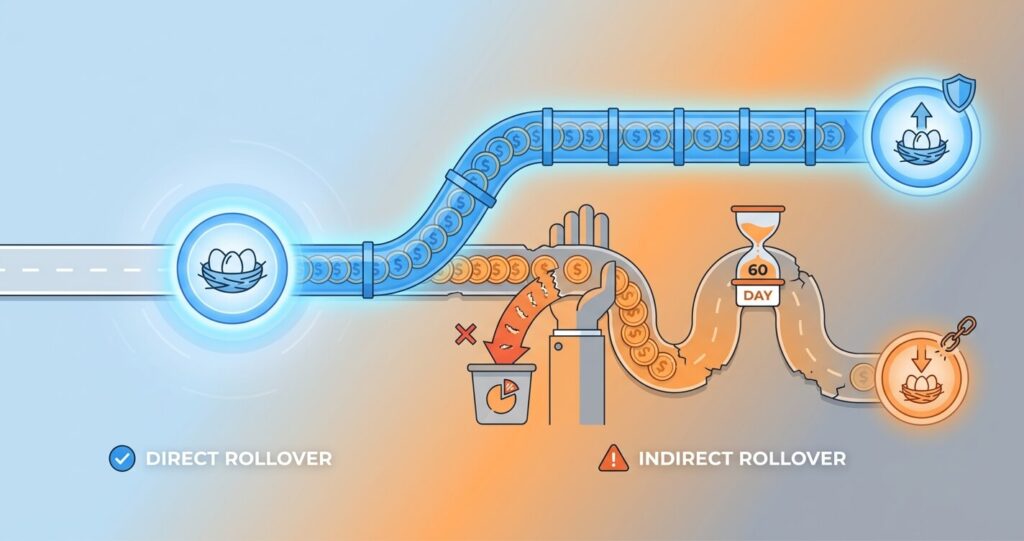
A TSP rollover is the transfer of your Thrift Savings Plan balance into another tax-advantaged retirement account without triggering a taxable distribution. The cleanest method is a direct rollover. You complete the TSP withdrawal request, name the receiving institution, and the TSP wires the money straight to that custodian. Because you never take possession of the funds, nothing is withheld and nothing is taxed in that year.
The other method is an indirect rollover. Here the TSP sends the money to you, withholds 20% for federal taxes on the pre-tax portion, and gives you 60 days to deposit the full original amount into the new account. The catch is that you have to replace that withheld 20% out of pocket to complete a full rollover. Miss the 60-day window and the IRS treats the whole thing as a distribution, with income tax and a possible 10% early-withdrawal penalty.
Jeff has watched a client lose thousands by choosing the indirect route when a direct transfer was available. The money sat in a checking account for five weeks, the 60-day clock nearly ran out, and the 20% withholding created a cash-flow scramble that never needed to happen. Direct is almost always the answer.
How does the Thrift Savings Plan (TSP) work for federal employees?
When Should a Federal Employee Roll Over Their TSP?
The right time to roll over your TSP is when you have a concrete reason the IRA gives you and the TSP cannot. The most common trigger is separation from federal service, since you generally cannot roll out while still contributing. After you separate, four reasons come up again and again.
First, you want investment options the TSP does not offer. The TSP holds five core funds plus lifecycle funds; an IRA opens the full market. Second, you want cleaner Roth conversion control, which an IRA handles more flexibly than the TSP's pro-rata rules. Third, you want to consolidate scattered accounts into one place for simpler required minimum distributions. Fourth, you want estate-planning features and beneficiary flexibility that some custodians provide. Jeff Judge notes: "Rolling out of the TSP makes sense when the IRA gives you something concrete the TSP cannot, whether that's Roth conversion flexibility, consolidated RMDs, or beneficiary options, but 'more choices' by itself isn't a reason if you're not going to use them."
The R.U.D.D.E.R. Method™ is Chesapeake Financial Planners' six-step planning process: Review and Recognize, Uncover and Understand, Design and Develop, Discuss and Decide, Execute and Empower, and Reassess and Refine. A TSP rollover decision lives in the Design and Develop stage, after you have actually mapped what the rollover buys you against what it costs.
What is the best strategy for withdrawing from my TSP when I retire?
What Are the Tax Implications of a TSP Rollover?
A properly executed direct TSP rollover is not a taxable event. Traditional (pre-tax) TSP money rolls into a traditional IRA with no tax due, and Roth TSP money rolls into a Roth IRA with no tax due. The danger comes from mixing the two buckets. If you roll Roth TSP money into a traditional IRA, or pre-tax money into a Roth without intending a conversion, you can create a surprise tax bill.
If you do convert pre-tax TSP money to a Roth IRA, that conversion is fully taxable in the year you do it. According to the IRS, the rollover chart spells out which account types can receive which dollars, and it is worth reading before you sign anything. Converting in a low-income year, such as the gap between separation and the start of Social Security, can keep the tax cost down.
Be careful about your tax bracket. A large conversion can push income into a higher bracket and even raise Medicare premiums later through IRMAA. For 2026, the IRA contribution limit is $7,500, with an extra $1,100 catch-up for savers age 50 and up, a useful figure when you are coordinating new contributions alongside a rollover.
What are the tax implications of a lump sum payout?

Should You Keep Money in the TSP or Roll It Out?
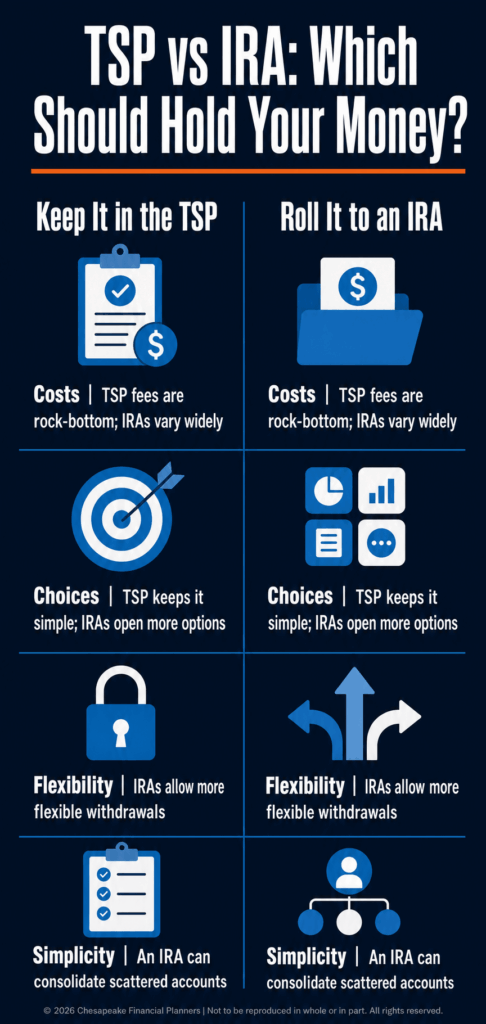
Keeping money in the TSP is often the smarter default, and that surprises people who assume more choices always win. The TSP's expense ratios are among the lowest of any retirement vehicle in the country, and the G Fund pays government-security yields with no risk of principal loss, something no IRA can replicate. For many federal retirees, the simplest, cheapest, safest move is to leave the core balance right where it is.
| Feature | Keep in TSP | Roll to IRA |
|---|---|---|
| Investment menu | 5 core funds plus lifecycle funds | Full market access |
| Fees | Among lowest available | Varies; can be higher |
| G Fund access | Yes, unique guarantee | No equivalent |
| Roth conversion flexibility | Limited, pro-rata rules | More flexible |
| Account consolidation | Stays separate | Combines accounts |
A balanced approach is a partial rollover. You can move part of your balance to an IRA for flexibility and conversions while keeping the rest, including the G Fund allocation, inside the TSP. According to the FINRA investor guidance, comparing fees and features before any rollover is one of the most overlooked steps savers take.
How do I coordinate my FERS pension, TSP, and Social Security for the best retirement outcome?
How does FERS retirement planning work for federal employees?
Frequently Asked Questions
How long does a TSP rollover take?
A direct TSP rollover usually takes two to four weeks from the time the TSP processes your withdrawal request to when funds settle at the new custodian. Processing times depend on whether your forms are complete and whether spousal consent is required, so submit clean paperwork and confirm the receiving account is open first.
Can I roll my TSP into a Roth IRA?
Yes, but the treatment depends on which TSP money you move. Roth TSP balances roll into a Roth IRA tax-free. Pre-tax traditional TSP money rolled into a Roth IRA counts as a Roth conversion and is fully taxable that year. Many federal retirees convert gradually in lower-income years to manage the tax cost.
Will I pay a penalty for rolling over my TSP?
No, a properly executed direct rollover is not a distribution, so there is no 10% early-withdrawal penalty and no income tax in that year. The penalty risk appears with indirect rollovers that miss the 60-day deadline, or with actual withdrawals taken before age 59½ that do not qualify for an exception.
What happens to TSP matching contributions if I roll over?
All vested matching contributions and agency automatic contributions roll over along with your own contributions once you separate from federal service. FERS employees vest in agency automatic contributions after a service requirement, so confirm your vesting status before separating, because unvested agency money is forfeited if you leave too early.
Should I roll over my TSP before or after retirement?
Most federal employees should wait until after they separate from service, since you generally cannot roll funds out while still working and contributing. The window after separation but before Social Security and required minimum distributions begins is often the best time, because lower income years make Roth conversions cheaper to execute.
Can I keep some money in the TSP and roll the rest out?
Yes, a partial rollover lets you move part of your balance to an IRA while keeping the rest in the TSP. This is a common strategy for federal retirees who want IRA flexibility for conversions and broader investments but still want the low-cost G Fund and TSP index funds for a portion of their portfolio.
Where This Leaves You
A TSP rollover is a tool, not a default. The right move depends on what the IRA buys you that the TSP cannot, and for many federal retirees the answer is a partial rollover or no rollover at all. At Chesapeake Financial Planners, we work through TSP rollover financial planning with federal employees every week, weighing fees, the G Fund, and Roth conversion timing before any money moves. If you are weighing this decision, a second opinion costs you nothing. Visit chesapeakefp.com to learn more.
Disclosures
The information provided is for educational purposes only and should not be construed as investment advice. Investment strategies should be tailored to individual circumstances, risk tolerance, and goals. Past performance doesn't guarantee future results. Consult with qualified financial professionals regarding your specific situation.
This information is not intended to be a substitute for specific individualized tax, investment or legal advice. We suggest that you discuss your specific situation with a qualified tax, legal or financial advisor.
Advisors associated with Chesapeake Financial Planners may be either (1) LPL Financial Registered Representatives offering securities through LPL Financial, Member FINRA and SIPC, and investment advisor representatives offering investment advice through Great Valley Advisor Group; or (2) solely investment advisor representatives offering investment advice through Great Valley Advisor Group and not affiliated with LPL Financial. Great Valley Advisor Group, and Chesapeake Financial Planners are separate entities from LPL Financial.


