

How Does the Step-Up in Basis Work on Inherited Assets?
Last reviewed: July 2026
The step-up in basis resets the cost basis of most inherited assets to their fair market value on the owner's date of death, so the years of growth that happened during that person's life drop out of the capital gains calculation. Inherit a brokerage account of long-held stock, and your basis usually becomes the value on the day the owner died, not what they originally paid. That single rule is one of the most valuable and least understood parts of inheriting assets, and the fix for keeping it usually starts with one document most families forget to request.
Key Takeaways
- The step-up in basis on inherited assets resets cost basis to the date-of-death value, so lifetime appreciation drops out of the capital gains math.
- Taxable brokerage accounts, real estate, and business interests step up; a traditional IRA or 401(k) does not, and heirs pay ordinary income tax on it.
- A date-of-death appraisal locks in the higher basis for property without a daily price, which can cut a reported gain by hundreds of thousands of dollars.
- Maryland charges both a $5 million estate tax exemption and a 10% inheritance tax on non-lineal heirs, far below the $15 million federal exemption.
About the Author: Jeff Judge, CFP®, AEP®, ChFC®, CLU® is Managing Partner of Chesapeake Financial Planners in Forest Hill, Maryland. He has been helping families and business owners in Harford County and the Baltimore metro area navigate inherited assets and estate transitions since earning his CFP® certification in 2013, using Chesapeake's signature process, the R.U.D.D.E.R. Method™. "I have watched heirs write big checks to the IRS on inherited stock that owed almost nothing, simply because nobody told them the basis reset the day their parent died," Jeff says.
What Is the Step-Up in Basis, and How Does It Work on Inherited Assets?
The step-up in basis is the rule that resets your cost basis on most inherited capital assets to the fair market value on the owner's date of death. Under the tax code, the original purchase price stops mattering the moment you inherit. What the person paid decades ago is replaced by what the asset was worth the day they died.
Picture a parent who bought $50,000 of stock in the 1990s that is worth $400,000 when they pass away. If they had sold it during their lifetime, they would have owed tax on $350,000 of growth. When you inherit it instead, your basis steps up to $400,000. Sell it the next week at $400,000 and your taxable gain is zero, not $350,000. That lifetime of appreciation comes out of the capital gains math entirely.
Does the original purchase price still matter after a step-up? No. Once the basis resets to the date-of-death value, the price the original owner paid is no longer part of your gain calculation. Your gain is measured only from the stepped-up figure forward, which is why the timing of the reset matters so much. Any growth after the date of death is still taxable when you sell, and understanding how capital gains tax works on that future growth helps you plan the sale.
Inherited property also gets automatic long-term treatment. Even if you sell shortly after inheriting, any gain above the stepped-up basis is taxed at the lower long-term capital gains rates rather than the higher ordinary income rates. Depending on your income, those long-term rates run 0% to 15% for many households, with a possible 3.8% net investment income surtax on top for higher earners. The R.U.D.D.E.R. Method™ is Chesapeake Financial Planners' six-step planning process: Review and Recognize, Uncover and Understand, Design and Develop, Discuss and Decide, Execute and Empower, and Reassess and Refine, and step number one is simply recognizing which assets reset and which do not.
Which Assets Get a Step-Up, and Which Ones Do Not?
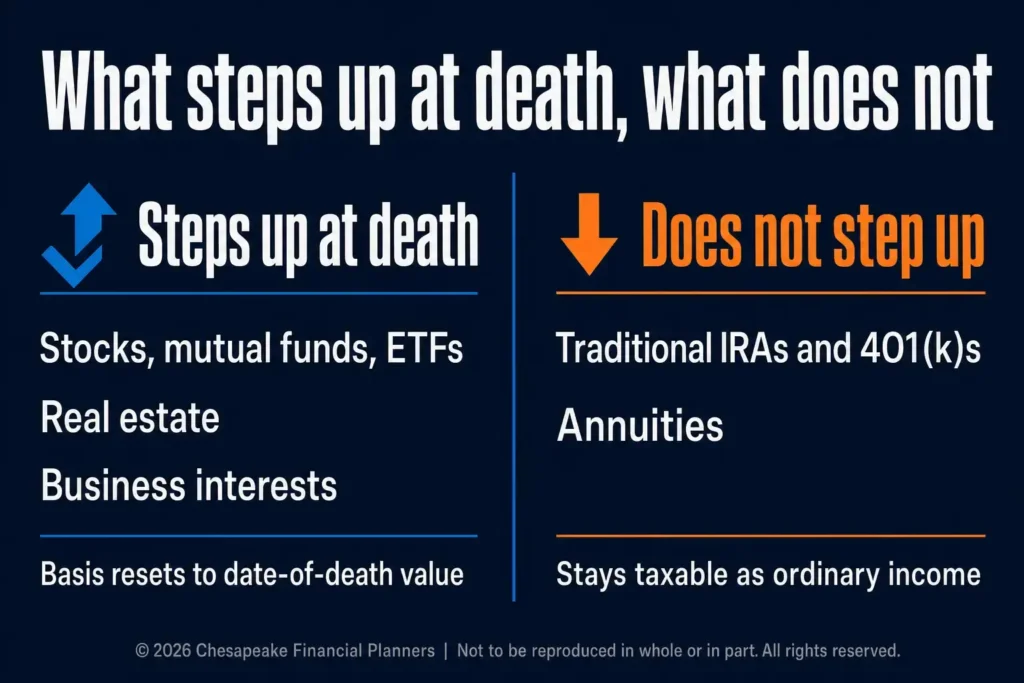
Most capital assets get the step-up, but retirement accounts do not, and that split changes the entire strategy. The step-up applies to individual stocks, mutual funds, real estate, and closely held business interests. Traditional IRAs, 401(k)s, and similar tax-deferred accounts get no basis reset at all.
Jeff Judge, CFP®, is blunt about the tradeoff:
"This single rule is the reason highly appreciated assets are often better held until death than gifted during life. A lifetime gift carries the original low basis with it, while an inheritance resets it. That is the whole ballgame for families sitting on decades of stock or a long-held building."
A traditional IRA is treated as income in respect of a decedent, which means the beneficiary pays ordinary income tax on every dollar withdrawn, and it typically has to come out under the inherited IRA 10-year rule. Annuities generally get no step-up either. So the same $400,000 looks completely different depending on where it sits, and this table shows why.
| Inherited asset | Gets a step-up? | How the heir is taxed |
|---|---|---|
| Taxable brokerage stock or funds | Yes | Gain measured from date-of-death value; long-term rates |
| Real estate | Yes | Basis resets to appraised date-of-death value |
| Closely held business interest | Yes | Basis resets to appraised date-of-death value |
| Traditional IRA or 401(k) | No | Ordinary income tax on every dollar withdrawn |
| Annuity (non-qualified) | Generally no | Ordinary income tax on the gain portion |
That contrast shapes which accounts an heir should draw down first. A taxable account already received its step-up, so selling may trigger little or no gain, while every dollar pulled from an inherited traditional IRA is taxed as ordinary income. An heir who needs cash is often better served tapping the stepped-up taxable account first.
Why Does a Date-of-Death Appraisal Matter for the Step-Up?
The step-up is only as good as your proof of it, and a date-of-death appraisal is how you prove it for assets without a daily market price. For publicly traded stock, the value is straightforward: the closing price on the date of death. For real estate, a closely held business, or other assets that do not trade every day, the stepped-up value is not automatic. Someone has to establish it.
Consider a family home bought for $120,000 that is worth $600,000 at death. With a date-of-death appraisal, the heir's basis is set at $600,000 on paper. Sell it two years later for $640,000 and the taxable gain is only $40,000. Skip the appraisal, and an heir who cannot document the $600,000 value may end up reporting a far larger gain built off the original $120,000 purchase price.
What if there is no appraisal? Without a credible date-of-death valuation, you may be unable to support the higher basis if the IRS questions your gain, which can turn a small taxable gain into a large one. The appraisal has to be done near the time of death, not reconstructed years later from memory or old listings. In my experience, this is the step families skip most often, and the one that costs the most to fix later.
How Should Heirs Sort and Spend Down Inherited Accounts?
Sort the inheritance by tax treatment before you decide what to sell, because the stepped-up assets and the ordinary-income assets call for opposite moves. Group everything into two buckets: assets that received a step-up, and assets that did not. A stepped-up brokerage position can often be sold with little gain. An inherited traditional IRA is taxable at ordinary rates on the way out, so the order you tap these accounts drives the size of your tax bill.
How assets were titled also changes how much basis resets. In most common-law states, when one spouse dies, only the deceased spouse's half of a jointly owned asset steps up, while the surviving spouse's half keeps its original basis, a partial step-up. In community property states, both halves can step up, a full double step-up. A second step-up waits down the road: when the surviving spouse later passes, the assets step up again for the next generation.
There is also a timing lever for larger estates. An estate may elect an alternate valuation date six months after death, using fair market value at that later point, but only when it both reduces the gross estate and reduces the estate tax. That narrows it to a small set of taxable estates. For most families, the core work is simpler. Here is the short list I give people navigating this:
- Get date-of-death valuations for everything without a public market price, especially real estate and business interests, close to the time of death.
- Separate the inherited assets by tax treatment before deciding what to sell or keep.
- Gather cost basis information while it is still findable, in case any asset did not step up.
- Resist the urge to sell or reorganize quickly, before you understand what you are holding.

How Do Maryland's Estate and Inheritance Taxes Affect Inherited Assets?
Maryland adds a state-level layer that the federal step-up does not erase, and it hits closer to home than most heirs expect. Maryland is the only state that charges both an estate tax and an inheritance tax. The Maryland estate tax uses a $5 million per-person exemption with a top rate of 16%, far below the $15 million federal exemption now in place. An estate can owe Maryland tax while owing nothing federally.
The inheritance tax works differently. Maryland charges a 10% inheritance tax on property passing to heirs who are not close relatives. A spouse, child, parent, grandparent, or sibling is exempt, but a niece, nephew, friend, or unmarried partner can owe 10% on what they receive. That matters for inherited retirement accounts especially. A non-lineal heir who inherits a traditional IRA can face Maryland inheritance tax on top of the federal ordinary income tax already owed on withdrawals, a double bite the step-up does nothing to soften.
This is daily work for our clients across Forest Hill, Harford County, and the Baltimore metro. Many local families hold a paid-off house, a brokerage account, and a traditional IRA, and assume the big federal exemption keeps their heirs in the clear. The Maryland thresholds are much lower, and the person on that IRA beneficiary line may not be a lineal heir. Sorting that out early is exactly the kind of planning Jeff Judge walks families through in a first meeting.
Frequently Asked Questions
What is the step-up in basis on inherited assets?
The step-up in basis resets your cost basis on most inherited capital assets to their fair market value on the owner's date of death. The original purchase price no longer counts toward your gain, so decades of appreciation during the owner's life drop out of the capital gains calculation when you sell.
Do retirement accounts get a step-up in basis?
No. Traditional IRAs, 401(k)s, and similar tax-deferred accounts get no step-up. They are income in respect of a decedent, so the heir pays ordinary income tax on every dollar withdrawn. This is the key reason an inherited IRA and an inherited brokerage account should be handled with completely different strategies.
How do I prove the stepped-up basis on inherited real estate?
You prove it with a date-of-death appraisal from a qualified appraiser that establishes fair market value as of the day the owner died. For publicly traded stock, the closing price on that date is enough. For a house or a business interest, order the appraisal near the time of death, not years later.
What is the alternate valuation date?
The alternate valuation date lets an estate value assets six months after the date of death instead of on the date of death itself. It is available only when it both lowers the gross estate and lowers the estate tax, so it applies to a narrow set of larger, taxable estates rather than to most families.
Does Maryland tax inherited assets?
Yes. Maryland charges a state estate tax above a $5 million exemption and a 10% inheritance tax on property passing to heirs who are not close relatives. Spouses, children, parents, grandparents, and siblings are exempt from the inheritance tax, but more distant heirs and non-relatives can owe 10%.
Is it better to inherit an asset or receive it as a gift?
Inheriting is often better for highly appreciated assets. A lifetime gift carries the original low cost basis to the recipient, while an inheritance resets the basis to the date-of-death value. That difference can mean a much smaller capital gains bill for the person who receives a long-held stock or property at death.
Ready to Put a Plan Around Your Inheritance?
Inherited assets reward the families who slow down, document the date-of-death values, and understand which pieces stepped up before they sell anything. Whether you recently inherited a portfolio, a home, or a business interest, or you are planning how your own assets will pass, that groundwork is worth getting right. Jeff Judge and the Chesapeake team serve families across Harford County and the Baltimore metro. Schedule a free fit call and put a plan around your step-up in basis on inherited assets.
A version of this article was originally published on Chesapeake Financial Planners' LinkedIn.
Disclosures
The information provided is for educational purposes only and should not be construed as investment advice. Investment strategies should be tailored to individual circumstances, risk tolerance, and goals. Past performance doesn't guarantee future results. Consult with qualified financial professionals regarding your specific situation.
This information is not intended to be a substitute for specific individualized tax, investment or legal advice. We suggest that you discuss your specific situation with a qualified tax, legal or financial advisor.
Investments in real estate may be subject to a higher degree of market risk because of concentration in a specific industry, sector or geographical sector. Other risks can include, but are not limited to, declines in the value of real estate, potential illiquidity, risks related to general and economic conditions, stage of development, and defaults by borrower.
Contributions to a traditional IRA may be tax deductible in the contribution year, with current income tax due at withdrawal. Withdrawals prior to age 59 ½ may result in a 10% IRS penalty tax in addition to current income tax.
Stock investing includes risks, including fluctuating prices and loss of principal.
Investing in mutual funds involves risk, including possible loss of principal. Fund value will fluctuate with market conditions and it may not achieve its investment objective.
Advisors associated with Chesapeake Financial Planners may be either (1) LPL Financial Registered Representatives offering securities through LPL Financial, Member FINRA and SIPC, and investment advisor representatives offering investment advice through Great Valley Advisor Group; or (2) solely investment advisor representatives offering investment advice through Great Valley Advisor Group and not affiliated with LPL Financial. Great Valley Advisor Group, and Chesapeake Financial Planners are separate entities from LPL Financial.
Chesapeake Financial Planners | 2402 Scotlon Ct, Forest Hill, MD 21050 | (410) 652-7868 | www.chesapeakefp.com
© 2026 Chesapeake Financial Planners | Not to be reproduced in whole or in part. All rights reserved.


