
How Does the Social Security Earnings Test Work if I Keep Working?
Last reviewed: July 2026
The Social Security earnings test reduces your benefits if you claim before full retirement age and keep working above an annual income limit. In 2026, if you're under full retirement age all year, Social Security withholds $1 in benefits for every $2 you earn above $24,480, according to the Social Security Administration. The money isn't gone forever. Once you reach full retirement age, your benefit is recalculated and you get credited back for what was withheld.
Key Takeaways
- The Social Security earnings test only applies if you claim before full retirement age and keep earning wages.
- In 2026, benefits drop $1 for every $2 earned above $24,480 if you're under full retirement age all year.
- Withheld benefits aren't lost; your monthly payment is recalculated upward at full retirement age.
- Only earned income counts toward the earnings test, not pensions, investments, or required minimum distributions.
About the Author: Jeff Judge, CFP®, AEP®, ChFC®, CLU® is Managing Partner of Chesapeake Financial Planners in Forest Hill, Maryland. Jeff has watched clients panic over the earnings test, thinking the government is keeping their money for good, when in reality it's a timing adjustment, not a permanent loss. He has been helping families and business owners in Harford County and the Baltimore metro area optimize their Social Security claiming strategies since earning his CFP® certification in 2013, by using Chesapeake Financial Planners’ signature process, the R.U.D.D.E.R. method™.
What Is the Social Security Earnings Test?
The Social Security earnings test is a rule that temporarily withholds part of your retirement benefits if you claim before full retirement age and earn wages above a set threshold. It exists to discourage people from collecting full benefits while still working a high-paying job in their early sixties.
There are two separate limits, and which one applies depends on your age. If you're under full retirement age for the entire year, the lower limit applies. In the year you reach full retirement age, a higher limit kicks in and the withholding rate softens. According to the Social Security Administration, the 2026 limit for people who reach full retirement age that year is $65,160, and benefits are reduced by $1 for every $3 earned above it, counting only earnings before the month you hit full retirement age.
Here's the part most people miss. Once you reach full retirement age, the earnings test disappears completely. You can earn a million dollars a year and Social Security won't withhold a penny. This is why Jeff Judge tells pre-retirees that the earnings test is a problem with an expiration date, not a permanent penalty.
How Much Will the Earnings Test Reduce My Benefits?
The reduction depends on how far above the limit you earn and which limit applies to your age. The math is mechanical once you know the rule. For 2026, the Social Security Administration sets these thresholds:
| Situation | 2026 Annual Limit | Withholding Rate |
|---|---|---|
| Under full retirement age all year | $24,480 | $1 withheld per $2 over the limit |
| Reaching full retirement age in 2026 | $65,160 | $1 withheld per $3 over the limit (earnings before FRA month only) |
| At or past full retirement age | No limit | No withholding |
Say you're 63 and earn $44,480 in 2026. That's $20,000 over the $24,480 limit. Social Security withholds half of that excess, or $10,000, spread across the year. If your monthly benefit is $1,800, they'd hold back roughly five and a half months of checks. The withholding isn't a small trim around the edges. For higher earners claiming early, the earnings test can swallow the entire benefit.
That outcome leads many people to a simple conclusion: if you're working a full-time job that pays well, claiming Social Security before full retirement age often makes little sense. You give up checks now and accept a permanently lower benefit, all for income that may be largely withheld anyway.
What Income Counts Toward the Earnings Test?
Only earned income counts. That means wages from a job and net earnings from self-employment. Everything else is excluded, and this distinction trips people up constantly.
The following do not count toward the earnings test:
- Pension and annuity payments
- Investment income, dividends, and capital gains
- Interest income
- Required minimum distributions from IRAs and 401(k)s
- Rental income (in most cases)
- Veterans benefits and other government benefits
So a retiree living on a pension and portfolio withdrawals can claim early and never trigger the earnings test, no matter how large those payments are. But someone still drawing a paycheck has to watch the wage threshold closely. Jeff often points out that this is one of the few places in retirement planning where the source of your income matters more than the amount.
How Do I Create Multiple Income Streams for Retirement?

Do I Lose the Withheld Money Forever?
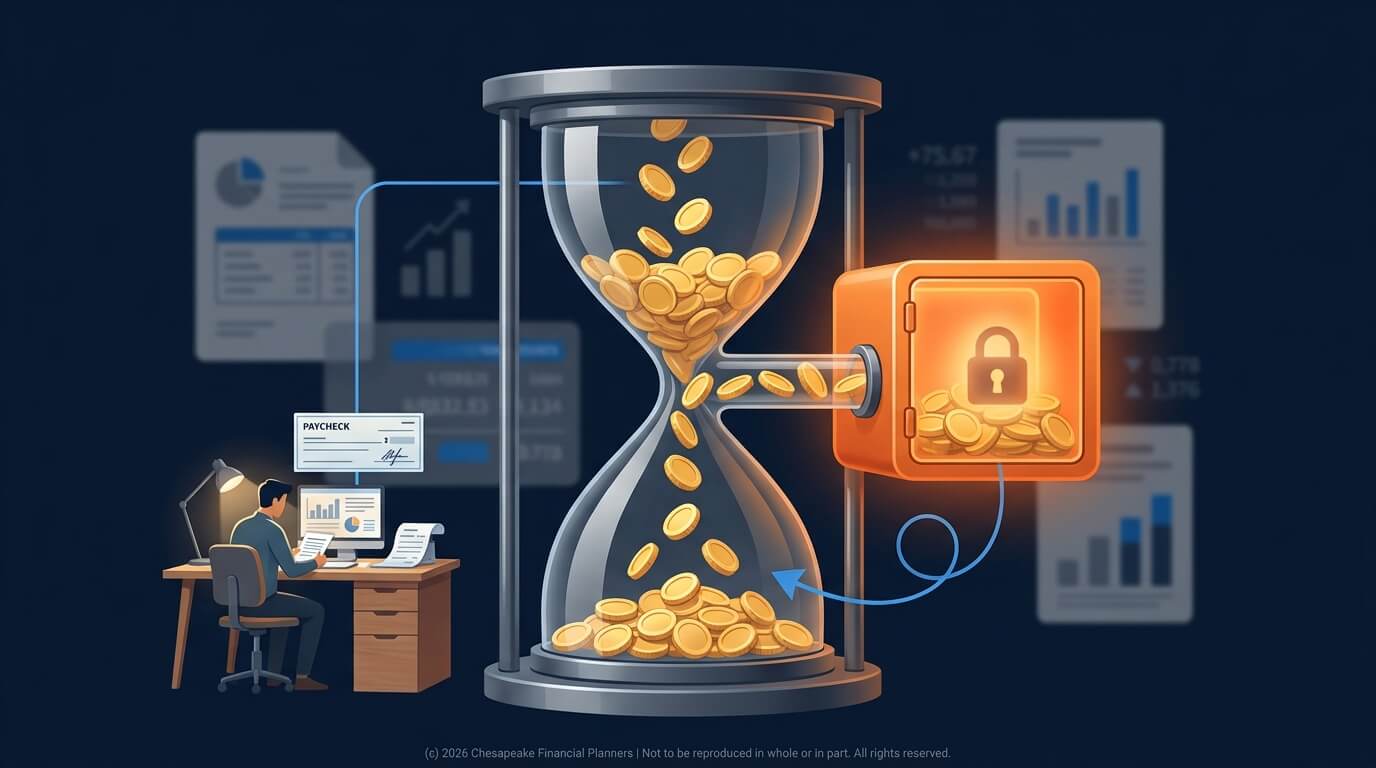
No. This is the single biggest misconception about the earnings test, and it causes people to make claiming decisions out of fear rather than math. The benefits withheld under the earnings test are not lost. They're returned to you in the form of a higher monthly benefit once you reach full retirement age.
When you hit full retirement age, Social Security recalculates your benefit and credits you for the months in which benefits were fully or partially withheld. The Social Security Administration treats those withheld months as if you had delayed claiming, which bumps your benefit upward. Over a normal retirement lifespan, most people recover the bulk of what was withheld.
That said, recovery is gradual. You get the higher monthly amount going forward, not a lump-sum refund. If you live a long life, you come out close to even. If you don't, the recovery is incomplete. This is the kind of trade-off the R.U.D.D.E.R. Method™ is Chesapeake Financial Planners' six-step planning process: Review and Recognize, Uncover and Understand, Design and Develop, Discuss and Decide, Execute and Empower, and Reassess and Refine is built to surface, so you're deciding with full information instead of reacting to a withheld check.
Should I Take Social Security at 62 or Wait Until 70?

Frequently Asked Questions
Does the Social Security earnings test apply after full retirement age?
No. The earnings test only applies before full retirement age. Once you reach full retirement age, you can earn unlimited income from any source and Social Security will not withhold any portion of your benefit. The limit disappears entirely in the month you reach full retirement age.
What is the Social Security earnings limit for 2026?
For 2026, the Social Security Administration sets the limit at $24,480 if you're under full retirement age all year, withholding $1 for every $2 over that amount. If you reach full retirement age in 2026, the limit is $65,160, with $1 withheld for every $3 over.
Does investment income count toward the Social Security earnings test?
No, investment income does not count toward the earnings test. Only wages and net self-employment earnings count. Dividends, capital gains, interest, pension payments, annuity income, and required minimum distributions are all excluded, so portfolio and pension income never triggers a benefit reduction.
Will I get my withheld Social Security benefits back?
Yes, withheld benefits are not permanently lost. When you reach full retirement age, Social Security recalculates your benefit and credits you for months in which benefits were withheld, raising your monthly payment going forward. Over a normal lifespan, most people recover most of what was withheld.
Should I stop working to avoid the Social Security earnings test?
Not necessarily. The earnings test is a timing adjustment, not a permanent penalty, since withheld benefits raise your future payment. For many people, the better question is whether to delay claiming altogether until full retirement age, which avoids the test and locks in a larger lifetime benefit.
How does self-employment income affect the earnings test?
Self-employment counts based on net earnings, not gross revenue, and Social Security also applies a monthly test in your first year of retirement. The Social Security Administration may count how much you work in the business, not just what you draw, so document your hours carefully.
Putting the Earnings Test in Context
The earnings test feels like a penalty, but it's really a nudge toward a smarter claiming decision. If you're working a job that pushes you well over the limit, the math usually favors waiting until full retirement age to claim. You avoid the test entirely and earn a permanently higher benefit. Want a clear framework for deciding when to claim? Our guide on Social Security claiming strategies walks through the trade-offs in plain language. Download it at chesapeakefp.com.
Disclosures
The information provided is for educational purposes only and should not be construed as investment advice. Investment strategies should be tailored to individual circumstances, risk tolerance, and goals. Past performance doesn't guarantee future results. Consult with qualified financial professionals regarding your specific situation.
Advisors associated with Chesapeake Financial Planners may be either (1) LPL Financial Registered Representatives offering securities through LPL Financial, Member FINRA and SIPC, and investment advisor representatives offering investment advice through Great Valley Advisor Group; or (2) solely investment advisor representatives offering investment advice through Great Valley Advisor Group and not affiliated with LPL Financial. Great Valley Advisor Group, and Chesapeake Financial Planners are separate entities from LPL Financial.


