

What Are the Signs You're Financially Ready to Retire?
Last reviewed: August 2026
You are financially ready to retire when your numbers, not your nerves, say so. The clearest signs you are financially ready to retire are age-based savings benchmarks you have met, several income streams, manageable debt, a stress-tested budget, a funded healthcare plan, a portfolio built for withdrawals, and a Social Security claiming age you chose on purpose. Hit most of those and the hesitation you feel is usually the emotional weight of a big transition, not a math problem.
Key Takeaways
- Retirement readiness is measured in numbers, not feelings, and seven concrete financial signs tell you far more than your confidence level does.
- Fidelity suggests having roughly 10 times your annual salary saved by your mid-60s as a savings benchmark.
- Delaying Social Security past full retirement age raises your benefit by about 8% for each year you wait, up to 24% more at 70.
- A single 65-year-old man may need about $172,500 after taxes for healthcare in retirement, so fund that plan before you leave work.
About the Author: Jeff Judge, CFP®, AEP®, ChFC®, CLU® is Managing Partner of Chesapeake Financial Planners in Forest Hill, Maryland. He has helped families and business owners across Harford County and the Baltimore metro area move from working to retired since earning his CFP® certification in 2013, using Chesapeake's signature process, the R.U.D.D.E.R. Method™. "The clients who struggle most at the finish line are usually the ones who are ready on paper but never gave themselves permission to believe it," Jeff says.
What Are the Real Signs You Are Financially Ready to Retire?
Retirement readiness is rarely a feeling. It is a set of numbers you can check. Plenty of people who are objectively prepared still lie awake wondering, am I ready to retire, while their spreadsheet has already answered the question. That gap between financial reality and emotional confidence is common, and it is worth closing with facts rather than vibes.
The honest way to figure out how to know if you can afford to retire is to work through concrete indicators instead of a single gut check. Here are the seven signs, at a glance, and what each looks like when you are actually ready.
| Sign | What it looks like when you are ready |
|---|---|
| 1. Savings benchmarks | You have hit roughly 10 times your salary by your mid-60s |
| 2. Multiple income streams | Three or more sources, not one lonely check |
| 3. Manageable debt | Mortgage nearly gone, no high-interest balances |
| 4. Stress-tested budget | Income covers essentials across several scenarios |
| 5. Funded healthcare plan | Coverage chosen and paid for, including any pre-65 gap |
| 6. Distribution-ready portfolio | Built to pay you, with a withdrawal order set |
| 7. Social Security strategy | A claiming age you selected deliberately |
None of these require perfection. They require evidence. The R.U.D.D.E.R. Method™ we use with clients starts by reviewing exactly this kind of evidence before anyone makes a decision, because a retirement date built on a hunch tends to unravel the first time the market has a bad month.
Have You Hit the Retirement Savings Benchmarks for Your Age?
Age-based savings benchmarks are the fastest way to see where you stand. Fidelity suggests aiming for roughly 10 times your annual salary saved by your mid-60s, with a set of milestones along the way that make the target less abstract.
- One times your salary saved by age 30
- Three times your salary by 40
- Six times your salary by 50
- Eight times your salary by 60
These guidelines assume you will want to replace somewhere around 70% to 80% of your pre-retirement income each year to keep your lifestyle roughly intact. If you have met or beaten the benchmark for your age, that is a strong sign the foundation is there. If you are a little behind, it does not mean retirement is off the table, it means the other six signs carry more weight and your spending plan needs to be tighter.
Jeff Judge often reminds clients that the benchmark is a starting point, not a verdict. "I have seen people with eight times their salary retire comfortably and people with twelve times feel broke, because the number that matters is what you spend, not what you saved," he says. Your personal target depends on your real budget, which is why a projection beats a rule of thumb every time.

Do Your Income Streams and Debt Levels Support Retirement?
Diversified income is one of the clearest markers of readiness. Leaning on a single source, whether that is Social Security or one pension, leaves you exposed to any change in that one check. Strong candidates for retirement usually have three or more sources feeding the household.
Common retirement income streams include Social Security benefits, withdrawals from retirement accounts like a traditional IRA or 401(k), Roth accounts that can offer tax-advantaged withdrawals in retirement, pension income, rental property, and part-time work. The point is not to collect sources for their own sake. It is that layering income gives you flexibility to adjust which bucket you draw from as markets and tax rules shift. If you want to go deeper here, our guide on managing multiple income streams in retirement walks through how to coordinate them.
In Harford County, some of the steadiest retirements I see belong to Aberdeen Proving Ground federal retirees, whose FERS annuity and Thrift Savings Plan savings stack a lifelong pension on top of invested assets without any extra effort. That built-in diversification is exactly what makes their transition smoother than a saver relying on one account.
Debt is the other half of this picture. Most advisors suggest entering retirement either debt-free or carrying only low-interest, manageable debt. A paid-off mortgage and zero high-interest credit card balances clear one of the biggest obstacles to a secure retirement. The exception is strategic: a low fixed-rate mortgage that lets you keep more money invested can make sense depending on your tax situation. If you are weighing that call, we cover it in detail in paying off your mortgage before retirement.
Have You Planned for Your Budget, Healthcare, and Withdrawals?
This is where readiness gets tested. Three signs live here: a stress-tested budget, a funded healthcare plan, and a portfolio positioned to pay you.
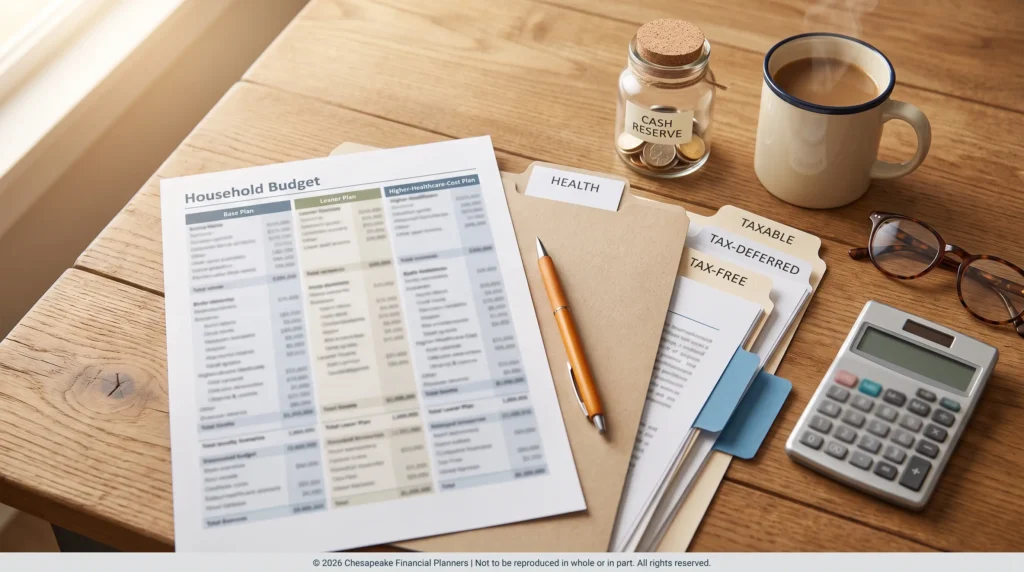
A stress-tested budget accounts for essentials like housing, food, and insurance, plus discretionary spending like travel, and then survives more than one scenario. Run your expected lifestyle, a leaner version if markets underperform, and one with higher healthcare costs. If your projected income covers the baseline across all three, that is real preparation. This is the design and stress-test work at the heart of the R.U.D.D.E.R. Method™, Chesapeake Financial Planners' six-step planning process: Review and Recognize, Uncover and Understand, Design and Develop, Discuss and Decide, Execute and Empower, and Reassess and Refine.
What if you retire before 65? Then you need a plan to bridge health coverage until Medicare eligibility begins, because Medicare does not start until 65. Options include COBRA, a spouse's employer plan, or a marketplace policy, and none of them are cheap. Our breakdown of health insurance between early retirement and Medicare lays out the choices.
Healthcare is one of the largest and least predictable retirement costs. Even after 65, Medicare is not free: the standard Part B premium is $202.90 per month for 2026, before any income-related surcharges. Fidelity estimates a single 65-year-old man may need around $172,500 after taxes to cover healthcare across retirement. Financially prepared retirees have not only chosen their coverage, they have funded it and modeled it into the budget.
Finally, a distribution-ready portfolio is built differently than one still in accumulation. That means a more conservative allocation as you approach the finish line, a defined withdrawal order across taxable, tax-deferred, and tax-free accounts, and often a cash reserve for the early years so you are not selling into a down market. Getting the withdrawal sequence right also helps you manage your tax bracket and avoid triggering higher Medicare premiums later.
Can You Explain Your Social Security Strategy?
The final sign is whether you can explain your Social Security decision out loud. Claiming choices have lifetime consequences, yet many people treat the timing casually. You can claim as early as 62 or wait as late as 70, and full retirement age is 67 for anyone born in 1960 or later.
The trade-off is real money. Delaying past full retirement age raises your benefit by about 8% for each year you wait, which adds up to roughly 24% more at 70 than at 67. That kind of increase is difficult to reproduce with other lower-risk choices, which is why the timing deserves a deliberate answer rather than a default one.
Does waiting until 70 always pay off? No, waiting is not automatically the right move. It makes the most sense when you expect a long life and have other income to live on in the meantime. If you claim early while still working, the Social Security earnings test can temporarily withhold benefits once your wages pass $24,480 in 2026. A readiness-level answer also weighs spousal and survivor benefits, not just your own record. Our full comparison of whether to take Social Security at 62 or wait until 70 walks through the break-even math.
If you have checked most of these boxes and still feel uneasy, you are in good company. The psychological transition to retirement often lags the financial reality by a year or two. Jeff Judge sees it constantly with pre-retirees: "The spreadsheet says go, but the paycheck has been their security blanket for forty years, so their brain needs time the math does not." Readiness is not about hitting a perfect score. It is about having enough resources to fund the life you want at a level of risk you can accept.
Frequently Asked Questions
How do I know if I have enough money to retire?
You have enough to retire when your reliable income covers your essential expenses across several market scenarios, not just the best one. Compare projected income from Social Security, pensions, and portfolio withdrawals against a real budget. If it covers the basics with room to spare, the math supports retiring.
What are the signs you are financially ready to retire?
The clearest signs you are financially ready to retire are hitting age-based savings benchmarks, holding three or more income streams, carrying little or no high-interest debt, running a stress-tested budget, funding a healthcare plan, positioning your portfolio for withdrawals, and choosing a deliberate Social Security claiming age. Most boxes checked signals readiness.
How much should I have saved to retire?
Fidelity suggests aiming for roughly 10 times your annual salary saved by your mid-60s, with milestones like three times your salary by 40 and six times by 50. Your real number depends on your spending, so a personalized projection matters far more than any single rule of thumb.
Do I need to be debt-free to retire?
You do not have to be completely debt-free to retire, but high-interest debt should be gone. A paid-off mortgage or a low fixed-rate loan you comfortably cover is manageable. Credit card balances at double-digit rates are the ones that quietly raise the income you need every single month.
Can I retire before I am eligible for Medicare at 65?
Yes, you can retire before 65, but you need a plan to bridge health coverage until Medicare eligibility begins. Options include COBRA, a spouse's employer plan, or an Affordable Care Act marketplace policy. Budget for those premiums, because a coverage gap is one of the most common early-retirement surprises.
Does it always make sense to wait until 70 to claim Social Security?
Waiting until 70 is not always the right move, though it raises your benefit by about 8% for each year past full retirement age. Delaying makes the most sense if you expect a long life and have other income to live on meanwhile. Health and cash flow drive the call.
Ready to Put a Plan Around Your Retirement?
If you recognize most of the signs you are financially ready to retire, the last step is turning that gut sense into a written plan you can act on. Jeff Judge and the Chesapeake team work with families and business owners across Harford County and the Baltimore metro every week on exactly this decision. Schedule a no-obligation fit call and get a clear read on where you stand.
A version of this article originally appeared in Kiplinger.
Disclosures
The information provided is for educational purposes only and should not be construed as investment advice. Investment strategies should be tailored to individual circumstances, risk tolerance, and goals. Past performance doesn't guarantee future results. Consult with qualified financial professionals regarding your specific situation.
Contributions to a traditional IRA may be tax deductible in the contribution year, with current income tax due at withdrawal. Withdrawals prior to age 59 ½ may result in a 10% IRS penalty tax in addition to current income tax.
A Roth IRA offers tax deferral on any earnings in the account. Qualified withdrawals of earnings from the account are tax-free. Withdrawals of earnings prior to age 59 ½ or prior to the account being opened for 5 years, whichever is later, may result in a 10% IRS penalty tax. Limitations and restrictions may apply.
This information is not intended to be a substitute for specific individualized tax, investment or legal advice. We suggest that you discuss your specific situation with a qualified tax, legal or financial advisor.
Advisors associated with Chesapeake Financial Planners may be either (1) LPL Financial Registered Representatives offering securities through LPL Financial, Member FINRA and SIPC, and investment advisor representatives offering investment advice through Great Valley Advisor Group; or (2) solely investment advisor representatives offering investment advice through Great Valley Advisor Group and not affiliated with LPL Financial. Great Valley Advisor Group, and Chesapeake Financial Planners are separate entities from LPL Financial.
Chesapeake Financial Planners | 2402 Scotlon Ct, Forest Hill, MD 21050 | (410) 652-7868 | www.chesapeakefp.com
© 2026 Chesapeake Financial Planners | Not to be reproduced in whole or in part. All rights reserved.


