

Should I Change My Investments After a Major Life Event?
Last reviewed: July 2026
You should change your investments after a major life event only when that event actually alters your time horizon, income, goals, or risk capacity. A windfall, divorce, retirement, or new child usually warrants a portfolio review. Normal market swings and minor income bumps do not. The goal is to match your portfolio to your new reality, not to react emotionally to a moment of change.
Key Takeaways
- Change investments after a life event only when the event shifts your timeline, income, goals, or risk capacity.
- A windfall above $1 million should be invested gradually, not all at once, to manage timing risk.
- Non-spouse beneficiaries must empty most inherited IRAs within 10 years under current rules.
- Concentrated stock positions above 10% of your portfolio create avoidable single-company risk worth diversifying.
- Small adjustments usually beat full overhauls; reacting to short-term volatility rarely helps.
About the Author: Jeff Judge, CFP®, AEP®, ChFC®, CLU® is Managing Partner of Chesapeake Financial Planners in Forest Hill, Maryland. He has been helping families and business owners in Harford County and the Baltimore metro area navigate investment transitions since earning his CFP® certification in 2013, by using Chesapeake Financial Planners’ signature process, the R.U.D.D.E.R. method™. Jeff has watched more portfolios get damaged by overreacting to a life event than by ignoring one entirely.
A major life event reshapes the ground your financial plan stands on. Marriage, divorce, a new job, an inheritance, the sale of a business, a health diagnosis, the birth of a child. Each one changes something real about your money. The mistake most people make is assuming the right response is to do something dramatic with their portfolio. Often the right response is smaller and more deliberate than they expect.
When Should a Life Event Trigger an Investment Change?
A life event should trigger an investment change when it alters one of four things: your time horizon, your income, your goals, or your capacity to absorb risk. If none of those four moved, your portfolio probably should not either.
Here are the events that genuinely warrant a review:
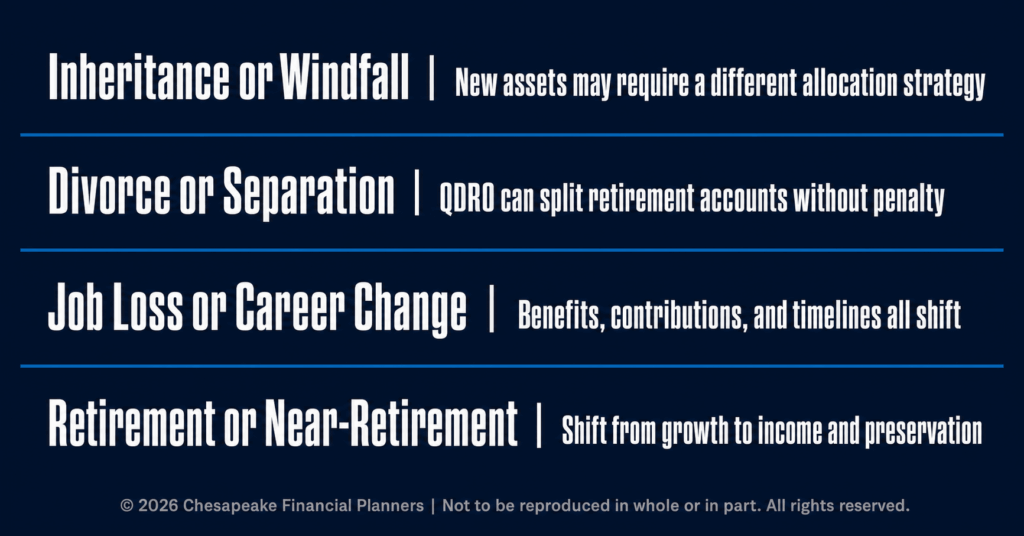
- You received a windfall. An inheritance, business sale, or stock option payout increases your asset base. You need to integrate the new money, rebalance, and decide whether you can dial risk down now that you have more cushion.
- Your income changed sharply. Job loss, a major promotion, or retirement changes your cash flow. That affects how much liquidity you need and how much risk you can afford to carry.
- Your time horizon shifted. Approaching retirement shortens it. A new child can lengthen the horizon for certain goals while adding new ones. The closer you are to spending the money, the less volatility your portfolio should tolerate.
- Your goals changed. Deciding to retire early, start a business, or relocate can create a near-term need for cash that no longer belongs in equities.
- Your real risk tolerance changed. If a market drop made you sell at the bottom, your portfolio was built for a braver version of you. Reality should win over the questionnaire.
Jeff often tells clients that the question is not "did my life change," but "did my life change in a way the portfolio can feel." A divorce that splits assets in half changes the math. A new job at the same income two towns over usually does not.
When Should You Leave Your Investments Alone?
You should leave your investments alone when the event that prompted the urge to act did not change your financial circumstances. Emotional energy is not a reason to trade. According to Morningstar research on the gap between investor returns and fund returns, investors lose meaningful return each year by buying and selling at the wrong times, a behavior driven mostly by emotion rather than fundamentals.
Stay the course in these situations:
- Short-term market drops. A 10% pullback is normal volatility, not a life event. Selling into it locks in the loss.
- Minor income changes. A modest raise is good news. It rarely justifies an overhaul.
- Temporary disruptions. Three months between jobs calls for your emergency fund, not a portfolio restructuring.
- Anxiety without a financial change. Worry about the economy or an election is understandable. If your actual circumstances held steady, your strategy should too.
This is one place where a portfolio rebalancing after life events discipline protects you from yourself. The plan was built for a long horizon. A bad week is not a reason to abandon it.

How Should You Review Your Investments After a Life Change?
You should review your investments after a life change by reassessing your goals, checking your allocation against your new timeline, and aligning your risk capacity with your risk tolerance before making any trades. The R.U.D.D.E.R. Method™ is Chesapeake Financial Planners' six-step planning process: Review and Recognize, Uncover and Understand, Design and Develop, Discuss and Decide, Execute and Empower, and Reassess and Refine. A post-event review fits naturally into that framework because it forces you to recognize what actually changed before you act. Jeff Judge notes: "The first question after any major life event isn't which funds to move — it's whether your goals and timeline actually changed, because rebalancing a portfolio that's still pointed at the wrong target just gets you there faster."
Start by reassessing your goals and timeline. What are you investing for, and has that target moved? If you are now retiring in five years instead of twenty, the portfolio should grow more conservative. If you just inherited money you will not touch for decades, you may be able to take more risk.
Next, evaluate your current allocation. Major events knock allocations off balance. Inherit a large stock position and you may be badly overweight in equities. Sell a business and you may be sitting in cash, dangerously underinvested for your goals.
Then weigh risk capacity against risk tolerance. Risk capacity is how much risk your finances can absorb. Risk tolerance is how much you can stomach emotionally. A 60-year-old retiring next year has low capacity even if she sleeps fine through volatility. The right portfolio respects both numbers, and a life event may have moved one or both.
How Should You Handle New Assets From a Windfall or Inheritance?
You should handle new assets by integrating them into your overall strategy deliberately rather than leaving them in cash or in their inherited form. The J.P. Morgan Guide to the Markets shows how concentrated and uninvested positions drag on long-term outcomes, which is exactly the trap a windfall creates.
Review inherited investments rather than holding them out of sentiment. The step-up in basis on inherited taxable assets often means you can sell with minimal capital gains tax, which gives you room to reshape the position toward your own plan.
Trim concentrated stock positions. When a single holding climbs above roughly 10% of your portfolio, whether it came from company stock or an inheritance, it adds single-company risk you are not being paid to take. Diversifying reduces that exposure.
Put cash from a business sale to work, but not all in one day. Investing a large lump sum gradually over six to twelve months can ease the fear of buying at a peak, even though the math does not always favor waiting. This is one of those decisions where helping someone sleep is part of the job. Jeff has seen clients who dumped a $2 million business sale into the market in a single week, then froze when it dropped 8% the next month. A measured pace would have kept them invested.
How Much Should You Actually Change?
You should usually make small, targeted adjustments rather than a complete overhaul. Shifting from 80% stocks to 70% stocks is a meaningful change. Liquidating and rebuilding a portfolio from scratch rarely is, and it generates taxes and trading costs along the way.
Reduce risk when your timeline shortened, your income dropped, or your tolerance fell. That typically means a bit more in bonds, cash, or stable value, and a bit less in stocks. Increase risk only when a windfall gives you a genuine safety net, your horizon is long, and your temperament can handle it.
Mind the tax bill on every move. Selling appreciated taxable investments triggers capital gains, so rebalance strategically and harvest losses to offset them where you can. Inherited retirement accounts carry their own rules. Under current IRS guidance, most non-spouse beneficiaries must withdraw the full balance of an inherited IRA within 10 years, which can push you into higher brackets if you are not planning the timing. Location matters too: tax-inefficient holdings like bonds belong in tax-deferred accounts, while tax-efficient index funds work well in taxable accounts.
If you are working through a divorce and dividing investment assets, the tax basis of each account matters as much as its current value, since two accounts worth the same dollar amount can carry very different after-tax outcomes.
Frequently Asked Questions
Should I change my investments after receiving an inheritance?
You should review your investments after an inheritance, but not necessarily overhaul them. Integrate the new assets into your existing allocation, check whether you are now overweight in any single holding, and use the step-up in basis to reshape inherited positions tax-efficiently. Inherited IRAs carry a 10-year withdrawal rule for most non-spouse heirs.
How soon after a life event should I review my portfolio?
You should review your portfolio within a few months of a major life event, once the immediate emotions settle but before bad habits form. Acting too fast risks emotional decisions; waiting too long lets cash sit idle or concentrated positions linger. A deliberate review in that window protects both your returns and your peace of mind.
Should I sell stocks when the market drops after a life change?
You should not sell stocks simply because the market dropped, since a market decline is volatility, not a change in your financial circumstances. Selling into a downturn locks in losses and often leads to missing the recovery. Only adjust your equity exposure if your actual timeline, income, or risk capacity changed alongside the market.
What should I do with a large cash windfall from a business sale?
You should invest a large windfall gradually rather than all at once if doing so helps you stay committed through volatility. Dollar-cost averaging over six to twelve months reduces the fear of buying at a market peak. First set aside cash for taxes and near-term goals, then integrate the rest into a diversified, goal-aligned allocation.
How do investment decisions change after a divorce?
Investment decisions after a divorce should account for the after-tax value of each divided account, not just the dollar balance. A taxable account and a traditional IRA worth the same amount carry very different real values once taxes are considered. Rebuild your allocation around your new single-household income, timeline, and goals rather than the old joint plan.
Should I become more conservative as I approach retirement?
You should generally reduce equity exposure as you approach retirement because your time horizon to recover from a downturn shrinks. This usually means adding bonds, cash, or stable value funds to protect the money you will spend first. The shift should be gradual and matched to your spending plan, not a sudden move to all-cash positions.
Working through a portfolio after a major change is rarely a one-time fix. It is a recurring conversation that should travel with you as your life keeps moving. At Chesapeake Financial Planners, we walk clients through exactly these decisions every week, weighing the tax math, the timeline, and the temperament behind every move. If a recent life event has you wondering whether your investments still fit, a second opinion costs you nothing. Visit chesapeakefp.com to learn more.
Disclosures
The information provided is for educational purposes only and should not be construed as investment advice. Investment strategies should be tailored to individual circumstances, risk tolerance, and goals. Past performance doesn't guarantee future results. Consult with qualified financial professionals regarding your specific situation.
Advisors associated with Chesapeake Financial Planners may be either (1) LPL Financial Registered Representatives offering securities through LPL Financial, Member FINRA and SIPC, and investment advisor representatives offering investment advice through Great Valley Advisor Group; or (2) solely investment advisor representatives offering investment advice through Great Valley Advisor Group and not affiliated with LPL Financial. Great Valley Advisor Group, and Chesapeake Financial Planners are separate entities from LPL Financial.


