

What's the Safest Way to Withdraw From My Retirement Accounts?
Last reviewed: July 2026
The safest retirement withdrawal strategy follows a deliberate order: satisfy required minimum distributions first, then draw from taxable brokerage accounts, then tax-deferred accounts like traditional IRAs and 401(k)s, and save Roth accounts for last. This sequence stretches the tax-advantaged growth on your most valuable dollars while keeping your annual tax bill predictable. The order you tap each account can swing your lifetime tax bill by tens of thousands of dollars.
Key Takeaways
- The standard withdrawal order is RMDs first, then taxable accounts, then tax-deferred, then Roth, preserving tax-free growth the longest.
- Missing a required minimum distribution triggers a 25% IRS penalty on the shortfall.
- In 2026 the IRMAA surcharge begins above $109,000 of MAGI for single filers, so withdrawal timing protects your Medicare premiums.
- Low-income early retirement years are the best window for Roth conversions before Social Security and RMDs raise your bracket.
About the Author: Jeff Judge, CFP®, AEP®, ChFC®, CLU® is Managing Partner of Chesapeake Financial Planners in Forest Hill, Maryland. He has been helping families and business owners in Harford County and the Baltimore metro area navigate retirement income decisions since earning his CFP® certification in 2013, by using Chesapeake Financial Planners’ signature process, the R.U.D.D.E.R. method™. Jeff often tells clients that the account you spend first matters more than the funds you picked inside it, because the tax drag of a sloppy withdrawal order quietly compounds for thirty years.
Why Does Withdrawal Order Matter So Much?
A safe retirement withdrawal strategy starts with one fact: not all retirement dollars are taxed the same way. Get the sequence right and you control your tax bracket year by year. Get it wrong and you hand the IRS money you never had to give.
Each account type carries its own tax rule:
- Traditional IRAs and 401(k)s: Taxed as ordinary income when you withdraw.
- Roth IRAs: Tax-free withdrawals on both contributions and qualified earnings.
- Taxable brokerage accounts: Taxed on capital gains when you sell, often at lower rates than ordinary income, with a step-up in basis at death.
- Health Savings Accounts: Tax-free when used for qualified medical expenses.
The old rule of thumb says spend taxable accounts first, tax-deferred second, and tax-free last. That works as a default. But it ignores the years where bending the rule saves real money. Jeff has watched clients follow the textbook order so rigidly that they wasted years sitting in the 12% bracket when they could have moved money to Roth at a discount.
What is the best order to withdraw from my 401k, Roth IRA, and taxable accounts in retirement?
What Is the Standard Withdrawal Sequence?
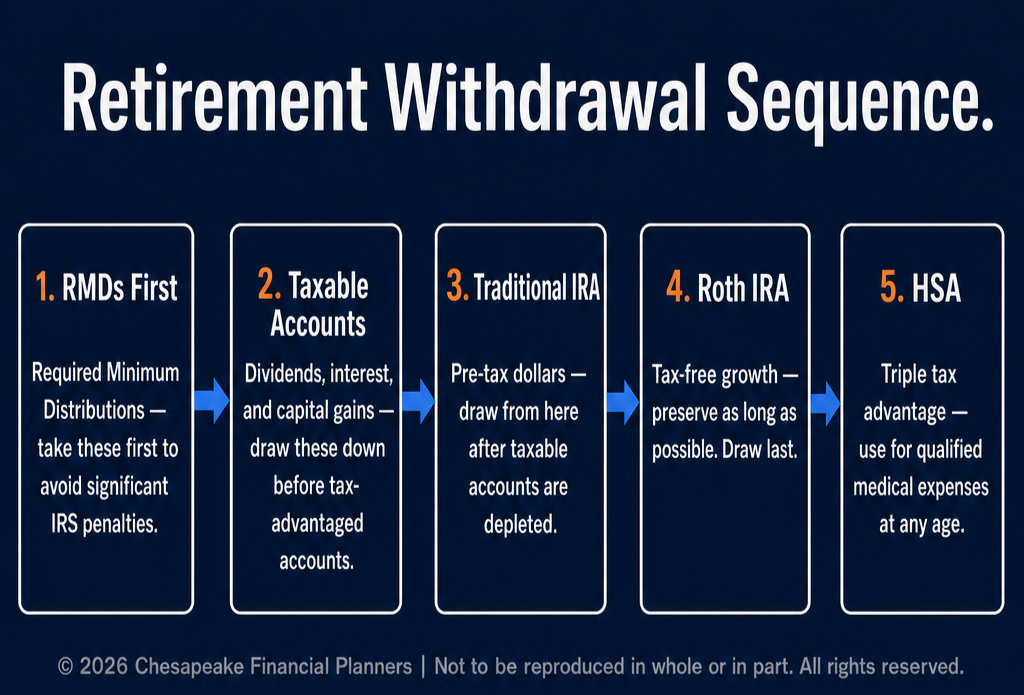
For most retirees, this order is the safe baseline. Each step builds on the last, and the logic is tax efficiency paired with longevity protection.
Step 1: Take your required minimum distributions. Once you reach age 73 (or 75 if you were born in 1960 or later), the IRS requires you to withdraw a set amount from traditional IRAs and 401(k)s each year. According to the IRS, failing to take a full RMD triggers a 25% penalty on the amount you should have withdrawn, reduced to 10% if corrected promptly. Always satisfy RMDs first.
Step 2: Draw from taxable brokerage accounts. Long-term capital gains are taxed at 0%, 15%, or 20%, usually below ordinary income rates. You also control the timing of each sale, and any assets left at death receive a step-up in basis so heirs inherit them with little or no tax.
Step 3: Tap tax-deferred accounts. Once taxable accounts are spent down to your target legacy level, begin drawing from traditional IRAs and 401(k)s. These withdrawals are ordinary income, so pace them to avoid jumping a bracket.
Step 4: Spend Roth IRAs last. Roth dollars grow tax-free, carry no lifetime RMDs, and pass to heirs tax-free under the 10-year rule. They are your flexible reserve and your most valuable legacy asset.
Step 5: Save your HSA for medical costs. A Health Savings Account is triple-tax-advantaged, so reserve it for the healthcare expenses that tend to rise in later retirement.
How do I coordinate all my retirement income sources to minimize taxes and maximize income?
When Should You Deviate From the Standard Order?
The baseline sequence is safe, but a tax-efficient retirement withdrawal plan flexes around your bracket, your Medicare premiums, and the market. Here are the moments worth breaking the rule.
You are in a low tax bracket. If you retire before Social Security begins, your taxable income may dip for a few years. Those years are gold. You can pull extra from a traditional IRA, or run a partial Roth conversion, to fill up the 10% and 12% brackets before RMDs and Social Security push you higher. The Social Security Administration confirms that up to 85% of benefits become taxable once your combined income clears the thresholds, so front-loading income while you are still in a low bracket is often the cheapest tax you will ever pay.
You are just under a bracket threshold. Blend withdrawals to stay put. If your taxable income sits at $44,000 and the 12% bracket tops out near the 22% line, you can pull a measured traditional IRA amount taxed at 12% instead of 22% later.
You are close to an IRMAA threshold. Medicare premiums rise when your modified adjusted gross income crosses a line. In 2026, the IRMAA surcharge begins above $109,000 for single filers and $218,000 for married couples filing jointly. Slipping one dollar over can add several thousand dollars in annual premium surcharges, so managing the source of each withdrawal protects your premium.
A market downturn hits. When stocks are down, selling taxable holdings or tapping a tax-deferred account to fund living expenses locks in losses. Drawing from Roth or cash reserves during a downturn lets your equities recover. This is where a sequence-of-returns plan earns its keep.
This kind of year-by-year coordination is exactly what the R.U.D.D.E.R. Method™ is built for. The R.U.D.D.E.R. Method™ is Chesapeake Financial Planners' six-step planning process: Review and Recognize, Uncover and Understand, Design and Develop, Discuss and Decide, Execute and Empower, and Reassess and Refine. A withdrawal strategy is not set once. It gets reassessed every year as brackets, balances, and tax law shift.
How do I coordinate all my retirement income sources to minimize taxes and maximize income?
Frequently Asked Questions
What is the safest retirement withdrawal strategy for most retirees?
The safest retirement withdrawal strategy is to take required minimum distributions first, then spend taxable brokerage accounts, then tax-deferred accounts like traditional IRAs, and draw from Roth accounts last. This order preserves tax-free growth on your most valuable dollars while keeping your annual taxable income controlled and predictable.
Which retirement account should I withdraw from first?
Withdraw to satisfy required minimum distributions first, because the IRS penalizes any shortfall by 25%. After RMDs, draw from taxable brokerage accounts, which often carry lower capital gains tax rates than ordinary income. This retirement account withdrawal order keeps your tax-advantaged accounts growing as long as possible during retirement.
How much is the penalty for missing a required minimum distribution?
Missing a required minimum distribution triggers a 25% IRS penalty on the amount you failed to withdraw, according to current IRS guidance. The penalty drops to 10% if you correct the shortfall within a defined window. Because of this steep cost, always satisfy your RMD requirements before tapping any other account.
When should I take money from my Roth IRA?
Withdraw from your Roth IRA last in most retirement plans, because Roth withdrawals are tax-free, carry no lifetime RMDs, and continue compounding tax-free. The exception is a market downturn or a year you are near an IRMAA or tax bracket threshold, when a Roth IRA withdrawal can keep your taxable income down without raising your bracket.
How do retirement withdrawals affect my Medicare premiums?
Retirement withdrawals raise your modified adjusted gross income, which can push you past an IRMAA threshold and increase your Medicare premiums. In 2026, IRMAA begins above $109,000 for single filers. Drawing from Roth accounts, which do not count toward MAGI, is one way to fund spending without triggering a premium surcharge.
Can I do a Roth conversion to make withdrawals more tax-efficient?
Yes. Converting traditional IRA dollars to Roth during low-income years, often the gap between retiring and starting Social Security, lets you pay tax at a lower bracket now and create tax-free income later. This tax-efficient retirement withdrawal move reduces future RMDs and can lower the taxes you owe on Social Security benefits.
If you want a clearer picture of how your accounts should work together, our retirement income planning guide walks through the full drawdown sequence step by step. Download it at chesapeakefp.com to see how the order applies to your own retirement withdrawal strategy.
Want to go deeper? Our Retirement Income Blueprint Workbook walks through this step by step.
Disclosures
The information provided is for educational purposes only and should not be construed as investment advice. Investment strategies should be tailored to individual circumstances, risk tolerance, and goals. Past performance doesn't guarantee future results. Consult with qualified financial professionals regarding your specific situation.
A Roth IRA offers tax deferral on any earnings in the account. Qualified withdrawals of earnings from the account are tax-free. Withdrawals of earnings prior to age 59 ½ or prior to the account being opened for 5 years, whichever is later, may result in a 10% IRS penalty tax. Limitations and restrictions may apply.
This information is not intended to be a substitute for specific individualized tax, investment or legal advice. We suggest that you discuss your specific situation with a qualified tax, legal or financial advisor.
Advisors associated with Chesapeake Financial Planners may be either (1) LPL Financial Registered Representatives offering securities through LPL Financial, Member FINRA and SIPC, and investment advisor representatives offering investment advice through Great Valley Advisor Group; or (2) solely investment advisor representatives offering investment advice through Great Valley Advisor Group and not affiliated with LPL Financial. Great Valley Advisor Group, and Chesapeake Financial Planners are separate entities from LPL Financial.


