

Robo-Advisor or Human Advisor: Which Do I Need?
Last reviewed: July 2026
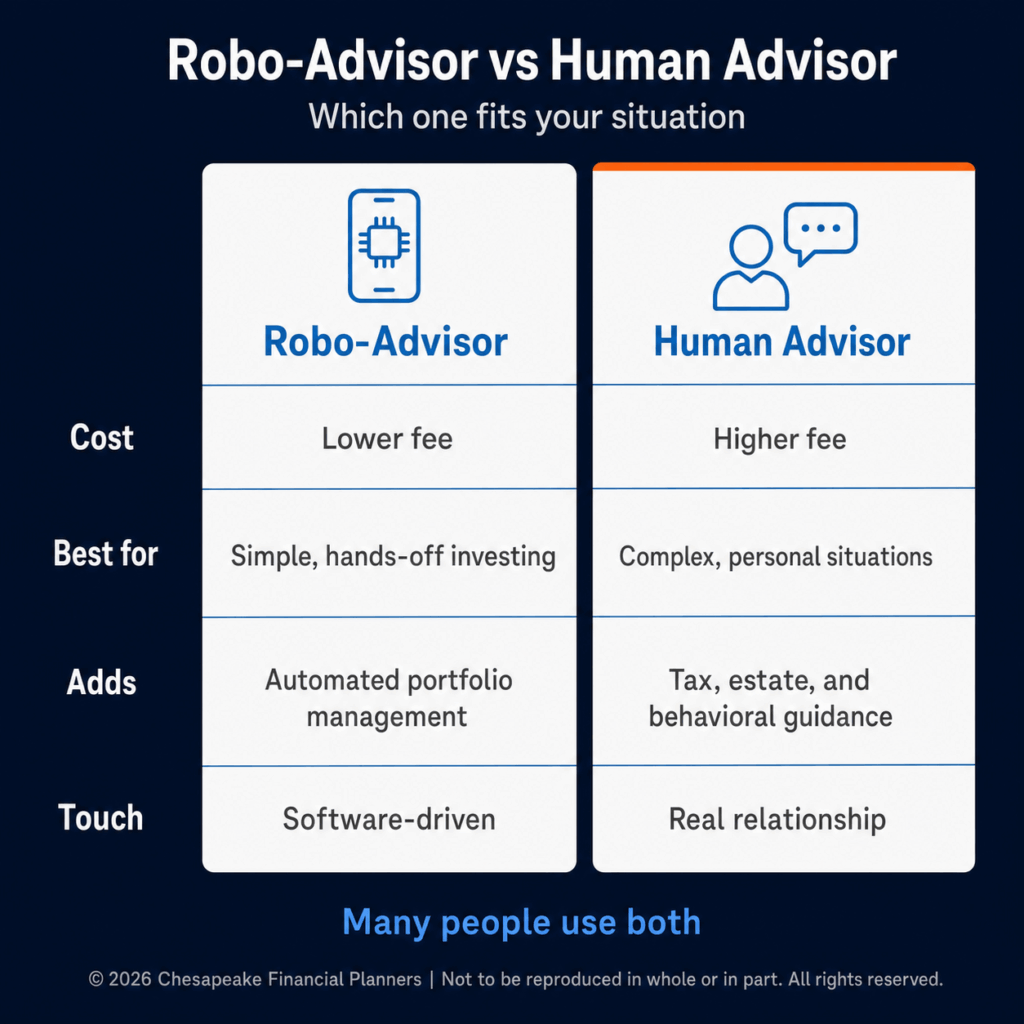
A robo-advisor manages your investments through software that builds and rebalances a portfolio based on a few questions about your goals and risk tolerance. A human financial advisor does that too, but adds judgment, tax planning, and a person you can call when the market drops 15% and you're tempted to sell everything. The robo advisor vs financial advisor decision comes down to one question: how complicated is your financial life right now? If your situation is simple and your only need is low-cost investing, a robo-advisor usually wins. If you have real decisions to make beyond asset allocation, a human earns their fee.
Key Takeaways
- Robo-advisors typically charge 0.25% to 0.50% annually; human advisors average around 1.02% on the first $1 million, per industry survey data.
- Robo-advisors suit simple portfolios; human advisors add value once tax, estate, and behavioral decisions enter the picture.
- The median U.S. household has limited investable assets, making automated investing a reasonable entry point for many.
- Many investors eventually use both: a robo platform for execution and a human for planning.
About the Author: Jeff Judge, CFP®, AEP®, ChFC®, CLU® is Managing Partner of Chesapeake Financial Planners in Forest Hill, Maryland. He has been helping families and business owners in Harford County and the Baltimore metro area navigate investment decisions since earning his CFP® certification in 2013, by using Chesapeake Financial Planners’ signature process, the R.U.D.D.E.R. method™. Jeff often tells clients the technology behind a robo-advisor isn't the problem; the gap shows up the day life gets complicated and there's no one to call.
What Is a Robo-Advisor and How Does It Work?
A robo-advisor is an automated investing platform that builds a diversified portfolio of low-cost funds, then rebalances it for you over time. You answer a short questionnaire about your age, goals, and tolerance for risk. The software assigns you a model portfolio, usually a mix of stock and bond index funds, and handles the buying, selling, and tax-loss harvesting without you lifting a finger.
The appeal is cost and simplicity. According to FINRA, robo-advisors generally charge lower fees than traditional advisors because the work is automated. For someone with a straightforward situation, automated investing removes the two biggest mistakes individual investors make: panic-selling and forgetting to rebalance.
What a robo-advisor does not do is know you. It can't tell you whether to take the lump sum or the pension. It won't catch that you're about to trigger a tax problem by selling concentrated stock. The model is only as good as the inputs, and most people don't know what inputs matter.
Should I manage my own investments or hire a financial advisor?
How Much Does a Robo-Advisor Cost vs a Human Advisor?
Cost is where the two diverge most clearly. Robo advisor fees typically run 0.25% to 0.50% of assets per year, and some basic platforms charge nothing on smaller balances. A human financial advisor who manages your money usually charges around 1% annually, though that number drops as your account size grows.
Here's the comparison in plain terms:
| Factor | Robo-Advisor | Human Advisor |
|---|---|---|
| Typical annual fee | 0.25% to 0.50% | Around 1% (lower at higher balances) |
| Tax-loss harvesting | Often automated | Manual, customized |
| Financial planning | Limited or add-on | Comprehensive |
| Behavioral coaching | None | Direct and ongoing |
| Estate and tax strategy | None | Included |
| Access to a person | Chat or none | Phone, email, in person |
On a $250,000 account, the fee difference between a 0.30% robo and a 1% advisor is roughly $1,750 a year. That's real money. The question is whether the human advisor delivers more than $1,750 in value through tax savings, better decisions, and avoided mistakes. For a simple portfolio, they often don't. For a complex one, they frequently save multiples of that. Investment fees compound over decades, so the math deserves a careful look before you decide.
How Do Investment Fees Impact My Long-Term Returns?
When Is a Human Financial Advisor Worth the Cost?
A human advisor earns their fee the moment your financial life stops being simple. The trigger isn't account size, it's complexity. You hit that point when you face a decision software can't make for you.
Jeff has watched this play out for years. A client with a paid-off mortgage, a maxed 401(k), and one brokerage account probably doesn't need to pay 1%. A client with equity compensation, a small business, aging parents, and a Roth conversion question almost always does. The behavioral piece matters too. In 2022, when markets fell hard, the clients who called before selling kept their plans intact. A robo-advisor would have processed the panic sell without a word.
This is where a defined process helps. The R.U.D.D.E.R. Method™ is Chesapeake Financial Planners' six-step planning process: Review and Recognize, Uncover and Understand, Design and Develop, Discuss and Decide, Execute and Empower, and Reassess and Refine. A robo-advisor handles one slice of that, the execution. The rest requires a human who knows your whole picture.
Consider a human advisor when you have:
- A major transition like retirement, inheritance, or selling a business
- Equity compensation, stock options, or a concentrated position
- Tax decisions such as Roth conversions or capital gains timing
- Estate planning needs or beneficiaries with special circumstances
- A tendency to make emotional decisions when markets move
How does equity compensation affect my financial plan?
How Can I Avoid Making Emotional Investment Decisions?
Can You Use Both a Robo-Advisor and a Human Advisor?
Yes, and plenty of people do. You can run a robo-advisor for the mechanical work of investing while hiring a human advisor for planning, tax strategy, and the big decisions. Some investors keep a robo platform for a portion of their assets and a human-managed account for the rest. Others use a robo early in their wealth-building years, then bring in an advisor once their situation grows complicated.
There's no rule that says you commit to one forever. The right answer changes as your life changes. A 28-year-old with a steady paycheck and a Roth IRA is a perfect robo candidate. That same person at 52, running a business with a liquidity event on the horizon, has outgrown the software. According to the Bureau of Labor Statistics, the typical worker changes jobs many times over a career, and each change can bring a 401(k) rollover decision worth getting right.
How do financial advisors choose investments for my portfolio?
Frequently Asked Questions
Are robo-advisors safe to use?
Robo-advisors are generally safe and are regulated as registered investment advisors by the SEC. Your money is held at a custodian and protected by SIPC up to applicable limits if the brokerage fails. The main risk is not fraud but a model that doesn't fit your real situation.
Do robo-advisors beat human advisors on returns?
Neither reliably beats the other on raw returns, because both typically invest in similar low-cost index funds. The difference shows up in behavior, tax management, and planning. A human advisor often adds value by preventing costly mistakes rather than by picking better-performing investments year to year.
How much money do you need to start with a robo-advisor?
Most robo-advisors have low or no account minimums, with many letting you start with a few hundred dollars or less. This makes automated investing accessible to people just beginning to build wealth, which is one reason robo-advisors grew so quickly among younger investors with smaller balances.
Is a robo-advisor good for retirement planning?
A robo-advisor can manage your retirement investments but generally does not handle full retirement planning. Decisions about Social Security timing, withdrawal sequencing, Roth conversions, and Medicare fall outside what software addresses. For those, most people benefit from a human advisor who sees the complete picture before retirement begins.
What are the biggest downsides of robo-advisors?
The biggest downsides are the lack of personalized advice and no one to talk to during a crisis. Robo-advisors can't adjust for life events the questionnaire never asked about, won't coordinate tax and estate strategy, and may let you panic-sell during a downturn without any intervention from a human who knows your goals.
Should I switch from a robo-advisor to a human advisor?
Consider switching when your financial life gains complexity that software can't handle. Triggers include a business sale, equity compensation, a large inheritance, retirement, or estate planning needs. If you're still in a simple wealth-building phase with one or two accounts, staying with your robo-advisor usually makes sense.
If you're weighing the robo advisor vs financial advisor question and want a clearer picture of what you'd actually be paying for, our guide on understanding investment fees breaks down exactly where your money goes. Download it at chesapeakefp.com and see the numbers for yourself before you decide.
Disclosures
The information provided is for educational purposes only and should not be construed as investment advice. Investment strategies should be tailored to individual circumstances, risk tolerance, and goals. Past performance doesn't guarantee future results. Consult with qualified financial professionals regarding your specific situation.
Advisors associated with Chesapeake Financial Planners may be either (1) LPL Financial Registered Representatives offering securities through LPL Financial, Member FINRA and SIPC, and investment advisor representatives offering investment advice through Great Valley Advisor Group; or (2) solely investment advisor representatives offering investment advice through Great Valley Advisor Group and not affiliated with LPL Financial. Great Valley Advisor Group, and Chesapeake Financial Planners are separate entities from LPL Financial.


