

Last reviewed: September 2026
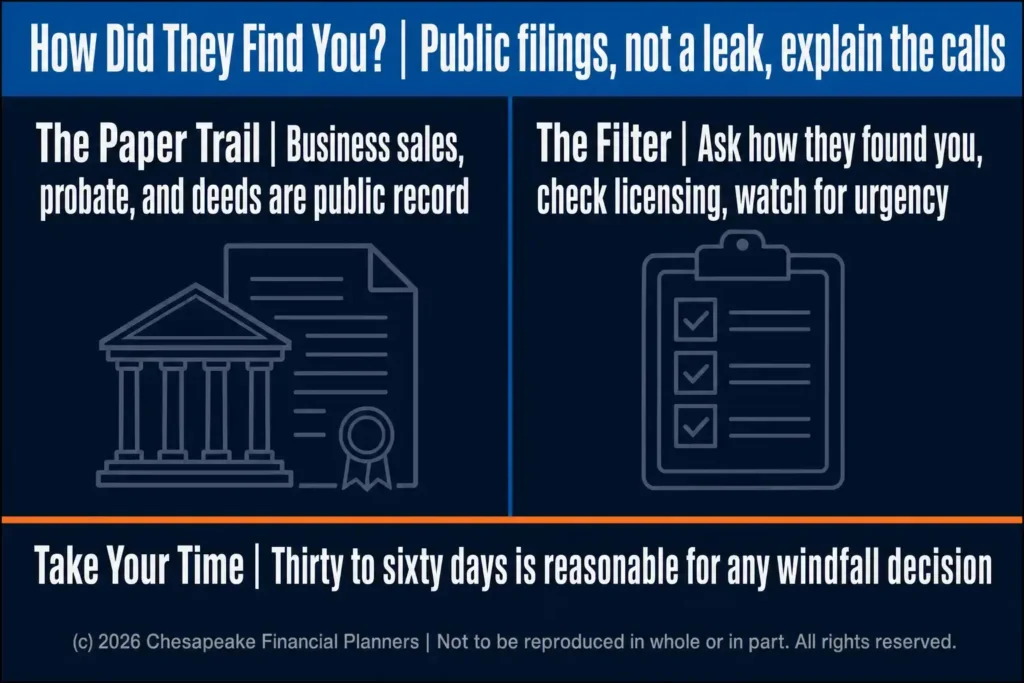
Probate is public record, and so are the business sale paperwork and the real estate deed transfer that often come with a wealth event. That probate public record status, not a leak, is why solicitation calls start within weeks. Nobody leaked your information. A data company noticed a new courthouse filing, matched it to a name and address, and added you to a call list. In Maryland, that filing is often findable online the same day it's recorded, through the state's own court and land record systems.
Key Takeaways
- Probate filings, UCC-1 business sale statements, and real estate deed transfers are public record in every state, and data companies scan them to build prospecting lists.
- Maryland's state estate tax exemption is $5 million per person in 2026, well below the federal threshold, which is part of why Maryland probate filings draw attention from list buyers.
- FINRA's BrokerCheck and the SEC's Investment Adviser Public Disclosure database are free tools that verify a caller's licensing in minutes.
- A thirty-to-sixty-day decision window is reasonable for almost any recommendation tied to a windfall, no matter how the caller frames the urgency.
About the Author: Jeff Judge, CFP®, AEP®, ChFC®, CLU® is Managing Partner of Chesapeake Financial Planners in Forest Hill, Maryland. He has helped families and business owners across Harford County and the Baltimore metro area sort legitimate outreach from opportunistic prospecting since earning his CFP® certification in 2013, using Chesapeake's signature process, the R.U.D.D.E.R. Method™. "The size of the check that just landed in your account is not information you owe a stranger on the phone," Jeff says. "Take your time before you return any of those calls."
Why Do Solicitation Calls Start Right After a Business Sale, Probate Filing, or Real Estate Closing?
Three ordinary events generate three separate public records, and any one of them can trigger a wave of calls. Before choosing a next call to return, it can help to understand who deserves your time in the first place; see Who Should Windfall Recipients Call First and in What Order? for the fuller picture of building your own team. When a business changes hands, a UCC-1 financing statement often gets recorded with the state if the buyer used SBA financing, and local business licenses transfer in a way that shows up in city or county filings. When someone dies, the will, the inventory of assets, and the names of heirs typically become part of the public probate court file, since the process exists to notify creditors and unknown heirs, not to protect the family's privacy. When property changes hands, whether through a sale or as part of an estate, the deed gets recorded and, in most states, a transfer tax stamp discloses roughly what it sold for.
Does a business sale, an inheritance, or a real estate closing get reported to marketing companies directly?
No, nothing gets reported directly. Courthouses and county recorders file paperwork because the law requires it, not because they sell leads. Data aggregation firms scan those same public filings, cross-reference them against property and licensing records, and package the result as a "recent inheritance" or "business sale" list for insurance agents, annuity wholesalers, and advisors to buy. Firms that specialize in this kind of prospecting track deed transfers above a certain dollar threshold, so a Harford County or Baltimore-metro sale tied to an estate or a business exit often draws faster attention than a routine home sale would.
Is Probate Public Record in Maryland, and What Does That Mean for You?
Yes, probate is public record in Maryland, and it's more accessible than most people expect. The Register of Wills in each Maryland county maintains the estate file, and Maryland's Judiciary Case Search lets anyone look up a case by name from a home computer, no courthouse visit required. Add Maryland's Department of Assessments and Taxation real property search, which makes deed and ownership records for Harford County and Baltimore County just as easy to pull, and a Maryland estate is unusually visible compared with states that require an in-person records request.
The state's own estate tax framework adds a second layer worth understanding. Maryland's estate tax exemption is $5,000,000 per person, and the top state estate tax rate runs to 16% above that threshold, on top of whatever federal exposure applies. A Harford County family with a paid-off home, a retirement account, and a modest life insurance policy can approach that state threshold quietly, and a filing anywhere near it tends to draw more attention from list buyers than a smaller estate would.
"Jeff Judge has told clients that the size of the check someone just received rarely requires an answer that week, and often not that quarter either."
How Can You Tell a Legitimate Advisor From a Bad-Faith Cold Caller?
This is the short framework we use to vet a financial advisor who reaches out unprompted, and the table below lines up the clearest financial advisor red flags next to what normal, legitimate outreach looks like. Both types of callers may be working from the exact same public-record list, so the list itself tells you nothing. What separates them is how they behave once you pick up the phone.
| What to watch | Legitimate outreach | Bad-faith pitch |
|---|---|---|
| How they found you | States plainly that they work from public probate, business, or property filings | Implies a personal connection or gets vague when asked |
| Licensing | Answers a BrokerCheck or SEC IAPD question without hesitation | Deflects, changes the subject, or claims licensing "doesn't apply" |
| Fiduciary standard | Confirms in writing whether they act as a fiduciary on everything recommended | Offers a verbal assurance only, with nothing in writing |
| Pace | Suggests a meeting weeks out | Pushes for a decision inside the current call |
Should you assume every unsolicited call about your inheritance or business sale is a scam?
No, you shouldn't assume that. Cold outreach built on public records is an old, mostly legal way advisors build a client base, and plenty of licensed, ethical advisors started exactly that way. The mechanism that got them your number says nothing about their conduct once they have it. Run the same four checks and let the answers decide. For a deeper walkthrough of vetting an advisor specifically, How Do You Vet a Financial Advisor After a Wealth Event? covers the fuller question list.

What Should You Do in the First 30 to 60 Days After the Calls Start?
Moving slowly is the actual advantage here, not a missed opportunity. This sits inside the broader first-90-days checklist we walk every windfall recipient through, and fielding these calls well is one piece of it. Chesapeake's R.U.D.D.E.R. Method™, our six-step planning process of Review and Recognize, Uncover and Understand, Design and Develop, Discuss and Decide, Execute and Empower, and Reassess and Refine, exists specifically for the disorienting first stretch after a wealth event, when a full inbox of "opportunities" competes with the actual planning work.
- Ask directly how the caller found your information, and note whether the answer is specific or evasive.
- Confirm FINRA and SEC registration through BrokerCheck or the SEC's Investment Adviser Public Disclosure database before a second conversation, and ask whether the fiduciary duty applies to everything they'd recommend.
- Give yourself a genuine thirty-to-sixty-day decision window, loop in your CPA and estate attorney before signing anything, and write down what was promised so verbal claims have to hold up on paper.
Jeff Judge has walked Harford County clients through their own probate filing on Maryland's Case Search site so they can see, firsthand, how ordinary and unremarkable the public record actually is. In practice, he's watched the same pattern repeat for years: the calls arrive before the estate is even fully settled, and roughly half the callers can't clearly explain how they found the listing when asked directly.
Why does it help to talk with a Maryland-based fiduciary before responding to any of these calls?
It helps because a local fiduciary already knows the mechanics you're navigating, which shortens the vetting work instead of adding to it. A planner familiar with Maryland's Register of Wills process, the state's estate tax exemption, and the Harford County and Baltimore-metro real estate market can tell you within one conversation whether a specific pitch fits your situation or is generic prospecting dressed up as personalized advice. That's why a Fit Call is a low-pressure way to get a second opinion before committing to anyone who called you first: a conversation with someone who already understands the paperwork you're dealing with, not a sales process of its own.
Frequently Asked Questions
Is a will public record once it goes through probate?
Yes, a will becomes part of the public probate court file once it's filed for administration, along with the inventory of assets and the names of heirs or beneficiaries. The filing exists to notify creditors and any unknown heirs, which is why courts treat it as a public document rather than a sealed family record. Some states allow limited sealing in unusual circumstances, but that's the exception, not the rule.
How did an advisor get my phone number after I sold my business?
An advisor, or more often a data company selling leads to advisors, likely pulled it from a UCC-1 financing statement, a business license transfer, or a local business journal item, then matched that filing to your name through marketing databases and property records. None of that requires a leak from your accountant or the buyer's team. It's public paperwork, cross-referenced at scale.
Is it illegal for someone to contact me based on public probate or business filings?
No, it's generally legal. Building outreach lists from public government filings isn't new, and campaigns, real estate agents, and marketers have used similar methods for decades. What can cross into a problem is what the caller does next, such as making unlicensed recommendations, misrepresenting their registration, or pressuring a fast decision. The legality of the list has nothing to do with the legitimacy of the pitch.
What's the fastest way to check if a financial advisor is actually registered?
The fastest way is FINRA BrokerCheck or the SEC Investment Adviser Public Disclosure database, both free and searchable in under five minutes. Enter the person's name or firm, and you'll see registration history, licensing details, and any disciplinary disclosures. Do this before the second conversation, not after you've already discussed your situation in detail.
Should I tell a cold-calling advisor how much I received from my business sale or inheritance?
No, you're under no obligation to disclose that on a first call, and a caller who pushes hard for the number before earning any trust is telling you something about their priorities. A legitimate advisor can have a useful first conversation about your general goals without needing an exact figure up front. Save the specifics for someone you've already vetted through a licensing check and a written fiduciary commitment.
Does Maryland's estate tax affect whether my inheritance shows up on a prospecting list?
Indirectly, yes. Maryland's state estate tax exemption is $5,000,000 per person in 2026, and estates that approach or cross that threshold tend to generate more detailed probate filings and more scrutiny from data companies that track larger estates specifically. A smaller estate still shows up in the public record, but a filing near the state or federal exemption line is more likely to attract a targeted list.
Is my financial advisor a fiduciary, and how do I confirm it?
Ask directly, and ask for it in writing, since the answer isn't always obvious from a title alone. Plenty of people in financial services are held to a fiduciary standard for only part of what they sell, which matters more in the first year after a wealth event than almost any other time. FINRA's BrokerCheck and the SEC's Investment Adviser Public Disclosure database both show registration type, and a firm's Form ADV will spell out its fiduciary obligations in plain terms if you ask for it.
Ready to Get a Second Opinion Before You Commit to Anyone?
If a call like this has reached you because of a probate public record filing, a business sale, or a real estate closing, Jeff Judge and the Chesapeake Financial Planners team serve families and business owners across Harford County and the Baltimore metro. Schedule a free Fit Call and bring the pitch you received. We're glad to be the second set of eyes.
A version of this article was originally published on Chesapeake Financial Planners' LinkedIn.
Disclosures
The information provided is for educational purposes only and should not be construed as investment advice. Investment strategies should be tailored to individual circumstances, risk tolerance, and goals. Past performance doesn't guarantee future results. Consult with qualified financial professionals regarding your specific situation.
This information is not intended to be a substitute for specific individualized tax, investment or legal advice. We suggest that you discuss your specific situation with a qualified tax, legal or financial advisor.
Investments in real estate may be subject to a higher degree of market risk because of concentration in a specific industry, sector or geographical sector. Other risks can include, but are not limited to, declines in the value of real estate, potential illiquidity, risks related to general and economic conditions, stage of development, and defaults by borrower.
Advisors associated with Chesapeake Financial Planners may be either (1) LPL Financial Registered Representatives offering securities through LPL Financial, Member FINRA and SIPC, and investment advisor representatives offering investment advice through Great Valley Advisor Group; or (2) solely investment advisor representatives offering investment advice through Great Valley Advisor Group and not affiliated with LPL Financial. Great Valley Advisor Group, and Chesapeake Financial Planners are separate entities from LPL Financial.
Chesapeake Financial Planners | 2402 Scotlon Ct, Forest Hill, MD 21050 | (410) 652-7868 | www.chesapeakefp.com
© 2026 Chesapeake Financial Planners | Not to be reproduced in whole or in part. All rights reserved.


