
What Is Lifestyle Creep, and Why Does It Keep High Earners Broke?
Last reviewed: July 2026
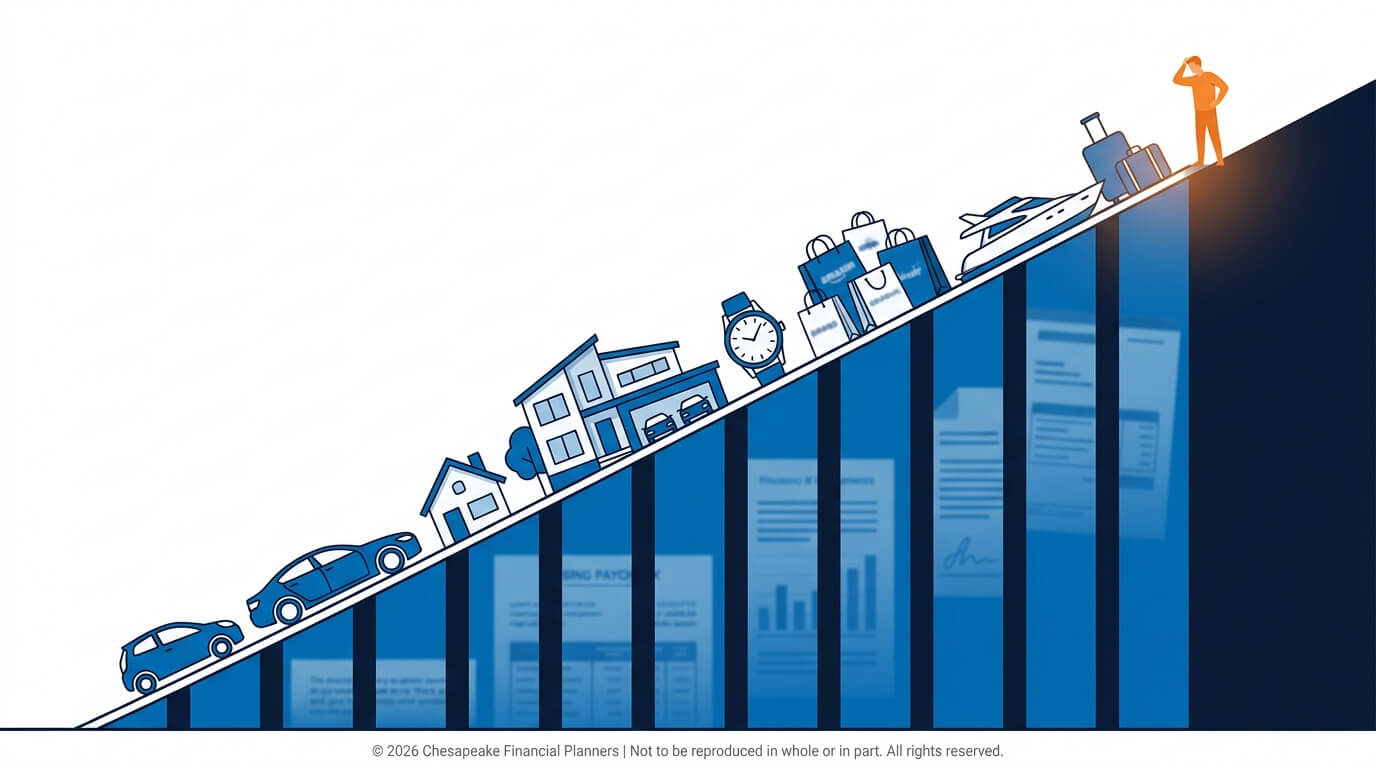
Lifestyle creep is the slow rise in spending that follows every raise, bonus, or promotion until your higher income funds a more expensive life instead of a stronger balance sheet. It is why a household earning $300,000 can feel just as stretched as one earning $90,000. The income went up, the lifestyle went up to match, and the savings rate never moved. For high earners, this is the single quietest reason wealth never accumulates the way the paycheck suggests it should.
Key Takeaways
- Lifestyle creep is rising spending that absorbs every income increase, leaving your savings rate flat despite a growing paycheck.
- High earners are most vulnerable because each raise feels like permission to upgrade housing, cars, and recurring subscriptions.
- The personal saving rate sat at just 4.5% in early 2026, showing how little income converts to wealth.
- Hedonic adaptation means lifestyle upgrades stop feeling special within months, so spending rises but lasting satisfaction does not.
- Banking a fixed share of every raise before it hits checking is the simplest defense against spending creep.
About the Author: Jeff Judge, CFP®, AEP®, ChFC®, CLU® is Managing Partner of Chesapeake Financial Planners in Forest Hill, Maryland. He has been helping families and business owners in Harford County and the Baltimore metro area navigate spending and savings behavior since earning his CFP® certification in 2013, by using Chesapeake Financial Planners’ signature process, the R.U.D.D.E.R. method™. Jeff often tells clients that the most dangerous money problem he sees is not a bad investment, it is a great income quietly spent on a life that no longer feels like a luxury.
What Is Lifestyle Creep and How Does It Start?
Lifestyle creep, sometimes called lifestyle inflation, is the gradual increase in discretionary spending that tracks rising income. It rarely arrives as one big decision. It shows up as a string of small, reasonable upgrades: a nicer apartment after the promotion, a car with the better trim, a few more subscriptions, dinners out twice a week instead of twice a month. Each step feels earned. Together they reset your baseline cost of living to a higher number that now feels normal and non-negotiable.
The mechanism is well documented. The Consumer Financial Protection Bureau describes how spending habits anchor to current income, which means a raise that should have widened the gap between earning and spending often closes it instead. The trap is that nothing here looks like overspending. No single purchase is reckless. The problem is the pattern, and patterns are nearly invisible while they happen.
Jeff has watched this play out with new clients who earn well into the top tax brackets yet have shockingly little liquid net worth. The income tells one story. The bank statement tells another.

Why Does Lifestyle Creep Hit High Earners the Hardest?
High earners are uniquely exposed because their raises are larger, their social environment is more expensive, and their spending capacity rarely runs out. A $20,000 raise on a $250,000 salary can disappear into a single housing upgrade without ever triggering the alarm a tighter budget would set off. There is always room for one more upgrade, so the natural stopping point that constrains lower earners never appears.
The data backs this up. The U.S. personal saving rate was roughly 4.5% in early 2026 according to the Bureau of Economic Analysis, historically low and a sign that across income levels, more money in tends to mean more money out. High earners are not exempt. They often have the most lifestyle to inflate.
There is also a psychological driver: hedonic adaptation. Humans normalize new comforts fast. The first month in the bigger house feels incredible. By month four it feels ordinary, and the brain starts scanning for the next upgrade. This is why spending creep is self-perpetuating, and why a higher income so rarely buys lasting satisfaction. The lifestyle floor keeps rising while the contentment ceiling stays put. Many of the same forces show up in the behavioral biases that hurt your portfolio, and the fix is similar: build a system that does not rely on willpower in the moment. Jeff Judge notes: "Hedonic adaptation is the reason I tell clients not to rely on feeling wealthy to control spending — the brain resets to the new normal in a few months, so without a savings rate locked in before the raise hits the account, the raise tends to vanish."
How Do You Recognize Lifestyle Creep in Your Own Finances?
The clearest signal is a savings rate that stays flat or falls while your income climbs. If you made $150,000 three years ago and $230,000 today but you still save roughly the same dollar amount, lifestyle creep has absorbed every dollar of that increase. Another tell: recurring monthly commitments that have quietly multiplied, from car payments to streaming services to club memberships you forgot you had.
A useful test is to total your fixed monthly obligations and compare them to your take-home pay. When fixed costs consume most of your income, you have less flexibility than your salary implies, and you are one disruption away from financial stress. According to the Federal Reserve's 2024 Survey of Household Economics, a meaningful share of higher-income households would still struggle to cover an unexpected expense, which is exactly what creep produces: a big paycheck and a thin cushion. Jeff frames this in his practice through the R.U.D.D.E.R. Method™, the firm's six-step planning process, where the Review and Recognize step is built specifically to surface spending patterns clients have stopped noticing.
What Is the Best Way to Stop Lifestyle Creep?
The most effective defense is automating savings increases before the money ever reaches your checking account. When a raise hits, route a fixed share of it straight into retirement accounts, taxable investments, or your emergency fund before you adjust your spending. What you do not see, you do not spend. This turns each raise into a wealth event instead of a lifestyle event.
A simple rule Jeff uses with clients: bank at least half of every raise. Live on the rest. You still get to enjoy a meaningful lifestyle improvement, but you also widen the gap between earning and spending every single time your income grows. Over a decade of raises, that habit is the difference between a comfortable retirement and a stressful one. The goal is not to deny yourself, it is to make sure your spending reflects your actual values rather than the default of upgrading because you can. That mindset connects directly to why your money values drive better outcomes than your investment picks.
Frequently Asked Questions
What is the difference between lifestyle creep and lifestyle inflation?
There is no meaningful difference; lifestyle creep and lifestyle inflation are two names for the same behavior. Both describe spending that rises to match increasing income, which keeps your savings rate flat even as your paycheck grows. Some people use "creep" to emphasize how gradual and unnoticed the process tends to be.
Is lifestyle creep always bad?
Lifestyle creep is not automatically bad if your savings rate still rises alongside your spending. The danger is spending that grows faster than your savings, which leaves you with a larger income but no greater financial security. A modest, intentional lifestyle upgrade you genuinely value is fine. The problem is unconscious upgrading that quietly consumes every raise you earn.
How much of a raise should I save to avoid spending creep?
A practical target is saving at least half of every raise before adjusting your spending. If you receive a $10,000 raise, direct $5,000 toward retirement or investments and let yourself enjoy the rest. This approach lets you improve your lifestyle while still widening the gap between what you earn and what you spend over time.
What is hedonic adaptation and how does it fuel lifestyle creep?
Hedonic adaptation is the tendency to quickly return to a baseline level of happiness after a positive change, including a lifestyle upgrade. A new car or larger home feels exciting at first, then becomes ordinary within months. This drives lifestyle creep because the brain keeps seeking the next upgrade to recapture that fading satisfaction, raising spending without lasting payoff.
Why do high earners struggle with lifestyle creep more than others?
High earners struggle more because their raises are larger, their social circles are more expensive, and they rarely hit a spending limit that forces them to stop. A big income absorbs upgrades without triggering the warning signs a tight budget creates. As a result, many high earners build a costly lifestyle while accumulating surprisingly little wealth.
Can a financial planner actually help with lifestyle creep?
Yes, a financial planner helps by making spending patterns visible and building systems that protect your savings before you can spend the money. A planner can automate raise-based savings, set targets tied to your values, and review fixed commitments that have crept up over time. The value is structure and accountability, not just budgeting advice you already know.
If you found this helpful, our guide on building a savings system that grows with your income covers these habits in depth. Download it at chesapeakefp.com and start turning your next raise into lasting wealth instead of a bigger lifestyle.
Disclosures
The information provided is for educational purposes only and should not be construed as investment advice. Investment strategies should be tailored to individual circumstances, risk tolerance, and goals. Past performance doesn't guarantee future results. Consult with qualified financial professionals regarding your specific situation.
Advisors associated with Chesapeake Financial Planners may be either (1) LPL Financial Registered Representatives offering securities through LPL Financial, Member FINRA and SIPC, and investment advisor representatives offering investment advice through Great Valley Advisor Group; or (2) solely investment advisor representatives offering investment advice through Great Valley Advisor Group and not affiliated with LPL Financial. Great Valley Advisor Group, and Chesapeake Financial Planners are separate entities from LPL Financial.


