

What Should I Do Financially After Losing My Job?
Last reviewed: July 2026
Financial recovery after job loss starts with three moves in your first week: calculate your liquid runway, file for unemployment, and protect your health coverage before it lapses. You do not need to solve everything at once. You need to stabilize cash flow, avoid the costly mistakes most people make in a panic, and buy yourself time to find the right next role instead of the first one that comes along.
Key Takeaways
- File for unemployment immediately, even with severance, since benefits often begin only after severance payments end.
- You have 60 days to elect COBRA, and coverage is retroactive to your termination date.
- Early 401(k) withdrawals before 59½ trigger a 10% penalty plus income tax, often cutting a withdrawal by a third or more.
- Roth IRA contributions can be withdrawn anytime tax- and penalty-free, making them a better emergency lever than a 401(k).
About the Author: Jeff Judge, CFP®, AEP®, ChFC®, CLU® is Managing Partner of Chesapeake Financial Planners in Forest Hill, Maryland. He has been helping families and business owners in Harford County and the Baltimore metro area navigate sudden income loss since earning his CFP® certification in 2013, by using Chesapeake Financial Planners’ signature process, the R.U.D.D.E.R. method™. Jeff has watched clients make their worst money decisions in the first two weeks after a layoff, and the costliest one is almost always cashing out a retirement account before exhausting every other option.
Losing a paycheck feels like an emergency, and in the short term it is one. But job loss does not have to become a permanent financial setback. The families who recover fastest are the ones who treat the first month as a stabilization project, not a fire drill. Below is how to build that runway, protect what you have, and avoid the traps that turn a temporary gap into a lasting loss.
How Do I Assess My Financial Situation in the First Week?
Before you make a single major decision, get an honest picture of where you stand. Your goal this week is one number: your runway, meaning how many months you can cover essential expenses with the cash you can actually reach.
Start by adding up your liquid assets, which include checking, savings, money market accounts, and any taxable brokerage funds you could sell quickly. Then list every income source that continues: a working spouse, rental income, investment dividends, and any severance payments still owed to you.
If you received severance, read the terms closely. Is it a lump sum or paid over several weeks? Does it continue your health benefits? Are you signing a release in exchange for it? Severance is often negotiable, especially for senior roles or terminations without cause. Jeff Judge tells clients to never sign a severance agreement the same day they receive it; a few days of review almost always reveals something worth questioning.
Finally, check the calendar on your benefits. Know the exact date your health insurance ends, whether you are forfeiting unvested stock or employer retirement contributions, and whether any noncompete or nonsolicitation agreement could limit your next move. If a noncompete is in play, a short consultation with an employment attorney is money well spent.
What should I do with a large severance package?
What Should I Do to Stabilize My Finances in the First Month?
Once you understand your runway, your job is to extend it. The earlier you act, the more options you keep.
File for unemployment right away. Even if you have severance, file immediately. In many states, benefits begin only after severance payments stop, but filing starts the clock and locks in your eligibility window. Delays in filing usually mean delays in money. The U.S. Department of Labor administers benefits through state agencies, so check your specific state's rules.
Protect your health coverage. You generally have three paths: COBRA continuation, a Health Insurance Marketplace plan, or joining a spouse's employer plan. COBRA is comprehensive but expensive because you pay the full premium plus an administrative fee. The good news is timing: you have 60 days to elect COBRA and coverage is retroactive to your termination date, so you can shop the Marketplace first. If your income has dropped sharply, you may now qualify for premium tax credits through HealthCare.gov that make a Marketplace plan far cheaper than COBRA.
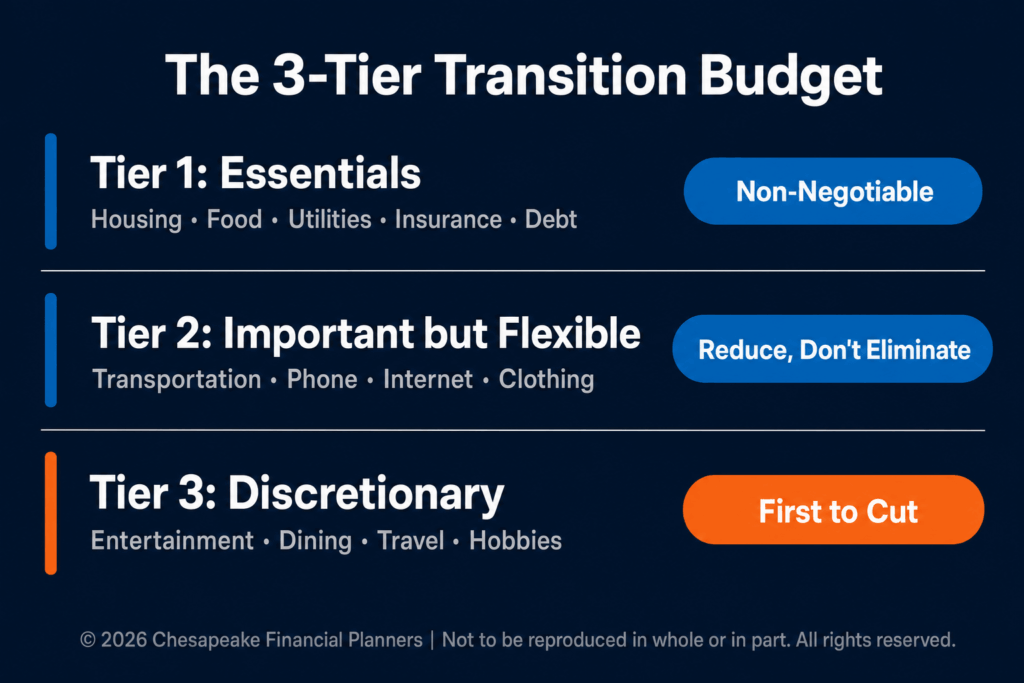
Build a bare-bones budget. Strip your spending to true essentials: housing, food, utilities, insurance, and minimum debt payments. Everything else is temporarily negotiable. Cancel unused subscriptions, pause memberships, and pull back on dining out. These are not permanent lifestyle changes. They are runway extensions.
Call creditors before you miss a payment, not after. Many lenders offer temporary forbearance or reduced-payment plans, but almost always only if you reach out proactively. A missed payment damages your credit; a pre-arranged hardship plan often does not.
Can I use my severance package to fund a career change?
Should I Withdraw From My Retirement Accounts After a Layoff?
Generally, no. Tapping retirement savings during unemployment is one of the most expensive ways to cover a short-term gap, and it permanently removes money that was supposed to compound for decades.
Here is the math that stops most people. Withdrawals from a traditional 401(k) or IRA before age 59½ typically trigger a 10% early withdrawal penalty on top of ordinary income tax. Depending on your bracket, a $20,000 withdrawal might net you closer to $13,000 after taxes and penalty. You are paying a premium to spend your own future money.
A few things to understand before you touch these accounts:
- Existing 401(k) loans accelerate. If you have an outstanding 401(k) loan, leaving your employer usually makes the balance due, and unpaid amounts are treated as a taxable distribution with the penalty attached. You cannot take a new 401(k) loan once you are no longer employed.
- Narrow penalty exceptions exist. The IRS allows penalty-free early access in limited cases, such as unreimbursed medical expenses exceeding 7.5% of adjusted gross income or substantially equal periodic payments. These are technical and easy to get wrong.
- Roth contributions are the exception worth knowing. You can withdraw your Roth IRA contributions, though not the earnings, at any time without taxes or penalties. That makes a Roth a more flexible emergency reserve than a 401(k).
Jeff Judge's rule of thumb: a retirement withdrawal is a last resort, not a first response. If the real choice is between a withdrawal and foreclosure or bankruptcy, the withdrawal may win. But exhaust unemployment benefits, severance, spending cuts, and short-term income first.
What happens to my stock options when I leave my company?
How Do I Rebuild Financially While I Look for Work?
Once the immediate crisis is handled, shift from defense to recovery. Treat the job search itself as your full-time job, with structured days, dedicated networking time, and a professional cadence to applications. Searches for professional roles commonly run three to five months, so plan for a marathon.
Update your financial projections monthly, not once. As severance winds down and the search continues, recalculate your runway and watch the trend line. If you are approaching the end of your resources, interim or contract work can extend the runway without forcing you to take the wrong permanent role out of panic. An emergency fund strategy that prioritizes liquidity over yield matters most here; cash you can reach beats a slightly higher return you cannot.
This is also where good planning before a layoff pays off. Disability insurance, an adequately funded emergency reserve, and a clear understanding of your unemployment financial planning options all reduce the pressure to make rushed decisions. The clients who weather a job loss best are usually the ones who built three to six months of expenses into accessible savings before they ever needed it.
What happens to my finances after a liquidity event?
Frequently Asked Questions
How long should my emergency fund last after losing my job?
Aim to cover three to six months of essential expenses, and lean toward six if you are a single earner or work in a volatile field. Because professional job searches often take three to five months, a runway shorter than that forces rushed decisions. Calculate your true monthly minimum, then divide your liquid savings by it.
Is COBRA or a Marketplace plan better after a layoff?
It depends on your income and health needs, but Marketplace coverage is often cheaper after a layoff because a drop in income can qualify you for premium tax credits. COBRA keeps your exact plan and network but charges the full premium. Since you have 60 days to elect COBRA retroactively, compare Marketplace prices first.
Can I withdraw from my 401(k) penalty-free if I am unemployed?
Unemployment alone does not waive the 10% early withdrawal penalty before age 59½. Limited exceptions apply, such as certain medical expenses or substantially equal periodic payments, but they are narrow and technical. Roth IRA contributions, however, can always be withdrawn tax- and penalty-free, making them a better emergency source than a traditional 401(k).
Should I file for unemployment if I received a severance package?
Yes, file immediately even with severance. In many states, unemployment benefits begin only after severance payments end, and filing early establishes your claim and eligibility window. Waiting to file usually delays your benefits, so start the process the week you lose your job rather than waiting for severance to run out.
What happens to an outstanding 401(k) loan when I leave my job?
When you leave an employer, an outstanding 401(k) loan generally becomes due, often within a short window set by the plan. If you cannot repay it, the unpaid balance is treated as a taxable distribution and may also trigger the 10% early withdrawal penalty if you are under 59½. Confirm your plan's specific repayment deadline.
Where to Go From Here
A layoff is a setback, not a verdict. The families who recover well are the ones who move fast on the few decisions that matter, runway, unemployment, and health coverage, and slow down on the ones that don't. Strong financial recovery after job loss is built in the first month, long before the next paycheck arrives.
If this was useful, our free guide on navigating sudden income changes walks through severance, benefits, and cash flow in more depth. Download it at chesapeakefp.com.
Disclosures
The information provided is for educational purposes only and should not be construed as investment advice. Investment strategies should be tailored to individual circumstances, risk tolerance, and goals. Past performance doesn't guarantee future results. Consult with qualified financial professionals regarding your specific situation.
Advisors associated with Chesapeake Financial Planners may be either (1) LPL Financial Registered Representatives offering securities through LPL Financial, Member FINRA and SIPC, and investment advisor representatives offering investment advice through Great Valley Advisor Group; or (2) solely investment advisor representatives offering investment advice through Great Valley Advisor Group and not affiliated with LPL Financial. Great Valley Advisor Group, and Chesapeake Financial Planners are separate entities from LPL Financial.


