

What is the HSA Triple Tax Advantage?
Last reviewed: July 2026
The HSA triple tax advantage means money goes into a Health Savings Account tax-free, grows tax-free, and comes out tax-free when used for qualified medical expenses. No other account in the U.S. tax code does all three. You get a deduction on the way in, no tax on growth or dividends, and no tax on the way out. That is why the HSA is the most underused account in America, and why people who understand the hsa triple tax advantage treat it as a stealth retirement account, not a checking account for copays.
Key Takeaways
- An HSA offers a tax deduction on contributions, tax-free growth, and tax-free withdrawals for qualified medical expenses.
- For 2026, the IRS set HSA limits at $4,400 for self-only coverage and $8,750 for family coverage.
- HSA owners age 55 and older can add a $1,000 catch-up contribution in 2026.
- Unspent HSA funds roll over every year, with no deadline to reimburse yourself for past medical bills.
About the Author: Jeff Judge, CFP®, AEP®, ChFC®, CLU® is Managing Partner of Chesapeake Financial Planners in Forest Hill, Maryland. He has been helping families and business owners in Harford County and the Baltimore metro area navigate tax-efficient retirement saving since earning his CFP® certification in 2013, by using Chesapeake Financial Planners’ signature process, the R.U.D.D.E.R. method™. Jeff sees the same pattern every year: people max their 401(k) and ignore the one account that beats it on taxes.
Most people treat their Health Savings Account like a spending account. They put a little in, swipe the card at the pharmacy, and never think about it again. That habit quietly throws away one of the best deals in the tax code. Done right, an HSA can outperform a 401(k) on an after-tax basis because of how the three tax breaks stack.
What Makes the HSA Tax Advantage "Triple"?
A health savings account is a tax-advantaged account you can only open if you are covered by a qualified high-deductible health plan (HDHP). The "triple" comes from three separate tax breaks that almost never appear together in one account.
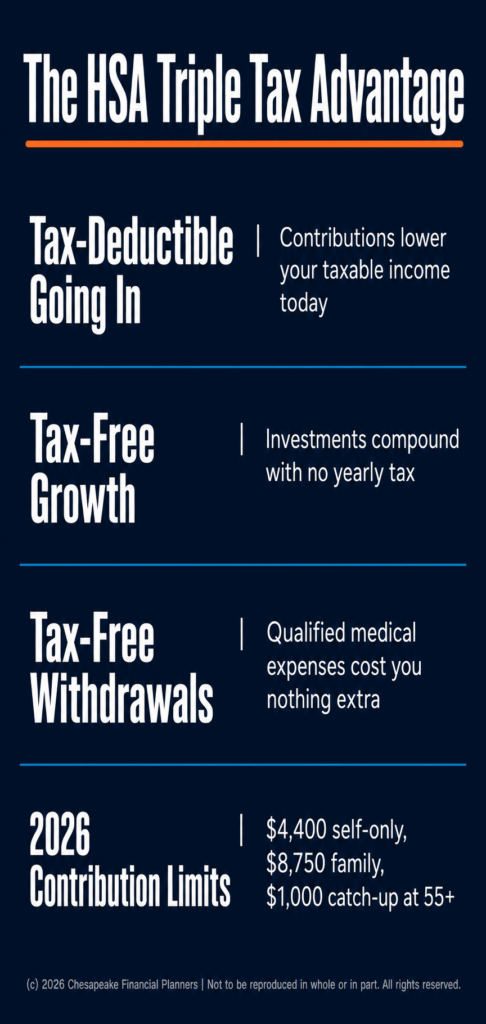
First, contributions reduce your taxable income. If you contribute through payroll, you also skip FICA taxes, which is a break a 401(k) does not give you. Second, the money grows tax-deferred, and you can invest it in funds rather than leaving it in cash. Dividends, interest, and capital gains inside the account are never taxed. Third, withdrawals for qualified medical expenses come out completely tax-free, at any age.
Compare that to a traditional 401(k), which taxes you on the way out, or a Roth IRA, which taxes you on the way in. The HSA is the only account that avoids tax at every stage. According to HealthCare.gov, eligibility hinges on being enrolled in an HDHP and having no other disqualifying coverage. Jeff Judge often tells clients that the HSA is the closest thing to a perfect account the tax code allows, and that hardly anyone uses it that way.
What Are the HSA Contribution Limits and Rules for 2026?
The IRS sets new HSA contribution limits each year, and they rose for 2026. According to the IRS, the 2026 HSA contribution limit is $4,400 for self-only coverage and $8,750 for family coverage. If you are 55 or older, you can add a $1,000 catch-up contribution on top of those amounts.
To contribute, you must be enrolled in a qualified HDHP. For 2026, the IRS defines an HDHP as a plan with a minimum deductible of $1,700 for self-only coverage and $3,400 for family coverage, with out-of-pocket maximums capped at $8,500 and $17,000 respectively. You cannot contribute if you are enrolled in Medicare, claimed as a dependent, or covered by a non-HDHP plan such as a spouse's traditional policy.
Here is the part most people miss: HSA contributions for a given tax year can be made up to the federal tax filing deadline of the following April. So you have a window after the calendar closes to top off the account. These hsa rules 2026 reward people who plan ahead rather than scrambling at year-end.
| Feature | 2026 Self-Only | 2026 Family |
|---|---|---|
| HSA contribution limit | $4,400 | $8,750 |
| Catch-up (age 55+) | +$1,000 | +$1,000 |
| Minimum HDHP deductible | $1,700 | $3,400 |
| Out-of-pocket maximum | $8,500 | $17,000 |
How Does an HSA Beat a 401(k) on Taxes?
An HSA can beat a 401(k) because it avoids tax at both ends, while a traditional 401(k) only defers tax. With a 401(k), you skip tax now but pay ordinary income tax on every dollar in retirement. With an HSA, qualified medical withdrawals are never taxed, so the money you spend on healthcare in retirement effectively costs you the most favorable rate available: zero.
This matters more than people expect, because healthcare is one of the largest expenses retirees face. Fidelity estimates a 65-year-old retiring in 2025 may need roughly $172,500 to cover healthcare costs in retirement. Paying that bill with tax-free HSA dollars rather than taxable 401(k) withdrawals is a meaningful difference over a 25- or 30-year retirement.
The catch is behavioral, not technical. To capture the full benefit, you have to invest the HSA and leave it alone, paying current medical bills out of pocket while the account compounds. Most people do the opposite. Jeff Judge has watched clients leave an HSA in cash earning nothing for a decade, then wonder why it never grew. The investment option was always there. They just never flipped the switch.
How Should I Place Investments Across Taxable and Retirement Accounts?
What Counts as a Qualified Medical Expense?
Qualified medical expenses are costs the IRS allows you to pay tax-free from an HSA, and the list is broader than most people assume. It covers deductibles, copays, prescriptions, dental work, vision care, and many over-the-counter items. In retirement, it expands to include Medicare Part B, Part D, and Medicare Advantage premiums, plus a portion of long-term care insurance premiums based on your age.
IRS Publication 502 is the authoritative list. One rule worth knowing: there is no deadline to reimburse yourself. If you pay a $3,000 medical bill out of pocket this year and keep the receipt, you can withdraw that $3,000 tax-free from your HSA twenty years from now, after the account has compounded the whole time. That receipt is a tax-free IOU you write to your future self.
What an HSA does not cover for tax-free purposes: cosmetic procedures, general health items not prescribed, and most insurance premiums while you are working. Pull money out for a non-qualified expense before age 65 and you owe income tax plus a 20% penalty.
How do you use the years between retirement and RMDs to reduce lifetime taxes?

What Happens to Your HSA After Age 65?
After age 65, your HSA becomes more flexible. The 20% penalty for non-qualified withdrawals disappears entirely. You can still take qualified medical withdrawals tax-free, but you can also withdraw for any reason and simply pay ordinary income tax, exactly like a traditional IRA. That makes the HSA a no-lose account: best case it is fully tax-free, worst case it behaves like a 401(k).
This is also where the account quietly becomes a healthcare-funding machine. With EBRI research showing that HSA balances and investment usage have been climbing as more savers treat these accounts as long-term vehicles, the people who started early have a tax-free pool waiting exactly when medical costs peak. The R.U.D.D.E.R. Method™ is Chesapeake Financial Planners' six-step planning process: Review and Recognize, Uncover and Understand, Design and Develop, Discuss and Decide, Execute and Empower, and Reassess and Refine. We use that framework to decide which clients should be front-loading an HSA versus a Roth, because the right answer depends on your bracket today and your expected bracket later. Jeff Judge notes: "Clients who spent years investing their HSA rather than spending it down are sitting on a completely tax-free pool right when their medical costs are climbing fastest — that's the payoff for treating the account like a second Roth from day one."
One word of caution: you must stop contributing to an HSA once you enroll in Medicare. Many people enroll automatically at 65, so plan your final contribution carefully to avoid an excess-contribution penalty.
How can I potentially optimize my taxes as my income grows?
Frequently Asked Questions
What is the HSA triple tax advantage in simple terms?
The HSA triple tax advantage means you get three separate tax breaks in one account: contributions are tax-deductible, the money grows tax-free, and withdrawals for qualified medical expenses are also tax-free. No other U.S. account combines all three, which is why financial planners often call it the most tax-efficient account available.
How much can I contribute to an HSA in 2026?
For 2026, the IRS set the HSA contribution limit at $4,400 for self-only coverage and $8,750 for family coverage. If you are age 55 or older, you can add an extra $1,000 catch-up contribution. You must be enrolled in a qualified high-deductible health plan to contribute at all.
Can I invest the money in my HSA?
Yes, most HSA providers let you invest your balance in mutual funds or ETFs once it exceeds a small cash threshold, often around $1,000 to $2,000. Invested HSA dollars grow tax-free, with no tax on dividends or capital gains. Leaving the balance in cash forfeits the most powerful part of the account's value.
What happens to my HSA if I don't use it?
Nothing bad happens. Unlike a flexible spending account, HSA funds roll over every year with no use-it-or-lose-it rule and no expiration. The account is yours for life, even if you change jobs or health plans. Unused funds keep growing tax-free, which is exactly how the account builds long-term wealth.
Can I use my HSA for non-medical expenses?
Before age 65, non-medical withdrawals trigger ordinary income tax plus a 20% penalty, so it is rarely worth it. After age 65, the penalty disappears, and non-medical withdrawals are simply taxed as ordinary income, just like a traditional IRA. Qualified medical withdrawals stay tax-free at any age.
Do HSA contributions reduce my taxable income?
Yes, HSA contributions reduce your taxable income for the year. If you contribute through payroll deduction, you also avoid Social Security and Medicare (FICA) taxes on the amount, a break that 401(k) contributions do not provide. Direct contributions outside payroll are deductible but do not skip FICA taxes.
Take the Next Step
The HSA rewards the people who treat it like a long-term account instead of a debit card. If you want to see how an HSA fits alongside your 401(k), Roth, and broader tax picture, our free guide to tax-efficient saving walks through the hsa triple tax advantage and the order to fund each account. Download it at chesapeakefp.com and put the most underused account in America to work.
Want to go deeper? Our Tax-Smart Financial Plan walks through this step by step.
Disclosures
The information provided is for educational purposes only and should not be construed as investment advice. Investment strategies should be tailored to individual circumstances, risk tolerance, and goals. Past performance doesn't guarantee future results. Consult with qualified financial professionals regarding your specific situation.
Growth investments may be more volatile than other investments because they are more sensitive to investor perceptions of the issuing company's growth of earnings potential.
This information is not intended to be a substitute for specific individualized tax, investment or legal advice. We suggest that you discuss your specific situation with a qualified tax, legal or financial advisor.
Advisors associated with Chesapeake Financial Planners may be either (1) LPL Financial Registered Representatives offering securities through LPL Financial, Member FINRA and SIPC, and investment advisor representatives offering investment advice through Great Valley Advisor Group; or (2) solely investment advisor representatives offering investment advice through Great Valley Advisor Group and not affiliated with LPL Financial. Great Valley Advisor Group, and Chesapeake Financial Planners are separate entities from LPL Financial.


