
How Do I Protect Myself From Identity Theft and Financial Scams?
Last reviewed: July 2026
To prevent identity theft, freeze your credit at all three bureaus, turn on multi-factor authentication for every financial account, and never share personal information with anyone who contacts you first. These three moves stop the most common attacks cold. Learning how to prevent identity theft is less about expensive tools and more about closing the simple doors thieves walk through every day.
Key Takeaways
- Freezing your credit at all three bureaus is free and the single strongest defense against new-account fraud.
- The FTC received 1.1 million identity theft reports in 2024, making it the most reported fraud category.
- Multi-factor authentication blocks the majority of account-takeover attempts even when a thief has your password.
- Scammers create urgency on purpose; slowing down for ten minutes defeats most schemes.
About the Author: Jeff Judge, CFP®, AEP®, ChFC®, CLU® is Managing Partner of Chesapeake Financial Planners in Forest Hill, Maryland. He has been helping families and business owners in Harford County and the Baltimore metro area navigate financial risk and fraud protection since earning his CFP® certification in 2013, by using Chesapeake Financial Planners’ signature process, the R.U.D.D.E.R. method™. Jeff has watched clients lose five figures to scams that a single phone call to the institution would have stopped, and the emotional toll is often worse than the financial one.
Identity theft and financial scams have moved from a nuisance to a genuine planning risk. The FBI's Internet Crime Complaint Center reported more than $16 billion in losses in 2024, a figure that has climbed every year. The good news: most protection costs nothing and takes an afternoon. Here is how to do it.
How Do I Freeze My Credit to Prevent Identity Theft?
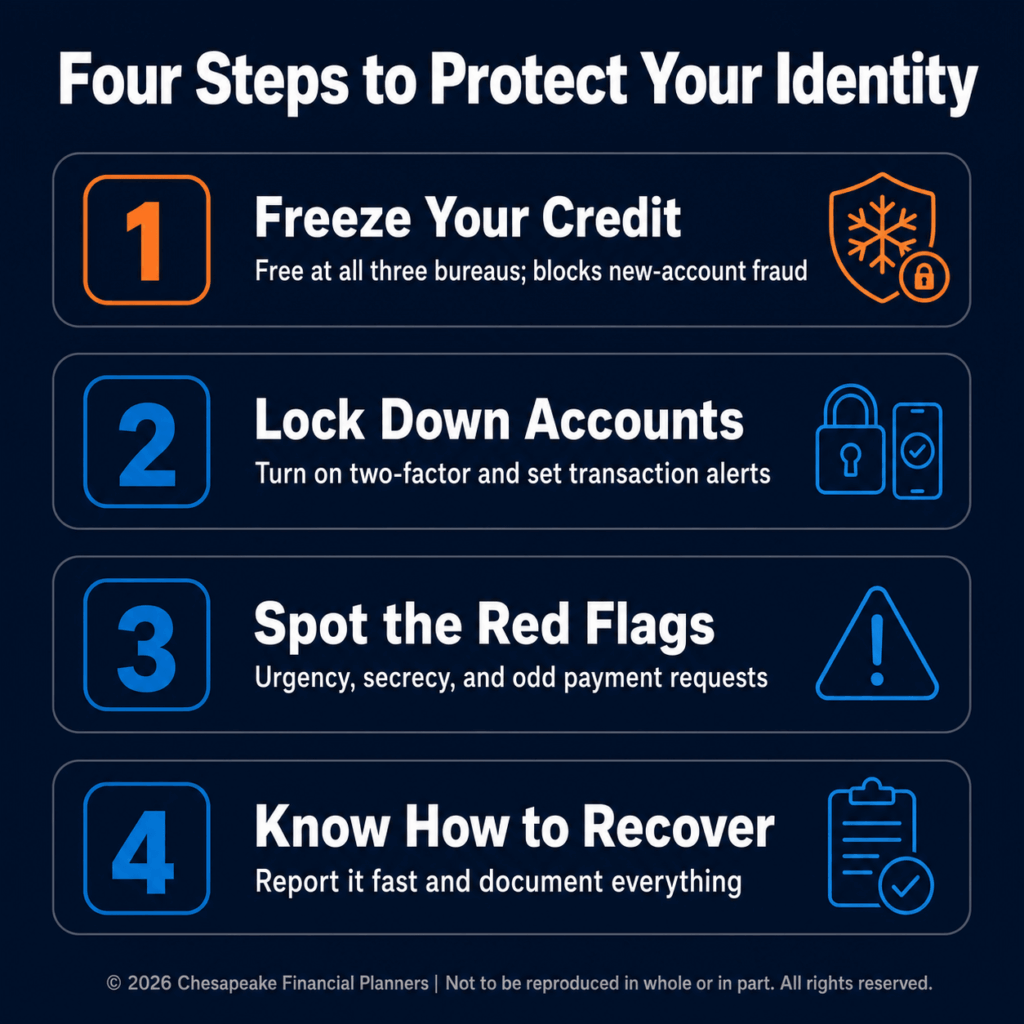
A credit freeze is the strongest single step you can take to prevent identity theft, and it is free by federal law. A freeze blocks lenders from pulling your credit report, which stops a thief from opening new accounts in your name even if they have your Social Security number.
Follow these steps:
- Contact each of the three credit bureaus directly: Equifax, Experian, and TransUnion. You must freeze all three separately.
- Create an account on each bureau's website or call their freeze line. Verify your identity with the questions they ask.
- Save the PIN or login each bureau gives you. You need it to lift the freeze later.
- When you legitimately apply for credit, temporarily "thaw" the freeze with the relevant bureau, then refreeze.
According to the Federal Trade Commission, placing and lifting a freeze is free and the lift takes effect within an hour for online requests. Jeff Judge often tells clients to freeze credit for every adult in the household, including older parents, because elder fraud is one of the fastest-growing categories.
What Are the Steps to Secure My Financial Accounts?
Securing your accounts means making your password worthless on its own. The goal is layered financial fraud protection, so that one stolen credential does not unlock your money.
- Turn on multi-factor authentication (MFA) for every bank, brokerage, and email account. Use an authenticator app rather than text messages when offered, because SIM-swap attacks can intercept texts.
- Use a unique password for each financial account. A password manager handles this without you memorizing anything.
- Set up account alerts for every transaction over a small threshold. Real-time alerts catch fraud in minutes instead of months.
- Review your accounts weekly. Scam prevention works best when you notice the first unfamiliar charge.
Your email is the master key. If a thief controls your email, they can reset passwords everywhere, so protect it like a bank account. This is the same logic behind How much should I save in an emergency fund during a job change?: a small, boring step now prevents a large, painful problem later.
How Do I Recognize and Avoid Financial Scams?
Recognizing a scam comes down to one pattern: someone you did not contact is creating urgency and asking for money or information. Every major scam, from fake IRS calls to romance fraud, runs on that script.
Watch for these red flags:
- Urgency and threats. "Your account will be closed in one hour." Legitimate institutions do not work this way.
- Requests for unusual payment. Gift cards, wire transfers, and cryptocurrency are the scammer's favorite tools because they are hard to reverse.
- Caller ID that looks official. Spoofing technology fakes any number, including the IRS and your own bank.
- Pressure to keep it secret. Real institutions never tell you to hide a transaction from family or your advisor.
The IRS states plainly that it will not call demanding immediate payment or threaten arrest over the phone. When in doubt, hang up and call the institution back using the number on your card or statement, never the number the caller gave you. Jeff Judge has a simple rule he shares with clients: if the request creates panic, that panic is the product. Slow down and verify before you act.
This habit of pausing before reacting is the same emotional discipline that protects investment decisions, a theme covered in What behavioral biases most commonly hurt investment decisions and how do you fix them?.
What Should I Do If I Have Already Been a Victim?
If you have been hit, act fast and in order. Speed limits the damage from identity theft and financial fraud.
- Report it at IdentityTheft.gov, the FTC's official recovery site, which generates a personalized recovery plan and an official affidavit.
- Contact the fraud department of any affected bank or card issuer immediately and dispute the charges.
- Place a fraud alert and, ideally, a freeze with the three bureaus.
- File a police report if a significant sum is involved or if you need documentation for creditors.
- Change passwords on every financial account and your primary email.
Document everything with dates and names. A clear paper trail is what gets fraudulent charges reversed. Working through a recovery checklist with a financial professional, much like the structured approach in What Does a Real Financial Review Actually Cover?, keeps you from missing a step while you are stressed.
Frequently Asked Questions
Is a credit freeze really free?
Yes, a credit freeze is completely free at all three credit bureaus under federal law, and so is lifting it. Equifax, Experian, and TransUnion cannot charge you to place, temporarily lift, or permanently remove a freeze. You will need to set one up with each bureau separately.
Does a credit freeze hurt my credit score?
No, a credit freeze has no effect on your credit score. It simply blocks new lenders from accessing your report, which prevents thieves from opening accounts. Your existing accounts, payment history, and score are unaffected, and you can still apply for new credit by briefly thawing the freeze.
What is the difference between a fraud alert and a credit freeze?
A fraud alert asks lenders to verify your identity before granting credit but does not block access to your report, while a credit freeze actually blocks new credit pulls entirely. A freeze offers stronger protection. A fraud alert is free, lasts one year, and is easier to set up across all three bureaus at once.
Should I worry about scams targeting older relatives?
Yes, elder fraud is one of the fastest-growing scam categories, and older adults often lose larger amounts per incident. Help parents freeze their credit, set up account alerts, and agree on a rule that any unexpected money request gets discussed with family before any action is taken.
How can I tell if a call from my bank is real?
Hang up and call the bank back using the number printed on your card or statement, never a number the caller provides. Legitimate banks will not pressure you, threaten you, or ask for your full password or a one-time code. Caller ID can be faked, so the number on your screen proves nothing.
If you want a deeper foundation for protecting your finances, our free guide on financial planning fundamentals walks through risk management step by step. Download it at chesapeakefp.com and start closing the doors that thieves rely on staying open.
Disclosures
The information provided is for educational purposes only and should not be construed as investment advice. Investment strategies should be tailored to individual circumstances, risk tolerance, and goals. Past performance doesn't guarantee future results. Consult with qualified financial professionals regarding your specific situation.
Advisors associated with Chesapeake Financial Planners may be either (1) LPL Financial Registered Representatives offering securities through LPL Financial, Member FINRA and SIPC, and investment advisor representatives offering investment advice through Great Valley Advisor Group; or (2) solely investment advisor representatives offering investment advice through Great Valley Advisor Group and not affiliated with LPL Financial. Great Valley Advisor Group, and Chesapeake Financial Planners are separate entities from LPL Financial.


