
How Are RMDs Calculated? A Plain-English Walkthrough
Last reviewed: July 2026
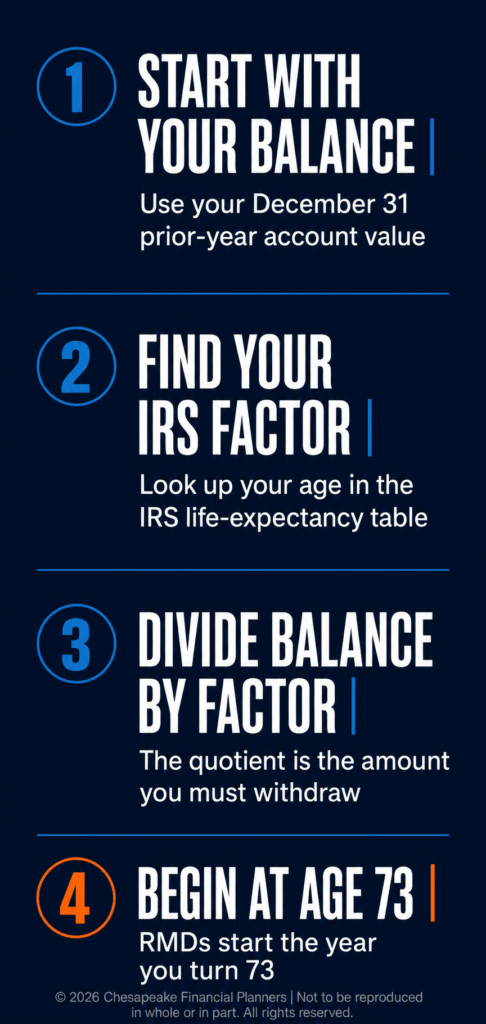
A required minimum distribution (RMD) is the smallest amount you must withdraw from a tax-deferred retirement account each year once you reach the RMD age. How are RMDs calculated? You take your account balance from December 31 of the prior year and divide it by a life-expectancy factor from an IRS table. That's the whole formula. Balance divided by factor equals your RMD for the year.
Key Takeaways
- An RMD equals your prior-year December 31 account balance divided by an IRS life-expectancy factor.
- The RMD age is 73 for anyone born between 1951 and 1959, under SECURE 2.0.
- Most retirees use the Uniform Lifetime Table; the factor at age 73 is 26.5.
- Miss an RMD and the IRS penalty is 25%, dropping to 10% if you fix it promptly.
- Roth IRAs have no RMDs during the original owner's lifetime.
About the Author: Jeff Judge, CFP®, AEP®, ChFC®, CLU® is Managing Partner of Chesapeake Financial Planners in Forest Hill, Maryland. He has been helping families and business owners in Harford County and the Baltimore metro area navigate retirement distribution rules since earning his CFP® certification in 2013, by using Chesapeake Financial Planners’ signature process, the R.U.D.D.E.R. method™. Jeff's view on RMDs is blunt: the calculation is simple, but the tax planning around it is where people leave real money on the table.
What Is an RMD and Why Does It Exist?
An RMD is a forced withdrawal from a tax-deferred account. The government let you defer taxes on that money for decades, and the RMD is how it eventually collects. Traditional IRAs, 401(k)s, 403(b)s, and most other pre-tax retirement accounts are subject to RMDs.
The rule exists for one reason: the IRS does not want you deferring taxes forever. Every dollar in a traditional IRA is a dollar that has never been taxed. RMDs guarantee the money comes out on a schedule, gets taxed as ordinary income, and stops growing tax-deferred indefinitely. Jeff Judge notes: "Every dollar sitting in a traditional IRA is a dollar the IRS has never touched, and RMDs are simply the government's way of saying the deferral period is over — so we plan around that schedule rather than being surprised by it."
Under the SECURE 2.0 Act, the RMD age is now 73 for anyone born between 1951 and 1959. If you were born in 1960 or later, your RMD age moves to 75. The IRS confirms your first RMD is due by April 1 of the year after you turn 73, and every RMD after that is due by December 31.
The RMD Calculation, Step by Step
Here is the actual math. The RMD calculation has two inputs and one division.
- Find your account balance. Use the fair market value of the account as of December 31 of the prior year. For a 2026 RMD, you use your December 31, 2025 balance.
- Find your life-expectancy factor. Look up your age in the correct IRS table. Most people use the Uniform Lifetime Table.
- Divide. Account balance divided by the factor equals your RMD for the year.
A quick example. Say your traditional IRA was worth $500,000 on December 31, 2025, and you turn 73 in 2026. The Uniform Lifetime Table factor at age 73 is 26.5. So $500,000 divided by 26.5 equals an RMD of about $18,868 for 2026.
That number is the floor, not the ceiling. You can always withdraw more. You simply cannot withdraw less without triggering a penalty.


Which RMD Table Applies to You?
The factor in your RMD calculation comes from one of three IRS tables. Picking the wrong one is the most common mistake Jeff Judge sees when people try to do this by hand.
| Table | Who Uses It |
|---|---|
| Uniform Lifetime Table | Most account owners. Use this unless your spouse is your sole beneficiary and is more than 10 years younger. |
| Joint Life and Last Survivor Table | Account owners whose spouse is the sole beneficiary and is more than 10 years younger. This produces a smaller RMD. |
| Single Life Expectancy Table | Beneficiaries who inherited a retirement account. |
The IRS Uniform Lifetime Table is the right starting point for the overwhelming majority of retirees. The factor gets smaller every year as you age, which means your RMD becomes a larger percentage of your balance over time. At 73 the factor is 26.5. By 85 it is closer to 16. That climbing percentage is exactly why RMD planning matters before you ever hit 73.
This is where the R.U.D.D.E.R. Method™, Chesapeake Financial Planners' six-step planning process of Review and Recognize, Uncover and Understand, Design and Develop, Discuss and Decide, Execute and Empower, and Reassess and Refine, earns its keep. The "Reassess and Refine" step is built for exactly this kind of annual recalculation.
How RMDs Work With Multiple Accounts
If you have more than one retirement account, the rules depend on the account type, and people get this backward constantly.
For traditional IRAs, you calculate the RMD for each IRA separately, then you can take the total from any one IRA or split it across several. The IRS treats your IRAs as a pool for withdrawal purposes.
401(k) and other employer plans work differently. Each plan's RMD must come out of that specific plan. You cannot aggregate a 401(k) RMD with an IRA RMD. If you have two old 401(k)s, you take an RMD from each one separately.
Jeff often tells clients this is the single best argument for consolidating old employer plans before age 73. Three scattered 401(k)s mean three separate RMD calculations and three separate deadlines. One IRA means one calculation and one deadline. Simplicity has real value when a missed deadline carries a penalty.

What Happens If You Miss an RMD?
Missing an RMD used to be brutal. The penalty was 50% of the amount you failed to withdraw. SECURE 2.0 cut that. The IRS now sets the excise tax at 25% of the shortfall, and it drops to 10% if you correct the mistake within the correction window and file the proper form.
That is still a steep penalty for a paperwork miss. The fix is straightforward: withdraw the missed amount as soon as you catch it, file Form 5329, and request a waiver if you have reasonable cause. The IRS grants these waivers more often than people expect, but you have to ask.
Want to get ahead of your RMDs before they start? The years between 60 and 73 are the most underused tax-planning window in retirement.
Frequently Asked Questions
At what age do RMDs start in 2026?
RMDs start at age 73 for anyone born between 1951 and 1959, under the SECURE 2.0 Act. If you were born in 1960 or later, your RMD age is 75. Your first RMD can be delayed until April 1 of the year after you turn 73, but every RMD after that is due by December 31.
Which account balance do I use to calculate my RMD?
You use the fair market value of your account as of December 31 of the prior year. For a 2026 RMD, that means your December 31, 2025 balance. You then divide that balance by the IRS life-expectancy factor for your age to get the required minimum distribution amount.
Do Roth IRAs have required minimum distributions?
No, Roth IRAs have no RMDs during the original owner's lifetime, which is one of their biggest advantages. You can leave the money to grow tax-free for as long as you live. Roth 401(k)s no longer require RMDs during the owner's lifetime either, thanks to a SECURE 2.0 change that took effect in 2024.
Can I take more than my required minimum distribution?
Yes, the RMD is a minimum, not a cap. You can withdraw as much as you want above the required amount in any year. Keep in mind that every dollar from a traditional account is taxed as ordinary income, so larger withdrawals can push you into a higher bracket or affect Medicare premiums.
Do I take one RMD or one per account?
It depends on the account type. For traditional IRAs, you calculate each separately but can take the total from any one IRA. For 401(k)s and other employer plans, each plan's RMD must come from that specific plan and cannot be combined with IRA withdrawals.
Ready to Plan Around Your RMDs?
The RMD calculation itself is simple division, but the tax planning around it is where retirees either save or lose thousands. If you found this helpful, our guide on using the pre-RMD years to cut your lifetime tax bill covers the strategy in depth. Download it at chesapeakefp.com.
How do you use the years between retirement and RMDs to reduce lifetime taxes?
What is a year-round tax planning calendar for retirees and pre-retirees?
How can I potentially optimize my taxes as my income grows?
Want to go deeper? Our Tax-Smart Financial Plan walks through this step by step.
Disclosures
The information provided is for educational purposes only and should not be construed as investment advice. Investment strategies should be tailored to individual circumstances, risk tolerance, and goals. Past performance doesn't guarantee future results. Consult with qualified financial professionals regarding your specific situation.
Advisors associated with Chesapeake Financial Planners may be either (1) LPL Financial Registered Representatives offering securities through LPL Financial, Member FINRA and SIPC, and investment advisor representatives offering investment advice through Great Valley Advisor Group; or (2) solely investment advisor representatives offering investment advice through Great Valley Advisor Group and not affiliated with LPL Financial. Great Valley Advisor Group, and Chesapeake Financial Planners are separate entities from LPL Financial.


