

Last reviewed: September 2026
Held-away assets are accounts you own that sit outside your advisor's custodial platform: an old 401(k), a spouse's rollover IRA, a brokerage account you opened yourself, company stock at a payroll broker. When a plan is built only on the accounts an advisor manages, the risk score, tax projection, and retirement math are precise but incomplete, and the blind spot is usually your largest risk.
Key Takeaways
- A "coordinated" plan often covers only the accounts on the advisor's platform, leaving old 401(k)s, spousal IRAs, and equity accounts out of the math.
- RMDs begin at age 73 and are calculated per account, so a forgotten balance can push future income into a higher bracket.
- Maryland's pension exclusion of up to $40,600 for 2026 applies to qualifying employer plans, not rollover IRAs.
- Seeing every account in one view does not require moving every account; visibility and consolidation are separate decisions.
About the Author: Jeff Judge, CFP®, AEP®, ChFC®, CLU® is Managing Partner of Chesapeake Financial Planners in Forest Hill, Maryland. He has been helping families and business owners in Harford County and the Baltimore metro area navigate retirement income and whole-household planning since earning his CFP® certification in 2013, by using Chesapeake's signature process, the R.U.D.D.E.R. Method™. "The account nobody asked about is usually the one that changes the answer," Jeff says. "I'd rather find it in year one than in the week after a funeral."
What Are Held-Away Assets, and Why Does a "Coordinated" Plan Miss Them?
I sat across from a client last year with $4.6 million spread across four accounts. His advisor called the plan "fully coordinated." It covered exactly one of those accounts, the one the advisor managed.
The other three weren't hidden. They were right there in his statements: a 401(k) from a job he left eleven years ago, a rollover IRA his wife controlled, and a taxable account he opened after a bonus year and didn't mention because nobody asked. No one built a risk model around them, checked whether they overlapped with the managed portfolio, or ran a tax projection that included them. The plan was thorough. It was also missing roughly 60% of his net worth.
Many advisors build the plan around assets under management because that's what shows up in their software, which pulls from custodial feeds. An advisor managing $2 million of your $5 million will build a detailed plan for the $2 million. He won't chase a 401(k) you haven't touched since 2015.
That's how the tools work, not a conspiracy. Nobody says "this analysis reflects 40% of your assets." The pie chart looks complete, the risk number looks exact, and a client holding a thick planning binder assumes precise means complete.
Where Do Held-Away Assets Usually Hide?
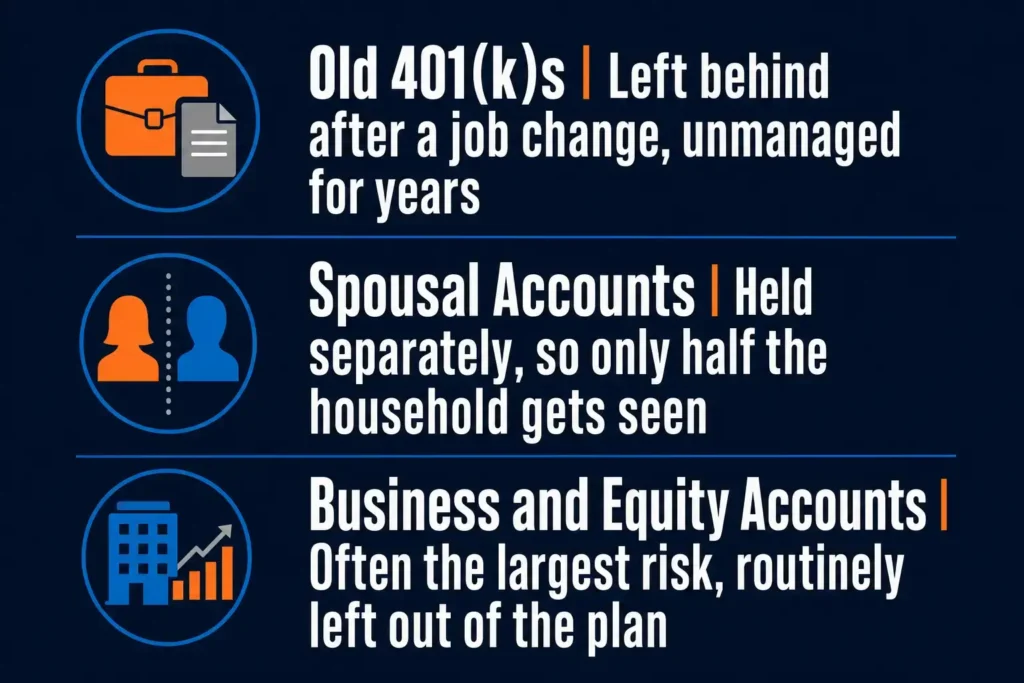
The same three spots show up repeatedly:
- Old 401(k)s and 403(b)s from job changes. Three job changes can leave three accounts, each in a target-date fund nobody has reviewed in years.
- Spousal accounts held separately. One spouse works with an advisor; the other keeps a rollover IRA from before the marriage. The household's real risk is the combination of both.
- Business retirement plans and equity compensation. A SEP-IRA or cash balance plan at a third-party administrator, or vested RSUs at a payroll broker, is often the single largest concentration of risk in the household.
"A plan is only as complete as the account list behind it. If the list is short, the confidence is borrowed," says Jeff Judge, CFP®.
Do held-away accounts cost more in fees? Often, yes. An old 401(k) carries its own expense ratios, sometimes in a share class the plan sponsor picked a decade ago. A client paying 0.9% in a forgotten fund while the managed account runs 0.6% doesn't see a blended cost, because no one is looking at both accounts at once. Over twenty years that gap compounds, invisibly. Whether to roll those accounts over is its own question, covered in our guide to consolidating old 401(k) accounts from past jobs.
How Do Held-Away Assets Distort Risk and Tax Planning?
I watched a version of this with a business owner whose advisor built an aggressive growth allocation across $1.8 million of managed accounts, reasonable for a fifteen-year horizon. What the advisor didn't know: the client held $2.3 million of company stock from an equity package, concentrated in one name, in an account the advisor didn't see. The household wasn't "aggressive growth." It was one bad quarter from a serious problem, and the plan said everything was fine.
Tax planning breaks the same way. Roth conversion sizing, RMD sequencing, and tax-loss harvesting all depend on seeing taxable, tax-deferred, and tax-free accounts together. Run the math on 60% of the assets and you get a confident, wrong answer with false precision behind it.
RMDs make it mechanical. Each tax-deferred account's required distribution is figured from its prior year-end balance, and the withdrawal order an advisor recommends depends on knowing every balance, which is also central to any retirement income drawdown strategy. I worked with a household where the wife had a 403(b) from a hospital job she left in her thirties. It had grown to just under $400,000, untouched. Their Roth conversion plan left it out, so it underestimated future RMDs by that account's share. That's the difference between converting into the 22% bracket and getting pushed into 32% a few years later without ever deciding to.
What about inherited IRAs? They create a more urgent version of the same blind spot. An inherited IRA the managing advisor doesn't know about has its own distribution schedule, so a Roth conversion recommended for a "low-income year" may collide with a required inherited-IRA withdrawal in that same year. Our overview of RMD rules and strategies explains how those schedules stack.
Why Do Held-Away Assets Matter More for Maryland Retirees?
Maryland adds a twist most national advice skips. Residents 65 and older can exclude up to $40,600 of qualifying retirement income for 2026, but only from employer plans. Maryland's Technical Bulletin 51 is explicit: "A traditional IRA, a Roth IRA, a rollover IRA, a simplified employee plan (SEP), a Keogh plan, an ineligible deferred compensation plan, or foreign retirement income does not qualify."
That changes the held-away conversation. The reflex fix, rolling every old 401(k) and 403(b) into one IRA for tidiness, can move dollars out of exclusion-eligible plans. For some Maryland households, the right answer is to keep an old employer plan and simply bring it into the planning view. Visibility and consolidation are two different decisions.
Baltimore-area hospital systems and universities have employed many local households, often leaving 403(b)s behind, and Aberdeen Proving Ground careers can mean federal and contractor accounts accumulated across several employers. For families in Forest Hill, Bel Air, Havre de Grace, and the Baltimore suburbs, we start with the full account list before any recommendation. The R.U.D.D.E.R. Method™ is Chesapeake Financial Planners' six-step planning process: Review and Recognize, Uncover and Understand, Design and Develop, Discuss and Decide, Execute and Empower, and Reassess and Refine. Review and Recognize is where every held-away account, beneficiary form, and cost basis gets listed, before any projection runs.

How Can You Tell If Your Plan Has This Gap?
This isn't about firing anyone, and it isn't purely an advisor problem. Plenty of clients forget the old 401(k) exists or think of it as "not part of the real plan." I've had clients hand me a stack of statements eighteen months into a relationship because a document review forced the issue, including a $60,000 rollover they didn't think mattered. The real failure is that nobody built a process to catch it.
Three questions surface the gap quickly:
- What is our household's total equity exposure, and which accounts is that number built from? If an account you own isn't on the list, you have a plan for part of your money.
- Which accounts were used for this year's Roth conversion or withdrawal-order recommendation? A missing 401(k) or spouse's IRA means the recommendation rests on incomplete data.
- Who is the beneficiary on every account, including the ones nobody has reviewed? I've seen a first spouse still named on a 401(k) fifteen years into a second marriage. Our list of beneficiary designation mistakes shows why this one hurts.
The fix is boring, which is why it gets skipped. Aggregation tools exist, advisors can request read-only access, and you can bring a statement to the meeting. For accounts you've lost track of, the Department of Labor's Retirement Savings Lost and Found database can help locate old employer plans. What it takes is habit: an advisor who asks every year, account by account, "is there anything else I should know about?" That question takes ninety seconds. The gap it closes, counting fee drag, misallocated risk, and a mis-sized Roth window, can run into six figures over decades. With $3 million or more spread across job changes, a spouse, and a business, the odds that it all sits in one place are low. Ask to see the account list behind your risk number.
Frequently Asked Questions
What are held-away assets?
Held-away assets are investment or retirement accounts you own that are not managed by, or held at the custodian of, your primary financial advisor. Common examples include old 401(k)s and 403(b)s, a spouse's separate IRA, a self-directed brokerage account, business retirement plans, and equity compensation held at a payroll broker.
Why should my advisor include held-away assets in my plan?
Your advisor should include held-away assets because risk, taxes, and retirement income depend on the whole household. Leaving accounts out can make an allocation look more diversified than it is, mis-size Roth conversions, misjudge future RMDs, and hide fees and beneficiary errors in accounts nobody is reviewing.
Do I have to move my accounts for my advisor to see them?
No. Seeing an account and moving it are separate decisions. Advisors can review statements, use read-only aggregation, or request access to outside accounts. For Maryland residents, keeping an old employer plan can matter because the state pension exclusion applies to qualifying employer plans but not to rollover IRAs.
How do held-away assets affect required minimum distributions?
Required minimum distributions begin at age 73 and are calculated from each tax-deferred account's prior year-end balance. If an old 401(k) or 403(b) is left out of the plan, future RMDs and taxable income are understated, which can lead to Roth conversions or withdrawals that push you into a higher bracket later.
How can I find an old 401(k) I forgot about?
Start with old W-2s, plan statements, or your former employer's HR department. The U.S. Department of Labor's Retirement Savings Lost and Found database can also help locate old employer plans. Once found, add the account to your planning view before deciding whether to leave it, roll it over, or consolidate it.
Ready to See Your Whole Account List?
Held-away assets are where a precise-looking plan quietly goes wrong, and finding them starts with one list. Ready to put a plan around yours? Jeff Judge and the Chesapeake Financial Planners team serve families and business owners across Harford County, Forest Hill, Bel Air, and the Baltimore metro area. Schedule a free fit call and bring every statement, including the ones you haven't opened in years.
A version of this article was originally published on Jeff Judge's LinkedIn.
Disclosures
The information provided is for educational purposes only and should not be construed as investment advice. Investment strategies should be tailored to individual circumstances, risk tolerance, and goals. Past performance doesn't guarantee future results. Consult with qualified financial professionals regarding your specific situation.
Contributions to a traditional IRA may be tax deductible in the contribution year, with current income tax due at withdrawal. Withdrawals prior to age 59 ½ may result in a 10% IRS penalty tax in addition to current income tax.
Traditional IRA account owners have considerations to make before performing a Roth IRA conversion. These primarily include income tax consequences on the converted amount in the year of conversion, withdrawal limitations from a Roth IRA, and income limitations for future contributions to a Roth IRA. In addition, if you are required to take a required minimum distribution (RMD) in the year you convert, you must do so before converting to a Roth IRA.
This information is not intended to be a substitute for specific individualized tax, investment or legal advice. We suggest that you discuss your specific situation with a qualified tax, legal or financial advisor.
Advisors associated with Chesapeake Financial Planners may be either (1) LPL Financial Registered Representatives offering securities through LPL Financial, Member FINRA and SIPC, and investment advisor representatives offering investment advice through Great Valley Advisor Group; or (2) solely investment advisor representatives offering investment advice through Great Valley Advisor Group and not affiliated with LPL Financial. Great Valley Advisor Group, and Chesapeake Financial Planners are separate entities from LPL Financial.
Chesapeake Financial Planners | 2402 Scotlon Ct, Forest Hill, MD 21050 | (410) 652-7868 | www.chesapeakefp.com
© 2026 Chesapeake Financial Planners | Not to be reproduced in whole or in part. All rights reserved.


