

How Should HCPS Employees Balance Their Maryland TRS Pension With a 403(b) or 457(b)?
Last reviewed: July 2026
Harford County Public Schools employees should treat their Maryland Teachers' Pension System benefit as the foundation of retirement income, then layer a 403(b) or 457(b) on top to fill the gap between that pension and the income they actually want. The pension covers a predictable base. The supplemental accounts cover everything the pension formula leaves on the table, including the years before pension eligibility, inflation drift, and the tax flexibility a fixed pension cannot give you. Understanding your Harford County Public Schools HCPS retirement benefits as a coordinated system, rather than three separate accounts, is the single biggest planning advantage most teachers and staff overlook.
Key Takeaways
- The Maryland Teachers' Pension System uses a 1.5% multiplier per year of service for members in the Reformed Pension Benefit tier.
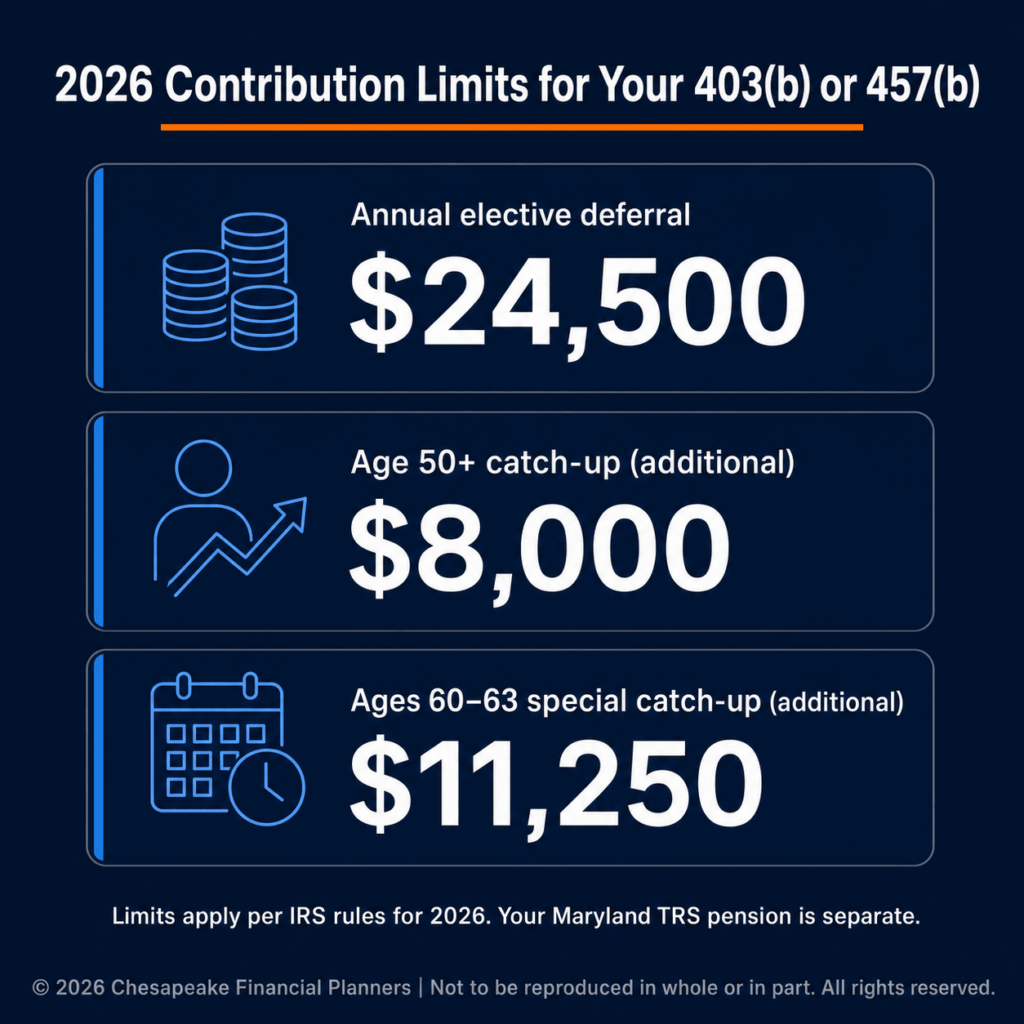
- HCPS employees can contribute up to $24,500 to a 403(b) in 2026, with higher catch-up amounts after age 50.
- A 457(b) lets you stack a second $24,500 contribution on top of the 403(b) in the same year.
- Maryland teachers generally pay into Social Security, so the WEP and GPO penalties that hit many other states do not apply.
- Vesting in the Maryland Teachers' Pension System requires 10 years of eligibility service.
About the Author: Jeff Judge, CFP®, AEP®, ChFC®, CLU® is Managing Partner of Chesapeake Financial Planners in Forest Hill, Maryland. He has been helping families and business owners in Harford County and the Baltimore metro area navigate teacher pension and supplemental retirement planning since earning his CFP® certification in 2013, by using Chesapeake Financial Planners’ signature process, the R.U.D.D.E.R. method™. Jeff has sat across the table from dozens of HCPS employees who assumed the pension alone would carry them, only to find a five-figure annual gap between the pension formula and the lifestyle they pictured.
How Does the Maryland Teachers' Pension Work for HCPS Employees in Harford County?
Most HCPS teachers and many staff members belong to the Maryland Teachers' Pension System, administered by the Maryland State Retirement and Pension System. For members in the Reformed Pension Benefit tier (those who joined on or after July 1, 2011), the Maryland State Retirement Agency calculates the annual benefit using a 1.5% multiplier applied to your average final compensation and your years of eligibility service.
Here is what that means in plain terms. If you work 30 years and your average final compensation is $75,000, the formula gives you roughly 1.5% × 30 × $75,000, or about $33,750 per year. That is a real, lifelong, defined-benefit payment. It is also, for most people, not enough on its own.
Vesting matters too. You need 10 years of eligibility service to qualify for a future pension benefit. Leave before that and you generally walk away with only your own contributions plus interest, not the employer-funded benefit. Jeff Judge often reminds HCPS clients that the years between year eight and year ten are the most expensive years to quit, because the vested pension is worth far more than the contributions you would refund.
The pension is the floor. It is predictable and it lasts for life. But it is fixed at retirement, and a fixed income loses purchasing power every year inflation runs. That gap is exactly what the supplemental accounts exist to close.

What Is the Difference Between a 403(b) and a 457(b) for Maryland Teachers Near Bel Air?
A 403(b) and a 457(b) are both tax-advantaged supplemental retirement accounts available to HCPS employees, and the most useful thing to know is that you can fund both in the same year. They are not an either-or choice.
The 403(b) is the school-system equivalent of a 401(k). For 2026, the IRS allows employees to contribute up to $24,500 to a 403(b), with a $8,000 catch-up contribution available beginning the year you turn 50. The 457(b) is a separate governmental deferred-compensation plan with its own $24,500 limit for 2026. Because the two plans live under different sections of the tax code, the contribution limits do not share a ceiling. A teacher near Bel Air who maxes both could defer roughly $49,000 in a single year before age-based catch-ups.
The biggest practical difference shows up at separation from service. Money in a 457(b) can be withdrawn after you leave HCPS employment without the 10% early-withdrawal penalty that normally applies before age 59½. That makes the 457(b) uniquely valuable for anyone planning to retire in their mid-fifties and bridge the years before the pension and Social Security fully kick in.
Here is a side-by-side view for HCPS employees in Maryland:
| Feature | 403(b) | 457(b) |
|---|---|---|
| 2026 base limit | $24,500 | $24,500 |
| Age 50 catch-up | $8,000 | $8,000 |
| Early-withdrawal penalty before 59½ | 10% applies | No penalty after separation |
| Can fund alongside the other | Yes | Yes |
| Tax treatment | Pre-tax or Roth, if offered | Pre-tax or Roth, if offered |
Do HCPS Employees Pay Into Social Security, and Will WEP or GPO Reduce Their Benefits?
Yes, HCPS employees generally pay into Social Security through their school-system employment, which means the two benefit-reducing provisions that punish teachers in many other states usually do not apply in Maryland. This is one of the most misunderstood points in Maryland teacher retirement planning, and getting it wrong can cost you years of unnecessary worry.
In states where teachers do not pay Social Security taxes on their school wages, the Windfall Elimination Provision and the Government Pension Offset can sharply cut Social Security benefits. Maryland teachers covered by the Maryland State Retirement and Pension System typically do pay Social Security taxes, so their Social Security record builds the same way a private-sector worker's does. The Social Security Administration confirms that full retirement age is 67 for anyone born in 1960 or later, which covers nearly every HCPS employee planning today.
The practical takeaway: most HCPS employees are building three income streams, not two. Pension, Social Security, and supplemental savings. Jeff Judge has watched Harford County teachers leave real money on the table by claiming Social Security early out of a mistaken belief their pension would reduce it. In most Maryland cases, it will not. The claiming decision should be driven by your full financial picture, not by fear of an offset that does not apply to you.
What Is the Best Social Security Claiming Age Strategy for Retirees?
How Should HCPS Employees in Forest Hill Coordinate All Three Accounts?
HCPS employees in Forest Hill and across Harford County should coordinate their pension, supplemental accounts, and Social Security by sequencing them around tax brackets and the years they actually need income, not by treating each account in isolation. The order in which you fund and later draw from these accounts can swing your lifetime tax bill by tens of thousands of dollars.
Our office sits in Forest Hill, a few minutes from several HCPS schools, and a large share of the families we work with are current or retired Harford County teachers and administrators. That proximity matters because Maryland-specific rules, the local pay scale, and the timing of HCPS retirements show up in the same patterns again and again. We built the R.U.D.D.E.R. Method™, Chesapeake Financial Planners' six-step planning process: Review and Recognize, Uncover and Understand, Design and Develop, Discuss and Decide, Execute and Empower, and Reassess and Refine, precisely to walk people through decisions like this without skipping a step.
A workable framework looks like this. First, contribute enough to capture the pension's full value by staying past your vesting date. Second, decide between Roth and pre-tax in the 403(b) based on whether your tax bracket is lower now than it will be in retirement. Many mid-career HCPS employees in a lower bracket today benefit from Roth contributions. Third, use the 457(b) deliberately if you plan to retire before 59½, since it becomes your penalty-free bridge account. Fourth, model your Social Security claiming age against the pension start date so you are not stacking income into a higher bracket than necessary.
One pattern I see constantly with HCPS clients: people max the 403(b) on autopilot and ignore the 457(b) entirely, then retire at 56 and discover they have no penalty-free money to live on until 59½. The accounts were right. The sequence was wrong.
What is the right retirement withdrawal order for your accounts?
Frequently Asked Questions
What is the Maryland Teachers' Pension multiplier for HCPS employees?
The Maryland Teachers' Pension System uses a 1.5% multiplier per year of eligibility service for members in the Reformed Pension Benefit tier, those who joined on or after July 1, 2011. The benefit is calculated by multiplying 1.5% by your years of service and your average final compensation, then paid as a lifelong monthly benefit.
How much can an HCPS employee contribute to a 403(b) in 2026?
An HCPS employee can contribute up to $24,500 to a 403(b) in 2026, according to the IRS. Employees who are age 50 or older during the year can add a catch-up contribution of $8,000, bringing the total to $32,500. These amounts apply per person, not per household, so two-teacher couples can each contribute the full limit.
Can an HCPS teacher contribute to both a 403(b) and a 457(b) in the same year?
Yes, an HCPS teacher can contribute to both a 403(b) and a 457(b) in the same year because the two plans fall under separate sections of the tax code with independent contribution limits. In 2026, that allows roughly $49,000 in combined base contributions, plus age-50 catch-up amounts in each plan if eligible.
Do Maryland teachers lose Social Security benefits because of their pension?
No, most Maryland teachers do not lose Social Security benefits because of their pension, since HCPS employees generally pay Social Security taxes on their school wages. The Windfall Elimination Provision and Government Pension Offset, which reduce benefits for teachers in some other states, usually do not apply to Maryland educators who paid into Social Security throughout their careers.
When does an HCPS employee become vested in the Maryland pension?
An HCPS employee becomes vested in the Maryland Teachers' Pension System after 10 years of eligibility service. Vesting means you qualify for a future lifelong pension benefit even if you leave before retirement age. Leaving before 10 years generally returns only your own contributions plus interest, not the employer-funded portion of the benefit.
Should a Harford County teacher choose Roth or pre-tax for the 403(b)?
A Harford County teacher should choose Roth contributions in the 403(b) when their current tax bracket is lower than the bracket they expect in retirement, and pre-tax when the reverse is true. Many mid-career HCPS employees in a moderate bracket today benefit from Roth, locking in today's rate on money that grows tax-free for decades.
Why is a 457(b) useful for HCPS employees who retire early?
A 457(b) is useful for HCPS employees who retire early because it allows penalty-free withdrawals after you separate from service, even before age 59½. This makes it the ideal bridge account for teachers retiring in their mid-fifties who need income before the standard early-withdrawal rules and pension start date align.
Plan Your HCPS Retirement With a Local Team
Your Maryland pension, 403(b), 457(b), and Social Security are four moving parts that only work well when they move together. If you want a clear picture of how your specific Harford County Public Schools HCPS retirement benefits fit, our team works with HCPS employees across Forest Hill, Bel Air, and the rest of Harford County every week. Schedule a no-obligation call with Jeff Judge and the Chesapeake Financial Planners team at chesapeakefp.com to map your pension and supplemental accounts into one coordinated plan.
Want to go deeper? Our Maryland Financial Planning Guide walks through this step by step.
Disclosures
The information provided is for educational purposes only and should not be construed as investment advice. Investment strategies should be tailored to individual circumstances, risk tolerance, and goals. Past performance doesn't guarantee future results. Consult with qualified financial professionals regarding your specific situation.
Advisors associated with Chesapeake Financial Planners may be either (1) LPL Financial Registered Representatives offering securities through LPL Financial, Member FINRA and SIPC, and investment advisor representatives offering investment advice through Great Valley Advisor Group; or (2) solely investment advisor representatives offering investment advice through Great Valley Advisor Group and not affiliated with LPL Financial. Great Valley Advisor Group, and Chesapeake Financial Planners are separate entities from LPL Financial.


