

Do I need a new financial plan after divorce?
Last reviewed: July 2026
Yes, you need a new financial plan after divorce because your income, expenses, assets, and goals have all fundamentally changed. A plan built for a two-person household no longer fits a one-person life. Financial planning after divorce starts with rebuilding your baseline, resetting your goals, and protecting your independent future. The old plan wasn't wrong. It just doesn't match the reality you're living now.
Key Takeaways
- Financial planning after divorce requires a full reset of your budget, goals, and risk tolerance to match a single-income household.
- You can contribute up to $7,500 to an IRA in 2026, plus $1,100 in catch-up if you are 50 or older.
- A marriage lasting 10 years or more may qualify you for Social Security benefits on your ex-spouse's record.
- Rebuilding starts with a clear inventory of what you have and what you actually need to feel secure.
About the Author: Jeff Judge, CFP®, AEP®, ChFC®, CLU® is Managing Partner of Chesapeake Financial Planners in Forest Hill, Maryland. Jeff often tells newly divorced clients that the hardest part isn't the math. It's giving yourself permission to want different things than you did when you were married. He has been helping families and business owners in Harford County and the Baltimore metro area navigate major life transitions and rebuild their financial futures since earning his CFP® certification in 2013, by using Chesapeake Financial Planners’ signature process, the R.U.D.D.E.R. method™.
Why does your old financial plan stop working after divorce?
Your old financial plan stops working after divorce because it was built around shared income, shared expenses, and shared decisions. All three are gone. The structure that held your money life together has been dismantled, and what's left is yours alone to carry.
Here's what typically shifts:
Income. You're now living on one income, or one income plus support payments, instead of two. Even with spousal or child support, total household cash flow usually drops. The U.S. Census Bureau reports that single-parent households face significantly higher rates of financial strain than two-parent households.
Expenses. Some costs fall because you're supporting one household. Others spike. Health insurance you once shared, housing, childcare, and legal fees can hit hard and fast. The math rarely works in your favor right away.
Assets. Retirement accounts, home equity, and savings were divided. What you hold now is your portion, and it has to carry you through your entire financial future. If a retirement account was split, it likely involved a QDRO: How to Split Retirement Accounts in a Divorce Without Triggering Taxes.
Goals and risk tolerance. Your retirement timeline, education savings, and home plans are all back on the table. Some clients become far more risk-averse, afraid of losing what little they kept. Others get aggressive, trying to make up lost ground. Jeff has watched both reactions cost people money. The right risk level is the one that matches your real timeline, not your emotional state in the year after the decree.
Forcing your post-divorce life into your pre-divorce plan is like wearing someone else's shoes. It might technically work. It's going to hurt.
How do I take control of my finances after divorce or loss?
How do you rebuild your financial baseline after divorce?
You rebuild your financial baseline after divorce by inventorying what you have, calculating your real monthly income, and mapping every expense. This is the least exciting step and the most important one. You cannot build a plan if you don't know where you stand.
Inventory your assets: retirement accounts (401(k), IRA, Roth IRA), taxable investment accounts, cash savings, home equity, and any other property now in your name.
Calculate your monthly income: employment income after taxes, spousal support if applicable, child support if applicable, and any investment or rental income.
Map your monthly expenses in three buckets:
- Fixed: rent or mortgage, insurance, utilities, car payment, loan payments
- Variable: groceries, gas, childcare, medical, discretionary spending
- Irregular: annual insurance premiums, property taxes, car maintenance
Then run the numbers. Is your income covering your expenses? If yes, how much is left for savings and goals? If no, how large is the gap, and how long can your reserves cover it?
This is where the R.U.D.D.E.R. Method™ earns its keep. The R.U.D.D.E.R. Method™ is Chesapeake Financial Planners' six-step planning process: Review and Recognize, Uncover and Understand, Design and Develop, Discuss and Decide, Execute and Empower, and Reassess and Refine. After divorce, you start at the very first step, reviewing and recognizing a financial reality that may look nothing like last year's.
This isn't about judgment. It's about clarity. Financial Independence After Divorce: Rebuilding Credit, Income, and a Financial Plan covers the credit-rebuilding piece in depth.
How do I rebuild my finances and establish financial independence after a divorce?
How should you reset your financial goals after divorce?
You reset your financial goals after divorce by deciding what you actually want now, then ranking those goals by urgency. Your pre-divorce goals were partly someone else's. The ones you keep should be the ones you'd choose for yourself today.
Ask yourself honest questions:
- Retirement: When do I realistically want or need to retire? Am I on track, or do I need to raise my savings rate? In 2026 you can contribute up to $24,500 to a 401(k), which is one of the most powerful catch-up tools available.
- Housing: Keep the home, downsize, or relocate? What makes sense financially and emotionally?
- Career: Am I in the right job? Do I need to grow income, pivot, or invest in training?
- Family: Am I still funding college? Does the new household structure change that math?
- Independence: What does security look like for me now, and how much do I need saved to feel safe?
Then prioritize ruthlessly. You can't chase every goal at once, especially with tight cash flow. A workable order looks like this:
- Emergency fund and basic stability
- High-interest debt reduction
- Retirement savings
- Everything else (home, education, travel)
One pattern Jeff sees again and again: newly divorced clients underfund their emergency reserve because they're rushing to rebuild retirement. The reserve comes first. It's what keeps a bad month from becoming a financial setback you spend years recovering from.
Don't overlook benefits you may have earned. If your marriage lasted at least 10 years, you may qualify for Social Security benefits on your ex-spouse's record without affecting their benefit, according to the Social Security Administration.
How do I stay financially strong after a major life change?
Should I work with a financial advisor who understands women's needs?
Frequently Asked Questions
Do I really need a new financial plan after divorce, or can I adjust my old one?
You need a new financial plan after divorce, not just an adjustment to the old one. Your income, expenses, asset base, and goals have all changed at the same time. A plan built for two people sharing costs and decisions cannot be patched to fit a single-income household. Start fresh with a clear inventory of what you now have.
How soon after divorce should I create a new financial plan?
Create a new financial plan as soon as your divorce is finalized and your asset division is complete. Waiting lets small problems compound, especially if your cash flow is tight or you are drawing down reserves. The first 90 days are ideal for rebuilding your baseline budget, even if you delay bigger decisions like investment changes until you feel steady.
Can I claim Social Security on my ex-spouse's record after divorce?
Yes, you may claim Social Security on your ex-spouse's record if your marriage lasted at least 10 years, you are unmarried, and you are at least 62. According to the Social Security Administration, claiming on their record does not reduce their benefit, and you do not need their permission to apply.
What financial documents do I need after a divorce is final?
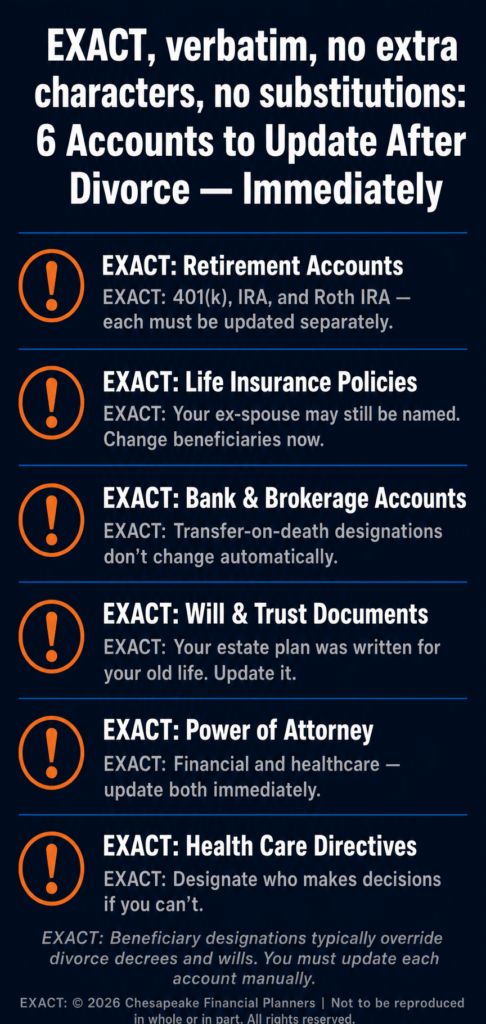
After a divorce is final, gather your divorce decree, QDRO paperwork, updated account statements, tax returns, insurance policies, and beneficiary forms. Update beneficiaries on retirement accounts and life insurance immediately, because an outdated beneficiary form can override your will. See What financial documents do I need to gather before filing for divorce? for the full list.
Should I work with a financial advisor after divorce?
Working with a financial advisor after divorce helps you rebuild a plan that fits your new reality without missing tax traps or benefit opportunities. A planner can pressure-test your budget, coordinate retirement and Social Security timing, and keep emotion out of major money decisions. A good fit costs nothing to explore and can prevent expensive mistakes during a vulnerable stretch.
If you're rebuilding your financial life after divorce, you don't have to map it out alone. Jeff Judge and the Chesapeake Financial Planners team help people across the Baltimore metro and beyond turn a disrupted financial picture into a clear, single-person plan. Schedule a free fit call at chesapeakefp.com and start your post-divorce financial planning with a steady hand.
Want to go deeper? Our Post-Divorce Financial Organizer walks through this step by step.
Disclosures
The information provided is for educational purposes only and should not be construed as investment advice. Investment strategies should be tailored to individual circumstances, risk tolerance, and goals. Past performance doesn't guarantee future results. Consult with qualified financial professionals regarding your specific situation.
Advisors associated with Chesapeake Financial Planners may be either (1) LPL Financial Registered Representatives offering securities through LPL Financial, Member FINRA and SIPC, and investment advisor representatives offering investment advice through Great Valley Advisor Group; or (2) solely investment advisor representatives offering investment advice through Great Valley Advisor Group and not affiliated with LPL Financial. Great Valley Advisor Group, and Chesapeake Financial Planners are separate entities from LPL Financial.


