

What Financial Conversations Should We Have Before Getting Married?
Last reviewed: July 2026
Want to go deeper? Our Couples Money System Guide & Worksheet walks through this step by step.
The financial conversations before marriage every couple should have cover five areas: full disclosure of income, debt, and credit; how you'll structure accounts; shared goals; how you'll handle disagreements; and whether you need a prenup. Have these talks before the wedding, not after. Money is consistently among the top sources of stress in relationships, and most of that stress comes from couples never aligning on the basics before they legally tied their finances together.
Key Takeaways
- Couples should disclose income, debt, credit scores, and assets fully before marriage to avoid surprises that erode trust.
- Money and finances rank as a top source of relationship stress, cited by 73% of partnered adults in a 2024 Bankrate survey.
- Three account structures work: fully joint, fully separate, or hybrid. Pick one together before the wedding.
- A prenuptial agreement is worth discussing for anyone bringing a business, significant assets, or children into the marriage.
About the Author: Jeff Judge, CFP®, AEP®, ChFC®, CLU® is Managing Partner of Chesapeake Financial Planners in Forest Hill, Maryland. He has been helping families and business owners in Harford County and the Baltimore metro area navigate major financial transitions since earning his CFP® certification in 2013, by using Chesapeake Financial Planners’ signature process, the R.U.D.D.E.R. method™. Jeff has watched couples spend a year planning a wedding and not one afternoon planning the marriage's money, and that gap shows up years later in resentment that was entirely avoidable.
You've said yes. You're deep in venue tours and guest lists. But the conversation that matters more than the seating chart is the one most couples keep putting off. Here's what you actually need to talk through, and how to do it without turning it into a fight.
What Financial Information Should We Disclose Before Marriage?
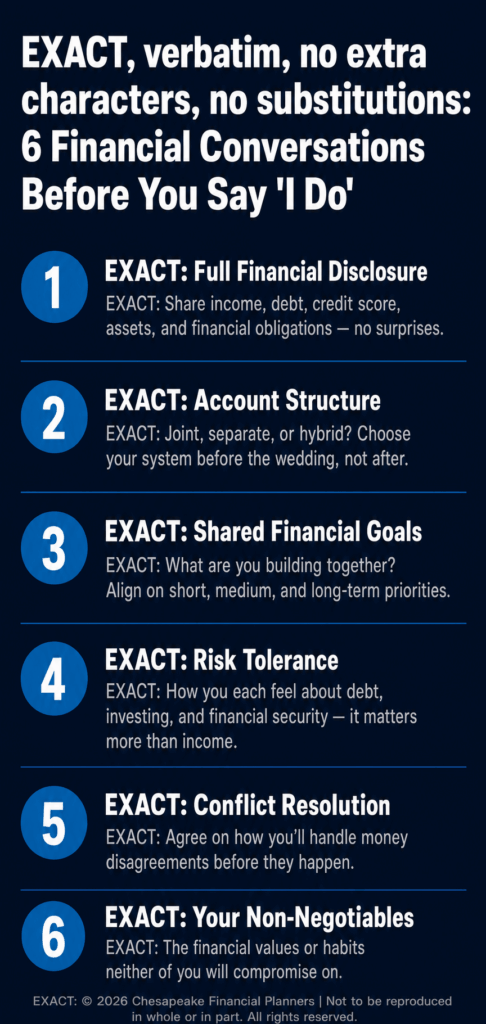
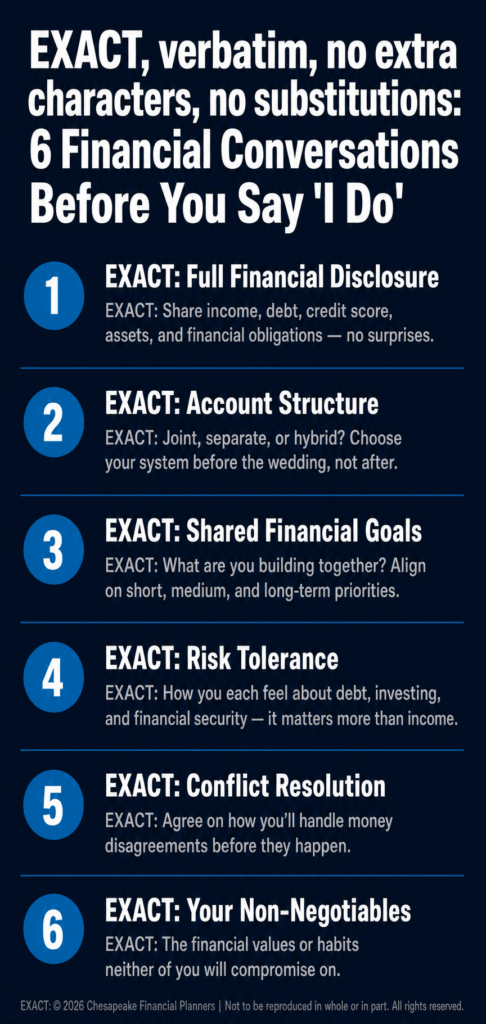
Before getting married, each partner should fully disclose income, all debts with their interest rates, credit scores, retirement and savings balances, property, business ownership, and any ongoing obligations like child support or alimony. This is the foundation. Everything else builds on it.
Financial secrecy, even when it's unintentional, breaks trust faster than almost anything else in a marriage. The numbers back this up. A 2024 Bankrate survey found that 42% of U.S. adults who are married or living with a partner have kept a financial secret from them. Those secrets, when discovered after the wedding, land like betrayals even when they were never meant that way.
Here's what full disclosure should cover:
- Income: What you each earn, whether it's steady or variable, and any side income.
- Debt: Student loans, credit cards, auto loans, medical debt, with the balances, interest rates, and monthly payments.
- Credit score: It affects your ability to get a mortgage, a car loan, even a rental. The Consumer Financial Protection Bureau explains how lenders use this number, and it doesn't merge when you marry, but your shared borrowing power depends on both.
- Assets: Retirement accounts, savings, investments, property, business interests.
- Obligations: Child support, alimony, co-signed loans, support for aging parents.
Set aside dedicated time for this, not the tail end of a busy weeknight. Share the actual numbers. Listen without scoring points. You're on the same team now, or you're about to be.
How Should We Structure Our Money After Marriage?
There's no single right way to organize finances in a marriage, but you do need to agree on your way before the wedding. The three common structures are fully joint accounts, fully separate accounts, or a hybrid that combines both. Each carries real tradeoffs around autonomy and transparency.
| Structure | How it works | Best for |
|---|---|---|
| Fully joint | All income and expenses flow through shared accounts | Couples who value full transparency and a single team mindset |
| Fully separate | Each keeps individual accounts and splits shared bills | Couples who want clear boundaries or are entering a second marriage |
| Hybrid | A joint account for shared goals plus individual spending accounts | Most couples; balances teamwork with personal freedom |
The hybrid model is what Jeff Judge recommends to most couples he works with. It funds the shared life (housing, kids, vacations, retirement) from a joint account while leaving each partner a no-questions-asked discretionary account. That second piece removes more friction than people expect, because the most common money fights aren't about big things. They're about small purchases that one partner thinks need a discussion and the other thinks are nobody's business.
Before you pick a structure, answer three questions together. How much spending autonomy does each of us need? What dollar amount triggers a check-in before a purchase ($200, $500, $1,000)? And if we earn different amounts, do we split shared expenses equally or proportionally to income? Proportional splitting tends to feel fairer when incomes are far apart.
What Shared Financial Goals Should We Set Before Marriage?
Couples should agree on short-term goals like building an emergency fund and paying off high-interest debt, medium-term goals like buying a home, and long-term goals like retirement, before marriage. Goals turn money from a source of anxiety into a shared project. They give every spending decision a reference point.
Start with the emergency fund, because it's the cushion everything else depends on. Bankrate's 2024 emergency savings survey found that only 44% of U.S. adults could cover a $1,000 emergency from savings. Most financial planners suggest building toward three to six months of essential expenses. As a couple, decide your target number and how fast you'll get there.
From there, map the rest:
- Short-term (1-3 years): Fully fund the emergency account, knock out high-interest debt, save a home down payment.
- Medium-term (3-10 years): Buy a home, fund education, build taxable investments.
- Long-term (10+ years): Retirement savings. The IRS set the 2026 401(k) employee contribution limit at $24,500, and coordinating who contributes how much (especially to capture every employer match) is one of the easiest wins a couple has.
This is also where a process helps. The R.U.D.D.E.R. Method™ is Chesapeake Financial Planners' six-step planning process: Review and Recognize, Uncover and Understand, Design and Develop, Discuss and Decide, Execute and Empower, and Reassess and Refine. For couples, the "Discuss and Decide" step is where most of the value lives, because it forces the conversation that goal-setting requires. Jeff Judge notes: "With couples, the 'Discuss and Decide' step is often where we find that two people have been using the same words — 'save more,' 'buy a house' — but picturing completely different timelines and numbers."
Do We Need a Prenuptial Agreement?
A prenuptial agreement is worth serious discussion for anyone entering marriage with significant assets, a business, an inheritance, children from a prior relationship, or substantial debt. It's not a prediction that the marriage will fail. It's a clear written agreement about how assets and obligations would be handled, made while both people are calm and fair-minded.
Prenups have grown more common, not less. A 2022 Harris Poll conducted for the Skylight financial app found that 15% of surveyed Americans had signed a prenup, up sharply from prior years and driven largely by younger couples. If a prenup is on the table, each partner should have independent legal counsel, and the conversation should happen well before the wedding, not in the final stressful weeks.
Jeff often tells couples that the prenup conversation, handled early and honestly, tends to surface every other money issue worth discussing. It's uncomfortable, but it's clarifying. Marriage is a legal and financial partnership in addition to an emotional one, and naming that out loud usually strengthens the relationship rather than threatening it.
Frequently Asked Questions
When should we have the money talk before getting married?
Couples should have detailed financial conversations during the engagement, ideally several months before the wedding, not in the final hectic weeks. This gives you time to align on account structure, goals, and any prenup discussion calmly. Rushing these talks under wedding-planning stress tends to produce avoidance rather than real agreement.
Should married couples combine all their finances?
Not necessarily. Combining finances completely is one valid option, but many couples do well with a hybrid structure that funds shared expenses from a joint account while keeping individual discretionary accounts. What matters is that both partners agree on the structure intentionally before marriage, rather than defaulting into one and resenting it later.
Does my spouse's debt become my debt when we marry?
Debt you bring into a marriage generally stays your individual responsibility, but debt taken on jointly after marriage, or in community property states, can become a shared obligation. Your spouse's poor credit also affects your joint borrowing power for mortgages and loans. Full disclosure of all debts before marriage prevents painful surprises.
How do we handle finances if we earn very different incomes?
Many couples with unequal incomes contribute to shared expenses proportionally rather than splitting bills 50/50, which tends to feel fairer. Decide together whether shared costs are split equally or by income percentage, and revisit the agreement as your earnings change. The right answer is whichever both partners experience as equitable, not a fixed formula.
Do we really need a prenuptial agreement?
A prenuptial agreement makes sense for couples bringing significant assets, a business, an inheritance, children from a prior relationship, or substantial debt into the marriage. It's a calm written agreement about how finances would be handled, not a sign of distrust. Each partner should use independent legal counsel and discuss it well before the wedding.
Money disagreements rarely come from the dollars themselves. They come from two people who never compared their financial maps before sharing the same road. Get these conversations on the calendar now, while you still have time to actually work through them.
If this was useful, our free guide on building a healthy money partnership walks through the exact questions and worksheets couples use to align their finances before and after the wedding. Download it at chesapeakefp.com.
How do we merge finances without losing financial independence?
How Do I Talk to My Partner About Money Without Fighting?
How Do I Develop a Healthy Money Mindset?
Can a financial planner help me navigate a major life transition?
Disclosures
The information provided is for educational purposes only and should not be construed as investment advice. Investment strategies should be tailored to individual circumstances, risk tolerance, and goals. Past performance doesn't guarantee future results. Consult with qualified financial professionals regarding your specific situation.
Advisors associated with Chesapeake Financial Planners may be either (1) LPL Financial Registered Representatives offering securities through LPL Financial, Member FINRA and SIPC, and investment advisor representatives offering investment advice through Great Valley Advisor Group; or (2) solely investment advisor representatives offering investment advice through Great Valley Advisor Group and not affiliated with LPL Financial. Great Valley Advisor Group, and Chesapeake Financial Planners are separate entities from LPL Financial.


