

How Can I Maximize Financial Aid With FAFSA Strategies?
Last reviewed: July 2026
The best FAFSA strategies focus on three levers: positioning assets the formula treats favorably, timing income to fall outside the years the FAFSA measures, and filing every year even if you think you earn too much to qualify. Smart college planning in the years before your child enrolls can lower your Student Aid Index and increase the aid your family receives. None of this games the system. It simply keeps you from giving up aid through avoidable timing and positioning mistakes.
Key Takeaways
- The FAFSA now calculates a Student Aid Index (SAI) instead of the old Expected Family Contribution, per Federal Student Aid.
- Retirement accounts and primary home equity are excluded from FAFSA assets entirely.
- Parent assets are assessed at up to 5.64%; student assets are assessed at a steep 20%.
- The FAFSA uses prior-prior year income, giving families a two-year planning window before aid is calculated.
- In 2026, you can shelter up to $32,500 by maxing a 401(k) and IRA at age 50-plus, per the IRS.
About the Author: Jeff Judge, CFP®, AEP®, ChFC®, CLU® is Managing Partner of Chesapeake Financial Planners in Forest Hill, Maryland. He has been helping families and business owners in Harford County and the Baltimore metro area navigate college funding decisions since earning his CFP® certification in 2013, by using Chesapeake Financial Planners’ signature process, the R.U.D.D.E.R. method™. Jeff often tells parents that the most expensive FAFSA mistakes happen two years before anyone fills out the form, not on the form itself.
How Does the FAFSA Calculate Your Student Aid Index?
The FAFSA uses a formula to determine how much your family is expected to contribute toward college. That figure, now called the Student Aid Index (SAI), gets subtracted from a school's Cost of Attendance to set your financial need. According to Federal Student Aid, the SAI replaced the old Expected Family Contribution starting with the 2024-2025 award year.
Four inputs drive the number, and they are not weighted equally:
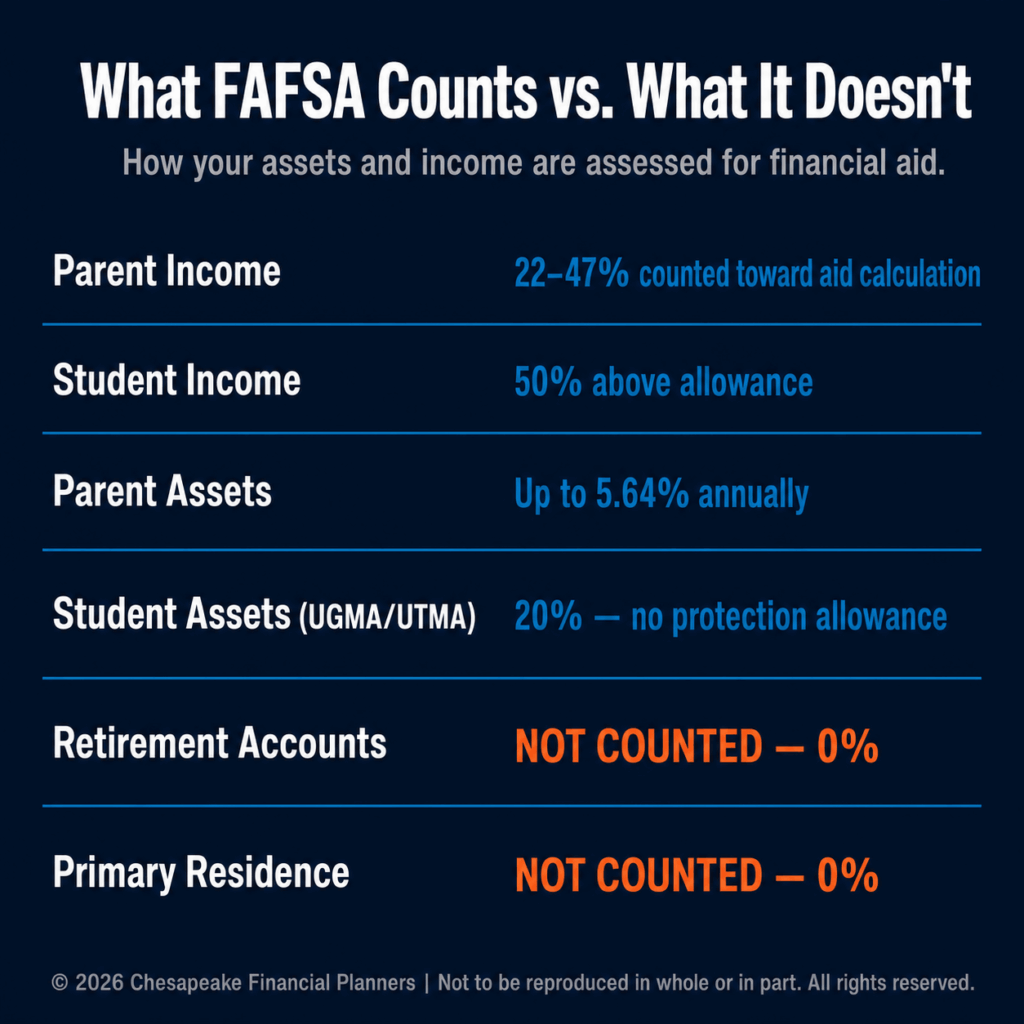
- Parent income is the heaviest factor, assessed on a sliding scale that climbs sharply as income rises.
- Student income is assessed at 50% above a small protection allowance.
- Parent assets are assessed at up to 5.64% after an asset protection allowance.
- Student assets are assessed at a flat 20% with no protection allowance.
Notice the asymmetry. A dollar sitting in your child's name costs you far more aid than the same dollar in your name. That single fact drives most of the asset strategy below. Jeff has watched families lose thousands simply because grandparents opened a custodial account in the child's name with good intentions and no idea how the FAFSA would treat it.
Can a high-income family qualify for financial aid, and what strategies are allowed?
How Does FAFSA Timing Affect Your Aid?
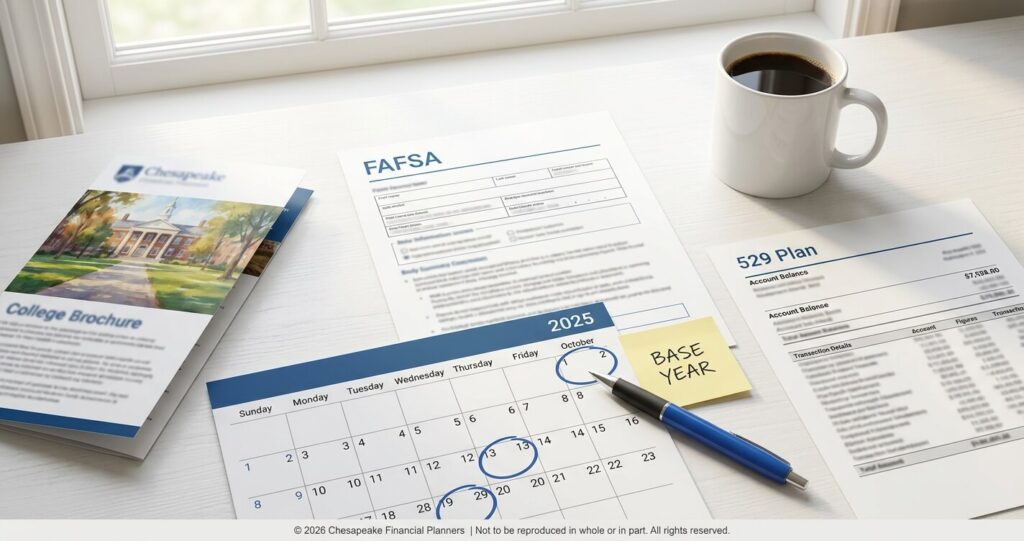
The FAFSA looks back at a base year of income, and that base year is two years before the school year it funds. For a student starting college in fall 2027, the FAFSA filed in late 2026 uses 2025 income. The Federal Student Aid office confirms this prior-prior year approach, and it creates a planning window most families never use.
Here is why it matters. By the time you sit down to file, the relevant income year is already closed. You cannot change it. But if your child is a sophomore in high school, the base year has not arrived yet, and you still have room to move.
If you expect a windfall, a bonus, a business sale, a stock option exercise, or an inheritance, the year you receive it changes everything. Income that lands inside a base year inflates your SAI for that aid cycle. The same income received one year earlier or later may not touch that year's FAFSA at all. Mapping these events against your base years is one of the highest-value moves in college planning, and it costs nothing but attention.
What are my college funding options when my income disqualifies us from financial aid?
Which Assets Count on the FAFSA and Which Don't?
Not all assets are treated the same way, and strategic positioning can lower your SAI without changing your actual net worth.
Retirement accounts are completely excluded. Money in 401(k)s, 403(b)s, IRAs, and pensions does not count as a reportable FAFSA asset. If you have cash sitting in a taxable savings account, moving it into retirement accounts before college shrinks your reportable assets. In 2026, the IRS caps 401(k) contributions at $24,500, with an additional $8,000 catch-up for those age 50 and older. Combined with IRA limits, a 50-plus parent can shelter roughly $32,500 in a single year.
Your primary residence is also excluded. Home equity in your main home does not count for federal FAFSA purposes, though many private colleges weigh it for their own institutional aid. That makes paying down your mortgage, rather than parking cash in savings, a quiet way to reduce reportable assets.
Custodial accounts hurt the most. UGMA and UTMA money counts as the student's asset at the 20% rate. Spending those funds on legitimate expenses before filing, or rolling them into a custodial 529 where they are treated as a parent asset, can dramatically improve eligibility. Parent-owned 529 plans are assessed at the gentler 5.64% rate, which is why a 529 is usually the better home for college savings.
529, Coverdell, or UTMA: which college account is right?
How does the grandparent 529 work after FAFSA simplification?
How Can You Manage Income to Improve Aid Eligibility?
Because parent income is the largest factor, managing it during base years carries outsized impact.
Minimize taxable income inside base years where you have control. If you are self-employed or can time compensation, deferring a bonus or delaying business income out of a base year helps. The reverse is true too: accelerating income into the year before your first base year keeps it off every FAFSA.
Be deliberate about Roth conversions. Converting a traditional IRA to a Roth creates taxable income in the conversion year, which lifts your SAI if it lands inside a base year. If conversions fit your long-term tax plan, complete them before the first base year or wait until after the last one. Jeff frames it this way for clients: a Roth conversion is rarely urgent, but a base year is a hard deadline, so let the FAFSA calendar decide the timing.
Watch capital gains. Selling appreciated stock or property generates income that the FAFSA sees. If you plan to rebalance or sell, try to do it outside a base year. And if a parent faces an unexpected income drop during a base year, the lower income may temporarily raise aid eligibility, which is worth knowing even though no one plans for it.
How Do I Pay for College Without Ruining My Retirement?
What FAFSA Mistakes Should Families Avoid?
A handful of errors quietly cost families aid every year.
Skipping the FAFSA because you assume you earn too much is the most common. Federal student loan eligibility requires it, and some merit scholarships do as well. Filing preserves options even when grants are off the table.
Spending student savings too early is another. Because student assets are assessed at 20%, using them in earlier college years removes them from later FAFSA calculations and can improve aid down the road. Drawing on parent assets first is often the smarter sequence.
Forgetting to request a professional judgment review is a missed opportunity. If a parent loses a job or faces a medical crisis after filing, the college financial aid office can adjust your SAI to reflect current reality rather than prior-year income. The initial number is not always final.
This is where the R.U.D.D.E.R. Method™, Chesapeake Financial Planners' six-step planning process of Review and Recognize, Uncover and Understand, Design and Develop, Discuss and Decide, Execute and Empower, and Reassess and Refine, earns its keep. College funding is not a one-time form. It is a multi-year sequence of decisions that needs to be reassessed as your income and your child's school list change.
How does a 529 plan work and what are the rules for contributions and withdrawals?
Frequently Asked Questions
What is the FAFSA Student Aid Index and how is it different from the EFC?
The Student Aid Index (SAI) is the figure the FAFSA now uses to estimate what your family can contribute toward college, replacing the old Expected Family Contribution. According to Federal Student Aid, the SAI uses a revised formula and can even go below zero, which the EFC could not. The core idea is the same, but the calculation and some thresholds changed.
Do retirement accounts count as assets on the FAFSA?
No, qualified retirement accounts do not count as reportable assets on the FAFSA. Money in 401(k)s, 403(b)s, traditional and Roth IRAs, and pensions is excluded entirely. This is why shifting cash from taxable savings into retirement accounts before college can lower your reportable assets and your Student Aid Index without reducing your real net worth.
How far back does the FAFSA look at my income?
The FAFSA uses prior-prior year income, meaning it looks back two years from the school year it funds. A FAFSA filed in late 2026 for the 2027-2028 school year uses 2025 tax data. This two-year lag is why income planning during your child's early high school years can affect the aid you ultimately receive.
Should I move money out of my child's name before filing FAFSA?
Yes, in most cases, because student-owned assets are assessed at 20% while parent assets are assessed at up to 5.64%. Spending down custodial UGMA or UTMA accounts on legitimate expenses, or rolling them into a custodial 529 plan treated as a parent asset, can meaningfully lower your Student Aid Index and increase aid eligibility.
Can a Roth conversion hurt my college financial aid?
Yes, a Roth conversion creates taxable income in the conversion year, which can raise your Student Aid Index if it falls inside a FAFSA base year. If conversions fit your long-term plan, complete them before your first base year or after your last one. Timing them around the FAFSA calendar protects aid without abandoning the strategy.
Should I still file the FAFSA if I think I earn too much for aid?
Yes, you should file the FAFSA every year regardless of income. Federal student loan eligibility requires it, and some colleges tie merit scholarships to a completed FAFSA. Filing costs nothing, preserves your options, and protects you if your financial situation changes mid-year and you need to request a professional judgment review.
If this breakdown helped, our College Funding Planning Guide walks through the same asset and income timing decisions in greater depth, with worksheets you can use against your own base years. Download it at chesapeakefp.com and start mapping your FAFSA strategies before the base year arrives.
Want to go deeper? Our College Funding Playbook walks through this step by step.
Disclosures
The information provided is for educational purposes only and should not be construed as investment advice. Investment strategies should be tailored to individual circumstances, risk tolerance, and goals. Past performance doesn't guarantee future results. Consult with qualified financial professionals regarding your specific situation.
All indices are unmanaged and may not be invested into directly.
Advisors associated with Chesapeake Financial Planners may be either (1) LPL Financial Registered Representatives offering securities through LPL Financial, Member FINRA and SIPC, and investment advisor representatives offering investment advice through Great Valley Advisor Group; or (2) solely investment advisor representatives offering investment advice through Great Valley Advisor Group and not affiliated with LPL Financial. Great Valley Advisor Group, and Chesapeake Financial Planners are separate entities from LPL Financial.


