
What Is Confirmation Bias in Investing?
Last reviewed: July 2026
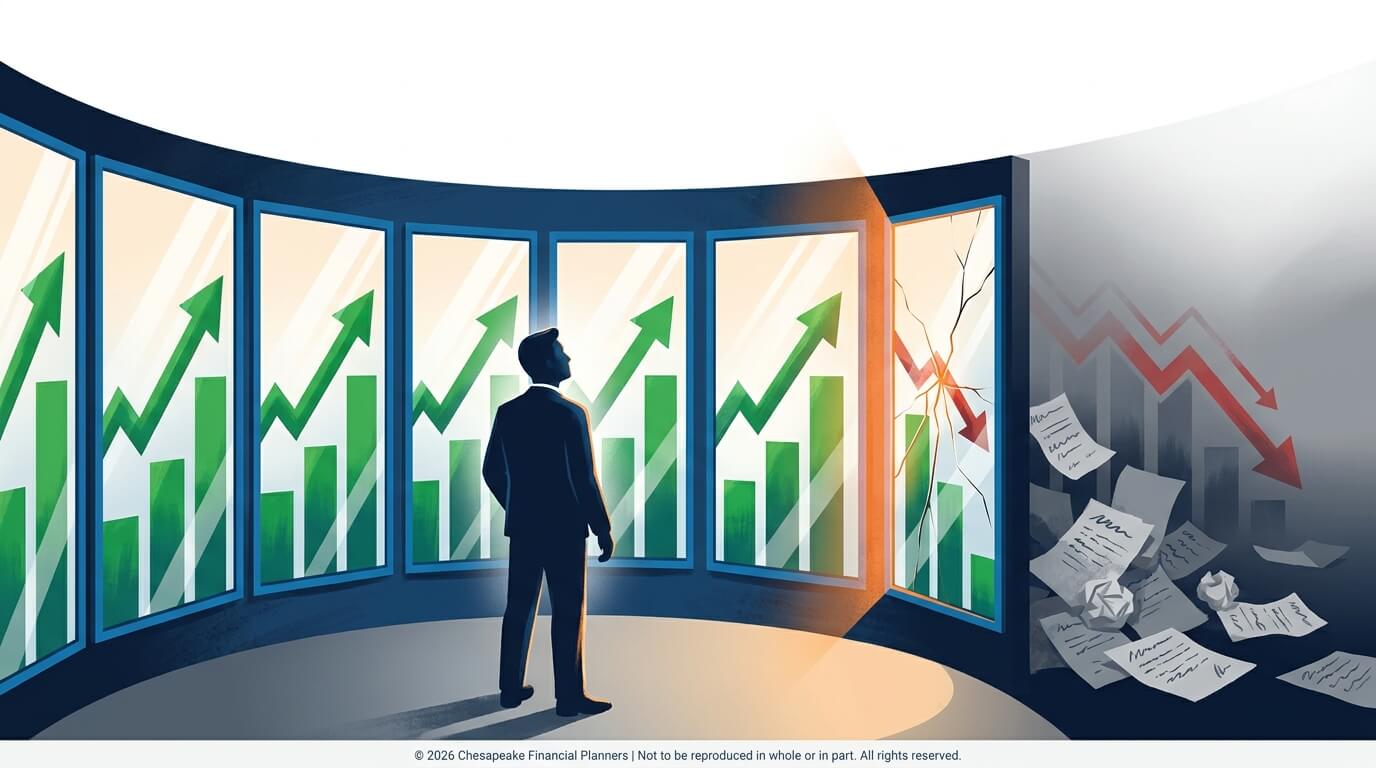
Confirmation bias in investing is the tendency to seek out, favor, and remember information that supports what you already believe about a stock or strategy, while ignoring evidence that contradicts it. It is the reason you can hold a losing position for years and feel more certain about it every month. The danger is simple: you stop evaluating the investment and start defending it.
Key Takeaways
- Confirmation bias makes investors collect evidence that supports a position they already hold and discard anything that challenges it.
- According to the CFA Institute, confirmation bias is one of the most common cognitive errors documented in individual investors.
- Echo chambers in social media and curated news feeds amplify the bias by feeding you more of what you already agree with.
- The fix is structural, not emotional: build a written investment thesis with disconfirming criteria before you buy.
About the Author: Jeff Judge, CFP®, AEP®, ChFC®, CLU® is Managing Partner of Chesapeake Financial Planners in Forest Hill, Maryland. He has been helping families and business owners in Harford County and the Baltimore metro area navigate behavioral investing mistakes since earning his CFP® certification in 2013, by using Chesapeake Financial Planners’ signature process, the R.U.D.D.E.R. method™. Jeff has watched smart, successful people defend a stock long past the point where the facts stopped supporting it, simply because admitting they were wrong felt worse than losing money.
How Does Confirmation Bias Show Up in Real Investing Decisions?
Confirmation bias shows up the moment you buy something and start rooting for it. Once you own a stock, you read the bullish analyst notes and skim past the bearish ones. You remember the quarter the company beat earnings and forget the two it missed. Your brain is no longer asking "Is this a good investment?" It is asking "How do I prove I was right?"
This is different from simply being optimistic. It is a filtering problem. The information is out there, both good and bad, but you only let half of it through. Jeff Judge often points out that the most expensive word in investing is "but." A client will say a position is down 30%, but the long-term story is intact. The "but" is where the bias lives.
The behavioral finance field has documented this pattern for decades. Daniel Kahneman, who won the 2002 Nobel Prize in Economic Sciences for his work on judgment under uncertainty, showed that people weigh evidence that confirms their existing view far more heavily than evidence that refutes it. Investors are not exempt. If anything, the money makes it worse, because now your ego and your account balance are both on the line.
Why Do Echo Chambers Make Confirmation Bias Worse?
Echo chambers make confirmation bias worse by surrounding you with people who already agree with you, which feels like validation but is actually just repetition. The money echo chamber is everywhere now. You follow accounts that hype the stocks you own. The algorithm feeds you more of the same. A forum full of people holding the identical position starts to sound like research.
It is not research. It is a crowd nodding along. Pew Research Center reporting from late 2024 found that a meaningful share of U.S. adults now regularly get news from social media platforms, where curated feeds reward engagement over accuracy. When your sources are all pre-selected to agree with you, the absence of disagreement starts to feel like proof.
The cruelest part is how confident this makes people. Ten voices saying the same wrong thing feel more reliable than one careful voice raising a concern. Jeff has seen clients walk in fully convinced about a position because "everyone in the group" agreed, when the group was just a few hundred strangers holding the same bag.

How Can You Counteract Confirmation Bias in Your Portfolio?
You counteract confirmation bias by building a process that forces you to confront the other side before you act. The bias is automatic, so willpower alone will not beat it. You need structure. Here is the approach that works with the clients Jeff advises.
Write down your investment thesis before you buy. State clearly why you own it and, more importantly, what would have to happen for you to sell. If you cannot name the conditions that would prove you wrong, you do not have a thesis. You have a hope.
Actively hunt for the bear case. According to a 2024 Morningstar analysis, the gap between investment returns and the returns investors actually capture is driven largely by poorly timed, emotionally driven decisions. Forcing yourself to read the strongest argument against your position is one of the few reliable defenses. Set a calendar reminder to revisit the thesis on a fixed schedule, not when the price moves.
This is where a second set of eyes earns its keep. A good advisor's job is not to agree with you. It is to ask the question you have been avoiding. That structured back-and-forth is exactly what the How Can I Avoid Making Emotional Investment Decisions? discipline is built to provide, and it is a core reason people choose to work with a professional rather than Should I manage my own investments or hire a financial advisor?.
Frequently Asked Questions
What is confirmation bias in simple terms?
Confirmation bias is the habit of noticing and believing information that agrees with what you already think, while overlooking or dismissing information that contradicts it. In investing, it means you collect reasons to keep a position and ignore the warning signs that you might be wrong about it.
Why is confirmation bias dangerous for investors?
Confirmation bias is dangerous because it stops you from updating your decisions when the facts change. You hold losing positions too long, double down on bad ideas, and mistake agreement from like-minded people for genuine analysis. Over time, this filtering of evidence leads to concentrated risk and avoidable losses.
How is confirmation bias different from just being optimistic?
Optimism is a general outlook; confirmation bias is a filtering error. An optimist hopes things go well but still reviews the bad news. A confirmation-biased investor screens out the bad news entirely, so their optimism is based on an incomplete picture rather than a full and honest assessment of the facts.
Can confirmation bias affect experienced investors?
Yes, confirmation bias affects experienced investors just as much as beginners, and sometimes more. Experience can deepen conviction, which makes people even less willing to consider that they are wrong. Smart, successful people are often the most stubborn about defending a position once they have publicly committed to it.
What is an echo chamber in investing?
An investing echo chamber is an environment, often a social media feed or online forum, where everyone holds the same view about a stock or strategy. The repeated agreement feels like confirmation, but it is just the same opinion bouncing back at you. Real research requires seeking out the strongest opposing arguments.
How do I overcome confirmation bias in my investing?
You overcome confirmation bias by writing a clear thesis with sell criteria before you buy, actively reading the bear case, and reviewing positions on a fixed schedule rather than reacting to price swings. A trusted advisor who is willing to challenge your assumptions provides the outside perspective that the bias hides from you.
Confirmation bias never fully goes away, but you can stop letting it run your portfolio. The investors who do best are not the ones who are always right. They are the ones who built a process to catch themselves when they are wrong. If this resonated, our free guide on behavioral investing mistakes breaks down the patterns that quietly cost people the most. Download it at chesapeakefp.com.
Disclosures
The information provided is for educational purposes only and should not be construed as investment advice. Investment strategies should be tailored to individual circumstances, risk tolerance, and goals. Past performance doesn't guarantee future results. Consult with qualified financial professionals regarding your specific situation.
Advisors associated with Chesapeake Financial Planners may be either (1) LPL Financial Registered Representatives offering securities through LPL Financial, Member FINRA and SIPC, and investment advisor representatives offering investment advice through Great Valley Advisor Group; or (2) solely investment advisor representatives offering investment advice through Great Valley Advisor Group and not affiliated with LPL Financial. Great Valley Advisor Group, and Chesapeake Financial Planners are separate entities from LPL Financial.


