
What Is a Bond Ladder and Should You Build One?
Last reviewed: July 2026
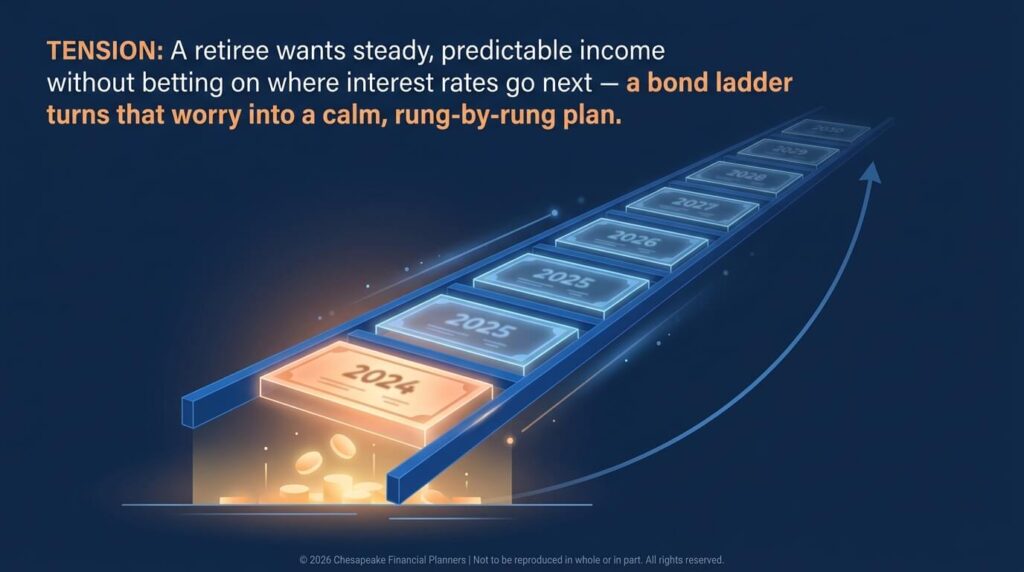
A bond ladder is a portfolio of individual bonds with staggered maturity dates, so a portion of your money comes due at regular intervals instead of all at once. You buy bonds maturing in, say, one year, two years, three years, and so on, then reinvest each maturing bond at the longest rung when it pays out. The strategy gives you predictable income, reduces your exposure to interest rate timing, and keeps cash flowing back to you on a schedule you control.
Key Takeaways
- A bond ladder staggers bond maturities so cash comes due at set intervals, giving you predictable income and reinvestment flexibility.
- As of 2026, the 10-year Treasury yields roughly 4.2%, making individual bond ladders more attractive than they were in the near-zero era.
- Laddering reduces interest rate timing risk because you reinvest maturing bonds at current rates rather than locking in one rate forever.
- Bond ladders work best for retirees, near-retirees, and anyone funding known future expenses on a timeline.
About the Author: Jeff Judge, CFP®, AEP®, ChFC®, CLU® is Managing Partner of Chesapeake Financial Planners in Forest Hill, Maryland. Jeff has watched too many retirees park their entire fixed income allocation in a single long bond and then panic when rates move; a ladder solves that without requiring anyone to guess where rates are headed. He has been helping families and business owners in Harford County and the Baltimore metro area build diversified bond ladders and other strategic investment portfolios since earning his CFP® certification in 2013, by using Chesapeake Financial Planners’ signature process, the R.U.D.D.E.R. method™.
What Is a Bond Ladder, Exactly?
A bond ladder is a set of individual bonds purchased so that each one matures in a different year. Picture a five-year ladder built with $100,000: you put $20,000 each into bonds maturing in 2027, 2028, 2029, 2030, and 2031. Each year, one "rung" matures and returns your principal. You then reinvest that money into a new bond at the far end of the ladder, keeping the structure intact.
The word "ladder" is literal. Each rung is a maturity date. The space between rungs is your interval, usually one year, though some investors use six-month or two-year spacing depending on their cash flow needs.
What makes this different from buying a single bond or a bond fund is the staggered timing. A single 10-year bond locks you into today's rate for a decade. A bond fund never matures at all; its value floats with the market every day. A ladder splits the difference. You hold each bond to maturity, so you know exactly what you'll get back and when, while the rolling reinvestment keeps refreshing your average yield as rates change.
Jeff often tells clients that a ladder is less about chasing the highest yield and more about removing one variable from the equation: the guess about interest rate timing. You stop trying to call the top or bottom of the rate cycle and let the structure handle it.
How Do Interest Rates Affect My Investment Portfolio?
How Does a Bond Ladder Actually Work?
You build a bond ladder in three moves. First, decide your total dollar amount and your time horizon. Second, divide the money into equal slices and buy bonds maturing at each interval across that horizon. Third, as each bond matures, reinvest the proceeds into a new bond at the longest rung.
Here is the mechanism that makes laddering valuable. When you reinvest a maturing bond at the far end of the ladder, you capture whatever interest rate is available that year. If rates have risen, your new rung earns more. If rates have fallen, you still hold older rungs locked in at higher yields. Over a full cycle, you blend high and low rate environments instead of betting everything on one moment.
According to the Financial Industry Regulatory Authority, this rolling reinvestment is what reduces the reinvestment and interest rate risk that comes with concentrating your money in a single maturity. You are never fully exposed to one rate.
The U.S. Treasury market makes laddering straightforward for individual investors. As of 2026, you can buy Treasury notes and bonds directly through TreasuryDirect or through a brokerage account with no commission on Treasuries at most major firms. Municipal bonds and high-grade corporate bonds work too, though they carry credit considerations that Treasuries do not.

What Are the Benefits of a Bond Ladder?
A bond ladder gives you four concrete advantages over a single bond or a bond fund.
- Predictable income and principal return. You know the exact date each bond matures and the exact amount you'll receive. That certainty is hard to replicate with a fund whose share price fluctuates daily.
- Reduced interest rate timing risk. Because you reinvest at staggered intervals, you never lock your entire allocation into one rate. You average into the market over years.
- Liquidity on a schedule. A rung matures every interval, so you have cash coming back regularly without selling anything at a loss. This matters most for retirees funding living expenses.
- Control. You choose the bonds, the credit quality, and the maturities. A fund manager makes those calls for you, and you pay an expense ratio for the service.
That last point is worth a number. Even a low-cost bond index fund carries an ongoing expense ratio, and the average bond mutual fund charged roughly 0.37% in expenses according to recent Investment Company Institute data. Holding individual Treasuries in a ladder costs nothing after the purchase. On a large fixed income allocation, that gap compounds.
How Do Investment Fees Impact My Long-Term Returns?
What Are the Downsides and Risks of a Bond Ladder?
A bond ladder is not free of trade-offs. The honest answer to "should you build one" depends on whether these downsides matter for your situation.
The biggest drawback is the work. Building a ladder means researching, buying, and tracking individual bonds, then reinvesting maturing rungs every year. A bond fund does all of that automatically. For investors who don't want a part-time job managing fixed income, that convenience has real value.
Diversification is the second issue. A ladder of five or ten bonds is not diversified across hundreds of issuers the way a fund is. With Treasuries, this barely matters because the credit risk is effectively zero. With corporate or municipal bonds, a single default can hurt, so you need enough issuers to spread the credit risk.
There is also opportunity cost. If interest rates fall sharply, your maturing rungs reinvest at lower yields, and you can't capture the price gains a longer bond or fund would have delivered. Laddering trades upside for certainty.
Jeff puts it this way with clients: a bond ladder is a discipline tool, not a return-maximizing tool. If your goal is the highest possible total return on your fixed income, a ladder probably isn't it. If your goal is reliable cash flow you can plan a retirement around, it often is.
How Can I Avoid Making Emotional Investment Decisions?

Should You Build a Bond Ladder?
You should consider a bond ladder if you fall into one of three groups. First, retirees and near-retirees who need predictable income to cover living expenses benefit most, because the maturity schedule can be matched to spending needs. Second, anyone funding a known future expense on a timeline, like college tuition or a planned home purchase, can build a ladder that delivers cash exactly when it's needed. Third, conservative investors who want to reduce interest rate timing risk without abandoning fixed income entirely.
You should probably skip a ladder if you have a small fixed income allocation, prefer hands-off investing, or value liquidity and diversification over schedule certainty. In those cases, a low-cost bond fund usually wins.
This is exactly the kind of decision the R.U.D.D.E.R. Method™ is built to work through. The R.U.D.D.E.R. Method™ is Chesapeake Financial Planners' six-step planning process: Review and Recognize, Uncover and Understand, Design and Develop, Discuss and Decide, Execute and Empower, and Reassess and Refine. A bond ladder is rarely a standalone decision; it sits inside a broader income plan, and the right rung spacing and credit quality come out of understanding your full cash flow picture first.
A bond ladder pairs naturally with a cash strategy like a CD ladder for shorter-term needs. The two together can form the foundation of a retirement income floor.
How should my investment mix change as I get closer to retirement?
How Does Inflation Affect My Savings and Retirement Money?
Frequently Asked Questions
How much money do I need to build a bond ladder?
You can build a basic Treasury ladder with as little as $5,000, since Treasury notes are sold in $100 increments. Practically, most advisors suggest at least $50,000 to $100,000 so each rung is large enough to matter and you can spread money across several maturities without paying outsized transaction friction.
What is the difference between a bond ladder and a bond fund?
A bond ladder holds individual bonds you keep until maturity, so you know the exact return date and amount for each one. A bond fund holds a constantly changing pool of bonds with no maturity date, and its share price floats daily with the market. Ladders offer certainty; funds offer convenience and diversification.
How long should a bond ladder be?
Most bond ladders run between five and ten years, with one-year spacing between rungs. The right length depends on your goal: shorter ladders give you faster access to cash and quicker reinvestment, while longer ladders lock in current yields for more years. Match the ladder length to when you'll actually need the money.
Are bond ladders good for retirement income?
Yes, bond ladders are well suited for retirement income because each maturing rung delivers predictable cash on a known schedule. Retirees can match maturities to spending needs, creating a reliable income floor that doesn't require selling assets at a loss during a market downturn. This is one of the most common uses Jeff sees in practice.
What kinds of bonds work best in a ladder?
Treasury notes and bonds work best for most investors because they carry virtually no credit risk and can be bought commission-free. High-grade corporate and municipal bonds also work, but they add credit risk, so you need enough different issuers to diversify. As of 2026, with the 10-year Treasury near 4.2%, Treasury ladders are competitive.
A Final Word Before You Build One
A bond ladder is one of the few investment structures that does exactly what it promises: it turns an unpredictable variable, the timing of interest rates, into a manageable one. It won't maximize your return, but it will give you cash flow you can plan around. That trade is worth making for many retirees and conservative investors, and worth skipping for others.
If you want to understand where a bond ladder fits inside your full income plan, our guide to building reliable retirement income walks through the building blocks step by step. Download it at chesapeakefp.com.
Disclosures
The information provided is for educational purposes only and should not be construed as investment advice. Investment strategies should be tailored to individual circumstances, risk tolerance, and goals. Past performance doesn't guarantee future results. Consult with qualified financial professionals regarding your specific situation.
Advisors associated with Chesapeake Financial Planners may be either (1) LPL Financial Registered Representatives offering securities through LPL Financial, Member FINRA and SIPC, and investment advisor representatives offering investment advice through Great Valley Advisor Group; or (2) solely investment advisor representatives offering investment advice through Great Valley Advisor Group and not affiliated with LPL Financial. Great Valley Advisor Group, and Chesapeake Financial Planners are separate entities from LPL Financial.


