

Last reviewed: July 2026
Asset location is the decision about which of your accounts holds each investment, and getting it right can quietly change how much of your return you keep. Two households can own the same funds, in the same proportions, in the same market, and still end up with meaningfully different after-tax results over decades. The difference is not what they own. It is where they hold it, and at the $3 million to $5 million level that "where" is usually an accident nobody has examined.
Key Takeaways
- Asset location decides which account holds each investment; it is a separate decision from asset allocation and directly shapes your after-tax return.
- Bond interest is generally taxed every year as ordinary income, so income-heavy holdings usually belong inside tax-deferred accounts, not a brokerage account.
- Long-term capital gains face 2026 federal rates of 0%, 15%, or 20%, with the top rate starting above $613,700 for joint filers.
- High earners may also owe the 3.8% Net Investment Income Tax once modified income tops $250,000 married or $200,000 single.
About the Author: Jeff Judge, CFP®, AEP®, ChFC®, CLU® is Managing Partner of Chesapeake Financial Planners in Forest Hill, Maryland. He has been helping families and business owners in Harford County and the Baltimore metro area navigate investment and tax decisions since earning his CFP® certification in 2013, by using Chesapeake's signature process, the R.U.D.D.E.R. Method™. "When a household finally sees their accounts as one portfolio instead of four separate piles, the wasted tax almost always shows up in the same place, and it is fixable," Jeff says.
How is asset location different from asset allocation?
Asset allocation is the split among stocks, bonds, and other holdings. It drives most of your risk and return, and for good reason it gets almost all of the attention. Asset location is the next decision, and it is a separate one: which account each piece actually lives in. You can nail the allocation and still hand the IRS more than you needed to, simply because the right investments are sitting in the wrong accounts.
Here is why the placement matters. Different investments are taxed very differently from one year to the next. A bond fund throws off interest that is generally taxed as ordinary income every year. A broad stock index fund generates very little annual taxable distribution, and most of its return is appreciation that is not taxed until you sell, potentially at lower long-term rates. Put those two holdings in the wrong containers and you pay tax you could have deferred. This is the same portfolio-construction discipline that runs through smart asset allocation by age and risk tolerance; location is simply the tax layer sitting on top of it.
Most people never make this decision on purpose. Accounts accumulate over a career, each one invested in isolation, and the placement ends up random even when the allocation is right.
How are the three account types taxed differently?
Three account types carry three different tax treatments, and that is the whole engine behind asset location. A traditional IRA or 401(k) is tax-deferred: nothing is taxed along the way, and every dollar you pull out is taxed as ordinary income. A taxable brokerage account is taxed as you go, with interest and dividends taxed yearly and long-term gains taxed at generally lower capital-gains rates. A Roth grows with no further tax, and qualified withdrawals come out untaxed once you are past age 59½ and the five-year rule.
| Account type | How it is taxed | Best-fit assets |
|---|---|---|
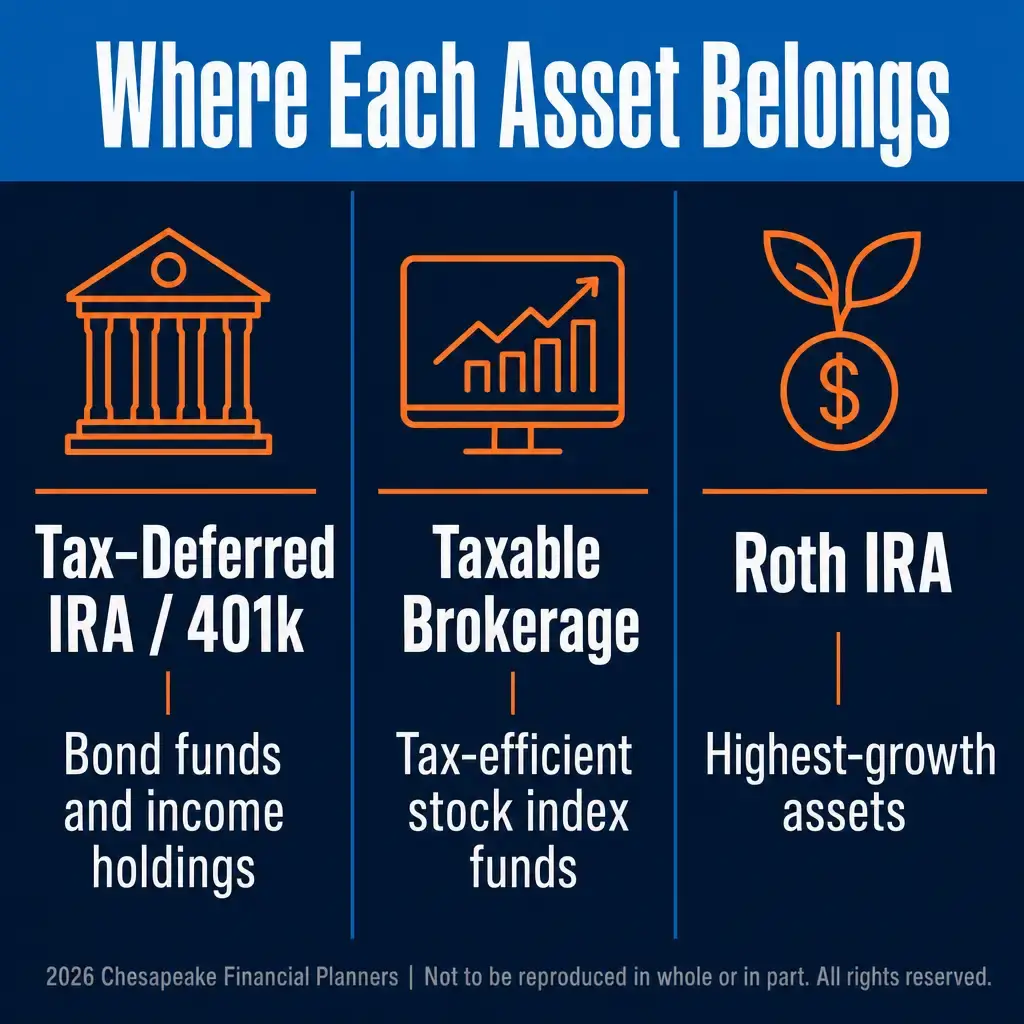
| Traditional IRA / 401(k) (tax-deferred) | Nothing taxed year to year; every dollar withdrawn is taxed as ordinary income | Tax-inefficient, income-heavy holdings such as bond funds and REITs |
| Taxable brokerage | Interest and dividends taxed each year; long-term gains taxed at capital-gains rates | Tax-efficient stock index funds, where most return is unrealized appreciation |
| Roth IRA / Roth 401(k) | Grows with no further tax; qualified withdrawals are untaxed after age 59½ and the five-year rule | Your highest expected-growth assets, held for decades |
The differences are not small. A high earner holding a taxable bond fund in a brokerage account may pay ordinary-income tax on that interest every year. Move the same fund into a tax-deferred account and the annual interest is sheltered until withdrawal.
"This is the kind of slow, invisible cost I see drag on otherwise sensible plans at this level, precisely because nobody ever looked at it." – Jeff Judge, CFP®

Which investments belong in which account?
The rule of thumb is to sort your holdings by how heavily they are taxed year to year, and your accounts by how much tax shelter they offer, then match the two. Push the tax-ugly, income-heavy holdings into tax-deferred accounts. Aim your highest-growth assets at the Roth. Let tax-efficient growth sit in the taxable account, where it earns favorable dividend treatment and its appreciation waits to be taxed until you sell.
Where does a tax-inefficient bond fund belong? In a tax-deferred account, in most cases. A bond fund pays interest that is generally taxed as ordinary income every year, so holding it in a taxable brokerage account means paying tax at your highest rate annually. Shelter it inside a traditional IRA or 401(k) and that annual interest stops showing up on your return.
The Roth deserves its own note, because it is the prize seat. Everything inside it grows and comes out with no further tax if the rules are met, which makes it a poor place for something safe and slow and a natural home for your highest expected-growth assets. That logic is why deciding what not to put in a Roth IRA matters as much as deciding what to keep in it. The ordering falls out naturally: highest-growth assets to the Roth, income-throwers to tax-deferred, tax-efficient growth to taxable. It is not a rigid law, but it is the spine of the decision.
Why does asset location matter more as your portfolio grows?
Asset location matters more the larger your portfolio gets. At $200,000 it is a nice-to-have. At $3 million to $5 million, a fraction of a percent of unnecessary tax drag, charged every year against a multimillion-dollar portfolio, compounds into real money over a retirement. The dollars at stake scale directly with the size of the accounts.
The cost also ripples outward. Higher annual taxable income from poorly located bonds can push more of your Social Security into the taxable column and can raise your Medicare premiums through IRMAA surcharges two years later. Those second-order effects are exactly the sort of thing that gets missed when each account is managed in isolation, and they are a core reason tax planning for high-income earners treats location as a lever, not an afterthought. Jeff Judge has watched carefully built plans leak thousands a year this way, not from a bad investment choice, but from the right investment sitting in the wrong account.
There is a genuine Maryland angle here too. Maryland levies a state income tax on top of a county "local" income tax, and Harford County adds its own rate. For a resident here, a tax-inefficient holding parked in the wrong account costs more than it would for someone in a no-income-tax state, because that yearly interest and dividend income is taxed again at the state and county level. That is a real, local reason asset location deserves attention for the households we work with across Harford County and the Baltimore metro area.
Why do smart households get this wrong, and how do you fix it?
Smart, financially successful households get asset location wrong for two ordinary reasons. First, portfolios get accumulated rather than built: each account is opened and invested in isolation, and no one ever views the collection as one portfolio. Second, standard advice usually stops at allocation and never reaches the placement question. The fragmentation hides the problem, because each account looks fine on its own; the inefficiency only appears when you line them up together.
The fix starts with viewing every account as a single portfolio. Any one account may then look lopsided, all bonds or all stocks, and that is fine, because the tax result is what you are managing across the whole picture. From there you match tax-ugly holdings to sheltered accounts and aim growth at the Roth. The R.U.D.D.E.R. Method™ is Chesapeake Financial Planners' six-step planning process: Review and Recognize, Uncover and Understand, Design and Develop, Discuss and Decide, Execute and Empower, and Reassess and Refine, and asset location tends to surface during the "Uncover and Understand" step, once every account is finally on one page.
Should you sell everything at once to reposition? No, and this is the real wrinkle. Selling appreciated holdings inside a taxable account to move them can trigger capital gains, so the cleanup itself has to be planned, sometimes staged across more than one tax year and coordinated with your return. The same discipline behind tax-loss harvesting applies here: reposition deliberately, use losses to offset gains where you can, and revisit the plan as contributions, rebalancing, Roth conversions, and tax-law changes shift the picture.
Frequently Asked Questions
What is asset location in simple terms?
Asset location is the decision about which type of account holds each of your investments. It is separate from asset allocation, which is your mix of stocks and bonds. Because a bond fund, a stock index fund, and a growth holding are each taxed differently year to year, placing each one in the account that taxes it most gently can reduce the tax you pay on the same overall portfolio.
Which investments should go in a taxable brokerage account?
Tax-efficient investments belong in a taxable brokerage account, chiefly broad stock index funds. These funds generate little annual taxable income, and most of their return comes from appreciation that is not taxed until you sell, often at long-term capital-gains rates of 0%, 15%, or 20% for 2026. Holding tax-efficient growth here lets the favorable rate and the deferral work in your favor.
Why do high-growth investments belong in a Roth?
A Roth suits high-growth investments because everything inside it grows and, once you meet the age 59½ and five-year requirements, comes out with no further tax. Since the account shelters all future growth, you want the assets with the highest expected return there, and you want to avoid parking slow, conservative holdings in that valuable space.
Does asset location really matter if I already have the right allocation?
Yes, because you can have a correct allocation and still overpay tax simply because the right investments sit in the wrong accounts. Allocation drives your risk and return, but location determines how much of that return you keep after tax. The larger your portfolio, the more a small annual tax drag compounds into a meaningful sum over a full retirement.
Can fixing asset location create a tax bill?
Yes, repositioning holdings inside a taxable account can trigger capital gains when you sell to move them, so the cleanup has to be planned rather than done all at once. Advisors often stage the changes across multiple tax years, use new contributions to shift the balance gradually, and coordinate the moves with your tax return to keep the transition efficient.
Ready to see your accounts as one portfolio?
If your investments are scattered across a 401(k), a brokerage account, and a Roth without anyone checking where each piece sits, asset location is worth a hard look. Schedule a no-obligation call with Jeff Judge to talk through how your accounts fit together and where the tax drag may be hiding.
A version of this article was originally published on Jeff Judge's LinkedIn.
Disclosures
The information provided is for educational purposes only and should not be construed as investment advice. Investment strategies should be tailored to individual circumstances, risk tolerance, and goals. Past performance doesn't guarantee future results. Consult with qualified financial professionals regarding your specific situation.
Contributions to a traditional IRA may be tax deductible in the contribution year, with current income tax due at withdrawal. Withdrawals prior to age 59 ½ may result in a 10% IRS penalty tax in addition to current income tax.
A Roth IRA offers tax deferral on any earnings in the account. Qualified withdrawals of earnings from the account are tax-free. Withdrawals of earnings prior to age 59 ½ or prior to the account being opened for 5 years, whichever is later, may result in a 10% IRS penalty tax. Limitations and restrictions may apply.
Traditional IRA account owners have considerations to make before performing a Roth IRA conversion. These primarily include income tax consequences on the converted amount in the year of conversion, withdrawal limitations from a Roth IRA, and income limitations for future contributions to a Roth IRA. In addition, if you are required to take a required minimum distribution (RMD) in the year you convert, you must do so before converting to a Roth IRA.
Advisors associated with Chesapeake Financial Planners may be either (1) LPL Financial Registered Representatives offering securities through LPL Financial, Member FINRA and SIPC, and investment advisor representatives offering investment advice through Great Valley Advisor Group; or (2) solely investment advisor representatives offering investment advice through Great Valley Advisor Group and not affiliated with LPL Financial. Great Valley Advisor Group, and Chesapeake Financial Planners are separate entities from LPL Financial.
Chesapeake Financial Planners | 2402 Scotlon Ct, Forest Hill, MD 21050 | (410) 652-7868 | www.chesapeakefp.com
© 2026 Chesapeake Financial Planners | Not to be reproduced in whole or in part. All rights reserved.


