

How can Roth conversions and RMDs trigger higher Medicare premiums (IRMAA)?
Last reviewed: July 2026
Most people think of Medicare as a fixed cost. It isn't. The 2026 IRMAA rules tie your Part B and Part D premiums directly to your income, and two of the most common retirement moves, a Roth conversion and a required minimum distribution, can quietly push you into a higher bracket. The standard Part B premium is $202.90 a month in 2026. At the top bracket, that same coverage costs $689.90. The difference is income you may have created on purpose.
On This Page
- Key Takeaways
- What Is IRMAA, and Who Pays It in 2026?
- How Do Roth Conversions and RMDs Push You Into a Higher IRMAA Bracket?
- Why Does the Two-Year Lookback Catch So Many Retirees Off Guard?
- How Can You Plan Around IRMAA Before It Hits?
- What If a Life-Changing Event Lowered Your Income?
- Related Topics Worth Reading
- Frequently Asked Questions
- Disclosures
Key Takeaways
- IRMAA ties Medicare Part B and Part D premiums to your modified adjusted gross income — the standard 2026 Part B premium of $202.90 rises to $689.90 at the top income bracket.
- Medicare uses a two-year lookback — your 2026 surcharge is based on your 2024 tax return, as confirmed by Social Security Administration guidance.
- A Roth conversion raises your MAGI in the conversion year and can trigger an IRMAA surcharge two years later, even though the money lands in a tax-free account.
- Required minimum distributions beginning at age 73 add ordinary taxable income whether you need the cash or not — large IRAs can trigger IRMAA on their own.
- IRMAA has no phase-in within a bracket — one dollar over the threshold triggers the full surcharge for the entire year per CMS bracket rules.
About the Author: Jeff Judge, CFP®, AEP®, ChFC®, CLU® is Managing Partner of Chesapeake Financial Planners in Forest Hill, Maryland. He has been helping families and business owners in Harford County and the Baltimore metro area navigate Medicare and retirement-income decisions since earning his CFP® certification in 2013, by using Chesapeake Financial Planners’ signature process, the R.U.D.D.E.R. method™. Jeff sees the same pattern every fall: a client does a smart Roth conversion in their early 60s, then gets a letter two years later raising their Medicare premium, and nobody warned them the two were connected.
What Is IRMAA, and Who Pays It in 2026?
IRMAA, the Income-Related Monthly Adjustment Amount, is a Medicare premium surcharge added to your Part B and Part D premiums when your income crosses certain thresholds. It is not a separate bill. It rides on top of the premium you already pay, and for Part B it's deducted straight from your Social Security check.
The surcharge affects roughly 8% of people with Medicare Part B. That sounds small until you're one of them. As the Centers for Medicare & Medicaid Services puts it plainly, "Since 2007, a beneficiary's Part B monthly premium has been based on his or her income." Higher income, higher premium. There's no phase-in within a bracket either; cross the line by one dollar and you pay the full surcharge for that tier all year.
Here's what the 2026 brackets actually cost. The income figures are your modified adjusted gross income (MAGI), and the premiums are per person, per month.
| 2026 MAGI (Single) | 2026 MAGI (Joint) | Part B IRMAA | Total Part B Premium | Part D IRMAA |
|---|---|---|---|---|
| $109,000 or less | $218,000 or less | $0.00 | $202.90 | $0.00 |
| $109,001 to $137,000 | $218,001 to $274,000 | $81.20 | $284.10 | $14.50 |
| $137,001 to $171,000 | $274,001 to $342,000 | $202.90 | $405.80 | $37.50 |
| $171,001 to $205,000 | $342,001 to $410,000 | $324.60 | $527.50 | $60.40 |
| $205,001 to $499,999 | $410,001 to $749,999 | $446.30 | $649.20 | $83.30 |
| $500,000 or more | $750,000 or more | $487.00 | $689.90 | $91.00 |
All figures are drawn from the official CMS 2026 premium release. A married couple where both spouses are on Medicare pays the surcharge twice, once each. So a joint MAGI of $280,000 in 2024 puts a couple in the third bracket and adds about $4,870 to their combined Part B premiums for the year, before counting Part D.
How Do Roth Conversions and RMDs Push You Into a Higher IRMAA Bracket?
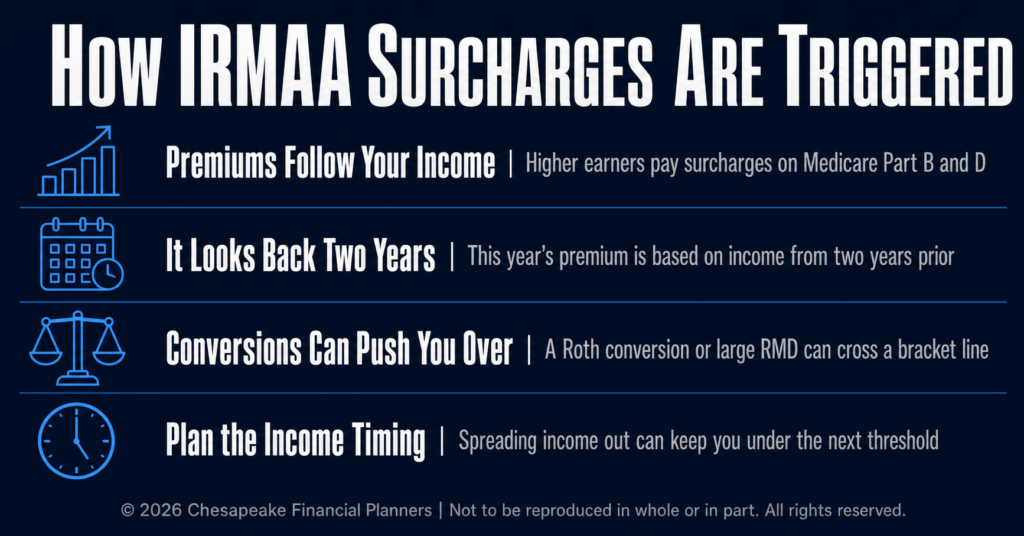
Both moves do the same thing to your tax return: they add ordinary income. IRMAA keys off MAGI, which for most retirees is adjusted gross income plus any tax-exempt municipal bond interest. A Roth conversion and an RMD each flow straight into that number.
A Roth conversion is voluntary. You move money from a traditional IRA to a Roth, pay the tax now, and the converted amount counts as income this year. Convert $80,000 and your MAGI rises by $80,000. That can be the right call, lower taxes later, no RMDs on the Roth, tax-free growth, but if it lifts you over a bracket line, you've also bought yourself a Medicare surcharge two years out.
An RMD is not voluntary. Once you reach age 73, the IRS requires you to start withdrawing from traditional IRAs and most workplace retirement plans. Those withdrawals are taxable income whether you need the cash or not. For someone with a large IRA, the first few RMDs can be substantial enough to trigger IRMAA on their own.
The trap is doing both in the same window. Convert aggressively at 65, then start RMDs at 73, and you can stack income in years where you weren't watching the Medicare thresholds. Jeff Judge has watched clients pay two and three brackets higher than they needed to, simply because the conversion and the distribution landed in the same tax year.
Does a Roth Conversion Count Toward IRMAA Even Though the Money Goes Into a Roth?
Yes. The IRS treats the converted amount as taxable income in the year of the conversion, so it raises your MAGI and counts toward IRMAA, even though the dollars end up in a tax-free account. The Roth pays off later; the IRMAA cost is felt now (well, two years from now).
Why Does the Two-Year Lookback Catch So Many Retirees Off Guard?
Because the premium and the income that caused it are two years apart. Social Security sets your 2026 IRMAA using the most recent tax return on file, generally from two years prior. So your 2026 surcharge is based on your 2024 MAGI.
That gap breaks the intuition. You do a large conversion in 2024, file your taxes in 2025, and the Medicare letter doesn't arrive until late 2025 for the 2026 premium year. By then the decision is two years old and impossible to undo. People who watch their income carefully in the current year still get surprised, because IRMAA isn't looking at the current year.
It also means planning has a built-in lead time. The income you generate in 2026 sets your 2028 premium. That lag is a problem if you ignore it and an opportunity if you don't. Knowing the surcharge is coming two years out gives you room to manage the income that drives it, which is exactly where a plan earns its keep.
How Can You Plan Around IRMAA Before It Hits?
You manage the income, not the premium. The premium is just the output. Here are the levers that actually move the number:
- Convert in the gap years. The window between retirement and age 73 is often your lowest-income stretch. Filling lower brackets with partial Roth conversions during those years, while staying under the IRMAA line you care about, spreads income out instead of stacking it.
- Size conversions to a threshold, not a whim. If you're $20,000 under the next IRMAA bracket, that $20,000 is the room you have. Convert to the edge of the bracket, not past it.
- Use qualified charitable distributions (QCDs). Once you're 70½, a QCD sends IRA money directly to charity and satisfies part or all of your RMD without adding to MAGI. For charitably inclined retirees, this is one of the cleanest ways to keep an RMD from triggering IRMAA.
- Coordinate with a spouse's timeline. If one spouse is already on Medicare and the other isn't, the income hit lands differently. Sequencing conversions around both enrollment dates matters.
- Watch the cliff, not the slope. IRMAA has no gradual phase-in. One dollar over the line costs you the full tier. Leaving a small buffer under a threshold is worth more here than almost anywhere else in the tax code.
Here's a concrete version. Say a 67-year-old couple has a joint MAGI of $170,000 before any conversion, comfortably under the $218,000 first threshold. They want to convert $60,000 from a traditional IRA. Convert the full amount in one year and their MAGI hits $230,000, landing them in the second bracket and adding roughly $2,300 to their combined Part B and Part D premiums two years out. Split that same conversion across two years, $30,000 each, and their MAGI tops out at $200,000 in both years, under the threshold. Same total converted, same long-term tax benefit, zero IRMAA surcharge. The only variable that changed was the timing.
This is the kind of multi-year sequencing the R.U.D.D.E.R. Method™ is built for. The R.U.D.D.E.R. Method™ is Chesapeake Financial Planners' six-step planning process: Review and Recognize, Uncover and Understand, Design and Develop, Discuss and Decide, Execute and Empower, and Reassess and Refine. IRMAA planning lives in the Design and Develop and Reassess and Refine steps, because the right conversion amount in 2026 depends on what you expect your RMDs and brackets to look like at 73 and beyond.
In Jeff's experience, the clients who avoid IRMAA surprises aren't the ones with the lowest income. They're the ones who map their income bracket by bracket for the decade before and after 73, then convert deliberately inside that map. The math isn't hard. The discipline to plan two years ahead is the hard part.
What If a Life-Changing Event Lowered Your Income?
If a major life event dropped your income, you can ask Social Security to use your current income instead of the two-year-old return. The form is Form SSA-44, the Medicare Income-Related Monthly Adjustment Amount life-changing event request, and retirement is one of the qualifying events.
This matters most in the first year or two of retirement. Your 2024 return might show peak earning-years income, but if you stopped working in 2025, your real 2026 income is far lower. SSA-44 lets you make that case rather than overpay and wait for it to correct itself. Qualifying events include marriage, divorce, death of a spouse, work stoppage or reduction, loss of pension income, and a few others. You'll need documentation, an estimate of your reduced income, and proof of the event. The full process is on the Social Security request to lower IRMAA page.
A Roth conversion or RMD, by the way, does not qualify as a life-changing event. Those are choices, not events, so you can't appeal an IRMAA surcharge you created through conversions. That's another reason the planning happens before the conversion, not after the letter.
Related Topics Worth Reading
- Should I do Roth conversions during the gap years before RMDs?
- What are the rules and strategies for required minimum distributions?
- How can a qualified charitable distribution lower my RMD and taxes?
- How do you use the years between retirement and RMDs to reduce lifetime taxes?
Frequently Asked Questions
What income counts toward IRMAA in 2026?
IRMAA uses your modified adjusted gross income, which is your adjusted gross income plus any tax-exempt interest, such as municipal bond interest. For 2026, Social Security uses the MAGI from your 2024 federal tax return. Roth conversions, RMDs, capital gains, wages, pensions, and IRA withdrawals all count toward that figure.
Does a Roth conversion increase my Medicare premiums?
Yes. A Roth conversion adds the converted amount to your taxable income for that year, raising your MAGI. If that higher MAGI crosses an IRMAA threshold, your Medicare Part B and Part D premiums rise two years later. The converted dollars land in a tax-free Roth, but the income still counts toward the surcharge.
How far back does Medicare look at my income for IRMAA?
Medicare uses a two-year lookback. Your 2026 IRMAA is based on the income reported on your 2024 tax return, the most recent return Social Security has on file. This lag means income decisions you make today affect your Medicare premiums two years from now.
Can I appeal an IRMAA surcharge?
Yes, if a qualifying life-changing event reduced your income. File Form SSA-44 with Social Security to request that they use your current, lower income instead of the two-year-old return. Qualifying events include retirement, marriage, divorce, death of a spouse, and loss of pension income. A Roth conversion does not qualify.
How much higher are 2026 Medicare premiums at the top IRMAA bracket?
At the highest 2026 bracket, single income of $500,000 or more, the total Part B premium is $689.90 per month, compared with the standard $202.90. That's a surcharge of $487.00 a month, plus an additional $91.00 a month on Part D, for one person.
Do both spouses pay IRMAA?
Yes. IRMAA is assessed per person, so if both spouses are enrolled in Medicare and your joint MAGI crosses a threshold, each spouse pays the surcharge on their own Part B and Part D premiums. A couple effectively pays the surcharge twice.
If you found this helpful, our retirement tax-planning guide covers Roth conversion timing and RMD strategy in depth. Download it at chesapeakefp.com.
Want to go deeper? Our Medicare and Social Security Guide walks through this step by step.
Disclosures
The information provided is for educational purposes only and should not be construed as investment advice. Investment strategies should be tailored to individual circumstances, risk tolerance, and goals. Past performance doesn't guarantee future results. Consult with qualified financial professionals regarding your specific situation.
A Roth IRA offers tax deferral on any earnings in the account. Qualified withdrawals of earnings from the account are tax-free. Withdrawals of earnings prior to age 59 ½ or prior to the account being opened for 5 years, whichever is later, may result in a 10% IRS penalty tax. Limitations and restrictions may apply.
Advisors associated with Chesapeake Financial Planners may be either (1) LPL Financial Registered Representatives offering securities through LPL Financial, Member FINRA and SIPC, and investment advisor representatives offering investment advice through Great Valley Advisor Group; or (2) solely investment advisor representatives offering investment advice through Great Valley Advisor Group and not affiliated with LPL Financial. Great Valley Advisor Group, and Chesapeake Financial Planners are separate entities from LPL Financial.


