
How Much Cash to Keep: What Belongs Outside Your Emergency Fund?
Last reviewed: July 2026
Beyond a three to six month emergency fund, most households should keep cash for three jobs: planned near-term spending, short-horizon goals, and a small flexibility buffer. Deciding how much cash to keep comes down to matching dollars to needs you can actually name. Hold enough to cover what is coming in the next year or two, and no more, because cash sitting with no job slowly loses ground to inflation.
Key Takeaways
- Beyond a three to six month emergency fund, keep cash only for spending and goals you can name within a year or two.
- Idle cash loses purchasing power: inflation ran 3.8% over the past year while the average savings account paid 0.38%.
- Sinking funds let you pre-fund known costs like taxes, insurance, and holidays without raiding investments.
- Too much cash is cash drag; too little forces you to sell investments at the worst times.
About the Author: Jeff Judge, CFP®, AEP®, ChFC®, CLU® is Managing Partner of Chesapeake Financial Planners in Forest Hill, Maryland. He has been helping families and business owners in Harford County and the Baltimore metro area right-size their cash since earning his CFP® certification in 2013, by using Chesapeake Financial Planners’ signature process, the R.U.D.D.E.R. method™. Jeff sees the over-saving mistake more than the under-saving one: good savers who let six figures pile up in checking, earning almost nothing.
What Is Cash Drag, and Why Does Holding Too Much Cash Hurt?
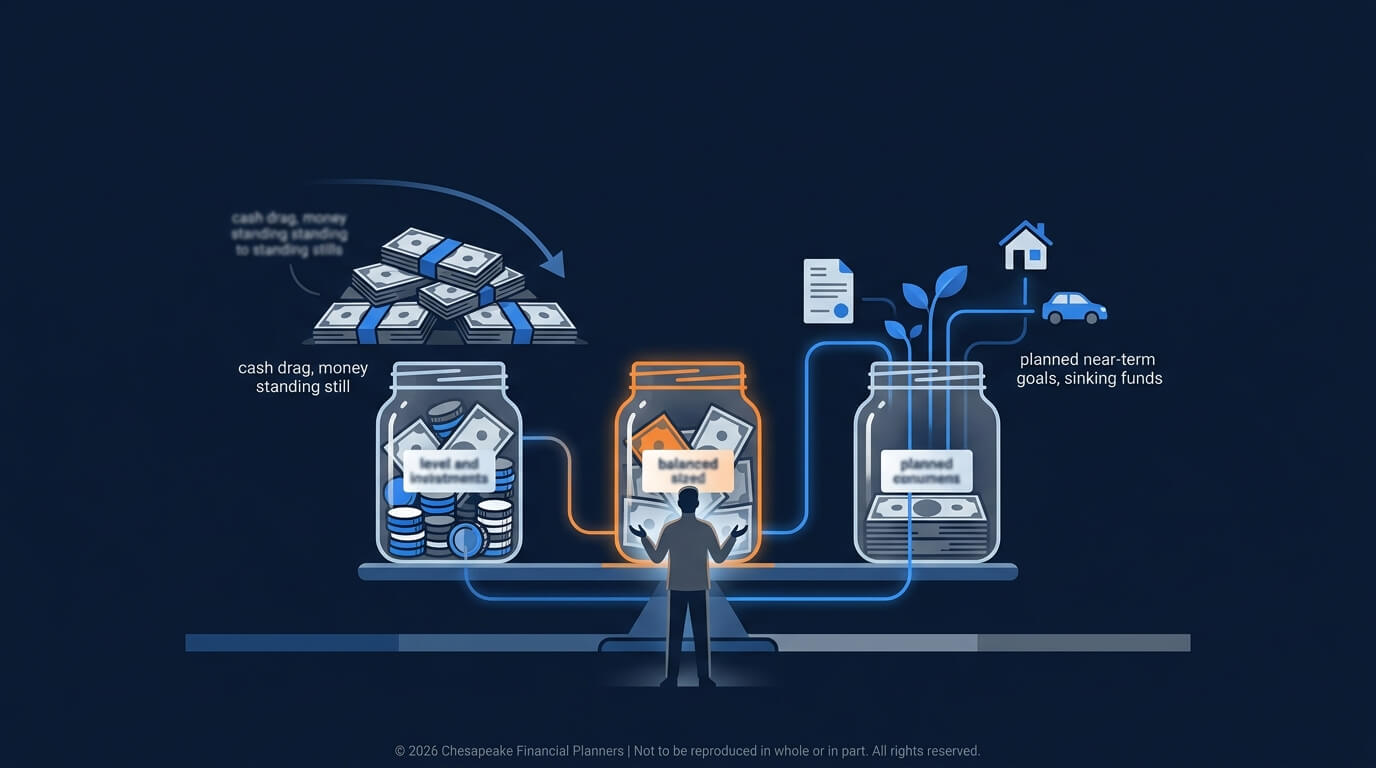
Cash drag is the slow, quiet cost of holding more cash than you need. It is not a loss you see on a statement, which is exactly why it is easy to ignore. Money parked in a low-rate account simply buys less each year as prices rise.
The gap is stark right now. Over the past year, consumer prices rose 3.8% according to the Bureau of Labor Statistics, while the national average savings account paid just 0.38%, per the FDIC. That means typical idle cash lost more than three percent of its real value in a single year. On $50,000 of excess cash, that is real money evaporating for no benefit. A reasonable cash cushion is smart. A giant one is a slow leak.
How Much Cash to Keep Beyond Your Emergency Fund
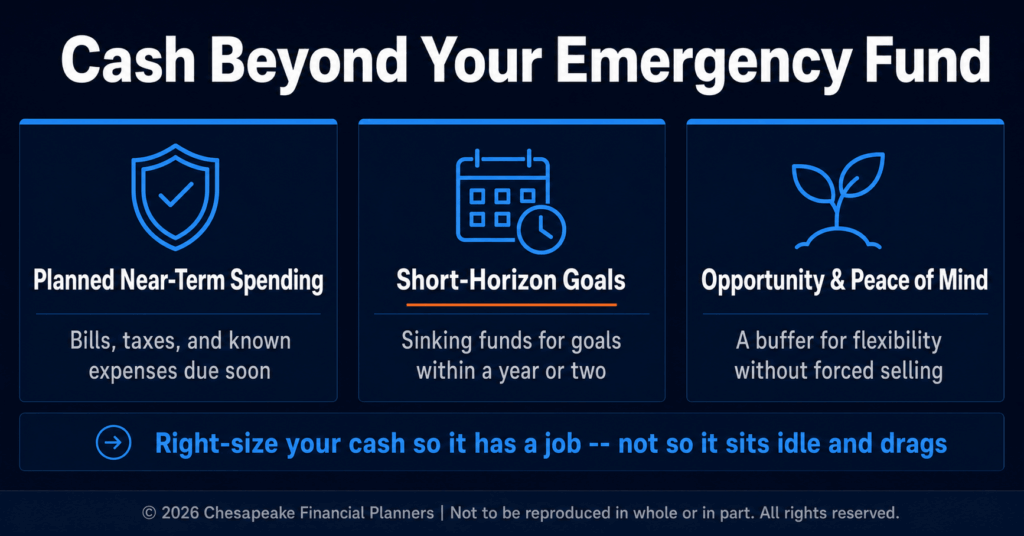
The right amount is the sum of cash that has a defined job in the next year or two. Think in three buckets, which is the heart of good cash allocation.
The first bucket is planned near-term spending: bills, estimated taxes, insurance premiums, and known expenses due within a few months. The second is short-horizon goals: a car replacement, a vacation, or a home project happening within a year or two, funded through sinking funds. The third is a flexibility buffer beyond your emergency fund, a modest amount that lets you act on an opportunity or absorb a surprise without selling investments at a bad moment.
Add those three up, and you have your number. For many households the total lands somewhere between a few thousand dollars and a few months of expenses, depending on what bills and goals are actually on the calendar. Everything beyond it is a candidate for investing or for higher-yielding cash. Notice what is not on the list: a vague pile held just because it feels comforting. That is the part that drags.
How Do Sinking Funds Help You Right-Size Cash?
Sinking funds turn lumpy, predictable expenses into smooth monthly savings, which is the cleanest way to hold the right amount of cash and not a dollar more. Instead of being surprised by a $3,600 property tax bill, you set aside $300 a month so the money is there when the bill arrives.
Build one for each known annual or semi-annual cost: insurance, taxes, holidays, car maintenance, tuition. Total them, divide by the months until each is due, and automate the transfers into a separate savings account. The result is that your cash balance reflects real obligations, not guesswork. A spreadsheet or a few separate savings buckets at your bank both work; the tool matters less than the habit of naming each dollar. When you can see exactly what your cash is for, the question of how much to hold answers itself.
Where Should You Keep Cash That Is Not in Your Emergency Fund?
Cash with a job in the next year or two belongs somewhere liquid and higher-yielding than a basic checking account, but not at market risk. High-yield savings accounts, money market funds, and short-term Treasury bills all keep the money accessible while paying far more than the 0.38% national savings average. The goal is to slow the cash drag without locking the money up or exposing it to the swings of the stock market. Laddering short Treasuries or keeping a tier in a money market fund can capture more yield on cash you will not need for several months, while everyday near-term money stays in savings.
Jeff Judge often tells clients to give every dollar of cash an address and a deadline. If a dollar has neither, it is probably a dollar that should be invested for the long term instead. For where to park near-term money, our Where should I keep my cash: high-yield savings, money market, or CDs? explainer and our I Bonds vs Treasury Bills: Which Is Right for Your Cash? comparison both help, and our How much should I save in an emergency fund during a job change? guide covers the base layer underneath all of this.
Frequently Asked Questions
How much cash should I keep outside my emergency fund?
Keep enough to cover cash needs you can name in the next year or two: planned spending, short-horizon goals, and a small flexibility buffer. There is no single dollar figure, because it depends on your upcoming expenses. Add up those specific obligations, and that total, not a comfort number, is your target.
Is it bad to keep too much cash?
Yes, holding far more cash than you need has a real cost called cash drag. Because inflation rose 3.8% over the past year while average savings rates sat near 0.38%, excess cash steadily loses purchasing power. A healthy cushion is wise, but money with no defined job usually belongs invested or in a higher-yielding account.
What is a sinking fund?
A sinking fund is money you set aside gradually to pay for a known future expense, like property taxes, insurance, or a vacation. Instead of scrambling when a large bill arrives, you save a fixed amount each month so the cash is ready. Sinking funds keep your cash purposeful and prevent you from dipping into your emergency fund.
Where should I keep extra cash so it does not lose value?
Keep near-term cash in a high-yield savings account, a money market fund, or short-term Treasury bills, which stay liquid while paying far more than a basic account. These options reduce cash drag without putting the money at market risk. Avoid leaving large balances in checking, where they often earn close to nothing.
How is cash beyond the emergency fund different from investing?
Cash beyond your emergency fund is money you expect to spend within a year or two, so it should stay steady and liquid, not invested for growth. Investing is for goals five or more years out, where market swings have time to recover. Mixing the two, like investing next year's tuition, is what forces selling at bad times.
So when you are deciding how much cash to keep outside your emergency fund, give every dollar a job and a date, then invest the rest. That single habit prevents both expensive mistakes: the cash drag of over-saving and the forced selling of under-saving. If you want a simple framework for organizing cash, savings, and goals in one place, our What are the fundamentals of personal financial planning? walks through it step by step. Download it at chesapeakefp.com. Jeff Judge notes: "Every dollar of cash sitting without a purpose and a timeline is either quietly losing ground to inflation or silently pushing you toward selling investments at the wrong moment — giving each dollar a job eliminates both problems at once."
Want to go deeper? Our Why Financial Advice Isn’t Just for Retirees walks through this step by step.
This material is for educational purposes only and should not be considered tax or legal advice. Please consult with your tax advisor or attorney regarding your specific situation.
The opinions voiced in this material are for general information only and are not intended to provide specific advice or recommendations for any individual.
All investing involves risk including loss of principal. No strategy assures success or protects against loss.
There is no guarantee that a diversified portfolio will enhance overall returns or outperform a non-diversified portfolio. Diversification does not protect against market risk.
Disclosures
The information provided is for educational purposes only and should not be construed as investment advice. Investment strategies should be tailored to individual circumstances, risk tolerance, and goals. Past performance doesn't guarantee future results. Consult with qualified financial professionals regarding your specific situation.
Advisors associated with Chesapeake Financial Planners may be either (1) LPL Financial Registered Representatives offering securities through LPL Financial, Member FINRA and SIPC, and investment advisor representatives offering investment advice through Great Valley Advisor Group; or (2) solely investment advisor representatives offering investment advice through Great Valley Advisor Group and not affiliated with LPL Financial. Great Valley Advisor Group, and Chesapeake Financial Planners are separate entities from LPL Financial.


